Hyundai Verna. A Quite Right Choice
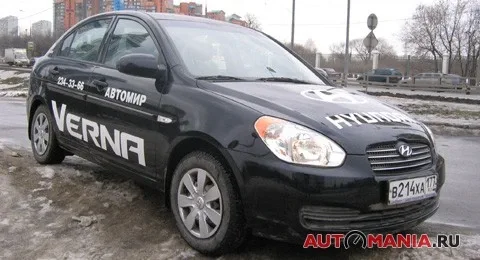
Surely many still remember that very advertising campaign with the “Vernoe solution” that some time ago flooded half of the capital's billboards.
Then a new model in the Hyundai lineup was announced — Verna. But soon rumors spread that the new model didn't catch on and was even leaving the Russian market. Journalists couldn't get the car for a test. We also had to wait almost a year, but the search was successful: thanks to the company “Avtomir”, this Korean (as it turned out later — Turkish) car was at our disposal.
Few people know that almost all Hyundai models are practically mirror copies of KIA. For example, the Tuscon SUV is the twin brother of the Sportage, and the Verna is the Rio in a sedan body. The engines are identical, the interior is almost one to one, except that the speakers are positioned differently. Controls, steering column switches, and even the logic of the power windows — everything is like on a Mitsubishi, so you won't have to get used to it for long.
Before getting behind the wheel, I did a traditional inspection, which immediately revealed both pros and cons. On the positive side — huge exterior mirrors, as if borrowed from a large SUV and transferred to a modest sedan. And on the threshold of the driver's door, there was a plate informing that the Verna was assembled not in Korea, but in Turkey. Don't be surprised: Hyundai has assembly plants in Turkey that produce cars for third-world countries. Russia, despite the abundance of Bentleys and Porsches, still belongs to their number — the mass buyer wants a foreign car cheaper and simpler.
In short, for four days we got a car from “Avtomir” on Fili in standard trim with a manual transmission without any special frills. The price is 407 thousand rubles. I'll note right away: a KIA Rio in a similar version, but with heated seats, would cost 399 thousand.
The engines are the same, the dimensions almost match (4280x1470x1470 for Verna vs 4240x1675x1470 for Rio). The mass of Rio is 1101 kg, Verna — 1116 kg, the difference is insignificant. Suspension, brakes (rear drums), acceleration to a hundred, and trunk (440 l vs 448 l) are almost identical. But the certified fuel consumption of Verna is 8.0 l, and Rio — 9.5 l. In reality, both cars consume about 10 l. We can't say more precisely: the test car had no onboard computer; it's only available in the top version. Moreover, the computer, like climate control and the standard radio, exist in our country only on the pages of advertising brochures. These options are not in the price list at all. But it is known for sure that the top version with heated seats, fog lights, and automatic transmission will cost 453 thousand rubles.
We start the test under a pouring rain. So, first of all, we'll check the car in the mud bath that our roads turn into at the slightest precipitation: we'll see how the side windows get dirty and how comfortable it is in the cabin at almost 100% humidity. To do this, we seat four fairly large passengers in the car. There is enough legroom, the trip from point A to point B is quite comfortable, but the rear side windows fog up instantly. The air ducts clearly can't cope with a full load. But with external dirt, everything is fine: the front side windows remain clean, the mirrors don't get splashed. The rear windows get a little dirtier, but not as much as, for example, on the Fiat Grande Punto, which is very difficult to drive on the eternally dirty Moscow roads.
The absence of splashes on the Hyundai is the merit of designers who worked in a wind tunnel. This is facilitated by decorative overlays on the doors that prevent dirt from spreading up the body. The door handles also almost don't get dirty. Getting out of the car without soiling your trousers or skirt is not a problem. Dirt accumulates at the very bottom of the body. Another plus is the absence of glare on the windshield from the central air duct. If on the Opel Astra half of the glass is invisible in the sun, here everything is fine.
The downside of the interior was discovered with the onset of darkness. There is no adjustment for the instrument lighting, and if their pale green light is almost not annoying, then the knobs for adjusting air flows and temperature glow with aggressive red, blinding almost like the high beam of an oncoming car.
I also didn't like the combination of light upholstery with the lower plastic part of the console and the dark top. Again, judging by the advertising brochure, no other options are provided. Overall, the central two-tone console looks primitive and clearly doesn't adorn a far from budget car. Compared to the KIA Rio — it's just yesterday.
But the Verna has a more balanced and energy-intensive suspension (especially on speed bumps) and better sound insulation. In terms of visibility and sense of dimensions, the Rio is slightly higher, but not by much. I repeat, the main trump card of the Verna is excellent side mirrors.
The manual transmission works very clearly. From the intersection, the car accelerates quite briskly. The eights and nines never dreamed of such a thing.
As a result, we have a good car at a quite acceptable, but far from budget price. Spacious, comfortable, maybe not as beautiful inside as we would like.
And everything would be fine with the Verna, if not for a dangerous competitor with Korean roots. This is, of course, the Chevrolet Aveo Sedan. It is longer, wider, taller (4310x1710x1505), lighter (1115 kg vs 1166), it has the same spacious trunk (410 l). It loses only 3 horsepower with the same engine displacement (1.4 l). It is more economical (9.6 l in the city) and more agile (11.9 s vs 12.3 for Verna). It already has heated seats in the base, and in the top version there are not 2, but 4 airbags. The interior trim and the algorithm of the air ducts are much better. The central console with an audio system from SAAB, automatic transmission, and fog lights. Increased ground clearance and a flat floor in the back. Climate control and excellent suspension. And this top car will cost only 431,700 rubles. The difference with the Verna even in the top version with automatic transmission is 22 thousand rubles. And if someone likes the Verna more externally, then inside there is no point in comparing these cars. The Aveo beats the Verna on all counts.
And finally, one more remark. In the price lists on the internet and in Moscow car dealerships, the Verna is sold at a price from 359,000 to 453,000 rubles only with a 1.4 DOHC 97 hp engine (in the first configuration even without air conditioning). And if you believe the colorful advertising brochure, there is also a car with a 1.6 l engine with 112 hp. The price of such a new car is unknown, but a one-year-old one is about 300,000 rubles.
Technical specifications:
Dimensions (mm) |
4280x1470x1470 |
Engine displacement (cc) |
1399 |
Power (hp) |
95 |
Curb weight (kg) |
1166 |
Maximum speed (km/h) |
177 |
Acceleration to 100 km/h (s) |
12.3 |
Average fuel consumption (l/100km) |
8.1 |
Maximum torque (Nm/rpm) |
125/4700 |
Price of the tested model (rub) |
407,000 |
We thank the “Avtomir” car dealership on Fili for providing the car for the test.
Dmitry Shavyrin
Source – AUTOMANIA.RU
