
Hyundai Verna. Price: from $14,000. On sale: since September 2006.
In the States, this model is still known as the Accent. But here, they decided to call the new model Verna. A new name is a good reason to start its own history without looking back at its predecessor.
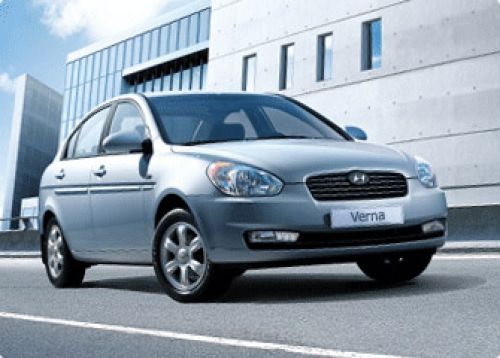
2007 Hyundai Verna
The Russian Accent, which is the most popular Hyundai model here, rolls off the assembly line in Taganrog. Full-cycle production is set up there, including welding and painting. Under the hood is a 1.5-liter engine with 102 hp. All reproaches about its modest appearance are traditionally countered with a democratic price.
The previous Accent was stuck in our throats for many years — since 1994. At first, it was purely Korean, then it gained Russian citizenship, which, however, changed nothing. Thanks to its cheapness, the car methodically squeezed competitors out of their niche and filled our cities. We got used to it. Got used to the condescending looks from owners of other foreign cars. To the fact that at the gas station no one rushes to this car with a nozzle. We even resigned ourselves to the fact that at the car wash this vehicle was billed as a domestic one. The savings are, of course, pleasant, but the residue remained — the Accent did not command an ounce of respect. In short, the saying "five minutes of shame — and you're at work" suited it perfectly. Therefore, we never even dreamed that something else would appear — just as affordable, but at the same time capable of making others acknowledge that you have a decent car.
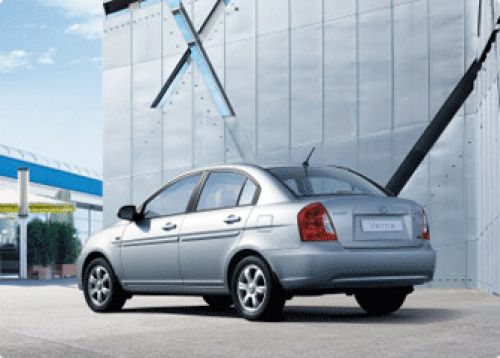
2007 Hyundai Verna
And so this very "something else" has finally appeared. The new Hyundai Verna is a car of a completely different order. Not only technically, but also visually. This time, the Koreans decided to create the new model's appearance in Europe, moving their design center to Rüsselsheim. And it worked. The car turned out well, acquiring features that Europeans have come to love, although the Eastern accent has not gone anywhere. True, the new Verna has a noticeable resemblance to the Lada Kalina. Not exactly, of course, but parallels can be drawn. You can also spot something from Chevrolet, Daewoo, and even Subaru. But then again, who these days doesn't borrow ideas from others? The main thing is that the result pleases those for whom it is intended.
And that the result will appeal to many is almost certain. And it's not just about the appearance. The interior has become noticeably more pleasant. Calling it the pinnacle of perfection is hard — in this class, there are more interesting options. But the former utilitarianism inherent in the old Accent is no longer there. Style has appeared in the interior. True, it is designed more for the undemanding buyer. Simply put — clean and neat. Plus, everything is intuitively clear.
Speaking of simplicity — the Koreans have outdone themselves. It got to the point that instead of the usual engine temperature gauge on the dashboard, they placed two indicator lights. The blue one stays on while the engine is cold, and the red one only flashes when it overheats. Such a simplified version — "blue" and "red." So that in case of something, it's easier to explain to the service technicians. The Verna generally does not like to overload the driver with unnecessary information. Nor does it want to burden him during operation. After all, a car for every day should be as comfortable as familiar shoes.
2007 Hyundai Verna
In motion, the Verna does not try to surprise — it is an ordinary car, of which there are many now. But that is precisely where its charm lies. You don't need to adapt to the car: you get in, you drive. And it drives quite briskly. The 1.4-liter engine with 97 hp pulls the 1.5-ton car without much strain, and it is not particularly voracious either. By the way, the same unit is installed in the new Kia Rio, with which the Verna shares a platform. And their behavior on the road is very similar. Except that the Verna's brakes seemed more tenacious. The pedal has to be literally stroked. At first, this is confusing, but you can get used to it; besides, ABS is in the arsenal. In short, the Verna doesn't reach for the stars, but it gives no reason for disdain either.
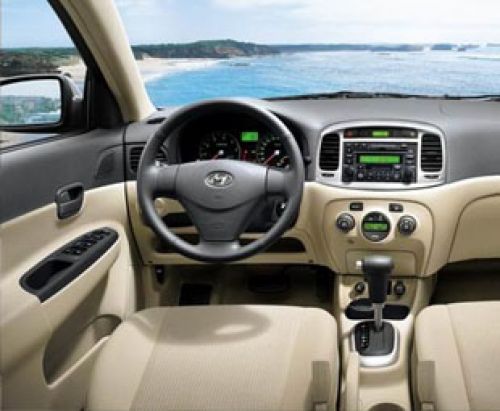
2007 Hyundai Verna
Driving
A solid middle-of-the-road performer, nothing outstanding. Only the meager choice of powertrains disappoints.
Interior
All controls are in sight and at hand. But the plastic is a bit hard.
Comfort
Quite acceptable for its class. However, sound insulation could be better.
Safety
Standard equipment includes two front airbags, front seatbelt pretensioners, an immobilizer, and child seat anchors. ABS and traction control are available in the more expensive trim.
Price
Quite competitive.
Technical specifications of Hyundai Verna 1.4
Dimensions – 4280x1695x1470 mm
Engine – petrol, 1399 cm3, 97 hp/6000 rpm
Transmission – manual, 5-speed
Dynamics – max 177 km/h; 12.3 s to 100 km/h
Competitors – Kia Rio, Ford Fiesta, Skoda Fabia
Advantages and disadvantages
+ Predictable behavior, very tenacious brakes, economical fuel consumption.
– Stiff suspension, weak sound insulation.
Our opinion
With the arrival of this car, competitors are likely to have a hard time. The price remains just as attractive, and the new image will surely attract not only those who have "outgrown" the old Accent but also a completely new audience. The new Accent has become much more attractive than its predecessor. And most importantly, it is built on a modern platform, which promises other advantages as well.
© 5 Koleso