
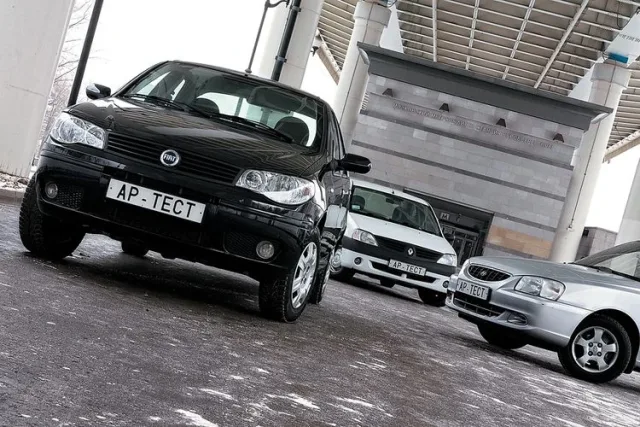
Budget foreign cars of domestic assembly are increasingly pushing out the products of Russian auto plants. On the former AZLK premises, Renault Logan now rolls off the assembly line; in Rostov-on-Don, at the combine plant's facilities, Hyundai Accent is assembled... A fresh example of such a "foundling" is the Fiat Albea, which took the place of the "Oka" at the Microcar Plant in Naberezhnye Chelny. Is this Italian ready to compete with the pioneers of the most mass-market segment — the Hyundai Accent and Renault Logan?
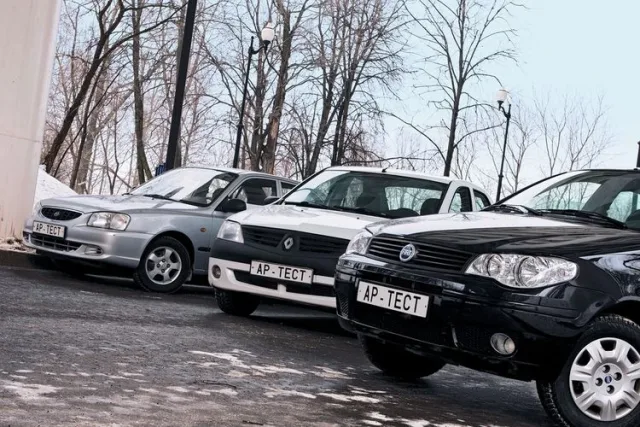
For the comparative test, we took the Albea and Logan in "mid-range" trim with 1.4-liter engines, and the Accent in the base version, but with a 1.5-liter engine.
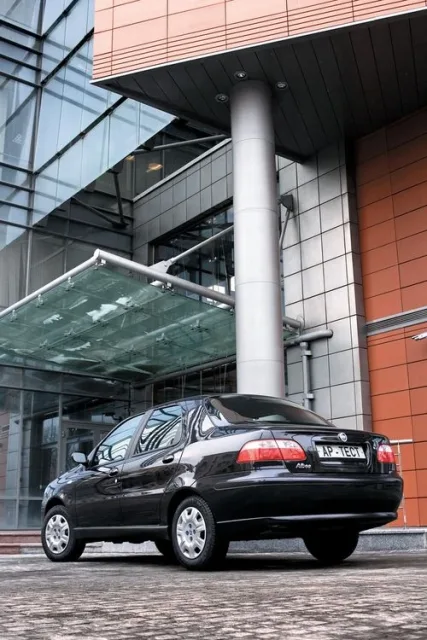
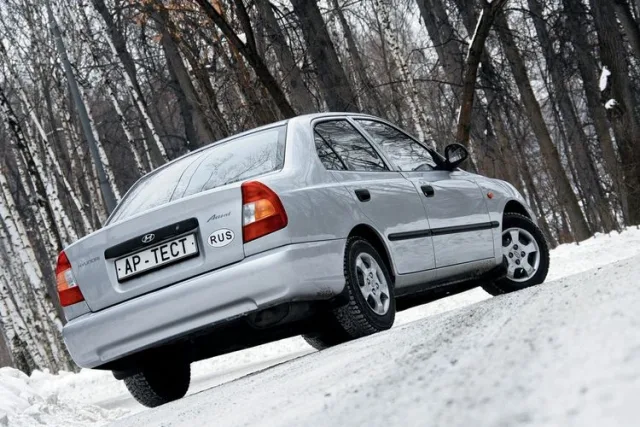
The creators of affordable sedans apparently do not consider appearance a priority. Angular silhouettes, inexpressive fronts... However, the Fiat Albea stands out favorably against this background — they say that Giugiaro himself had a hand in updating the model, which is already over ten years old. True, it seems the maestro worked in a hurry: the impression is that he only managed to tweak the headlight line, and the rest was finished by interns on the weekend.
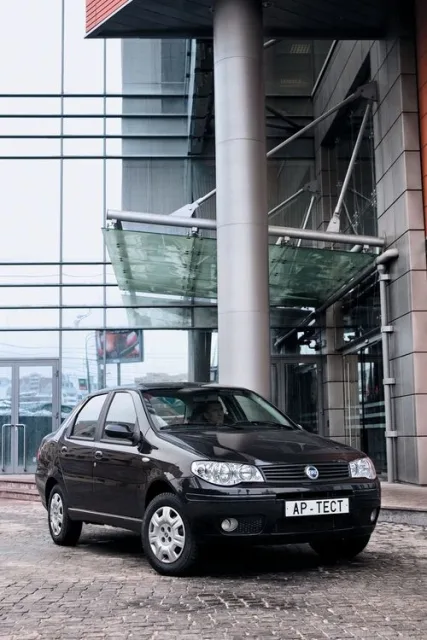
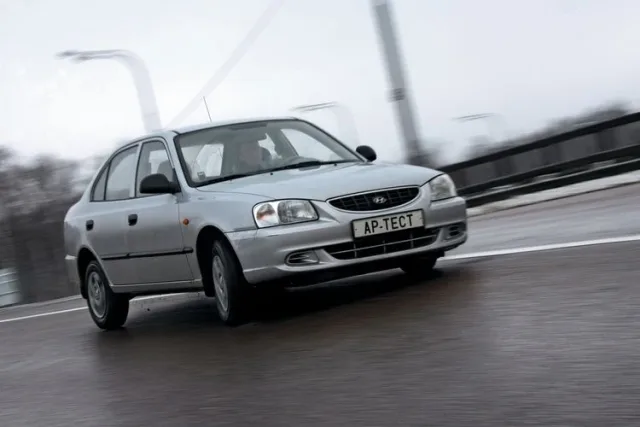
But you must agree: the Albea with its cute "face" and the albeit brutal but memorable Logan are still more attractive than the unremarkable Accent in all respects.
| Fiat Albea | Hyundai Accent | Renault Logan |
 |
 |
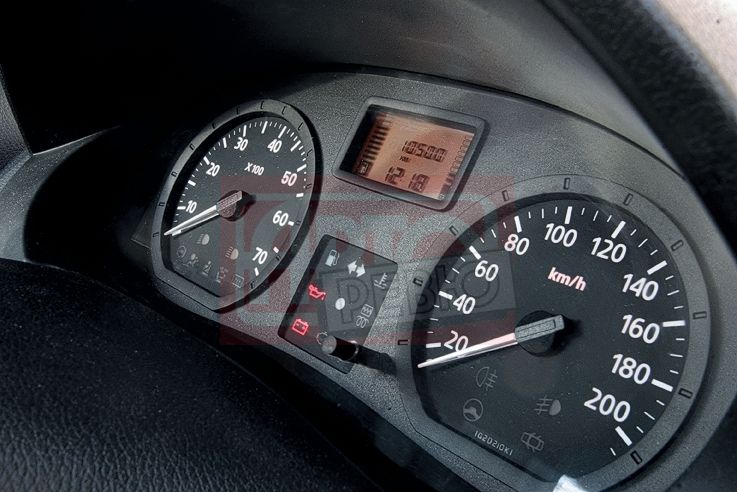 |
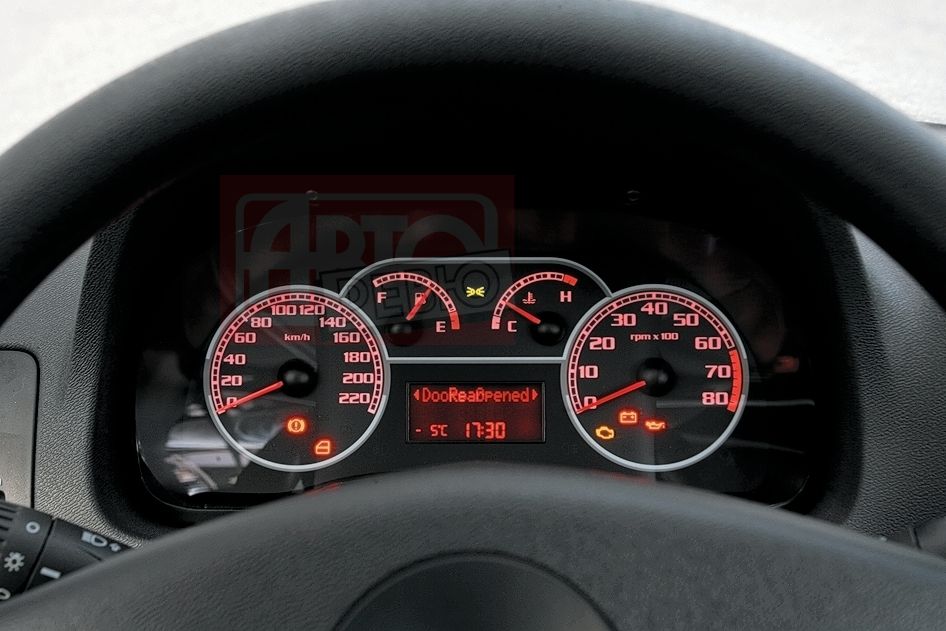
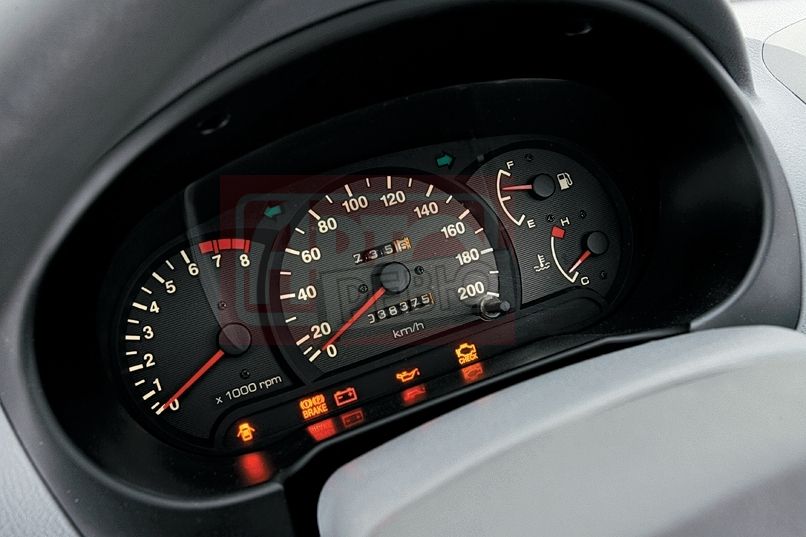
| The Fiat's scales are beautiful, but they yield in functionality to the simple and clear instruments of the Hyundai. Meanwhile, the Renault's instrumentation looks faded against their background — without backlighting, the "columns" of the fuel and temperature indicators are almost invisible on a sunny day | ||
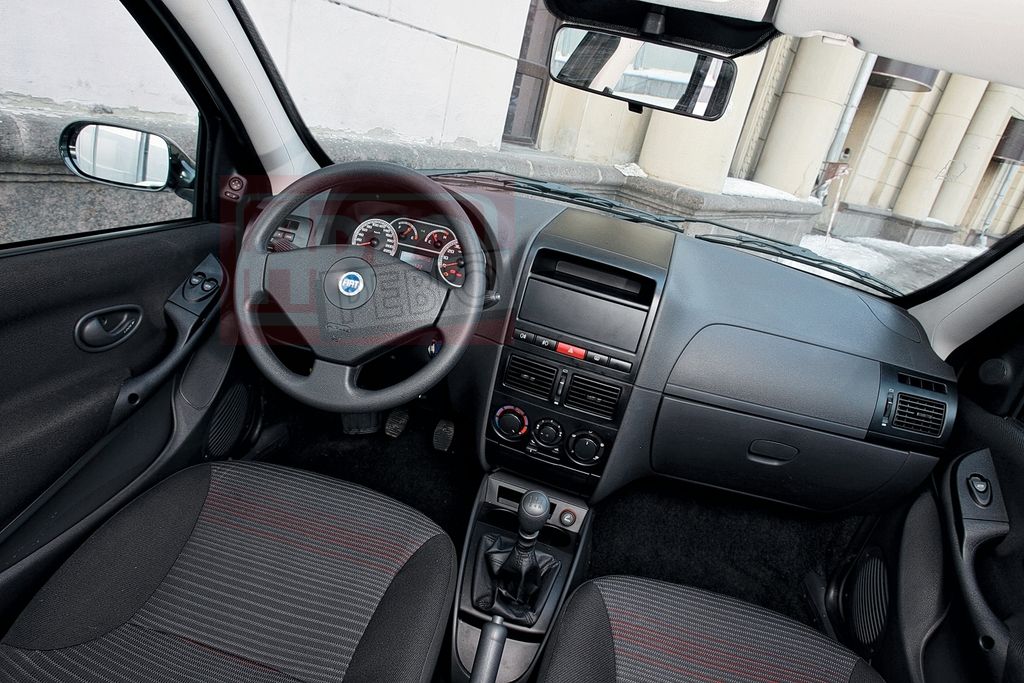
The Fiat's interior also pleased — of course, with an allowance for its budget nature. The massive front panel of dark hard plastic is assembled neatly, although the corners of the glovebox lid noticeably stick out. The instruments are almost like those of the modern Grande Punto hatchback, only the scale graphics are its own. And the trip computer includes a programmable "limiter" that beeps when you exceed a set speed.
 |
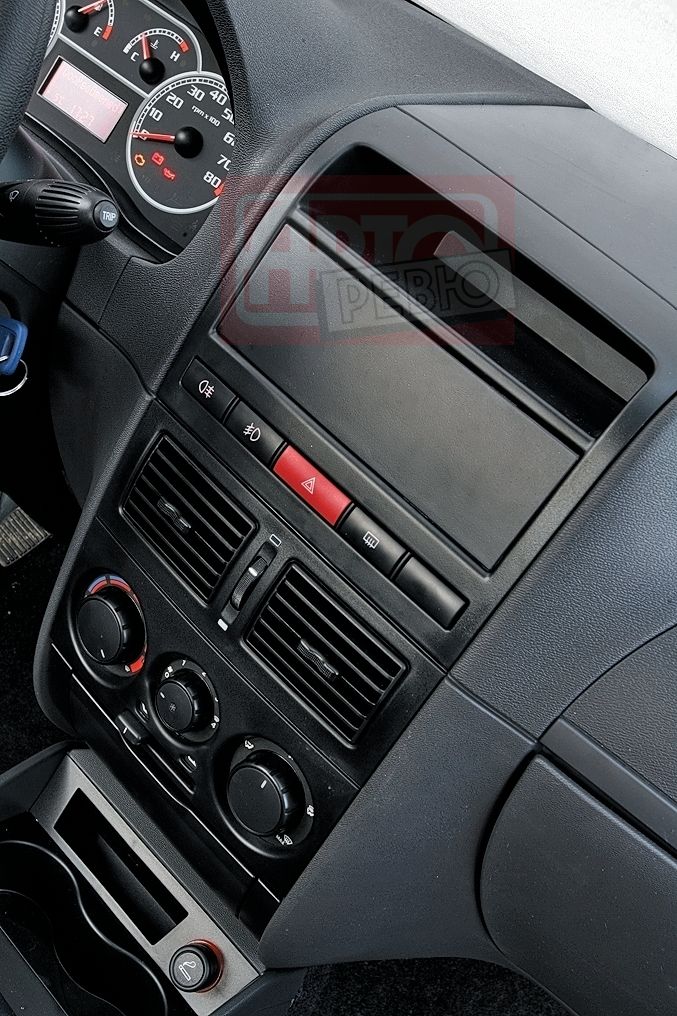 |
| The Albea's interior is strict and solid — of course, by "budget" standards | The recessed wells of the climate control knobs are an unfortunate solution: fingers get stuck in them |
 |
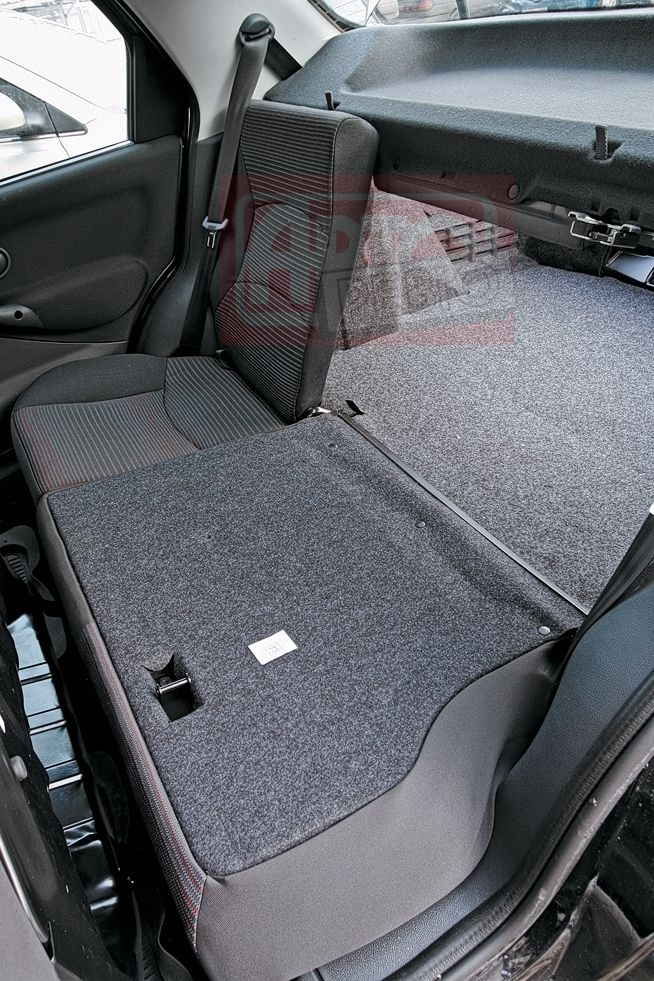 |
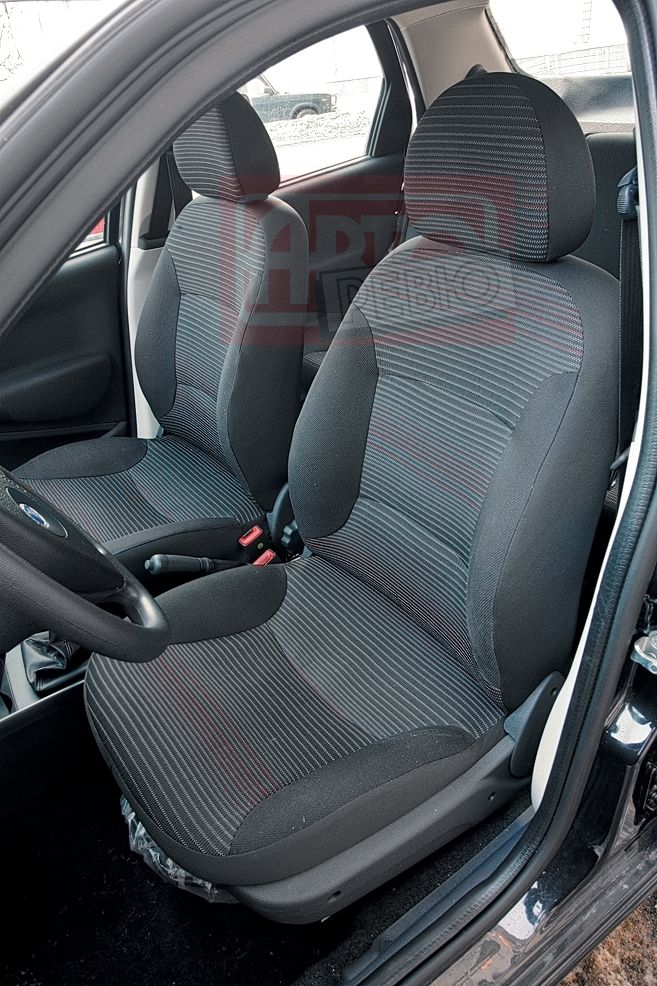
| A soft backrest with pronounced lateral support bolsters and a firm cushion — a successful combination | Split backrest is an option: in the base, the seat is one-piece |
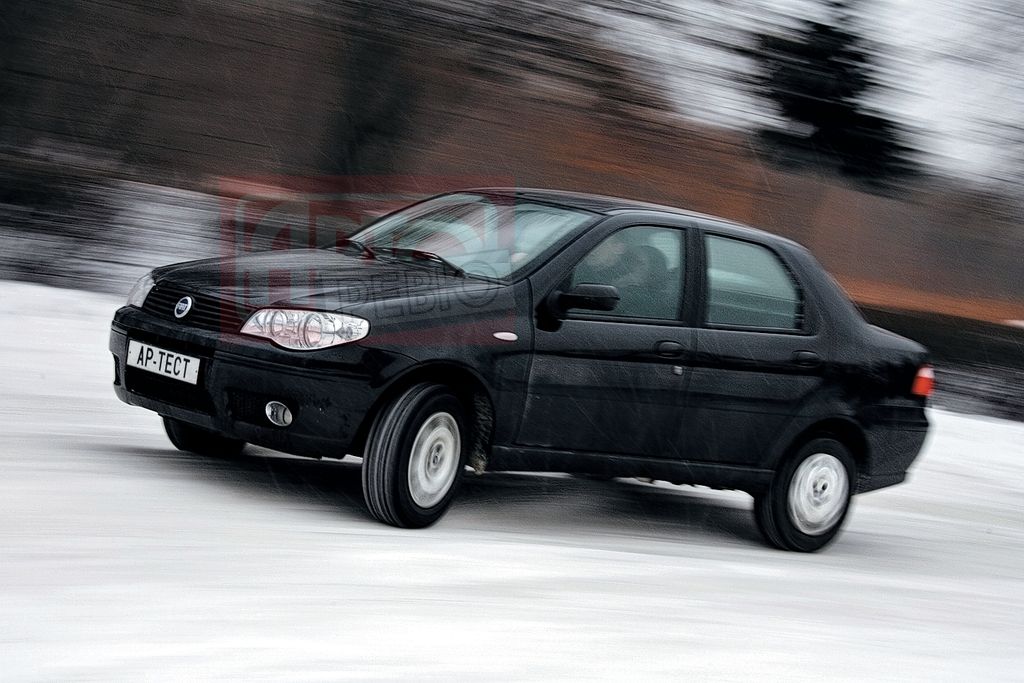
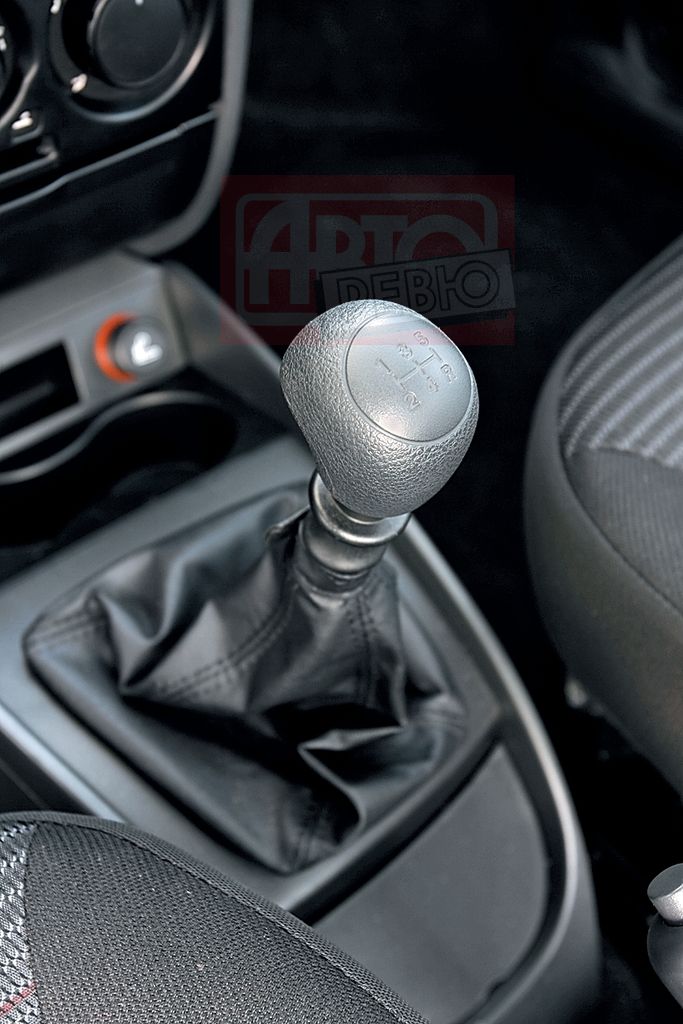
The pre-restyling Palio and Siena had flawed ergonomics — for example, the front seats sat on "rocking" slides, like on VAZ classics. But the Albea is a completely different matter. The seat with a firm cushion and soft backrest holds you well in corners and sits on normal slides, and the height-adjustable, chunky steering wheel of optimal diameter fits comfortably in your hands. The gear lever is a bit long, but gears engage easily and precisely. Only the steering column stalks are a bit stiff, and the heater knobs are recessed too deeply — the top icons are hard to see, and fingers get stuck in the narrow gap.
 |
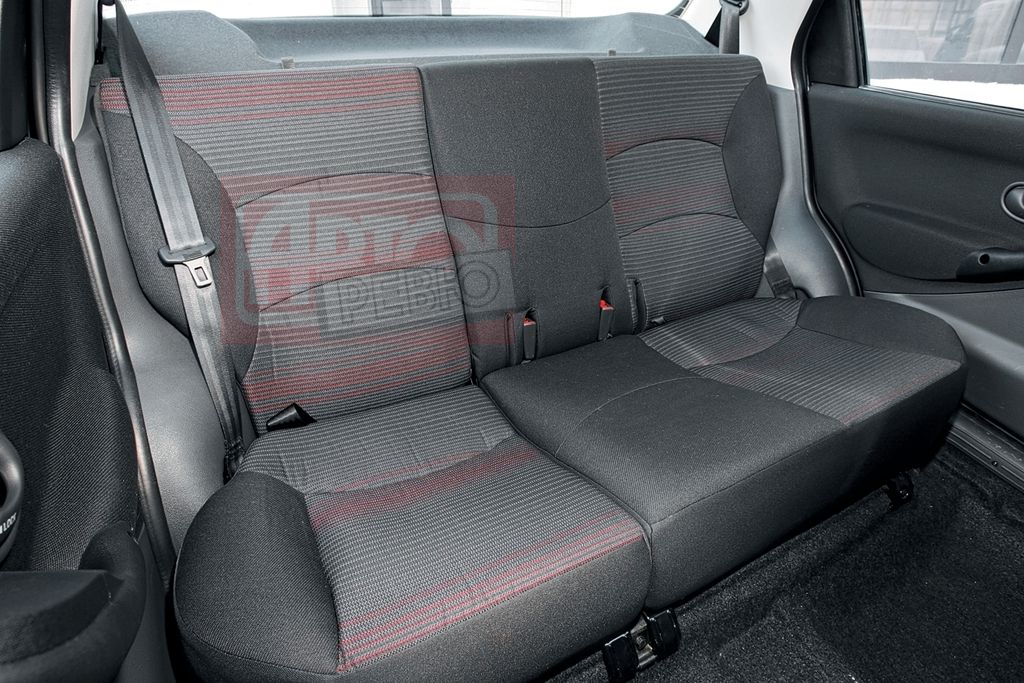 |
| Calm reactions, reliable handling... A family car! | In the back, three in the Fiat is a bit cramped |
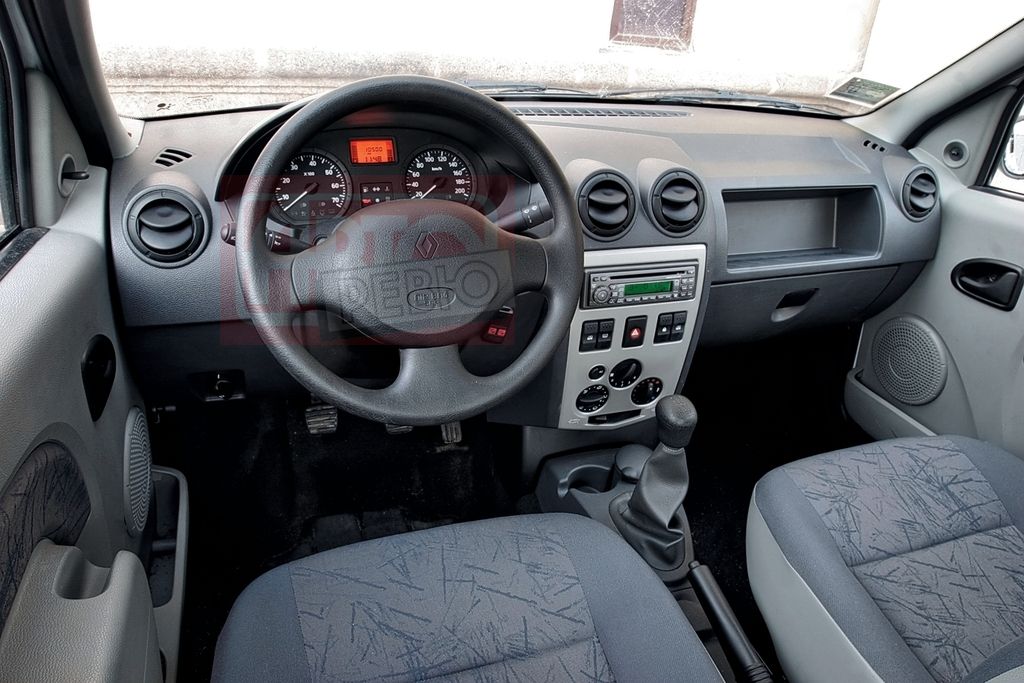
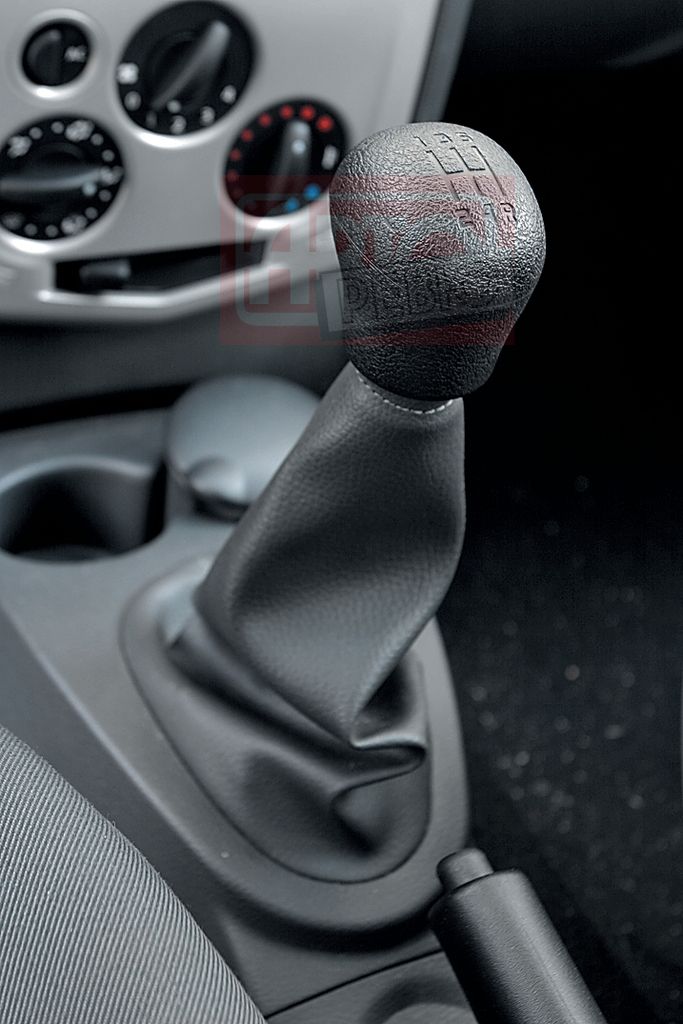
The Renault Logan with its Spartan techno-minimalism will appeal to few, and there are plenty of ergonomic miscalculations. There's the steering wheel without height adjustment, a seat with a flat backrest, and "blind" heater control — the knobs are located at the bottom of the console with a reverse tilt. However, the gear lever, even on a year-old car with considerable mileage, shifts clearly, and the steering column stalks and buttons please with their softness and ease of pressing.
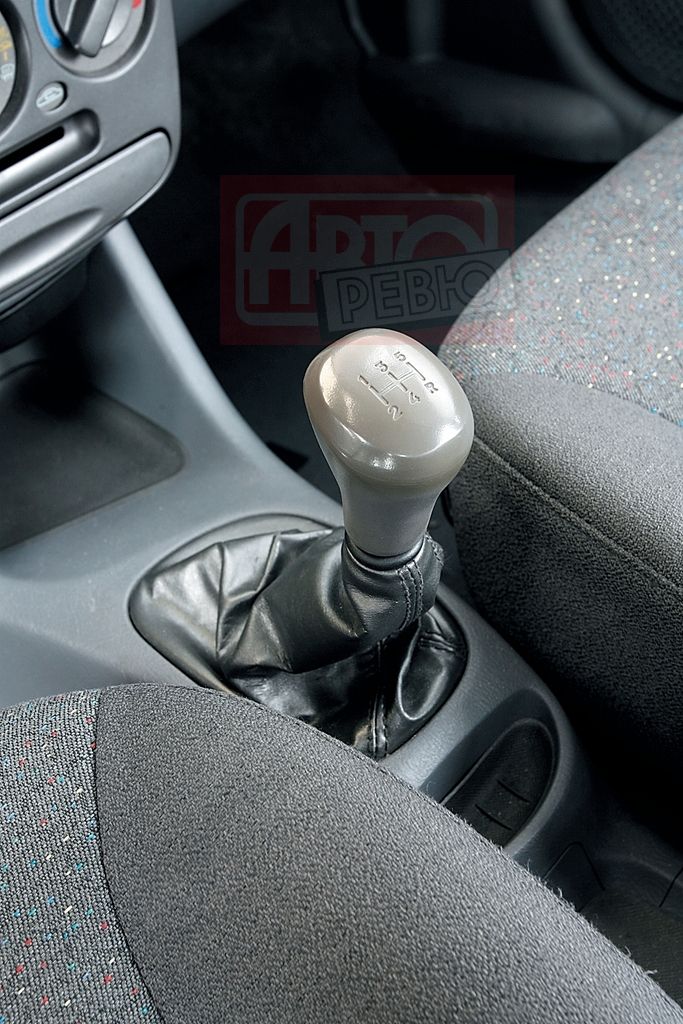
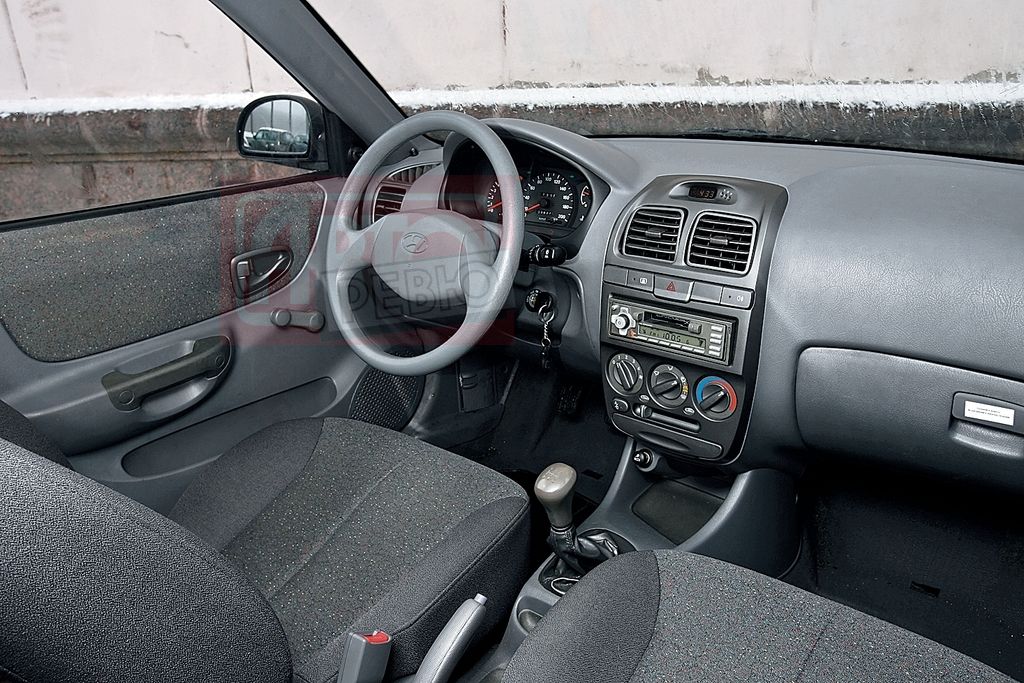
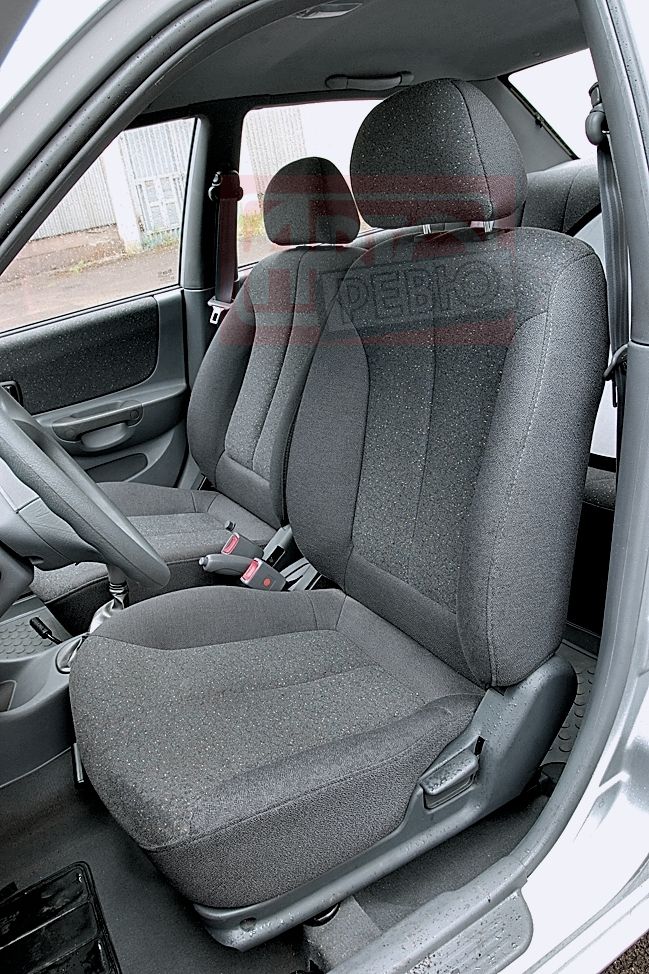
But the Hyundai Accent's interior makes an even more depressing impression than its exterior. Formally, everything is at hand and convenient, but after a couple of hours you want to get out, as if from a boring office — at least to breathe. The large "donut" steering wheel, the "bald" and long-throw gear lever... And if the Fiat and Renault have a high, "urban" seating position, the Hyundai's seat is lowered low, and the backrest doesn't stand upright and adjusts in steps, like in old Japanese models.
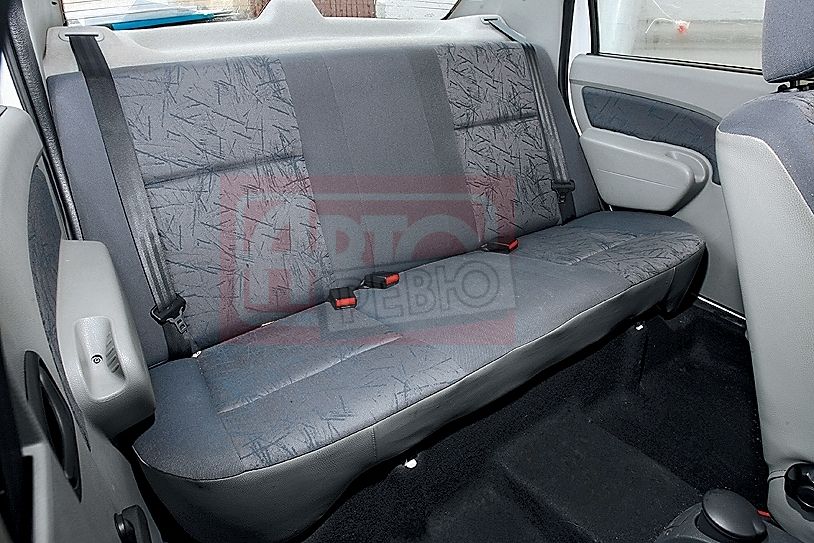
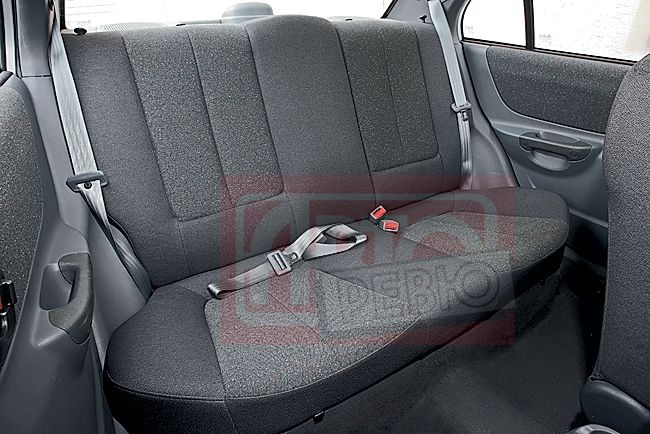
The rear row for such sedans is not a trifle: often it's the only car in the family, used to take the mother-in-law to the dacha and friends to a picnic... The most rear space is in the Renault Logan — even three people aren't cramped there! In the Fiat, there's less space, and getting in and out is more difficult: the opening is narrow, and the door opens at a small angle (about 70 degrees). But the worst is the Hyundai Accent: a low cushion, knees pressing against the front backrests, and sitting three is simply unrealistic.
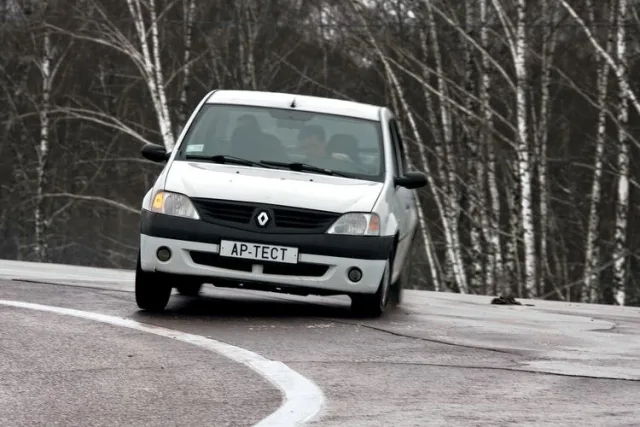
The Logan breaks into a slide somewhat abruptly and not always predictably...
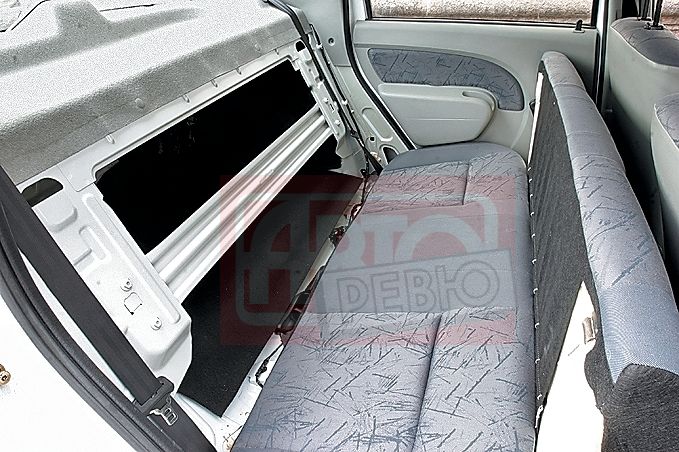
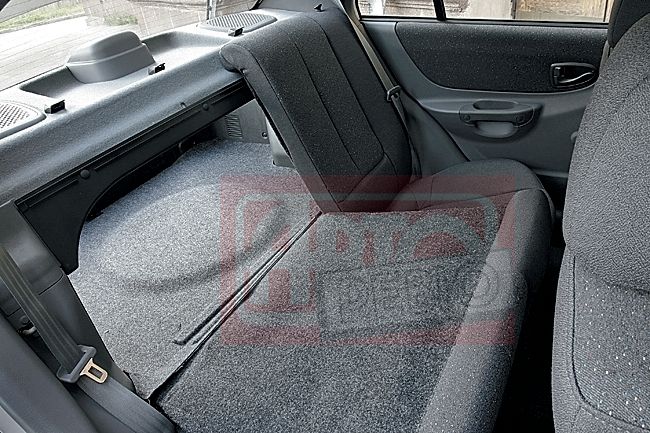
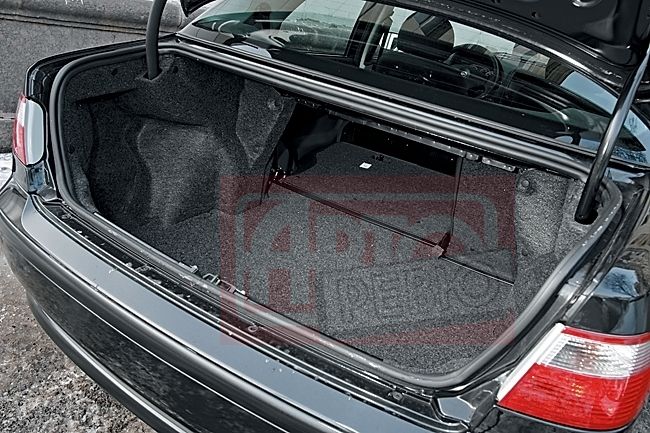
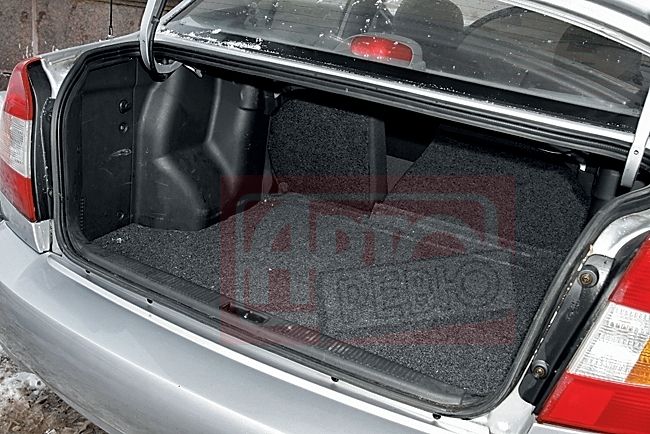
However, loading the neat trunk of the Accent is much more convenient than the huge "caves" of the Fiat and Renault with their protruding wheel arches. Moreover, the massive hinges and springs prevent filling the Logan "to the brim," and the Albea's bumper protrudes strongly and the lid closes tightly. Therefore, we rated all three compartments equally. And if the Fiat and Hyundai are decent "transformers" — their asymmetrical halves of the rear backrest fold almost flush with the floor — then Logan owners, to transport something longer than a meter and a half, will have to get out the wrenches: the backrest is held by two bolts, and the opening reinforcement by another four...
 |
 |
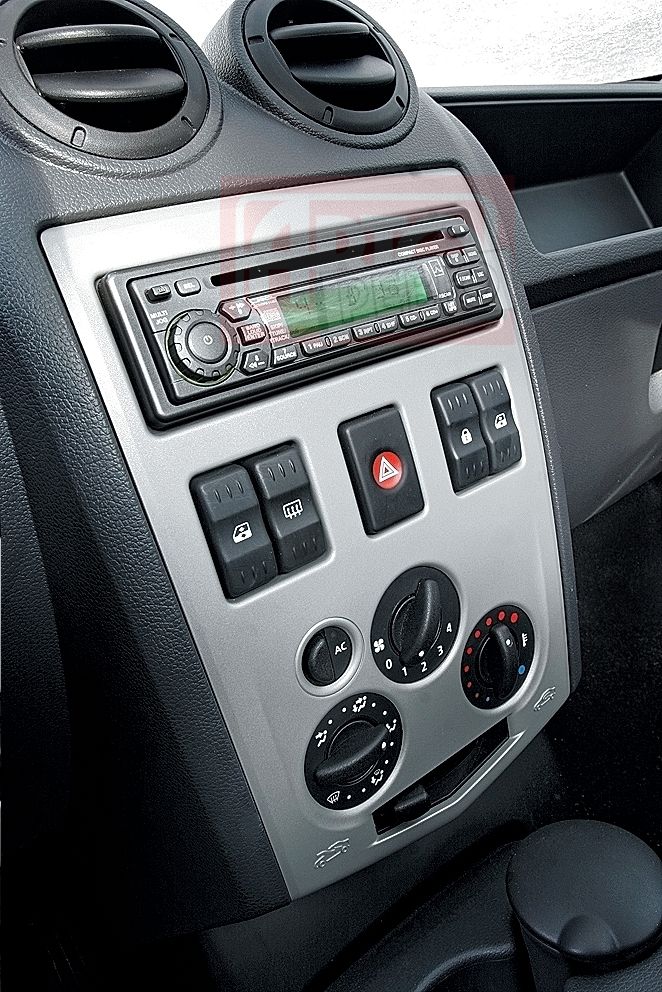 |
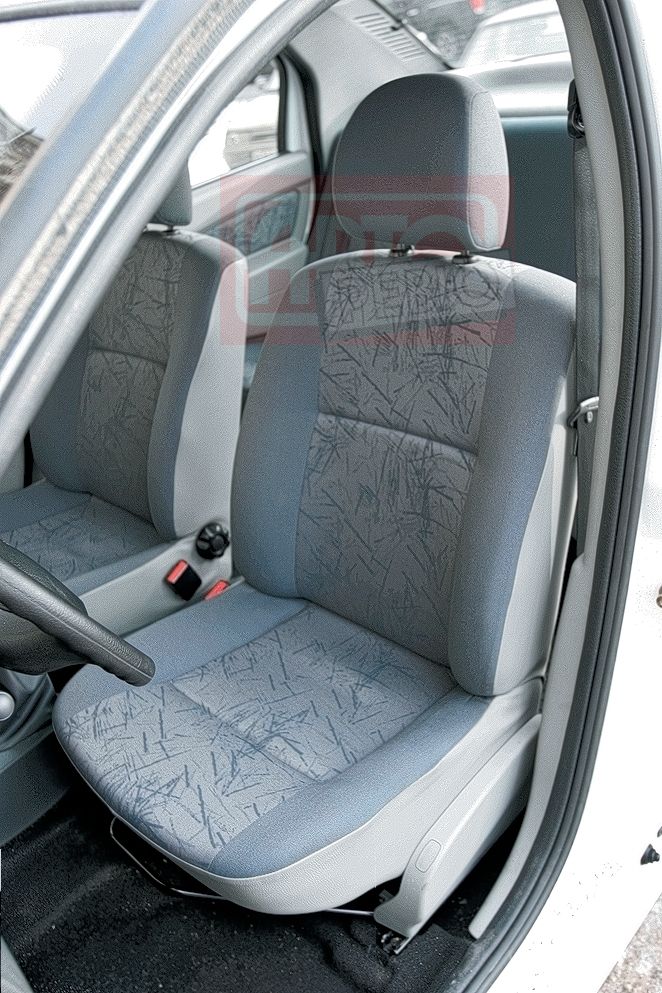
| Logan: barracks-like stinginess of lines and textures. But all buttons and knobs work easily and clearly | The lateral support of the Renault's seats is the weakest | Radio, power windows, air conditioning — all for an extra charge |
Acceleration dynamics? The sedans drive — and that's fine. But the Hyundai Accent does it quite briskly. The powerful 1.5-liter engine isn't hindered even by slightly stretched gears: it revs eagerly up to the limit of 6400 rpm, accelerating to 97 km/h in second and 137 km/h in third. The dynamic reserve is enough both in the city and on the highway. True, the Accent reacts somewhat sharply to the gas pedal, and low-end torque below 2000 rpm could be more.
 |
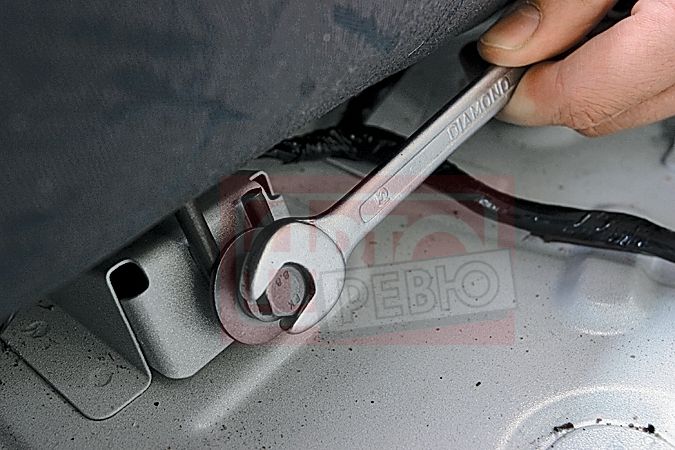 |
| The sofa backrest can only be removed with a wrench | |
 |
 |
| On the flat sofa of the Logan, even three are not cramped |
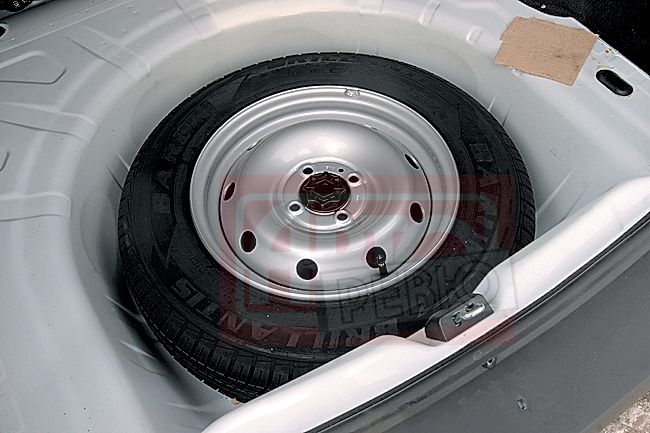
Full-size spare wheels — in all three cars |
Albea and Logan are noticeably inferior to Accent in dynamics. The weakness of the Renault engine is not saved by either the well-tuned gas pedal or the shortened gears: for a confident overtaking, you have to rev the engine to the limit of 6000 rpm — on second gear that's only 85 km/h on the speedometer, on third — up to 125 km/h. The "Fiat" has slightly more power, but the sluggish response to pressing the long-travel accelerator pedal interferes, and the gears are stretched just like the Accent's.
| Fiat Albea | Hyundai Accent | Renault Logan |
 |
 |
 |
| The long-travel Fiat lever moves easily and precisely |
Despite the low height of the lever, its travel is huge | Exemplary gearbox drive — for the "budget" class |
The brakes of all three, unlike domestic cars, work perfectly. The force on the pedal is calibrated, the follow-up action is precise — catching the moment of wheel locking is easy. This is fundamental, because none of the cars in the base version has ABS. Here Renault is slightly preferable: when braking on mixed surfaces (when the left wheels are on asphalt and the right ones on gravel or snow), it hardly pulls to the side. Fiat in the same conditions tends to spin, and Accent slightly pulls toward the asphalt.
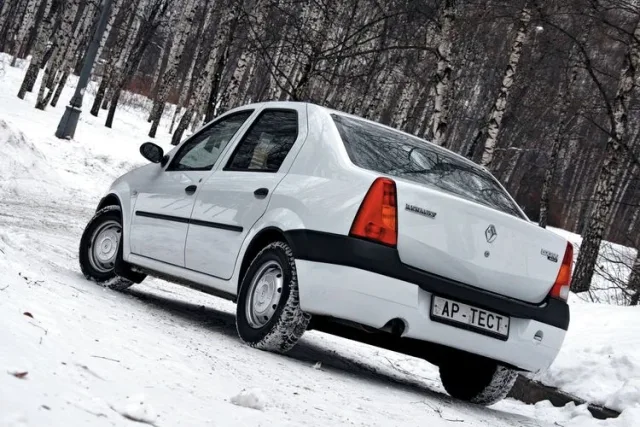
The design of the Logan does not awaken emotions: "square, practical"... In early cars, the trunk opened with a key, but in new ones, a button has appeared on the lid
Expecting exciting handling from budget sedans is naive. It isn't there. The main thing is predictability on the road, because such cars don't have stability systems…
Fiat Albea on winter tires Pirelli Winter Carving — a "horse as calm as a cow." It confidently holds the straight line, weakly reacting to snow drifts and ruts. The steering wheel is "empty," but due to low sensitivity, the Albea changes lanes smoothly and calmly. However, in the city, the sluggishness of reactions is annoying and prevents the Fiat from quickly avoiding unexpected obstacles. Albea enters slippery corners without hesitation, immediately actively working with the rear axle. When lifting off the gas — a smooth and predictable drift that is easily corrected both by the steering wheel and throttle. But there's no pleasure in it: the damped accelerator and "rubbery" reactions to steering wheel turns interfere.
A slight understeer, then a smooth drift — an excellent chassis!
Hyundai Accent on Nokian Hakkapeliitta 2 tires on the highway behaves even better than Fiat: reactions during lane changes are faster, smoother, and more stable. The steering wheel at small angles also seems "empty," but if you turn it more, it fills with remarkably informative effort! Accent enters sharp corners on snowy roads willingly, and a smooth drift under throttle lift won't scare a beginner and will delight an experienced driver. On the "moose test," Accent, though not as agile as one would like, reacts to a sharp steering turn faster than the Fiat.
 |
 |
 |
| If you close your eyes to the Accent's interior design, the quality of Russian assembly pleases |
A soft wide seat will only appeal to people of solid build |
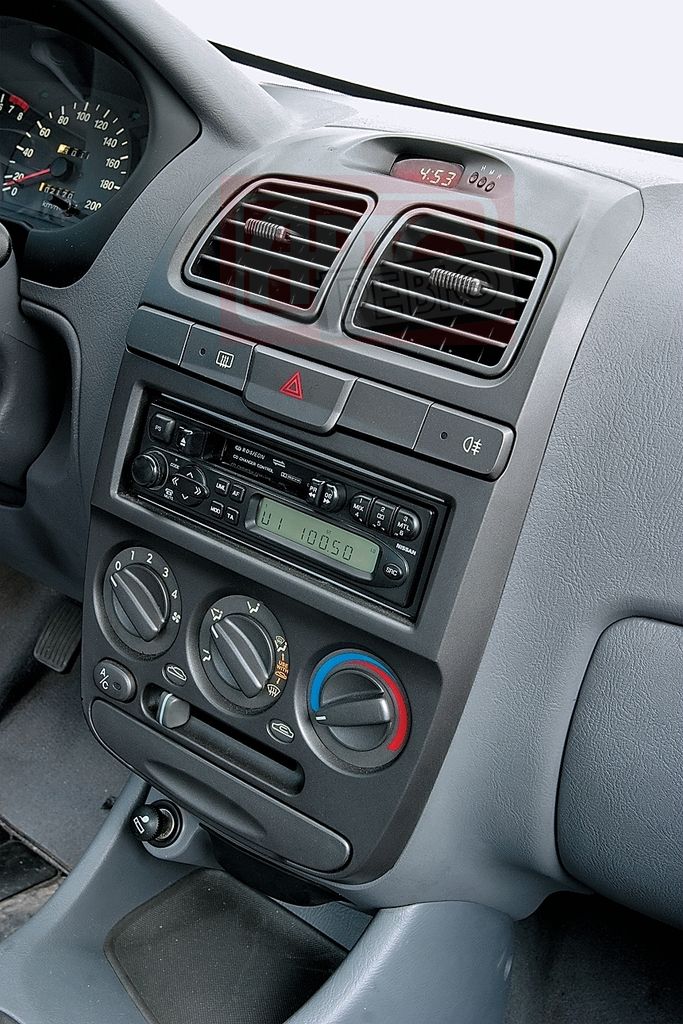
Three "pointed" knobs — exemplary climate control |
And the least confident at high speed is the Logan on Brigestone Ice Cruiser tires — overly sharp reactions to steering wheel deviations are annoying, accompanied by a drop in effort on the wheel if you turn it at a large angle. Of course, the liveliness of reactions helps to avoid a pothole within your lane or maneuver in the city. But on a winter road, this liveliness turns into a dangerous tendency to skid: first the Logan slides with the front outward, then rather sharply transitions into a rear-wheel slide. On the "moose test," you also have to fight the skid — behind the wheel of the Logan, keep your ears open!
 |
 |
| In the back, it's cramped even for two — knees press into the seatbacks |
Folding rear seat — in the base trim |
In terms of ride smoothness, the clear leader is the Fiat Albea. Neither vibrations from rough asphalt nor pitching on waves. And energy intensity is at its best — you can dash very confidently along a snowy dirt road. The Logan's suspension is slightly weaker, but also "takes the hit" well. However, harsh bumps shake the body more, and vibrations from the road come both into the cabin and onto the steering wheel. And the least comfortable is the Accent. Its suspension more often lets impacts through to the body, noticeable pitching on waves, and driving on a dirt road faster than 20 km/h is simply dangerous — passengers won't survive it. In addition, the Accent and Logan are distinguished by noticeable vibration from the engines at idle: in the Hyundai, the steering wheel shakes the most, and in the Renault, the gear lever. There is also engine vibration in the Fiat, but its frequency is higher.
Furthermore, the Fiat is quieter! The voice of the engine, though colorless, is less annoying than the rich overtones of sounds from under the hoods of the Renault and Hyundai. The hum from the road, the clicking of studs on asphalt, the knocking of sand on the wheel arches — in the Fiat, all this is heard not as strongly as in the Accent and especially in the Logan. And only in aerodynamic noises in our trio is there parity — an annoying whistle begins already at 100 km/h in all cars.
What's the result? Formally, the Logan lost. Only the lack of normal transformation of the rear seat cost the French sedan 35 points — after all, this is a serious minus for a car for all occasions. Although… For the 315,000 rubles they ask for the "base" Fiat Albea 1.4, you can take a Logan 1.6 Expression with air conditioning. Therefore, the choice of economical people is precisely Renault: the lowest "starting" price, the lowest cost of ownership, and incredible space for passengers.
| Fiat Albea | Hyundai Accent | Renault Logan |
 |
 |
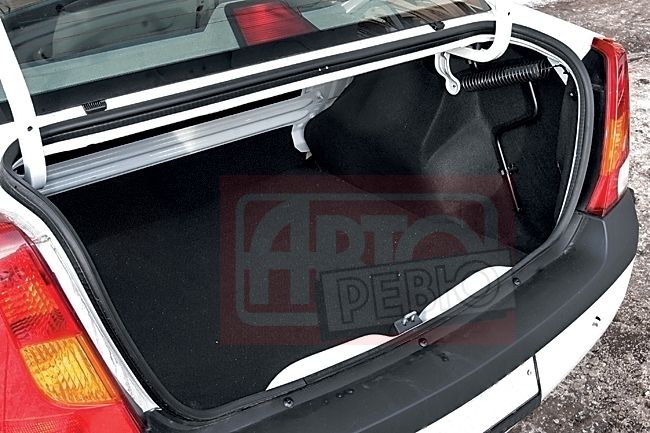 |
| Huge volume and whimsical wall shapes — that's the Fiat's trunk |
Modest volume is compensated by neatness |
Exemplary gearbox drive — for the "budget" class |
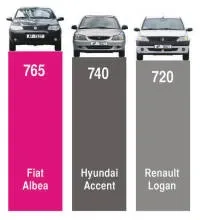
The Accent is good for its driving qualities, and only it has a version with an "automatic." But passengers will be uncomfortable in it, and the ride smoothness is low. And the Accent costs more than the Logan — almost as much as the Fiat, which, judging by the table of expert assessments, won our test.
Ride smoothness, impressive suspension energy intensity, decent acoustic comfort for the budget segment, and confident behavior on the road — these are the trump cards of the Fiat. Those who are ready to pay extra for such a set of qualities increasingly choose the Italian. Sales figures confirm this: in December, 723 cars were sold. It seems that the "Fiats" have finally taken root in our market.
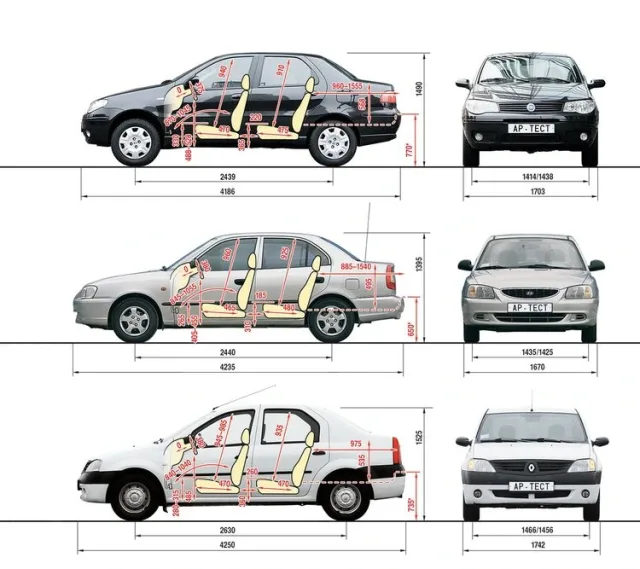
Black indicates manufacturer data, red — the results of Autoreview measurements
* Loading height
| Passport data | |||
| Parameters | Cars | ||
| Fiat Albea | Hyundai Accent | Renault Logan | |
| Body type | 4-door sedan | 4-door sedan | 4-door sedan |
| Number of seats | 5 | 5 | 5 |
| Trunk volume, l | 515 | 375 | 510 |
| Curb weight, kg | 1120 | 1065 | 975 |
| Gross weight, kg | 1605 | 1555 | 1535 |
| Engine | petrol, with distributed fuel injection | ||
| Location | front, transverse | front, transverse | front, transverse |
| Number and arrangement of cylinders | 4, in-line | 4, in-line | 4, in-line |
| Displacement, cm³ | 1368 | 1495 | 1390 |
| Cylinder bore/piston stroke, mm | 72.0/84.0 | 75.5/83.5 | 79.5/70.0 |
| Compression ratio | 10.3:1 | 10.0:1 | 9.5:1 |
| Number of valves | 8 | 16 | 8 |
| Max. power, hp/kW/rpm | 77/57/6000 | 102/75/5800 | 75/55/5500 |
| Max. torque, Nm/rpm | 115/3000 | 133/3000 | 112/3000 |
| Gearbox | manual, 5-speed | ||
| Gear ratios | |||
| I | 4.27 | 3.62 | 3.73 |
| II | 2.24 | 2.05 | 2.05 |
| III | 1.44 | 1.37 | 1.39 |
| IV | 1.03 | 0.97 | 1.03 |
| V | 0.87 | 0.83 | 0.79 |
| reverse | 3.91 | 3.25 | 3.55 |
| final drive | 4.10 | 3.84 | 4.21 |
| Drive | front | front | front |
| Front suspension | independent, coil spring, McPherson | ||
| Rear suspension | semi-independent, coil spring | independent, coil spring, McPherson | semi-independent, coil spring |
| Front brakes | disc, ventilated | disc, ventilated | disc |
| Rear brakes | drum | drum | drum |
| Tires | 175/70 R14 | 175/70 R13 | 165/80 R14 |
| Maximum speed, km/h | 162 | 181 | 162 |
| Acceleration time 0-100 km/h, s | 13.5 | 10.5 | 13.0 |
| Fuel consumption, l/100 km | |||
| urban cycle | 8.2 | 9.9 | 9.2 |
| extra-urban cycle | 5.0 | 6.1 | 5.5 |
| combined cycle | 6.2 | 7.5 | 6.8 |
| Fuel tank capacity, l | 48 | 45 | 50 |
| Fuel | petrol AI-95 | petrol AI-92 | petrol AI-92 |
Fiat Albea, aka Siena
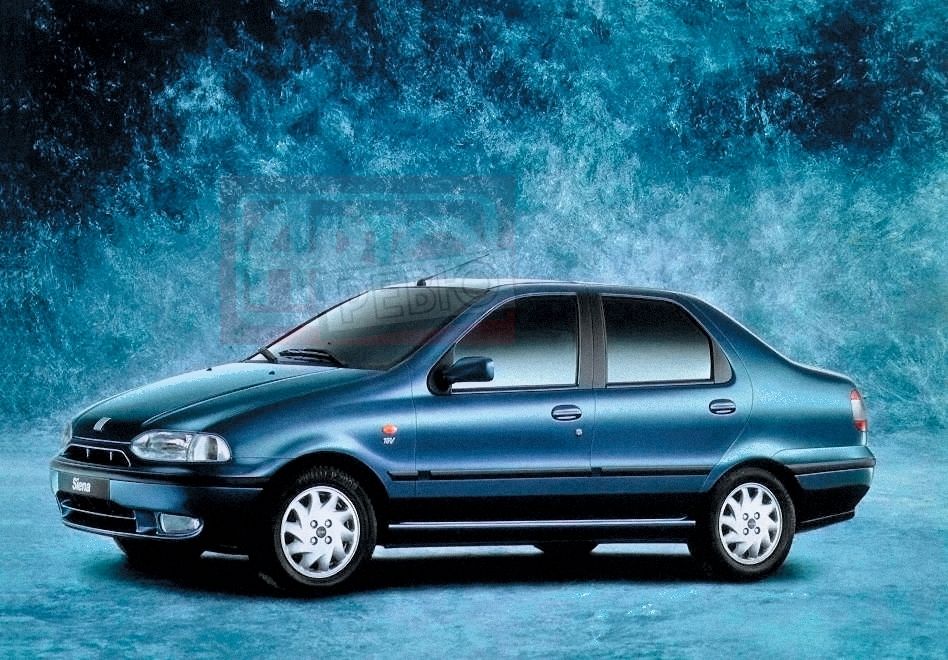 The lineage of the Fiat Albea sedan goes back to 1983, when the Fiat Uno hatchback appeared. It was its platform that formed the basis of the global "Project 178" - the Fiat Palio model, launched in 1996. Within this project, it was planned to produce three body variants: the hatchback remained Palio, the station wagon was named Palio Weekend, and the sedan - Siena, after the picturesque Italian town.
The first Palio and its modifications rolled off assembly lines in Brazil. A year later, in 1997, production was established in Venezuela, Morocco, and Poland, and since 1998, the Turkish plant Tofas joined them. Over ten years, these "worldwide" Fiats underwent restyling twice - in 2001 and 2004. After the second modernization, the sedan acquired a new name - Albea, and its exterior and interior were completely updated, although the chassis and body structure remained the same.
Russian buyers have known the Fiat Albea since 2004 - then cars began to be supplied from Turkish Tofas. Today, sedans assembled at the ZMA plant in Naberezhnye Chelny from Turkish car kits are sold in our country: in essence, this is a large-unit assembly, where only the power unit and suspension are installed on the finished car. However, by July, the Chelny residents plan to launch their own welding and painting of bodies. Production of 26,000 cars is planned for 2007.
We can judge the reliability of "worldwide" Fiats from our own experience: the Palio hatchback participated in the resource test of Autoreview from 2001 to 2004 (see AR No. 2, 2004). Among the undoubted advantages, we then noted the durable suspension, corrosion resistance, and low operating cost - maintaining the Palio cost the editorial office only slightly more than the VAZ "ten". The disadvantages were mostly minor: sticking rear brake cylinders, a short-lived release bearing, a broken radiator bracket. If Fiat manages to create a developed dealer network in Russia that will save owners from problems with maintenance and finding spare parts, then owning an Albea is unlikely to become burdensome.
Interior heating dynamics
To evaluate the effectiveness of climate systems, we measured how quickly the interiors warm up after an overnight stay at minus 8°C. On all three cars, the climate controls were set the same: heating on maximum, fan on second speed, airflow directed to the windshield and feet. Temperature was recorded at four points - at the driver's feet and head, as well as at the rear passenger's feet and head, taking sensor readings every minute for 20 minutes.
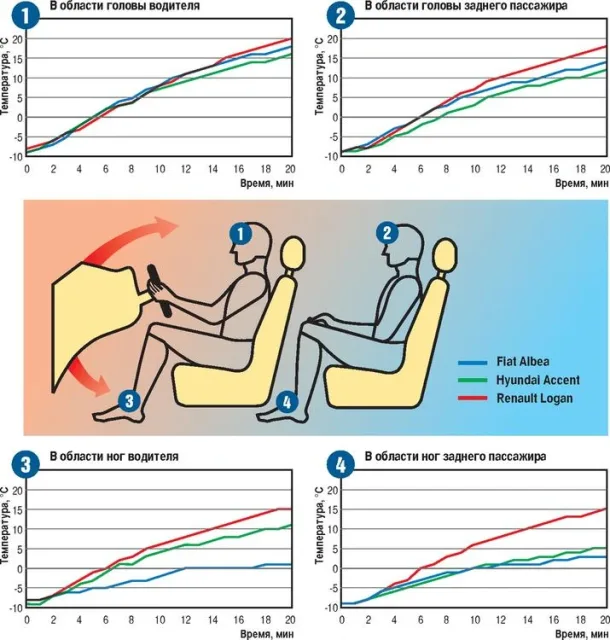
The biggest problems with foot heating turned out to be in the Fiat: here both the driver and rear passengers freeze. In the Hyundai, it is noticeably warmer in the front, but rear passengers are also uncomfortable there. And only the Renault quickly provides a comfortable microclimate for all passengers.
As for the temperature in the area of the driver's and rear passenger's head, in the Fiat and Renault it rises approximately the same. But in the Hyundai, this indicator is 3-8°C lower.
Visibility
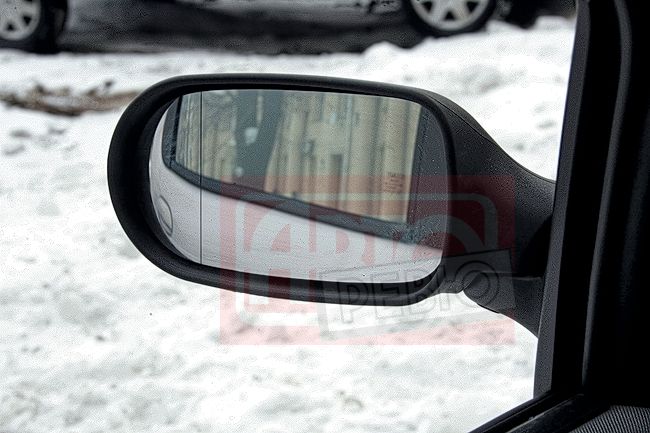
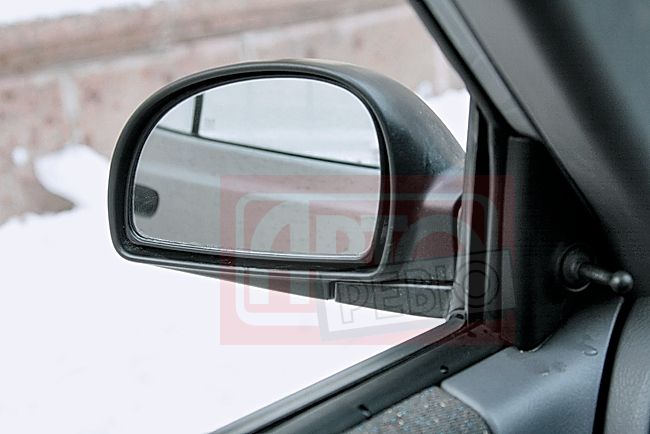
The Hyundai Accent can boast excellent visibility: it has the best mirrors, the largest total viewing angle - 2840, the widest wiper cleaning zone, and the rear window opening is not blocked by headrests.
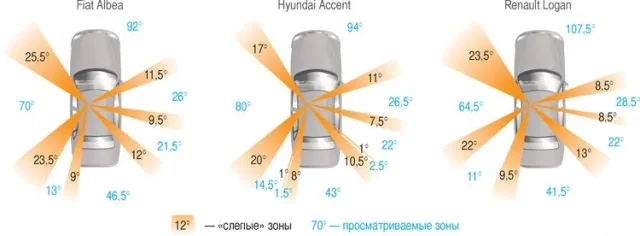
But in the Renault, the small mirrors are annoying, and the overall viewing sector is more modest - 2750. In addition, its side windows get dirty with mud more than in the other two sedans.
The massive front pillars and the six-centimeter "blind" zone near the left pillar of the Albea's windshield significantly complicate maneuvering in dense city traffic. The side mirrors are inferior in image quality to those on the Hyundai, but surpass the Renault mirrors. At the same time, the total viewing angle of the Italian model is the smallest - 2690.
| Fiat Albea | Hyundai Accent | Renault Logan |
 |
 |
Autoreview readers' forecast
Before the start of these tests, on the website www.autoreview.ru we asked visitors to choose which of the three cars they would prefer within our test.
The votes were distributed as follows:
Renault Logan 46.76%
Hyundai Accent 32.35%
Fiat Albea 20.89%
A total of 6572 people took part in the survey.
| Expert ratings from Autoreview | ||||
| Parameters assessed | Max. score | Cars | ||
| Fiat Albea | Hyundai Accent | Renault Logan | ||
| Design | 160 | 120 | 105 | 115 |
| Exterior | 80 | 55 | 50 | 55 |
| Interior | 80 | 65 | 55 | 60 |
| Ergonomics | 160 | 130 | 130 | 125 |
| Driver's workplace | 80 | 65 | 60 | 60 |
| Visibility | 80 | 65 | 70 | 65 |
| Dynamics | 270 | 210 | 220 | 205 |
| Acceleration dynamics | 80 | 60 | 65 | 60 |
| Braking dynamics | 100 | 80 | 80 | 80 |
| Handling | 90 | 70 | 75 | 65 |
| Ride comfort | 210 | 160 | 145 | 155 |
| Smoothness, vibration protection | 80 | 70 | 60 | 65 |
| Acoustic comfort | 70 | 55 | 45 | 45 |
| Climate control | 60 | 35 | 40 | 45 |
| Interior comfort | 200 | 145 | 140 | 120 |
| Passenger seats | 70 | 55 | 50 | 65 |
| Trunk | 70 | 55 | 55 | 55 |
| Interior transformation | 60 | 35 | 35 | 0 |
| Total score | 1000 | 765 | 740 | 720 |
Final ratings from Autoreview
What costs how much?
For the base Renault Logan Authentique with a 1.4-liter engine producing 75 hp, they ask only $9,500. The initial trim includes only an immobilizer and a driver's airbag, which, however, can be declined to save $100 — but we wouldn't advise it. The Expression version, which already has power steering, central locking, and body-colored bumpers, costs $900 more, i.e., $10,400. Options are available for this trim: air conditioning for $750, power windows for $120, fog lights for $150, CD player for $280, and ABS with a passenger airbag for $700. Thus, a fully equipped Logan 1.4 is priced at $12,570.
The Logan with a 1.6-liter engine (90 hp) starts at $11,000. The Privilege version in top trim, including air conditioning, fog lights, and an onboard computer, will cost from $12,300. There is also a special Storia series, additionally equipped with a power package, CD player, and heated front seats. Its price is $12,700, which is slightly less than $12,960 for an equivalently equipped Logan Privilege. Most dealers have cars in stock, but all are painted in "metallic," for which you will have to pay an extra $170. Sedans in regular paint (white or blue) are only available on order, and you may have to wait up to three months. The indicated prices also add the cost of delivery from the factory to a specific dealer: in Moscow it's $150, in Samara — $230, in Rostov — $250. In Moscow and St. Petersburg, sellers are guided by the Central Bank exchange rate, but regional dealers set their own dollar rate. For example, in Rostov showrooms, the dollar is still calculated at 29 rubles: the base Logan for $9,500 in rubles will come to 275,500. When recalculated at the rate of 26 rubles per dollar, this is $10,600 — $1,100 more than the Moscow price!
The warranty on the car is 2 years without mileage limit. Renault is sold by 89 dealers in 57 Russian cities.
Fiat Albea Base (1.4 L, 77 hp) costs noticeably more — 315 thousand rubles ($12,115*), and the base equipment includes one airbag, power steering, central locking, immobilizer, and six speakers. For this money, a similar Logan would be $1,400 cheaper. Fiat fans have little to choose from: only one engine (1.4 L, 77 hp) and three fixed trims are available. The Albea we tested in the Classic version, equipped with electric mirror and front window adjustment, air conditioning, onboard computer, fog lights, and a partially folding rear seat, costs 346 thousand rubles ($13,310*). The most expensive Comfort modification for 368 thousand rubles ($14,155*) includes a passenger airbag, ABS, and brake force distribution system. Currently, dealers only have cars in the middle Classic trim; others will have to wait up to two months.
Warranty — 2 years without mileage limit. Fiat is sold by 34 dealers in 23 Russian cities.
The more powerful Hyundai Accent (1.5 L, 102 hp) costs only 8,700 rubles more than the Fiat, but is better equipped — for 323,700 rubles ($12,350*) the base already includes air conditioning, power steering, immobilizer, cassette player, and Isofix mounts. This is exactly the car that participated in our test. By paying an extra 18 thousand rubles ($690), you can get central locking, power package, and heated mirrors. Another 15 thousand rubles ($580) cost a driver's airbag and ABS. In addition, only the Accent of this trio can be equipped with an automatic transmission. Such sedans are available only in base and maximum trims for 353,700 rubles ($13,600*) and 386,700 rubles ($14,875*) respectively. In May, the most affordable version is expected to appear for 293,700 rubles ($11,290*), with only power steering and immobilizer as options. The given prices are valid almost throughout Russia, although there are pleasant exceptions. For example, in Samara, an Accent with an "automatic" can be bought with a discount of 7,700 rubles. There are no queues for these cars.
Warranty — 3 years or 100,000 km. Hyundai produced by TagAZ is sold by 153 dealers in 63 Russian cities.
* At the exchange rate of $1 = 26 rubles.
| Equipment of the cars participating in the test | |||
| Equipment | Cars | ||
| Fiat Albea | Hyundai Accent | Renault Logan | |
| Base price of the car, $ | 12115 | 12350 | 9649* |
| Driver airbag | + | – | + |
| Power steering | + | + | O |
| Adjustable steering column by height | + | + | – |
| Heated front seats | – | – | – |
| Central locking | + | – | O |
| Air conditioning | O | + | O |
| Power-adjustable exterior mirrors | O** | – | – |
| Front power windows | O | – | O |
| Split-folding rear seat | O | + | – |
| Audio system | – | + | O |
| Trip computer | O | – | – |
| Remote trunk lock | + | + | – |
| Remote fuel filler flap lock | + | + | – |
| Fog lights | O | – | O |
| Full-size spare wheel | + | + | + |
| Metal engine compartment protection | – | + | + |
| Alloy wheels | – | – | – |
| Metallic paint | + | + | – |
| Child safety locks on rear doors | + | + | + |
| Rear head restraints | – | – | – |
| Isofix child seat anchors | – | + | – |
| Price of the tested car, $ | 13310 | 12350 | 11708 |
| * Including delivery to the dealer in Moscow | |||
| ** Without heating | |||
| (+) Included in base version | |||
| (–) Not available in base version | |||
| (O) Options installed on the cars participating in the test | |||
We decided to find out how much the prices for scheduled maintenance differ depending on the region. To do this, we called dealers in St. Petersburg, Rostov-on-Don, and Samara. It turned out that the cost of routine work for the same brand can differ noticeably from Moscow prices — in both directions.
In the northern capital, the situation turned out to be close to the capital's: the differences are minimal. The cost breakdown is the same as in Moscow. The cheapest to maintain is the Logan, the Fiat Albea is slightly more expensive, but the Accent forces its owner to spend twice as much on service visits.
In Samara, the picture is similar, although all maintenance there is more expensive, and the labor rate, surprisingly, is cheaper. For Fiat, it is estimated at only $20, while in Moscow it is $30, and in St. Petersburg — $42.
The most unexpected situation developed in Rostov-on-Don. Here, maintaining the Accent is almost as economical as the Logan! The reason is that local Hyundai dealers charge almost half as much for service as Moscow ones. For example, the most expensive maintenance at 60,000 km will cost $370, while in the capital they ask $557 for it. At the same time, similar work on a Renault costs $460, which is noticeably more expensive than Moscow's $368. The Logan is saved only by the fact that it needs to be taken to the service less often. But the Fiat is the most expensive to maintain in Rostov — prices are one and a half times higher than Moscow's.
| Approximate cost of scheduled maintenance with consumables and parts at Moscow dealers* | ||||
| Scheduled maintenance | Cars | |||
| Fiat Albea | Hyundai Accent | Renault Logan | ||
| Labor rate | 30 | 40 | 45 | |
| Mileage, km | 2000 | 57** | 179 | — |
| 7500 | — | — | 45** | |
| 10000 | — | 209 | — | |
| 15000 | 84 | — | 139 | |
| 20000 | — | 298 | — | |
| 30000 | 198 | 244 | 139 | |
| 40000 | — | 383 | — | |
| 45000 | 103 | — | 139 | |
| 50000 | — | 415 | — | |
| 60000 | 267 | 557 | 368 | |
| 70000 | — | 214 | — | |
| 75000 | 439 | — | 139 | |
| 80000 | — | 378 | — | |
| 90000 | 229 | 301 | 199 | |
| Total | 1377 | 3178 | 1168 | |
| * Prices are in US dollars | ||||
| ** Performed at the owner's discretion | ||||
| Approximate prices for original parts at Moscow dealers* | |||
| Parts | Cars | ||
| Fiat Albea | Hyundai Accent | Renault Logan | |
| Oil filter | 12 | 6 | 7 |
| Fuel filter | 50 | 15 | 15 |
| Air filter | 14 | 12 | 14 |
| Cabin filter | 42 | 42 | — |
| Spark plug | 10 | 3 | 6 |
| Front brake pads | 74 | 44 | 67 |
| Rear brake pads | 100 | 53 | 53 |
| Front shock absorber | 137 | 113 | 88 |
| Rear shock absorber | 60 | 113 | 92 |
| Clutch kit** | 351 | 202 | 190 |
| Timing belt | 76 | 55 | 53 |
| Front headlight | 267 | 230 | 99 |
| Rear taillight | 76 | 49 | 46 |
| Front fender | 175 | 110 | 60 |
| Front bumper | 537 | 153 | 248 |
| Hood | 477 | 223 | 206 |
| Windshield | 412 | 215 | 179 |
| * Prices are in US dollars | |||
| ** Includes clutch disc, pressure plate, and release bearing | |||
"Budget" safety
The set of systems responsible for safety in inexpensive sedans is, frankly, modest. ABS is not found in the base trims of any of the three test participants, and electronic brake-force distribution EBD is available only on the Fiat Albea in the most expensive version. Of the airbags, Renault and Fiat have only the driver's in the base, and even that would have to be ordered for extra money by the Accent owner. However, Hyundai has a brand advantage — seatbelt pretensioners, which are installed on all cars without exception, plus Isofix anchors. But Fiat and Renault, for an additional and considerable fee, allow the installation of a second airbag for the front passenger.
| Fiat Albea | Hyundai Accent | Renault Logan |
 |
 |
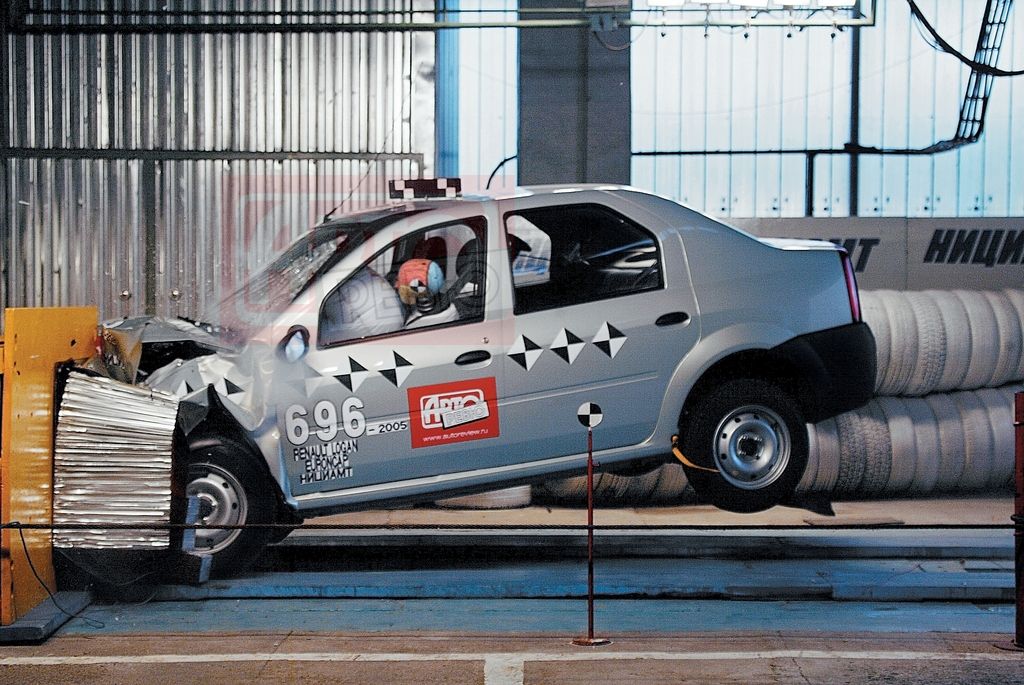 |
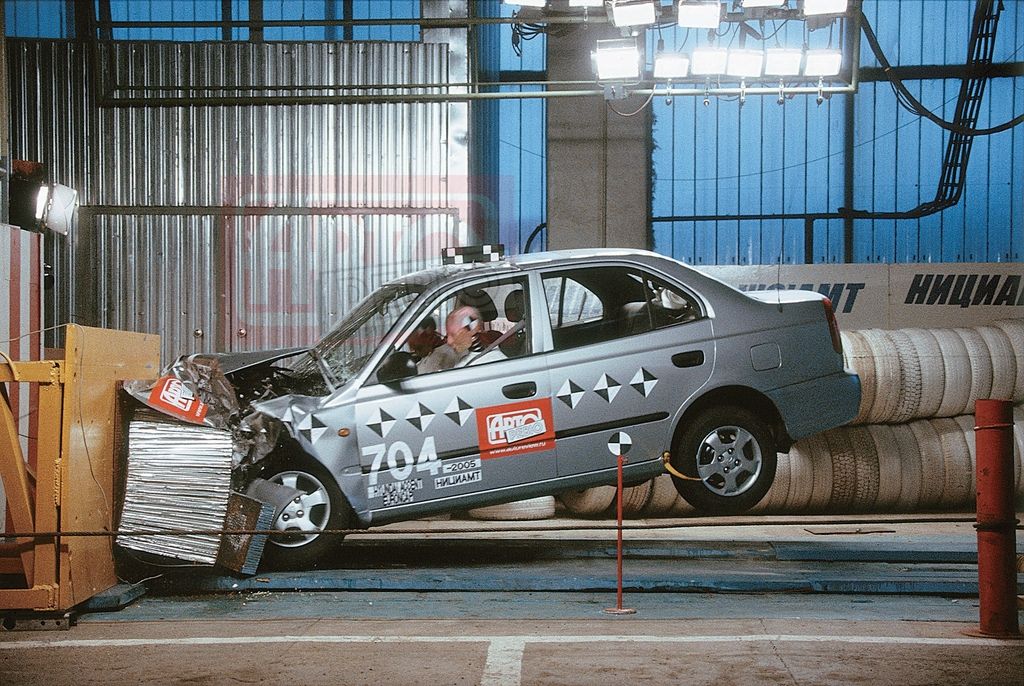
Of the three, only the Logan assembled in Romania (Dacia) has undergone independent EuroNCAP testing. In a frontal impact, it scored 8 points out of 16 and earned three stars. The main complaint was that the pedals moved more than 200 mm. In 2005, experts from "Autoreview" conducted their own frontal crash tests of the Logan and Accent using the same EuroNCAP methodology. Both budget cars performed admirably: Logan scored 12 points, and the Accent without an airbag scored 10 out of 16 possible. Both cars' bodies survived the impact excellently — the cabin retained its geometry, the steering wheel didn't move, and the floor on the driver's side deformed only slightly. The loads on the dummies remained within acceptable limits. The Accent was greatly helped by its seatbelt pretensioners, which its competitors lack. If it had lost its airbag, it would have lost two points, and without such pedal displacement (180 mm), the result could have been higher. Incidentally, according to the American NHTSA methodology, the Accent earned four out of five stars for front passenger protection.
The Renault's weak point is its cheap airbag, which causes the driver's head to experience excessively high loads. In our test, the pedal displacement was within normal limits. Overall, an excellent result!
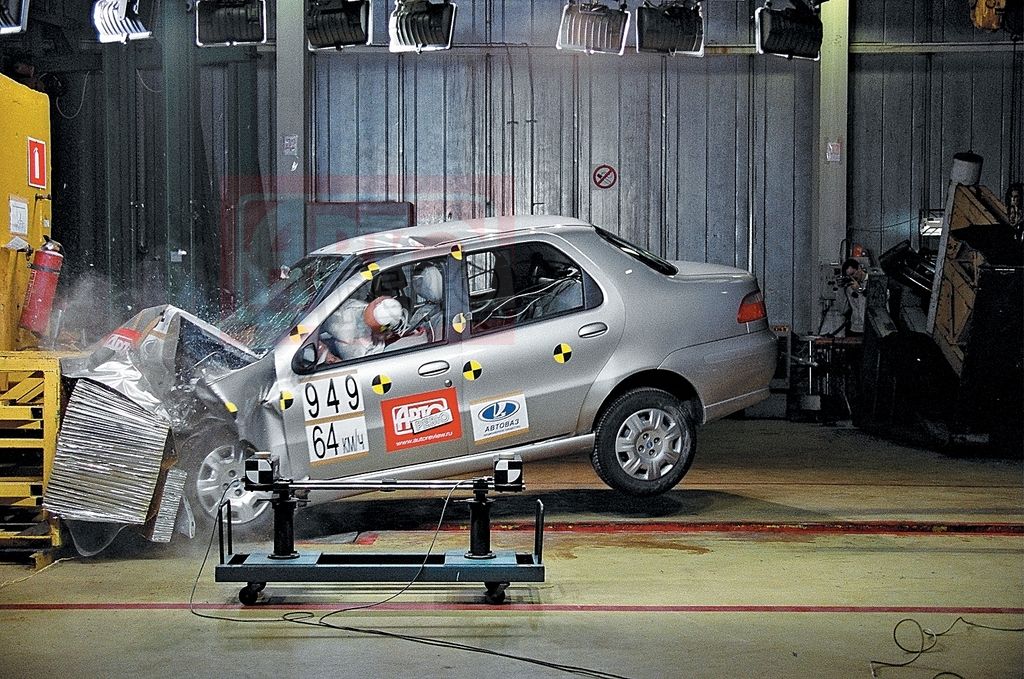
As for the Fiat Albea, like its siblings Palio and Siena, it hasn't undergone independent crash tests yet. We decided to rectify this oversight — read about how the Albea behaves in a frontal collision in the next issue of "Autoreview."
What else?
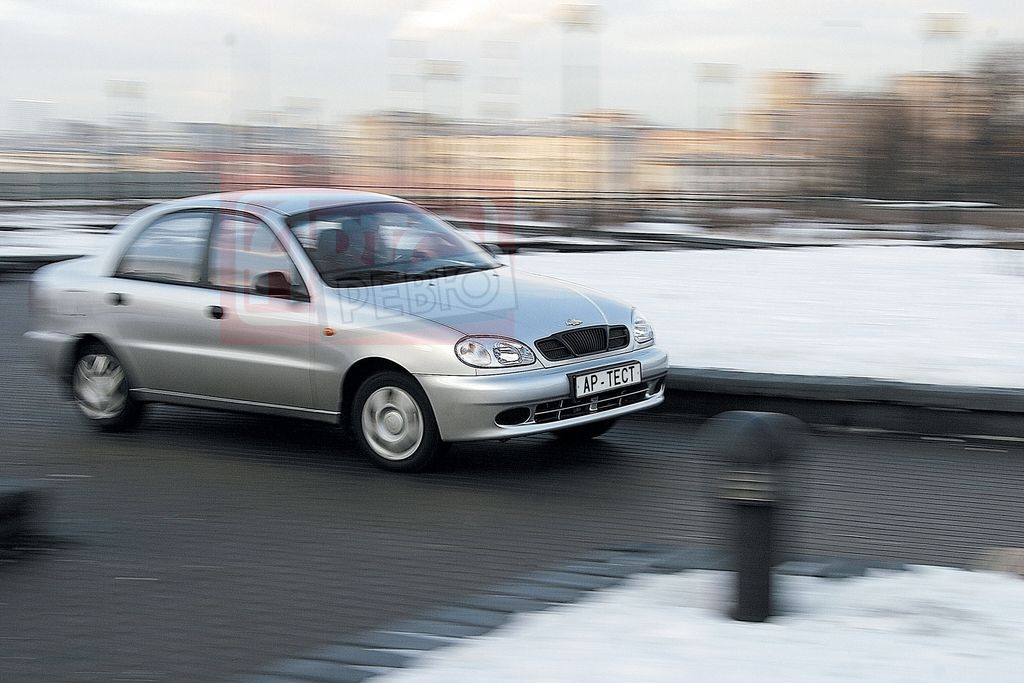
If we talk about other options in this segment, it's worth considering the Chevrolet Lanos (1.5 L, 86 hp), which sells for $8,980. Its plus is a substantial ground clearance of 200 mm. But the exterior and interior of the Ukrainian sedan look dreary, tall drivers will find the front seats uncomfortable, and only two people can sit comfortably in the back. The ride comfort isn't impressive either. More details in AR No. 2, 2006.
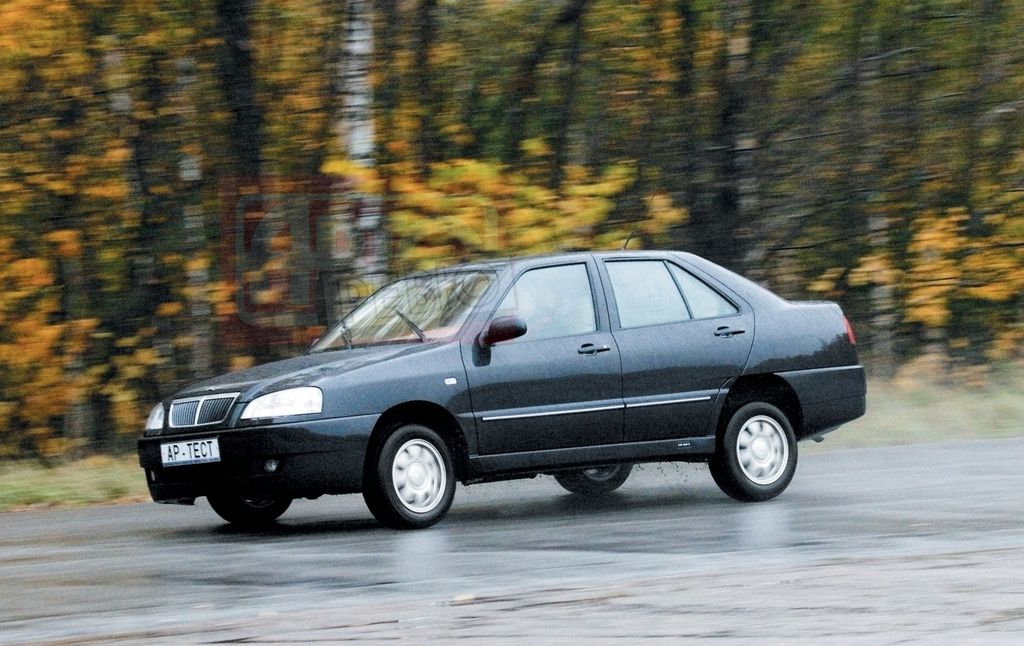
About the same money — $9,000 — is asked for the Chinese liftback Chery Amulet (1.6 L, 94 hp). It already comes standard with air conditioning and power steering, which the Lanos lacks. But the build quality leaves much to be desired, and there are questions about ergonomics and road behavior. The cabin noise and mediocre ride comfort finally spoil the impression. Details in AR No. 22, 2006.
| Chevrolet Lanos | Chevrolet Aveo | Chery Amulet |
 |
 |
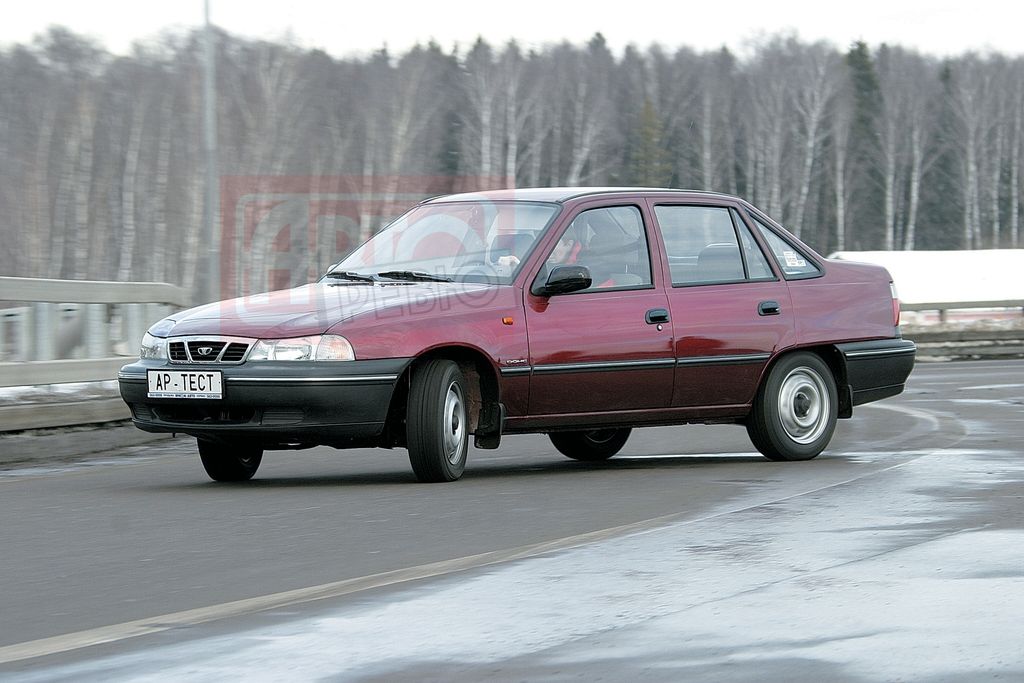
The Daewoo Nexia starts at $9,650 — this is the version with the 1.5 L eight-valve engine producing 75 hp. The interior and ergonomics are hopelessly outdated, the front seats are uncomfortable, the rear is cramped, and ride comfort leaves much to be desired. Details in AR No. 2, 2006.
The Chevrolet Aveo sedan with the 1.2 engine (72 hp) costs from $11,430, while the version with the 1.4 engine (94 hp) starts at $13,330. Pre-facelift hatchbacks can be found from $10,280. Standard equipment includes one airbag, a CD player, and front power windows. The Aveo looks modern, and the interior pleases with its design and comfort, but it's noisy, and handling and ride comfort are average. More details in AR No. 3, 2007.
The Renault Symbol in a modest base trim (one airbag and power steering) with the 1.4 engine (75 hp) is offered for $12,000. The Turkish sedan can boast a huge trunk, but it comes at the expense of the cabin: even with average-height front passengers, rear passengers' knees press against the seatbacks. However, the Symbol delights with excellent ride comfort and cabin quietness, and higher trims offer climate control and an automatic transmission. Details in AR No. 3, 2007.
| Daewoo Nexia | Iran Khodro Samand | Hafei Princip |
 |
The Iran Khodro Samand (1.8 L, 100 hp), built on the Peugeot 405 platform, costs at least $12,380. Even the base version includes power steering, power windows, and air conditioning, but even top trims lack airbags and Isofix anchors. The car is contradictory: decent handling and comfort are undermined by brake and ergonomic issues, as well as low build quality and trim materials. Details in AR No. 22, 2006.
The Peugeot 206 Sedan, assembled at the same plant as the Samand, costs $12,550 in base trim with the 1.4 engine (75 hp). Equipment includes two airbags, power steering, front power windows, and a CD player. The Iranian sedan retains the charm of the French hatchback but loses all its chassis tuning — the suspension feels loose. A downside is the cramped rear row. More details in AR No. 3, 2007.
The Kia Spectra (1.6 L, 101 hp), assembled in Izhevsk, costs from $13,320. Standard equipment includes power steering, power windows, two airbags, and Isofix anchors. The car's exterior and interior are "nothing special," the rear is spacious for only two, and the Spectra doesn't like corners. Comfort enthusiasts will be annoyed by noise, rocking on waves, and jolting over sharp bumps. Details in AR No. 21, 2004 and AR No. 22, 2006.
| Kia Spectra | Peugeot 206 Sedan | Renault Symbol |
In the same price segment, AvtoVAZ also offers its products: the VAZ-2110 sedans start at $9,020 with discounts. The four-door Kalina will cost slightly more — $9,250. Under the hood of both cars is the same 1.6-liter engine producing 80 hp. The Kalina only wins over the "ten" in driver's seat ergonomics and visibility, while noise and vibration levels are comparable. However, in extreme driving modes, the Kalina's handling becomes simply dangerous. This is detailed in AR No. 2, 2006.
Also on the Russian market are two Chinese classmates. The BYD F3 sedan (1.6 L, 100 hp), which is a copy of the previous-generation Toyota Corolla, sells for $12,350. Base equipment includes power steering and a cassette player. The Hafei Princip (1.6 L, 101 hp) has similar dimensions but costs $410 more (from $12,760), though its equipment includes only power steering and audio preparation.
Finally, we must not forget the related Kia Rio and Hyundai Verna. These are worthy cars with a good combination of consumer qualities, but their prices are significantly higher — from $15,350* for the base Rio and from $14,785* for the Hyundai Verna.
* At an exchange rate of $1 = 26 rubles.