Hummer H3. Little Dirty One
Over the years of working in automotive journalism, I've tried many cars, but somehow I never clicked with Hummer. I didn't even glance at the military H1 — didn't feel drawn. I tested the H2 twice, and both times left disappointed: no emotions. Maybe the third 'heir' will manage to surprise? Especially since it's almost one of us — it's assembled in Kaliningrad, so you could say it's our guy.
To understand the philosophy of all three generations of 'Hammers', it's worth looking into history. The name 'Hummer' won't be found in dictionaries — it was invented by journalists, reworking the word 'hammer'. In GM, this idea was developed into the abbreviation 'High Utility, Maximum Mobility Easy Riding' — that is, 'high practicality, maximum off-road capability, easy handling'.
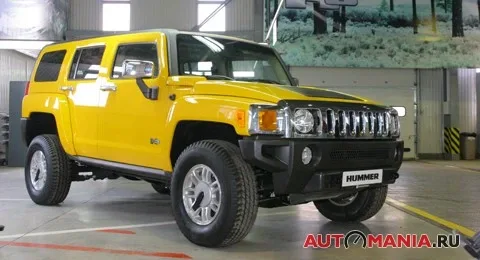
Externally, the third Hummer relates to the second like a rifle to a carbine. From its predecessor, only short overhangs and narrow embrasure-like windows remain. The H3 looks more sculpted and toned, but thanks to widened arches and overlays above them — even meaner. From the front, it's easy to mistake it for its older brother: the same chrome grille, xenon headlights, and fog lights in the bumper. On the sides — mirrors with excellent visibility. And the rear — a nod to Discovery 3 and Nissan Patrol GR: they have the same massive vertical lights. As in the H2, the central mirror can be folded — you can't see anything in it anyway, no matter how you adjust it. There's more chrome: now it also covers the door handles. Front and rear — a pair of tow hooks each, so massive you could hitch a tractor to them. The spare wheel has been moved from the cabin to the tailgate, jeep-style. Looks solid, but it opens heavily, and if the door is dirty — quite inconvenient.
Inside, compared to the H2, everything is much more modest. The instruments are informative, without extra voltmeters and inclinometers. The compass is in place, as in all Americans, but there's no onboard computer. So fuel consumption had to be estimated by eye. According to the specs — no more than 15 liters in the city and 12 on the highway. But reality is different: over the first hundred kilometers, the tank emptied halfway. That's at least 20–22 liters per hundred. Then you understand why even Schwarzenegger's wife grumbles that such a car should come with a gas station as a gift.
At first, I had to get used to the steering wheel. To figure out its adjustment, I recalled all the tests of classic American SUVs, especially from GM. To the right under the steering wheel, it's empty — all switches are on the left: wipers, turn signals, and washer. Reaching is inconvenient, and movements of the left hand distract from the road if you're not left-handed. The leather seats are comfortable, 'sofa-like'. The exterior mirrors adjust without problems — the algorithm and switches are like on the Opel Vectra 'B'. But the window buttons are not near your hand, but almost under your elbow — extremely uncomfortable. The seat heating is hidden below, next to the electric adjustments, like in Ford — also inconvenient. The automatic selector is typically American: no hints on the side, everything by feel, then you look at the indicator in the center of the panel. Saw 'D' — drove off. The left foot has nowhere to go — only on the floor, there's no usual footrest for an 'automatic'. In the center of the panel — three round knobs: temperature (no climate control), airflow, and air direction. Above the stereo — buttons for the transmission and two-speed transfer case. The rear fog light button, tiny, I found by chance — it's hidden under the ignition lock. And the three buttons in the right sun visor will only be useful if you have a garage with automatic gates.
As soon as you get behind the wheel of the H3, you immediately want to turn off the asphalt and have some fun. The 231 mm ground clearance just begs you to press the gas. The car promises that vertical obstacles up to 40 cm are nothing to it, and a ford 61 cm deep can be crossed at 10 km/h. A depth of 41 cm is easily taken at 30 km/h. The overhangs allow climbing slopes up to 60% (31 degrees) and descending slopes up to 40% (22 degrees). The turning radius is 11 meters — maneuvering in the city is easier than in the H2. Another plus is excellent forward visibility thanks to the greater slope of the hood, which the 'second' didn't have.
Under the hood — a 3.5-liter engine with 220 horses. That's enough to confidently pull 2132 kg to the claimed 160 km/h (the H2's max is only 140). Americans, as usual, don't specify acceleration time, but by feel, it takes about 12–14 seconds to reach a hundred. However, it's not worth playing around: the rear leaf-spring suspension is not a gift for comfort, and on a long road, rear passengers will get motion sickness. I note that cars with leaf springs that can be driven with a 'B' category license are few on the market today — 'Gazelles', a couple of Chinese cars, Mitsubishi L200, and Ford Ranger. And another thing prevents enjoying the speed: the wheels protrude slightly beyond the body, and after driving a hundred meters on a wet or dirty road, the sides are splattered up to the roof, and the side windows are impossible to see through. The turn signals with their 'tick-tock-tick-tock' reminded me of the 'Zhiguli' — the sound is loud and annoying. It's also unclear why a car assembled in Kaliningrad for Russia comes with instructions only in English, and the speedometer scale is duplicated in miles.
In conclusion: an American will enjoy the H3 for $35,690, a Russian — for $65,600. Decide for yourself whether it's expensive or not, but don't forget to compare with other powerful American SUVs. And lastly: if the H2 comes only in black, then the 'three' — only in the color in the photo. Although, that's a matter of taste.
Technical specifications.
| Dimensions (mm) |
4742 x 1896 x 1893 |
| Curb weight (kg) |
2135 |
| Fuel tank capacity (l) |
87 |
| Average fuel consumption (l/100km) |
11.2 - 16.3 |
| Maximum speed (km/h) |
160 |
| Acceleration to 100 km/h (s) |
12 |
| Engine displacement (cc) |
3640 |
| Power (hp at rpm) |
220/5600 |
| Maximum torque (Nm /rpm) |
305/2800 |
| Engine type |
inline 5-cylinder |
| Tire size |
R 265/75 R 16 |
| Price ($) |
65,600 |
P.S. If the third Hummer also seems too big and its dimensions scare you, be patient until autumn 2008. Then they promise to release the smallest SUV of the brand — the fourth generation. According to rumors, the 'four' will be built on the Chevrolet Captiva / Opel Antara platform and assembled in Korea. The price will be announced later.
Dmitry SHAVYRIN.
Source – www.automania.ru
