
 Comments
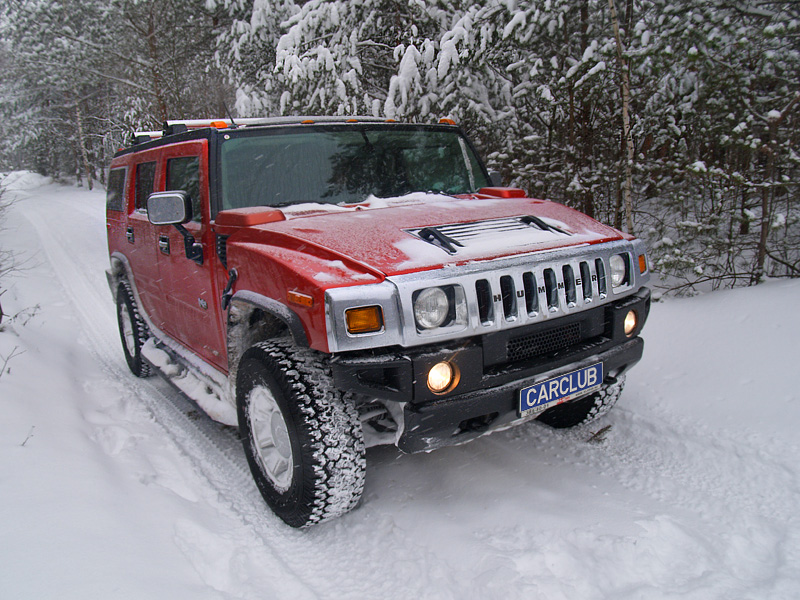
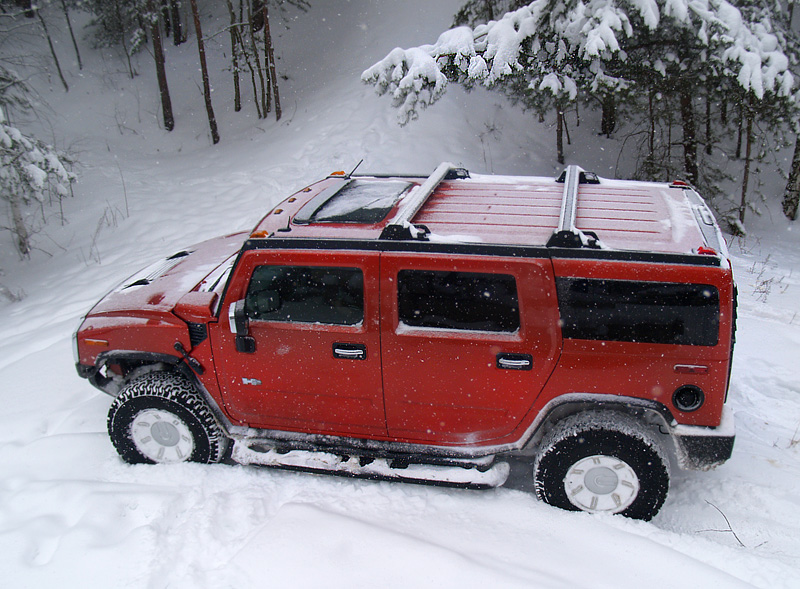
  The idea to take a ride in the Hummer was suggested by my colleague, who proposed we enter his "Showdown." We perfectly understood that we were participating in such an event for the first time and were unlikely to become winners, so we chose the Hummer for our appearance — if we don't win, at least they'll remember us. The plan worked, and now the bright brick-colored SUV is parked under my window, gradually turning into a snowdrift. Tomorrow is Saturday, but the wake-up call is early: a busy workday lies ahead, so I'll go to bed early.
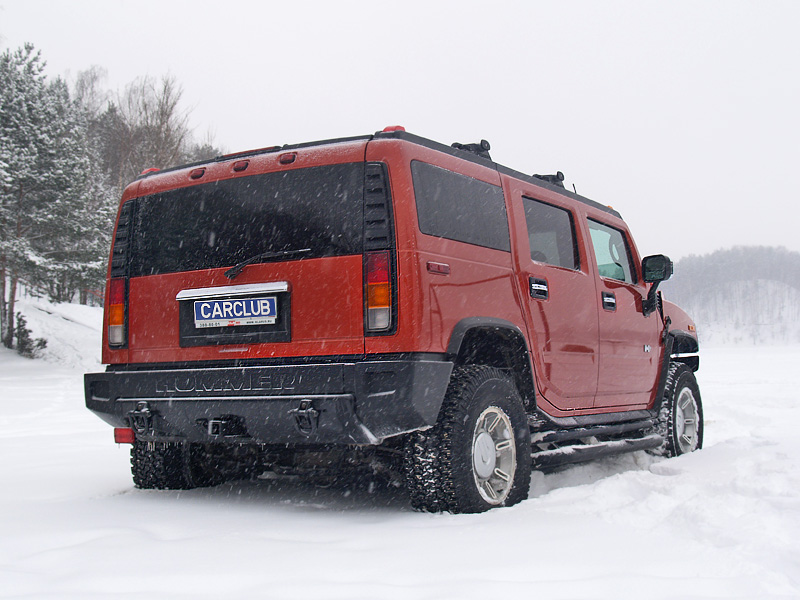
I agreed to meet the photographer at nine in the morning — photographing such a giant in the city is pointless; it's too cramped there. So we headed out of town to a sand quarry. The first surprise from meeting the Hummer happened when I pulled the driver's door: due to its shape, a whole pile of snow pours from the roof into the cabin, and you can't shake it off in advance — the top is over two meters high, and the brush won't reach until you open the door. Good thing the seats are leather — the snow is easy to brush back outside. Inside, the feelings are mixed: the body is very wide, and this is emphasized by the massive center console with bolts sticking out. But if you look around, you notice that the ceiling isn't as high as it seems from outside, and the narrow windshield with tiny wipers reminds you of a "Zhiguli." The rear sofa is more like a bench covered in leather, where three or even four people can sit comfortably if they're not too tall. Another "seat" is hidden in the back, next to the spare tire in a fleece cover, but getting there is uncomfortable: your knees end up at chest level, like in some kind of solitary confinement. It's unclear why it's needed, but it eats up the already small trunk. To carry anything useful in the Hummer, you'll have to fold or completely remove the rear row, and secure the spare tire on the tailgate or roof — for the aerodynamics of a "brick," that's not a problem, but the space for cargo will noticeably increase. From time to time, the sound of the air compressor working can be heard from the trunk, which pumps up the rear suspension. Formally, it should add comfort, but in reality, the effect is almost imperceptible. However, the compressor has a fitting for inflating tires — convenient off-road when you need to let air out on loose ground. But we'll get to the fields and forests yet, and for now, I'm pulling out of the parking lot.
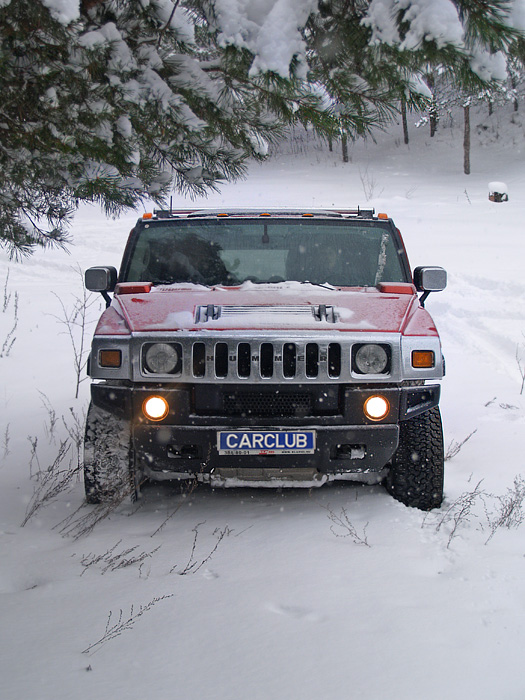
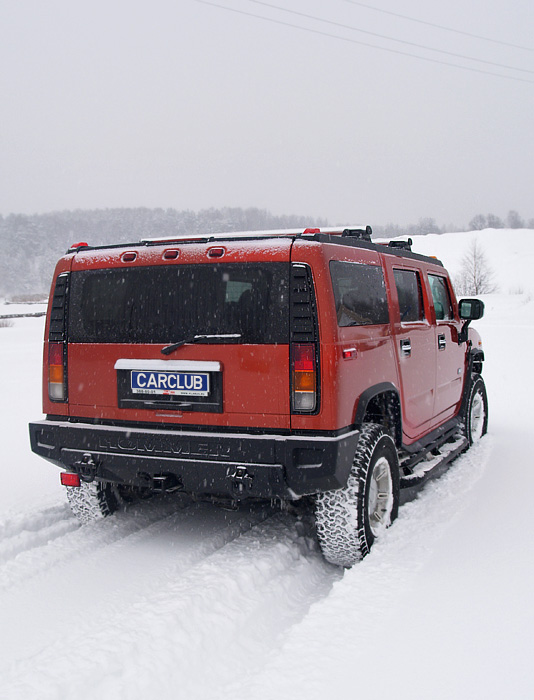
Driving the Hummer in the city turned out to be difficult, but not physically, rather morally — the steering wheel turns easily, even with one finger, but it's unclear whether there's an airbag in its small hub. Just in case... And the weight of responsibility for those around you constantly presses down. The high seating position and three tons of weight will protect you in almost any accident, unless, of course, you encounter a KamAZ. But what will happen to someone who accidentally ends up under the wheels is something you don't want to think about. The responsibility is heightened by poor visibility: the large side mirrors are positioned too low to show what's happening right next to the vehicle. Such a monster needs mirrors like a truck's — convex, higher, and wider. In traffic, it's easy to miss a car on the right: you can't see it in the mirror, and its roof is lower than the Hummer's window line. To avoid hitting anyone, you have to constantly turn your head and monitor the situation. It's better to change lanes as rarely as possible. After the test, I noticed that Hummer owners usually drive straight and almost always in the left lane, occasionally flashing their headlights and urging slow drivers on — and it's not about stubbornness, but about how hard each lane change is. To part the traffic flow, you don't need xenon headlights (those can be installed on anything for two hundred dollars) or "flashing lights" — they're not visible on the roof anyway. A massive chrome radiator grille is enough, which, although plastic, sits at the level of the rear window of passenger cars. And for extra effect, you can turn on the string of yellow lights on the roof. On the way into the city, we were stopped twice by traffic police officers, even though we were driving calmly and not touching anyone. Once they tried to pin a violation on us that didn't happen, but when they saw our journalist credentials and realized we weren't going to pay a fine on the spot, they let us go.
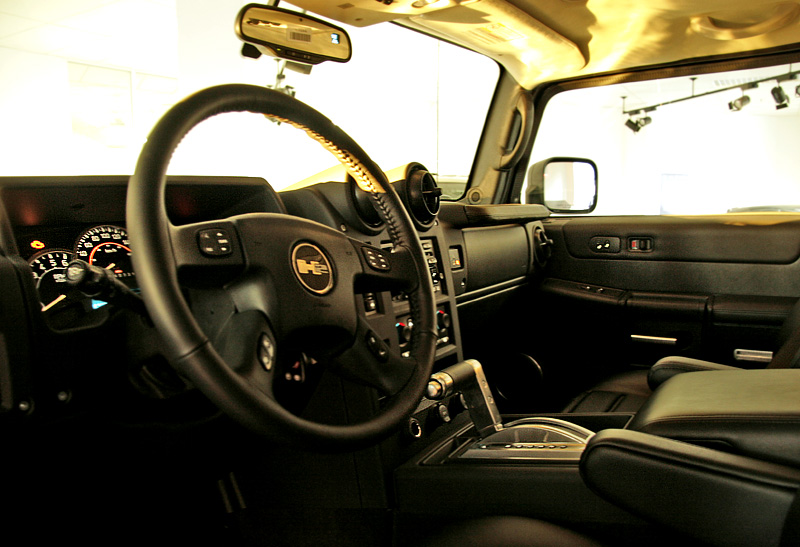
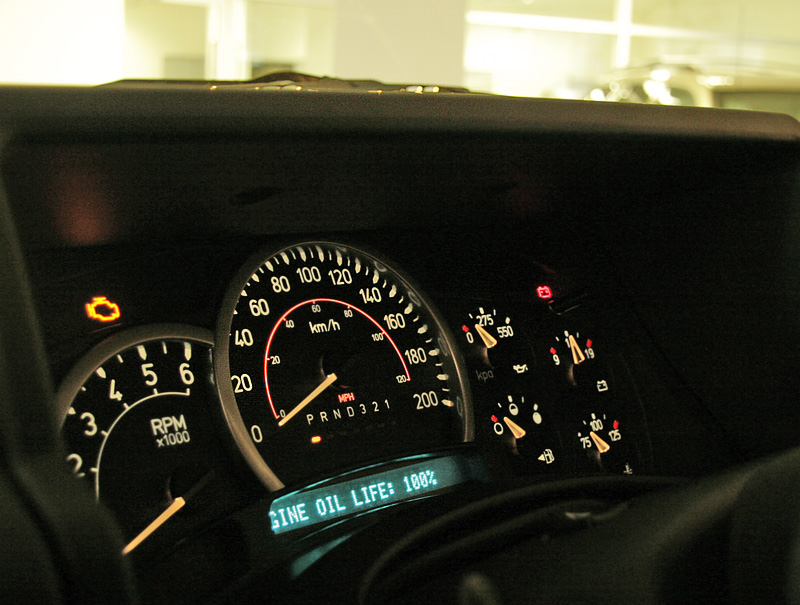
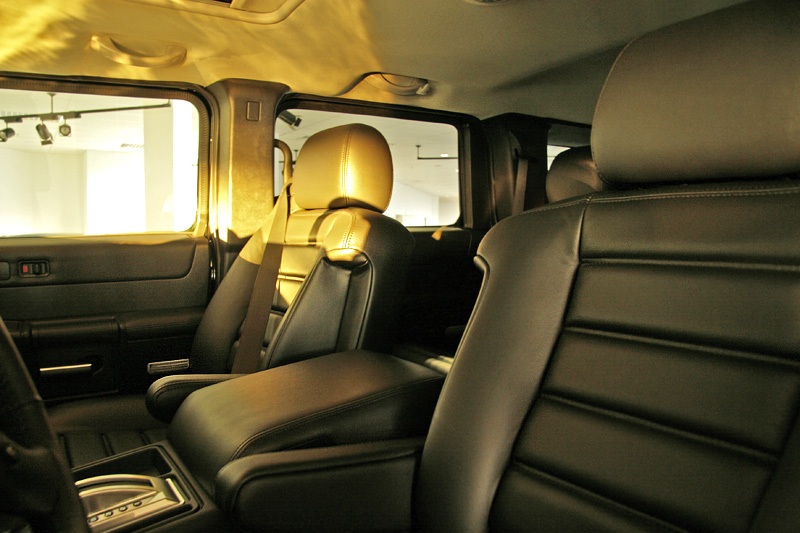
Outside the city, the Hummer H2 feels noticeably more confident — the enormous size stops weighing on your psyche. Caution is only needed when passing a truck or another Hummer on a narrow road, but if necessary, you can safely pull the right wheels onto the shoulder. At the same time, the agility with which the three-ton SUV started in the city, overtaking almost everyone, hasn't disappeared on the highway either, but only up to 150 km/h. Beyond that, the car hits an air wall and accelerates with obvious reluctance. If you glance at the onboard computer at that moment, you'll feel uneasy: fuel consumption exceeds 50 liters per hundred kilometers. At a calm 100 km/h, the appetite drops to a "modest" 15 liters. Over the entire test, the computer showed 28 liters — well, nothing else was expected from a car with a 6-liter engine and a complete lack of aerodynamics. No car we've had has burned that much fuel, and the only consolation is that you can fill the tank with 92-octane or even 76-octane gasoline, although we wouldn't risk it. But enough about economy — it's unlikely that buyers of such cars care about it. Especially since the 120-liter tank allows you not to think about refueling too often.
Otherwise, on the highway, the "second" Hummer behaves predictably and understandably. Wide tires and an archaic worm steering mechanism force you to slightly correct the steering on a straight line, but you quickly get used to it. It feels like you're driving a "Gazelle" (their dimensions are similar, although the Hummer subjectively seems much larger), but with an engine from a Ferrari or Lamborghini. Remember, the Italians produced a similar car with a 400-horsepower engine in the early nineties — that's probably what can be considered the progenitor of the H2. After a passenger car, the most annoying thing in the Hummer is the delayed response to steering input: on a turnaround loop, you turn the wheel, wait half a second, and wonder where the car will go. The desire to drive recklessly completely disappears, especially since our car was on knobby but summer tires (finding others for the Hummer is extremely difficult), so we had to be especially careful in corners. Fast driving is also not helped by the complete lack of steering feedback — you can only guess about the start of a slide of the three-ton beast when it has already drifted half a lane outward on a curve.
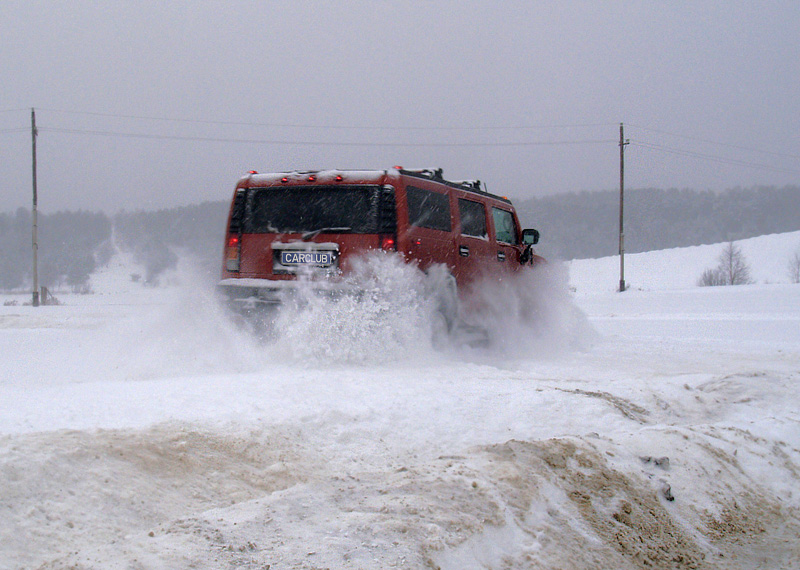
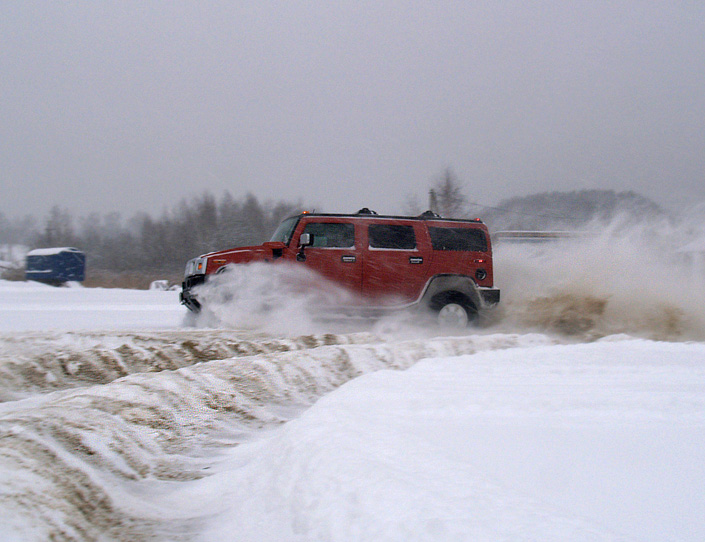
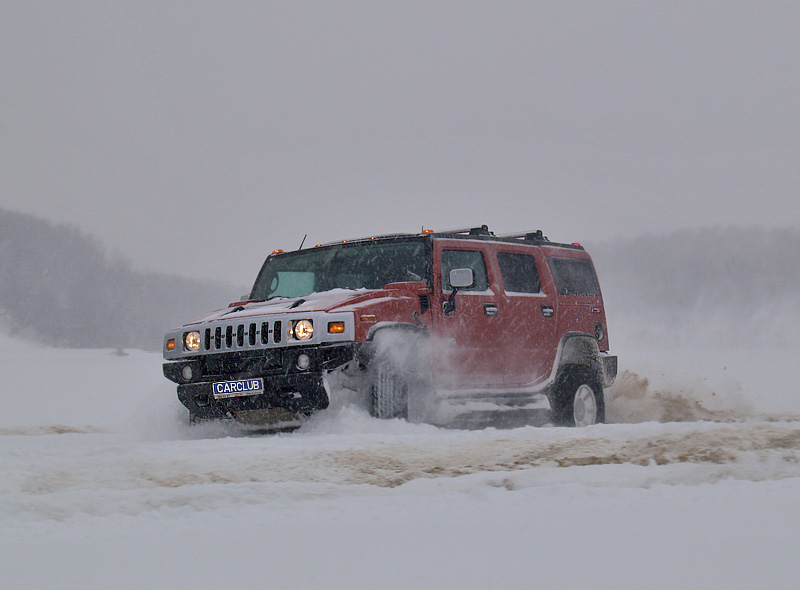
While driving, another characteristic feature of the Hummer emerged — the massive knobby tires actively collect water and mud, causing the SUV to quickly splatter not only its own sides but also the side windows and mirrors. So you have to stop from time to time to wipe them off, or drive almost blind. When we arrived at the shooting location, a new snag arose — the H2 doesn't fit into every car wash: either the opening is too narrow or the ceiling is too low. True, this only applies to country car washes; in the capital, they willingly accept Hummers and usually charge double, citing the complex body shape.
Finally, we made it to the quarry. Because of the overnight snowfall, we leave the asphalt cautiously — pulling out a deeply stuck Hummer is likely beyond even many tractors. Maybe we should immediately lock the center differential or engage low range to also activate the rear lock? Fortunately, all these manipulations are done with buttons on the angular center console. First, we decided to try without off-road tricks — that way there's a chance to get out on our own if we do get stuck. Result: after two hours of persistent attempts, we failed to get the H2 stuck for good, at least on frozen ground and knee-deep snow. All we achieved was getting wet and cold while measuring the depth of the snowdrifts. The SUV sometimes spun its wheels a bit, throwing snow from under itself like a grader, but never gave up. For fun, we engaged the center differential lock, but with it, the H2 only responded slightly worse to the steering, while acceleration remained about the same. After all, even in standard mode, torque is constantly sent to both axles. The locks truly came in handy only during the diagonal articulation test: the rear wheel hung in the air when the front one lifted about half a meter, but the H2 was ready to keep going until wheel traction ran out or the vehicle tipped over. The ground clearance also impressed — with such ride height, you can safely follow truck ruts, and if necessary, pave the way with the skid plate; it seems nothing fazes it.
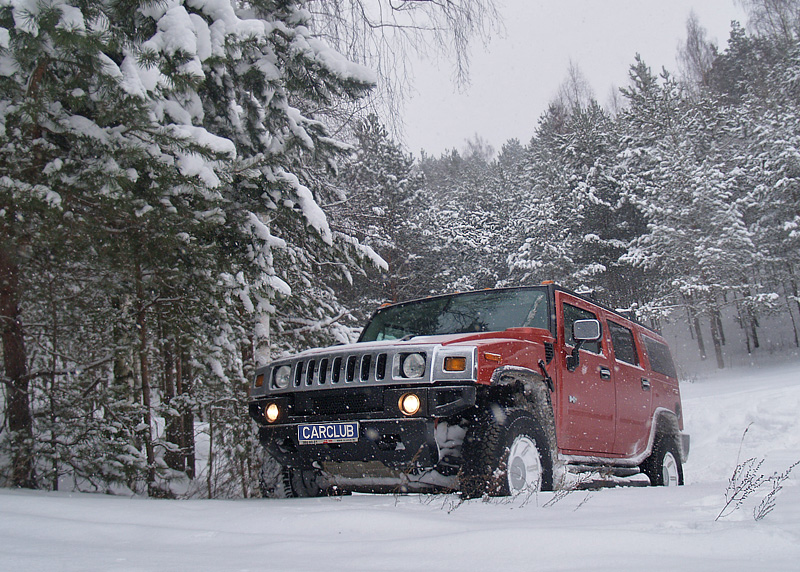
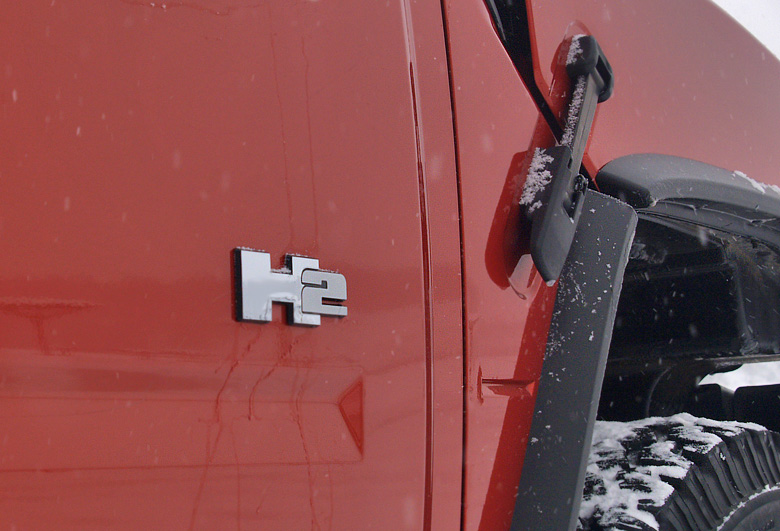
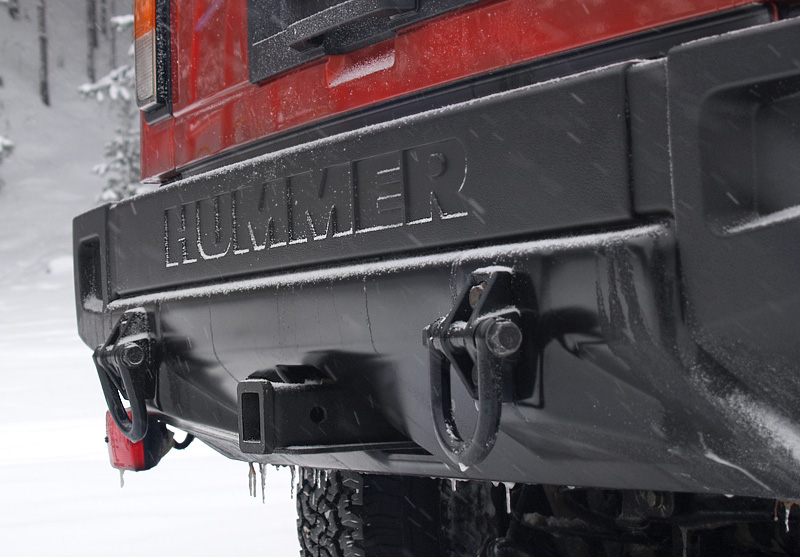
Probably, the Hummer is the first car in my practice that I truly didn't want to leave the quarry in. On vast expanses — be it sand or snow — it's its true element. Here, its rough appearance and angry engine roar blend in harmony with wild nature, and you start to truly enjoy driving and understand what this machine was really made for. Let marketers talk as much as they want about showbiz stars and various David Beckhams supposedly targeted by this car, the Hummer, even the "second" one, is essentially a light military truck with a small dose of comfort and light adaptation for the city. Its true essence is revealed precisely off-road. By the way, the Hummer is almost the only production car in the world capable of covering a trophy raid distance without any preparation, never breaking down. Even the stock tires are perfect for storming any swamp.
Leonid Pavlov