
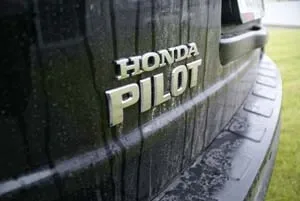
Honda Pilot
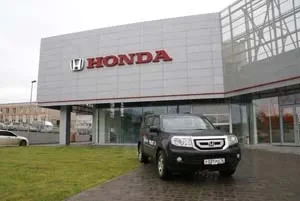
TOP-FLIGHT PILOTING
Engine — 3.5 L V6
Maximum power — 257 hp/5700 rpm
Maximum torque — 347 Nm/4800 rpm
Maximum speed — 180 km/h
Acceleration 0-100 km/h — 9.9 s
Fuel consumption (L/100 km):
city — 16.3
highway — 9.2
combined — 11.8
5-speed automatic transmission
Length — 4870 mm
Width — 1995 mm
Height — 1895 mm
Curb weight — 2107 kg
Tires 245/65R17
Ground clearance — 203 mm
All-wheel drive, ESP, Hill Start Assist, front parking sensors, rearview camera, immobilizer, 10 airbags, audio system with subwoofer, 3-zone climate control, light sensors, power seat, heated front and rear seats, fog lights, power sunroof, cruise control, humidity control system, compass
Price $50,626 (405,000 UAH) (maximum trim), base version — $47,251 (378,000 UAH)
Maintenance cost:
Service interval: 15000 km
Service 1 — 5100 RUB (3.4 standard hours)
Service 2 — 5100 RUB (3.4 standard hours)
Service 3 — 9000 RUB (6 standard hours)
Service 4 — 5100 RUB (3.4 standard hours)
Service 5 — 5100 RUB (3.4 standard hours)
Service 6 — 10500 RUB (7 standard hours)
Standard hour — $51 (405 UAH). Prices exclude parts
Warranty — 3 years or 100,000 km
Competitors:
Toyota Land Cruiser Prado
Nissan Pathfinder
Land Rover Discovery 3
Volvo XC90
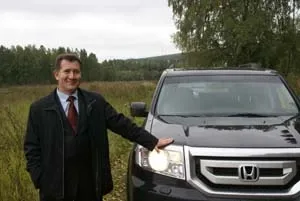
Marat Makhmutov, Deputy Director of the Kazan School of Advanced Driving
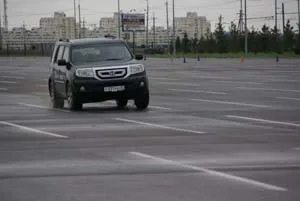
Of all the test drives I have participated in, this one was the most vivid and exciting. Let me start from the very beginning, which, as usual, happened on the asphalt area of our homemade race track. A huge black crossover the size of a Toyota Land Cruiser Prado was rolled out there — the Honda Pilot (in English the name is read as "Pilot", but for our ears "Pilot" is more familiar and melodious). Since the summer of this year, the Japanese decided to start selling this overgrown crossover in Russia as well, apparently considering that the American market is already saturated with the big brothers of the well-known CR-V.
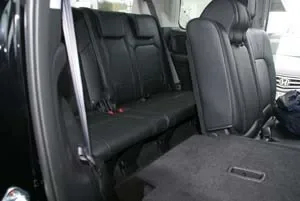
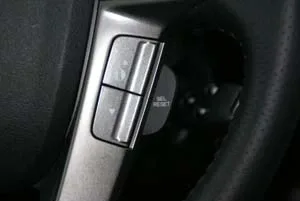
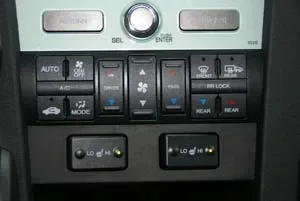
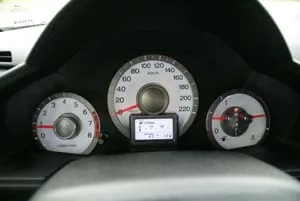
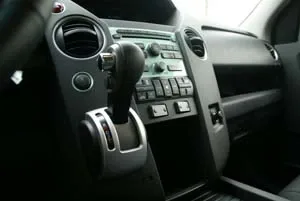
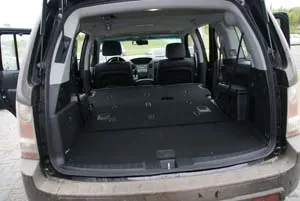
The Pilot's appearance is brutal and imposing: in profile, the body lines are straight but not chiseled, with noticeable wheel arch flares, and from the front and rear the car looks wide and squat — this is how the designers achieved stability at high speeds (more on that below). Large, almost rectangular headlights, between which a massive chrome grille is displayed, also emphasize solidity. Overall, the design commands respect. And what about the inside? As befits such a giant, there is ample space on the leather seats of the first two rows for five adult men, and on the third row, according to the developers, two more can sit comfortably. I wasn't going to check the passenger capacity of the trunk, so I won't claim anything. As for the second row and seating comfort — no questions, there is even excess space. The driver's seat is all luxurious and comfortable: the seat with many electric adjustments, including lumbar support, memory for two drivers, a wide armrest under the right hand, and between it and the central console, on the protrusion of which a small selector of the five-speed automatic transmission is perched, there is not just a niche for small items, but a real chest with a lid. The instrument panel — simple but perfectly readable white-blue round dials. One highlight: a rectangular display of the onboard computer, built exactly at "six o'clock" under the speedometer. Its control is on the right spoke of the steering wheel. I won't go into detail about the climate control and audio system with the central display — they are no better or worse than on other modern cars, nothing special. But the rearview camera screen built into the self-dimming rearview mirror is an interesting thing. Even though it doesn't have lines showing the trajectory, it performs its main task — showing the driver of a large car what is behind — properly. For the front dimensions, there is the usual ultrasonic parking sensor with a separate activation button. The only thing I can find fault with in the cabin is the trim plastic; it is somewhat plain for such a solid car.
To evaluate handling, dynamics, and brakes, we first headed to the asphalt test site. The three-and-a-half-liter engine with 257 hp and the proprietary I-VTEC system paired with a five-speed automatic gives the sizable car confident and assertive acceleration, but what impressed me most was navigating the high-speed slalom! It would seem that the high center of gravity, inevitable for a large SUV, should strictly limit the maneuver speed, but no — the Pilot, with the composure of a fighter jet, allowed us to weave around cones so quickly that with each attempt we increased the pace, feeling that the car was capable of even more. Usually, the director of our school calmly observed such tests from the sidelines, secretly believing he could do better himself. But here, during another slalom pass (I was at the wheel), he couldn't resist and asked to take the wheel himself — so impressed was he by the phenomenal stability of this large crossover. None of us doubted that the "director's" speed would be higher than ours, and at the end, Oleg Yuryevich additionally spectacularly "drifted" in this car. I last saw such childish enthusiasm in his eyes at the beginning of summer, at a training session with the Porsche Carrera and Porsche Cayman, which, after all, are from a completely different class. Well, kudos to the Honda folks — they endowed the Pilot with such driving qualities!
Speed and handling are great, but this is an off-road-capable vehicle, so it would be a sin not to test its off-road talents. After indulging in high-speed maneuvers, we headed to a section with complex terrain that we had long since tested. For backup, a real body-on-frame SUV, the Nissan Terrano, came with us — with a turbodiesel, manual transmission, and transfer case, plus a tow rope and rubber boots in the trunk. How the Honda behaves on the asphalt track, I think others will tell, because in this part of the test I was studying the rear passenger seats: I noted separate climate control adjustment and rear seat heating, as well as sunshades on the rear windows. It was warm, dry, nothing shook (the lower arms are aluminum), and the engine at 150 km/h ran absolutely quietly (please don't judge strictly — it was a test after all), so we talked on the road without raising our voices. Oh yes, I forgot to mention: the engine can deactivate cylinders — during steady motion, two or even three of the six cylinders automatically shut off to save fuel, signaled by the "ECO" light on the instrument panel.
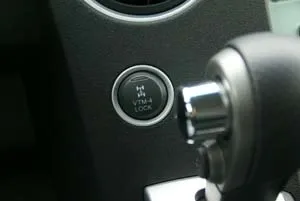
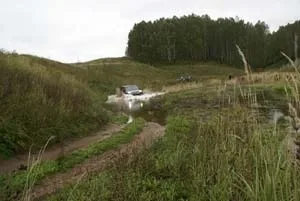
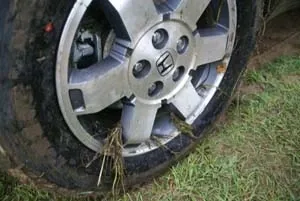
So we finally made it to the mud testing ground. Fortunately, it had been raining nonstop those days, so the off-road track was thoroughly churned up. I knew in advance that the SUV test would include such trials. I should have worn tall rubber boots and old jeans with a sweater, or better yet, a hunting suit — but no, that day I was wearing a business suit and half-boots, which I later paid for when I got stuck in a rut. And at first everything went smoothly: I calmly drove behind the Nissan along the bottom of the ravine, then without delay conquered a more difficult muddy section, and on the way out of it I landed in that very treacherous waterlogged rut, which was completely invisible from the driver's seat due to the grass. After spinning the wheels a bit (and of all the off-road gadgets, the Pilot only has a button for forcibly locking the center differential), I realized I wouldn't get out on my own. And then it began! Alfred was gleefully rubbing his hands, recalling how I had teased him when he beached the Tager, and Shatov, while pulling boots and a tow strap from the trunk of his Nissan, made sarcastic remarks at my expense: like, I'd be sitting here in a suit and patent leather shoes while he had to wade into the mud. I tried to get out of the car, but it was stuck in the rut with such a tilt to the left that opening the driver's door without damage was impossible. Sarcastic comments rained down, like "The sunroof is big, you can climb out through it." I admit, I was dressed inappropriately, and the fault for the car getting stuck is clearly mine (I should have realized this isn't a full-fledged off-roader!), so a huge thank you to everyone who saved me from having to dig in the mud and attach the tow strap to the recovery vehicle. By the way, at the rear of the Honda there's a fixed towing device like a tow bar, so the strap was attached directly to it. However, pulling the car up the slope didn't work — the tow vehicle itself was spinning its wheels, so we had to screw the tow hook into the hole in the front bumper and yank the "Pilot" sideways and downward, and only then did we manage to free it from the mud trap. I unscrewed the hook and disconnected the strap myself — my conscience got the better of me. I didn't dare test the crossover further off-road; the director himself took over, driving the car through the water at the edge of the swamp and then climbing a fairly steep muddy incline. Our subject handled all these tasks brilliantly. Spectacularly, like a speedboat, it pushed a wave with its front bumper and climbed the slippery muddy slope with apparent ease. But even here there were adventures: during the water procedures, the front license plate fell off and was lost; we searched for it and only found it the next day. At the end of the test drive, we returned "to base" dirty, mud-splattered, with the front plate missing, replaced by dangling scraps of swamp vegetation, cheerful and satisfied, full of emotions from the off-road part of the trials, and from the car as a whole, which I personally definitely liked very much. Good luck on the Russian market, Pilot!
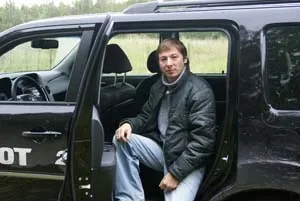
Alfred Mardanov, Avtoklub-Kazan newspaper
I first saw this car at the Moscow Auto Show, which took place at the end of August this year. The Pilot was so popular among visitors that it was simply impossible to get close to it. I had to settle for just admiring its exterior, and that was it!.. And the look, I must say, is impressive — this muscleman would have taken far from last place in a bodybuilding competition. A brutal guy with a pumped chest, biceps, and back, what can I say. I really like the strict rectangular shapes that leave no doubt about the car's gender, no unisex. I arrived at the Honda dealership for the car a bit earlier than Vadim, and that time was enough for me to literally fall in love with the Pilot. By the time Vadim arrived, I was already running around the car with eyes bulging with happiness and clicking my camera. Such are the whims of fate: the car I liked so much didn't fit me in size. I'm too narrow and skinny for it; I can't even reach its armrests with my elbows.
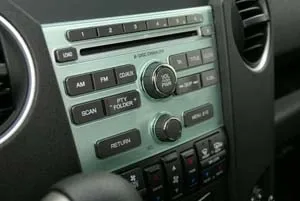
It's clearly made for a solid audience, not for skinny guys like me. The spaciousness of the cabin simply scares me; you could summon an echo! The cabin, the cabin, just a great cabin! True, the gearshift lever, or rather not the lever itself, but the gear shifting process, I didn't like. I'd prefer a mechanism with H-pattern movements, not such a straight-line one as here — you need to watch to get into the right position. Also, the color of the stereo panel bothers me; it strongly resembles the trim color of the Toyota Camry and Verso. Otherwise, I have no complaints, only positive emotions. Never mind me, look how happy others are!!!!!!!!!! And as for what happened, you already know, and to those responses I can add, in general, not much. Yes, I was the first to test its off-road capabilities, and I must note, the rear end swayed so much that the whole body sometimes literally turned sideways across the road, which was especially unpleasant during climbs. This trait of the car was noticeable further on, apparently due to the long wheelbase and fairly powerful engine! And so, I managed to capture the astonished and joyful face of Mr. Shatov after he stormed the height that he had only conquered on his Terrano on the ninth attempt! Yeah, the Pilot that day simply dazzled and shocked us, and not only that day. We were still impressed the next day when we were looking for the lost license plate. We couldn't do without waist-high swamp boots, and we had driven there yesterday!
I wonder what its wading depth is (where we found the plate, it was very deep!). I remember how we dove in there, engaged reverse gear, and drove out as if nothing had happened. Fantastic!!! It's a swamp!!! Oleg Shatov flatly refused to leave until, I quote: "I splash into this swamp in my Nissan." He splashed, and I must say, his Terrano overcame the obstacle more confidently; there was none of that rear-end swaying I mentioned, and apparently, that's a signature trait of the Pilot. Well, the off-road part is clear, let's go, buddy, to the highway, show what your herd of horses under the hood and the 5-speed automatic can do. I won't go into details, I'll say briefly — great. It pulls confidently, and at the same time, it feels like it's not really straining; there's enough power for confident overtaking and "shots" from a standstill. What kind of manners are these?! On the serpentine, it behaves like a grass snake, off-road — like a rhinoceros, on the highway — like a cheetah. Yeah, these are modern Honda technologies. I involuntarily recalled the famous humanoid Honda robot Asimo, first presented to the Russian public at the aforementioned auto show. I was shocked by what I saw; it felt like the future from sci-fi movies is unfolding before our eyes. In terms of comfort, the suspension responds very nervously to bumps only if it's a very serious bump, but the sound insulation is top-notch. Vadim, talking on the phone while driving at 160 km/h (we accidentally glanced at the speedometer), made much more noise than the engine and the air masses outside. Alas, we didn't measure the average fuel consumption; I, scrolling through the computer readings, saw that the readings corresponded to a consumption of 17.3 liters per 100 km. Considering the fact that on test cars, the accelerator pedal isn't treated with much ceremony, the result is quite decent. Slowly and sadly, Vadim and I roll to the dealership, a bit sad to part with this car, but there's nothing to be done. I can imagine the faces now when they see the car splattered with mud, including the roof. And it even suits it, and driving it in that state isn't embarrassing at all.
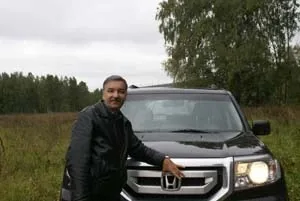
Vadim Sadykov, Avtoklub-Kazan
For the whole week after the Pilot test drive, I did nothing but enthusiastically tell my acquaintances about the car. I suppose Marat and Alfred will also praise the car to the skies, so I decided to take on the thankless task of finding the downsides. Let's begin.
The first impression — wow, it's huge! Clearly too big for my build. And it's twofold: both when standing outside and when sitting inside. Perhaps that's a minus. Although it's unclear to whom: the car or my build, which doesn't reach 100 kg of live weight. Now we sit behind the wheel and try to assess the quality of the trim materials: it's good here, and there. Aha, but the plastic on the doors is clearly hard and cheap. I wonder at what mileage it will start to squeak? We move to the back seat. Everything seems great: there's seat heating and climate control (temperature, direction, and intensity of air flows). But for some reason, there's no stereo control. Surely the boss will sit in the front seat or, God forbid, behind the wheel? The ride revealed another minus: you get more motion sickness in the back than in the front.
Not enough minuses are adding up.
Perhaps, it's worth starting with criticism of the engine and five-speed automatic transmission combination. The final drive ratio here is 4.3, a fairly high figure. Usually, such a solution makes the car lively and allows to bring gear ratios closer together. This, as usual, has two sides to the coin. On one hand, acceleration becomes smoother: when shifting up, the RPMs don't have time to drop significantly. On the other hand, each gear hits a relatively low speed ceiling, meaning the gearbox is forced to shift through gears more often. Ideally, gear ratios are selected so that after an upshift, the RPMs drop from the maximum power zone (usually 6000 rpm) to the torque peak (most often around 4000). Then acceleration is most effective. But, as practice shows, five gears—whether manual or automatic—are almost always not enough to fully comply with this rule. Most often, a compromise is made when shifting from first to second, where RPMs drop from 6000 to 3300–3800. Why am I leading to all this theory? Because during the test, I noticed that the car accelerates from a standstill not as briskly as in third or fourth gear. Obviously, a sixth gear is missing here. Let's check my suspicions with numbers. The situation is aggravated by the engine itself: the power peak is at 5700 rpm, and maximum torque at 4800. The gap between these points is too small. It's already clear that RPMs during upshifts will be below the ideal 4800. Let's calculate: from first to second—3400, from second to third—3800, from third to fourth—4070, from fourth to fifth—4560. Everything adds up: on lower gears, acceleration indeed lags. If there were a six-speed gearbox here, all values could be raised above 4000. But alas—we have what we have.
Now a few words about the engine itself. It is, without a doubt, magnificent—a 3.5-liter V-shaped "six." In economy mode, when the green ECO indicator lights up on the dashboard, only four cylinders operate. But this comes at the cost of a slight delay when pressing the gas pedal when exiting this mode.
And yet, I cannot remain silent about the main advantages. The handling is such that many sedans would envy it. And after all, the Pilot is a huge SUV with a ground clearance of 203 mm! It would seem that if such refined handling is achieved, then comfort and off-road potential should be sacrificed. But no. The car handles small potholes and bumps surprisingly softly. And as for off-road capability—this car will give many rivals a run for their money.
Perhaps I am mistaken, but I'll say it as it is: in my opinion, this is the best car in the class of large SUVs. Somewhere, maybe, there are cars that are better in one aspect—comfort, ride, or off-road capability. But if you evaluate the combination of all these qualities, the Pilot is an undeniable leader. Especially if you recall the price: 1,400 thousand rubles for the base version and 1,500 for the top one.