
Now it's fashionable to bring American cars to our market! Sales overseas are falling, while our market is growing by leaps and bounds. That's why the Honda Pilot is launching in Russia at the same time as the Mazda CX-9: both new models will be shown at the Moscow Auto Show in August. Both are large crossovers, both come from America. How can one resist comparing them? True, the Honda costs less — from 1,400,000 rubles. And, unlike the Mazda, it has heated second-row seats, a power tailgate, and a rearview camera...
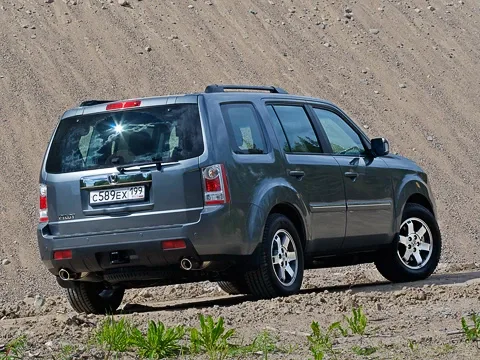
The decision to sell the Pilot in Russia was made two years ago — when the model was being prepared for production. And adaptation was thought out right away: the optics were changed, a headlight washer was added, and the engine was recalibrated for cold starts. In addition, the Pilot is sold in Canada, Mexico, Latin American countries, and Ukraine.
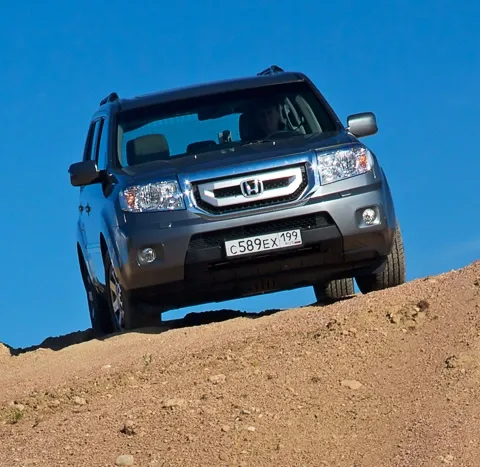
But there's no striking individuality. Whether it's a Nissan, a Ford, or something else... A massive but straightforward car. Remove the flashy grille and badges — what's left? Just bulk. "Appreciate the aggression of the design," they ask us. The mosquitoes appreciated it. And they recognized their death only by the emblem: "Oh, Hon..." Splat!
But you're not paying only for looks. And the best of Honda is inside. A large steering wheel, big instrument dials, the automatic gearshift lever on the console, the console itself — pale blue, with tiers of buttons, the black abyss of the information display with tiny star-like symbols. The interior lacks a bit of coherence, but you don't feel like a separate element: the driver's seat has a wide range of adjustments, and it's easy to find a comfortable position.
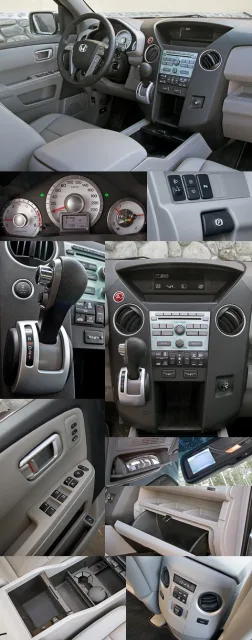
- Alabama assembly didn't harm the cabin. But there are quite a few various bulges, flows, and sharp joints. And the large buttons on the console are placed so densely that they merge into one whole.
- The automatic selector lies very conveniently, right under your hand.
- An original solution: the rearview camera image is displayed on the rearview mirror. A panoramic reflector in the glasses holder — to keep an eye on passengers.
- The number of compartments, pockets, and cubbies is impressive. It seems you could take a whole Honda scooter apart and carry it with you.
Unlike the Mazda, the Honda has seat belts for eight! But in the third row, only two people of average height are comfortable, while tall ones sit like grasshoppers, knees spread wide. And the Honda folks' mention of a picnic by the roadside suggests not a friendly barbecue, but the hard life of a stalker. And where to put the luggage? To fit our bags and the "lunch control" (a basket of provisions), we had to fold the third row.
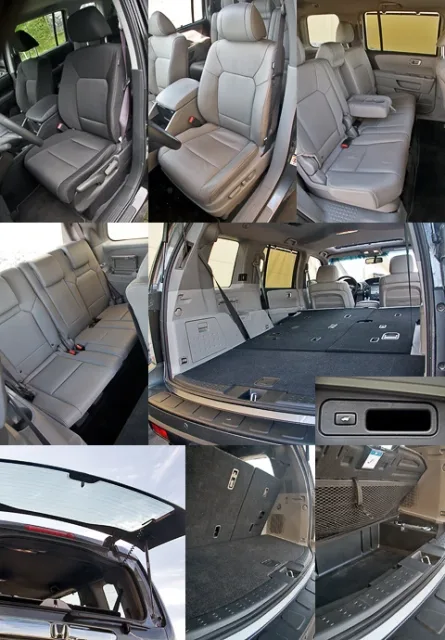
- The profile of the "manual" seats with combined upholstery is better than that of the fully leather ones with power adjustments.
- Production flexibility doesn't allow Honda to offer us the third row as an option. "But for that money," say the Honda folks, "the third row comes as a bonus."
- The tailgate is equipped with a sluggish power drive. If you can't wait, you can open only the rear window.
Technically, the Pilot is more intricate than the CX-9. The ten-year-old V6 3.5 engine is equipped with a function to deactivate two or three cylinders. The all-wheel drive is a bit more complex: there's a forced clutch lock and a hill-start assist system. But the Japanese are categorical: the Pilot is not an off-roader. The resemblance is formal. Consider our crossover, they say, as an alternative to business sedans. For example, if you've outgrown your Accord... How much would you have to eat to get that big?
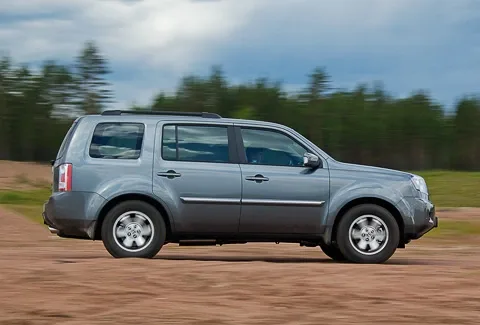
What's not visible in the striking photo is how it shakes us on bumps and rocks us on gentle waves.
In exchange for size, you'll have to sacrifice the "Honda feeling." In the engine's voice, muffled by sound insulation, you can't discern nuances. On a short stretch of good highway, the smooth and powerful engine accelerates the Pilot inexorably, like a locomotive. But there are no shades in the dynamics. The Pilot perceives attempts to play with the gas pedal as inappropriate fuss. The five-speed automatic is tuned for smooth, comfortable driving and downshifts only after an explicit "shout": pedal to the floor, a kick-down pause — and intense acceleration. The more enthusiastic can drop the gearbox two gears at once with the overdrive button. But that doesn't add thrills. The deactivation and activation of cylinders are imperceptible: no wonder Honda engineers fought so hard against vibrations and noises. The only hint that some cylinders are out is the Eco light, indicating the most economical mode. But it only comes on when you release the gas while driving.
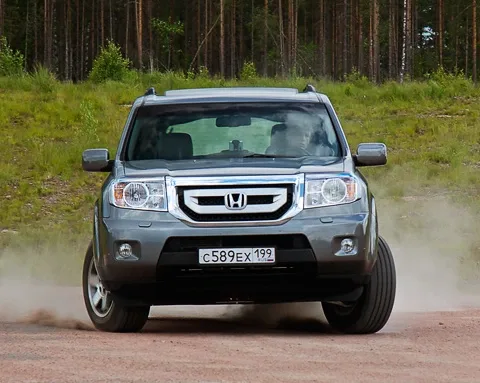
On a steep turn sprinkled with sand, even with the stability control on, the Pilot manages to drift outward. But it doesn't lean much.
Sharpness, agility — that's not about the Pilot at all. The suspension rocks the body up and down softly, American-style. The steering wheel has an almost indistinguishable "center" and permanently uninformative effort. However, in a corner, the Pilot holds its line better and leans much less than you'd expect. The brakes are good too. But in the end, you want to find the most important button somewhere — to turn on the autopilot.
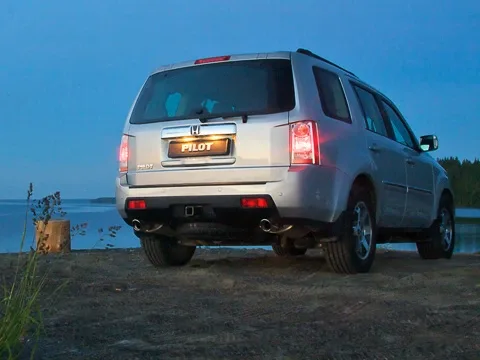
Most roads in Karelia are terrible. On broken, battered asphalt, those sitting in front grit their teeth. The Pilot is simply not ready for such horrors: the steering wheel jerks in your hands, the suspension makes noise trying to preserve the remnants of car-like comfort, and constantly bottoms out on the bump stops. Meanwhile, the body continues to rock up and down — people in the second row regret having breakfast. On winding, packed dirt roads, the crossover is calmer, although there it stubbornly understeers, and if it does tuck in on lift-off, it's with a long delay. And we didn't dare venture onto serious off-road, fearing to overheat the clutch and get stuck — where would we go for a tractor? And you shouldn't expect such feats from a Yankee crossover.
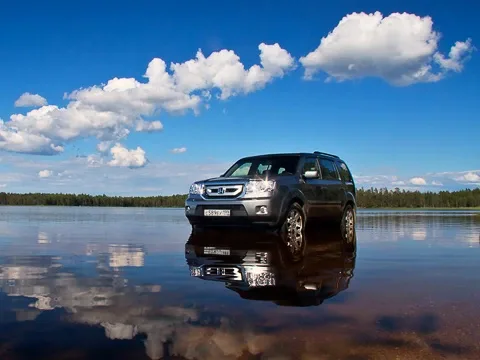
Forget about off-road. And about aerobatics. The Pilot is a spacious, very comfortable, and well-equipped... cabin. Consider the big Honda as a motorized solution to the housing issue. Watching how cozy we are inside, the midges pound on the windows with doubled force. And we, never finding the coveted autopilot button, spend a long time gathering the life-saving spray cans from the cubbies, pockets, and cup holders.
Specifications
| Specifications | Honda Pilot |
|---|---|
| Body | |
| Number of doors/seats | 5/8 |
| Length, mm | 4870 |
| Width, mm | 1995 |
| Height, mm | 1845 |
| Wheelbase, mm | 2780 |
| Track front/rear, mm | 1725/1740 |
| Curb weight, kg | 2048 |
| Gross weight, kg | 2765 |
| Trunk volume, l | 588 |
| Engine | |
| Type | petrol |
| Location | front, transverse |
| Number and arrangement of cylinders | 6, V-shaped |
| Number of valves | 24 |
| Displacement, cm3 | 3471 |
| Max. power, hp | 257/5700 |
| Max. torque, N•m/rpm | 347/4800 |
| Transmission | |
| Gearbox | automatic, 5-speed |
| Drive | all-wheel, with electromagnetic clutch in rear-wheel drive |
| Chassis | |
| Front suspension | independent, coil spring, McPherson |
| Rear suspension | independent, coil spring, multi-link |
| Front brakes | disc, ventilated |
| Rear brakes | disc |
| Ground clearance, mm | 200 |
| Performance characteristics | |
| Maximum speed, km/h | 180 |
| Acceleration time 0–100 km/h, s | 9.9 |
| Fuel consumption, l/100 km | |
| — urban cycle | 16.3 |
| — suburban cycle | 9.2 |
| — combined cycle | 11.8 |
| Toxicity standard | Euro-4 |
| Fuel tank capacity, l | 79.5 |
| Fuel | AI-92-95 |
Trim levels
| Trim name | Elegance | Executive |
|---|---|---|
| Standard equipment | ||
| ABS | + | + |
| VSA stability control system | + | + |
| Airbags (10) | + | + |
| Hill Start Assist system | + | + |
| Immobilizer | + | + |
| Central locking | + | + |
| Climate control (tri-zone) | + | + |
| Leather upholstery | - | + |
| Combined upholstery (fabric + leather) | + | - |
| Leather steering wheel | - | + |
| Power sunroof | - | + |
| Power-folding and heated side mirrors | + | + |
| Power windows | + | + |
| Heated front seats | + | + |
| Heated second-row seats | + | + |
| Power-adjustable front seats | - | + |
| Driver's seat memory | - | + |
| Power tailgate | - | + |
| Light sensor | + | + |
| Headlight washer | + | + |
| Fog lights | + | - |
| Parking sensors | - | + |
| Rearview camera | - | + |
| Cruise control | + | + |
| Audio system with MP3 support | + | + |
| CD changer | + | + |
| 7 speakers | + | - |
| 9 speakers | - | + |
| Alloy wheels R17 | + | + |
| Full-size spare wheel | + | + |
| Additional equipment | ||
| Metallic paint | 10,000 rubles | |
| Trim price | 1,400,000 rubles ($59,574) | 1,500,000 rubles ($63,830) |
Technology
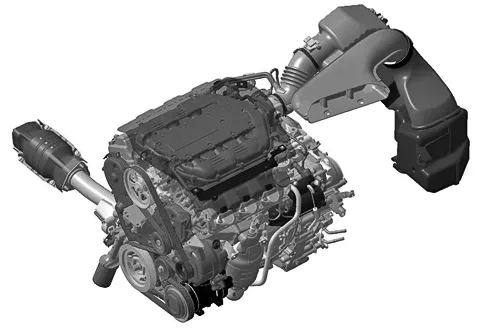
The six-cylinder 3.5-liter engine with i-VTEC is a veteran, but by 2008 Honda engineers reworked its cylinder deactivation system, called Variable Cylinder Management. VCM was first tested on the American Accord, then it moved to the Odyssey minivan, and now it has reached the Pilot. The new version of VCM differs from the previous one in that the hydraulic valve drive can shut off the mixture supply to either three cylinders or two.
According to the developers, all cylinders operate when the engine starts and during acceleration. When the driver releases the throttle or drives evenly at low and medium speeds, pressing the pedal a quarter, three cylinders are deactivated. Two cylinders are deactivated during steady driving at high speeds. The driver receives no information about mode switching — neither visual nor indirect, and that's good. The stealth of VCM operation is ensured by two auxiliary systems: Active Control Engine Mount (ACM) — an active engine mount that dampens vibrations, and Active Noise Control (ANC), which sends sound waves into the cabin in antiphase to engine noise.
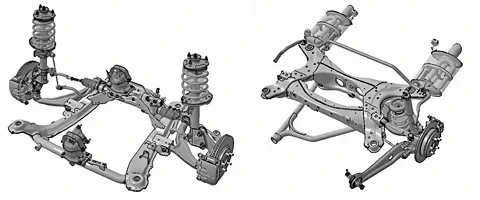
Both generations of Pilot are built on the Acura MDX platform. However, the MDX has a 3.7 V6 engine with 300 hp, a five-speed automatic with manual mode, active shock absorbers, and SH-AWD all-wheel drive. The Pilot has a simple electromagnetic clutch at the rear.
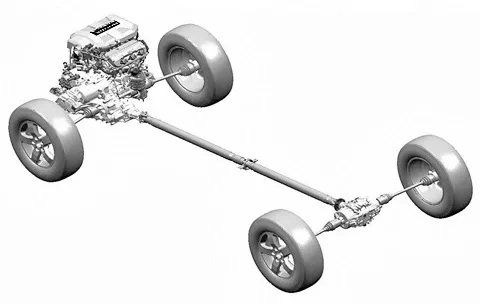
In normal mode, the Variable Torque Management 4-wheel-drive (VTM-4) system sends torque to the front axle. During acceleration or when the front wheels begin to slip, part of the torque goes to the rear. Full clutch lock is available only up to 30 km/h — after that it automatically disengages.
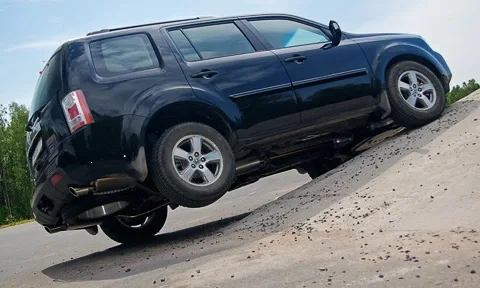
This system is not suitable for serious off-road: the rear wheels engage with a noticeable delay. Locking does not help when the wheels are hanging. Interestingly, in America the Pilot is also sold in front-wheel-drive version.
But the Hill Start Assist system pleasantly surprised. It maintains pressure in the brake system when starting on an incline, preventing the car from rolling backward. It is included in the standard equipment.
Design
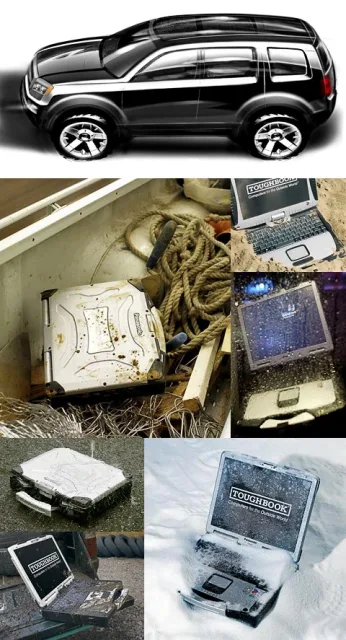
The designers claim they drew inspiration from the Panasonic Toughbook laptop, designed for extreme conditions. The Pilot's body is just as angular and straightforward. But extreme is not about this Honda.
Behind the scenes
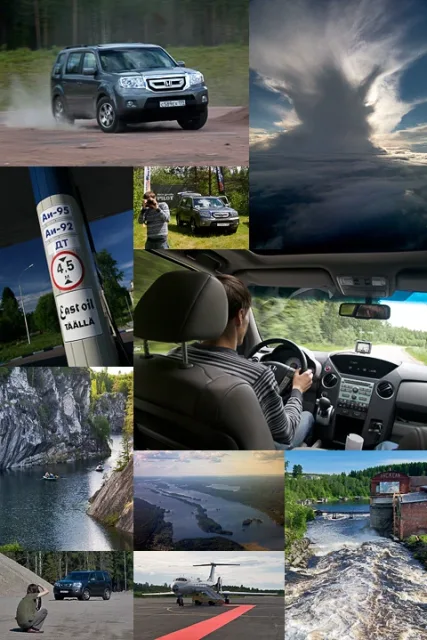
The organization of the Pilot presentation was at a European level: detailed route maps, compact navigators, checkpoints. And Karelia itself? The nature around Ladoga is mesmerizing. But this time the beauty took a back seat — the main focus was on the ruthless roads. However, it seems the situation is changing: we encountered convoys of dump trucks with crushed stone and embankments of new highways, along which rollers and asphalt pavers crawled.