Honda Legend
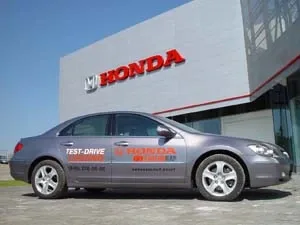
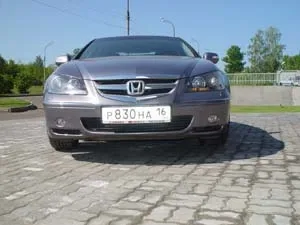
Japanese legend
Engine — 3.5 SOHC VTEC/V6
Max power — 295 hp/6200 rpm
Max torque — 351 Nm/5000 rpm
Max speed (km/h) — 250
Acceleration time
0-100 km/h — 7.3 sec.
Fuel consumption (l/100 km):
city — 17
highway — 8.9
combined — 11.9
Fuel tank capacity (l) 73
Drive — all-wheel drive SH-AWD
Wheelbase — 2800 mm
Length — 4955 mm
Width — 1845 mm
Height — 1450 mm
Curb weight — 1860 kg
Tire size — 235/50 R17 100W
A bit of history
Honda appeared in the late thirties as a manufacturer of components. The full name is Honda Motor Company (Honda Giken Kogyo KK). The company was founded by Soichiro Honda. Today Honda produces passenger cars, motorcycles, special equipment, and various engines. The headquarters is located in Tokyo.
In 1949, the company started with motorcycles. By 1959, just a decade later, Honda had overtaken even Harley-Davidson in motorcycle production and became the world leader. This success was ensured by competent development and production. At the same time, the American Honda Motor Company (Acura) division was opened in the USA.
Having established itself in the motorcycle market, the company decided to try its hand at automobile manufacturing. The first car appeared only in 1962, when a small sports model S360 S N was shown at the Tokyo Motor Show. Later, the S 600 was based on it, with exports starting in 1965. This series also served as the basis for sedans and the N series. Despite their elegant shapes, these cars did not gain popularity outside Japan.
Real success came to Honda with the appearance of the compact all-wheel-drive Civic. In the early seventies, the model was put into production, and it quickly gained popularity — largely due to a successful combination of price and quality. Four years later, the Accord was introduced, which was also highly appreciated. In the eighties, Honda strengthened its position by releasing the Prelude, Integra, and Legend.
The 2006 Legend received a 3.5-liter engine with 280 hp, an automatic transmission with manual mode, and SH-AWD all-wheel drive, which distributes torque among all four wheels depending on road grip at any given moment.
The Legend is also equipped with a lane-keeping assist system and adaptive cruise control, which automatically maintain the course and set pace.
All this is complemented by standard ABS, ESP, and a rich set of airbags. Let us remind you that the new Honda Legend is equipped with the most powerful 3.5-liter V6 with 24 valves in the brand's history, producing 295 hp, specially created for it. The Legend's toxicity is 75% lower than Japanese standards.
Among Japanese manufacturers, Honda is a pioneer: it often introduces technical innovations and is not afraid of competition with renowned brands. The Honda NSX sports car was a direct challenge to Ferrari. Every year Honda produces about 2 million cars, of which more than half a million are in the USA, about a hundred thousand in Canada and the UK. The brand's models are associated worldwide with the highest quality, durability, and comfort.
One of Honda's subsidiaries is Acura, which makes cars for America. The plant was opened in Ohio in 1982. Acura models belong to the executive class and claim a share of the American luxury market.
One of the main features of Honda cars is high-revving engines. Recently, the company has started producing power units with variable valve timing.
hondamycar.org

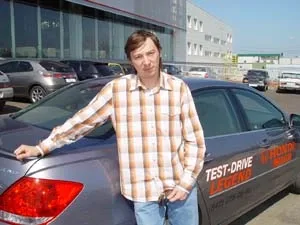
Amir Gatin, director of the company "Avtomakiyazh"
Finally, I am going on a test drive of a car that is completely new for Russia. As far as I know, Honda has not had such a model here yet. The Honda Motor concern has created an expensive car packed with the latest technical solutions — the Honda Legend. There is a new all-wheel-drive transmission and special torque distribution among the wheels. Plus a bunch of "gadgets" that make the car safe at high speeds and on steep serpentines. I do not want to delve into technical details and will not. I will only tell about my impressions of meeting this car.
I have long been in love with Honda and was looking forward to this moment. I read all the reviews dedicated to this new miracle of Japanese technology. When journalists describe the delights and conveniences of tested cars, you want to try it all yourself. And here is a Honda, and one that has almost become a legend of the Japanese auto industry.
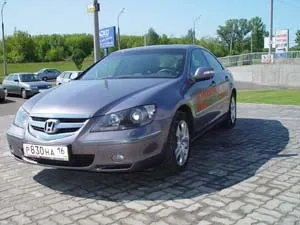
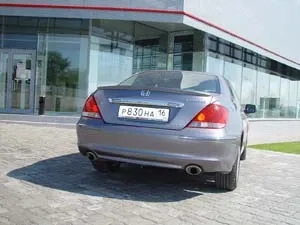
So, we get into the car, and I am still in the front passenger seat. It is hot outside, so we need to turn on the air conditioning. But it is not easy to figure it out right away: the dashboard at first glance scares with an abundance of buttons and knobs. However, this is only the first impression. Alfred and I, by trial and error, quickly master the climate control. When the eyes get used to the interior, the feeling arises: "Everything is very luxurious and stylish." Nothing superfluous, it seems every little detail is thought out for the convenience of the driver and passenger. The interior trim, as befits an expensive car: natural leather, wood, aluminum.
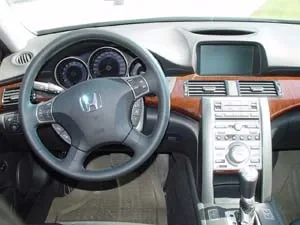
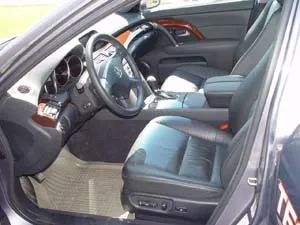
Now I am behind the wheel. I start moving — the car rapidly gains speed. Everything is convenient, visibility is excellent. Smooth ride and at the same time sporty dynamics — these are the main impressions. I imperceptibly catch up with cars on the highway. Of course, the Japanese had to find a balance between comfort and speed qualities. And Honda, as is known, is primarily about drive, sporty asceticism, which means a stiffer suspension is needed. But here these characteristics are balanced, in my opinion, with the precision of the best pharmacist. This is a car for rich and successful people who need to maintain status and feel the charm of high-speed "flight." If compared to the royal hierarchy, the Honda Legend is a tsar or king possessing wealth, scope, power, and influence. As you understood from these laudatory epithets, I really liked the car.
Alfred, editor of the newspaper "Autoclub-Kazan"
Only two hours of communication with this car is catastrophically little. What can you understand in this time? Yes, it accelerates! Yes, it brakes! Yes, it is big! Yes, it is comfortable! How many more of these "YESes" can you list? Many, very many. But the point is completely different! This car was created as something more than just a car. To make it clear what I mean, I will start from the very beginning.
It happened in distant Japan. There lived two outstanding engineers capable of creating the most technically advanced transmissions in the world. They are Yasuji Shibahata and Kaoru Sawaze. The first is from Honda, the creator of the transmission for the front-wheel-drive Honda Prelude with the ATTS (Active Torque Transfer System) differential; the second is from Mitsubishi, the creator of all all-wheel-drive systems on the Evo and the revolutionary Evo IV transmission with similar AYC (Active Yaw Control). The Honda Prelude has already been discontinued, and the primacy seems to have remained with Mitsubishi. And now Shibahata-san makes a response move in the form of the SH-AWD transmission on this very Legend. It is based on a front-wheel-drive mechanism, but it is capable of transmitting power to the rear wheels.
This car actually hides two automatic transmissions, and one of them is responsible for delivering traction to the rear axle. The electronics choose between direct and overdrive gears at its own discretion. Electromagnetic clutches are hidden in the rear half-shafts, controlled by smart internals that periodically engage one wheel or the other. Thanks to this, the car can become three-wheel-drive at any moment. Depending on the direction of the turn, the required half-shaft is activated. The system steers the car using the outer wheels in a corner, noticeably reducing the turning radius. So, the car is controlled not only by the steering wheel but also by traction force, all without driver involvement. The feeling of moving "on rails" appears in every turn—this is the merit of the SH-AWD system. Today, there is no other car in the world with anything like it! Honda engineers claim they have created the most advanced drivetrain on the planet. And with such knowledge, you have to venture into ordinary city traffic. Honestly, it even gets boring. If only it would start raining—then you could try playing with slides on wet pavement. But no, a real test of such a machine requires a proving ground. You have to settle for city streets with their chaotic traffic, "washboard" roads, tram tracks, and other delights of the European hinterland. And the car drives, I must say, excellently: the responsive automatic doesn't let speed enthusiasts off the hook at traffic lights and on straights to the next intersection. The steering is slightly "taut," and perhaps even sharper than you'd want for such a large car, although with such internals as SH-AWD, it's probably justified. The suspension is tuned perfectly: it dampens longitudinal pitching but doesn't become stiff. Softly swallowing bumps is expected behavior for a car of this class, and it fully lives up to those expectations.
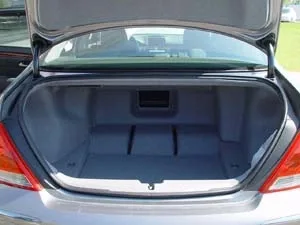
Overall, the entire philosophy of this car is pure selfishness. Yes, exactly selfishness. In the back, of course, it's spacious, passengers are comfortable, the car's dimensions are impressive, but it wasn't created for them. You sit in the back—during acceleration you're pressed into the seatback, during braking you're thrown forward. In short, you're tossed around like a piece of wood. Moreover, the driver makes no sudden movements—the car behaves this way on its own. This car is one hundred percent created for the person behind the wheel!
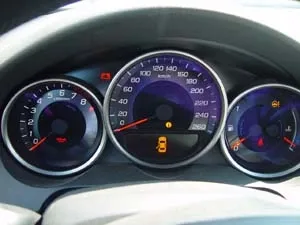
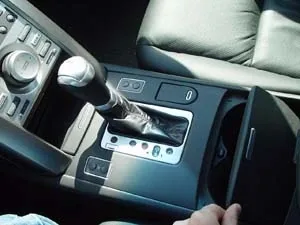
The automatic has a manual mode, and you can shift gears using the familiar paddle shifters. I'm always curious to check how "honestly" the gearbox works in manual mode. Here's the situation: gears don't shift up automatically, only down. The car allows you to rev the engine to the limit, and you get a chance to hear the engine sound, which does manage to penetrate the excellent sound insulation. Only when the tachometer needle hits the red zone does the limiter kick in. At that point, the car jerks unpleasantly, so it's better not to let it get to that and to monitor the revs via the instruments—you can't rely on your ears here; the sound insulation hides the engine's work too well. You control the revs only by the tachometer, which is huge and perfectly readable, as are all the other instruments. When you drive under a bridge, you notice how beautifully the instrument readings are illuminated in bluish tones.
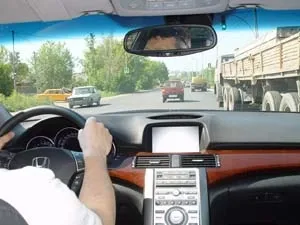
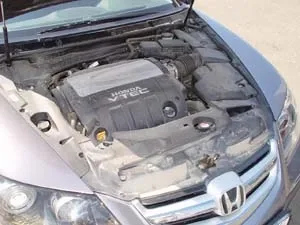
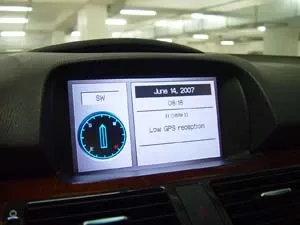
The instruments are very laconic and perfectly readable. Honda has never had problems with this—engineers always carefully design the dashboard. But on the center console, I was initially confused by the number of buttons. I didn't immediately find how to turn on the climate control. But when you look closer, the logic of button placement becomes clear. Once you set up the climate system, you can forget about it—it will cool the necessary zones on its own, tracking the sun's position. Moving to the back seat, I noticed that acoustic comfort there is worse than expected. The noise of tires, beating out the rhythm of road irregularities, is clearly audible. And what about the praised active noise cancellation system ANC? Why is it not heard at all in the driver's seat? No, no better way to combat noise than built-in music has been invented yet. The powerful audio system with nine speakers and a subwoofer can drown out not only internal noises but also throw a real disco with the windows open. It's clear that everything here is maximally electrified and packed with servos. You turn on the ignition—and first, the steering wheel and seat come to life. The steering wheel moves closer to the driver, and the seat takes the position stored in memory. You engage reverse—the screen shows the rearview camera image, and the exterior mirrors adjust themselves so the wheels are visible. The car is literally overflowing with modern systems, and I repeat: two hours with it to understand all this diversity is catastrophically little. But the design against the background of other Honda models looks somewhat dull. Remember the sensational Civic or the latest CR-V—exactly! Maybe it's a deliberate decision to add conservatism, because the car aspires to solidity and status. Summing up, I'll say: this car will be appreciated by those who have already achieved a certain position in society, succeeded in their business, or hold high posts in someone else's. This is certainly an adult, but not yet old, person who knows how to "hooligan" but is used to keeping everything under control.