
Honda Jazz. Smart format
Honestly, I don't recall any Honda that left me indifferent or disappointed. Take the Legend sedan, for instance — it simply amazed me with its "Super Handling — All Wheel Drive" system: this "smart" transmission with electromagnets instantly redistributes torque between axles and wheels, making the car respond to the steering wheel phenomenally.
And the CR-V? Inside — true spaciousness, comfortable seats, solid trim, and the trunk is designed so that cargo can be arranged in tiers: for example, potatoes can be loaded at the very bottom, and a box of eggs placed higher up to ensure they never meet.
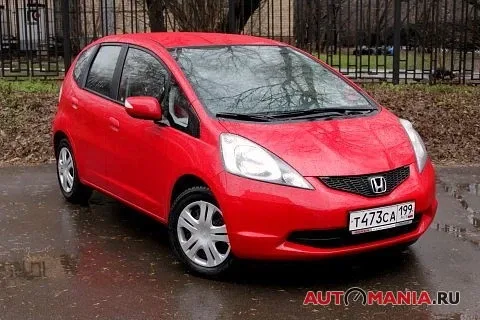
And now, having returned the new Honda Jazz, I'm still impressed by how many simple and well-thought-out solutions are packed into this neat body.
In its homeland, Japan, this car (known there as the Fit) is highly respected: right after its debut, it received the title "Japan Car of the Year 2007–2008," repeating the success of the 2001 model, which sold over two million units worldwide. And here? In Russia, the car was also quickly appreciated: the Jazz sold quite briskly — by the end of the relatively prosperous 2008, 6,591 units of the previous generation were sold. That's right between such mid-level compact van class models as the Opel Meriva (8,416) and Hyundai Matrix (5,193).
And since mid-last year, the next generation has been available at dealers.
In its niche
Before I got behind the wheel, I was troubled by a question: what exactly is the Jazz — a hatchback or a compact van? And I was wrong to try to classify it. With a length of 3,900 mm, width of 1,695 mm, and height of 1,525 mm, it occupies its own niche between B-class hatchbacks and compact vans, combining the style of the former and the practicality of the latter.
And from the side, the car looks interesting: the cabin has noticeably shifted forward, the previous "iron-like" silhouette has become more wedge-shaped and monovolume, the triangular windows in the front pillars have roughly doubled in size, the height remains the same, the length has increased by 55 mm, and the body has become 20 mm wider. The wheelbase has grown by 50 mm, and the front and rear tracks have widened by 35 and 30 mm respectively, adding stability.
But even after all these rejuvenating procedures, the calm, gender-neutral, Pokemon-like face of the Jazz won't be called a beauty. However, this is not surprising: the previous generation was most often chosen by elderly couples whose children had grown up and moved out, and for whom this car was the only one. But Honda sincerely believes that the new model can interest a wider audience: young families where both spouses work, often have two cars, and want something brighter, with individuality and rich equipment. The main thing for them is ease of driving and low costs. The new Jazz is a universal: suitable for ferrying kids, shopping trips, and daily city routine. It can also be used as a company car to save on taxes.
Externally, the changes are more evolution than revolution, but it's not just about design. The new model retains the main idea of its predecessor — small on the outside but big on the inside, plus a set of smart solutions and build quality that together create that very Jazz charm.
For example, I immediately appreciated the benefits of the central placement of the fuel tank under the front seats and the "Magic Seats" that provide enormous flexibility in transforming the interior.
Smart spaciousness
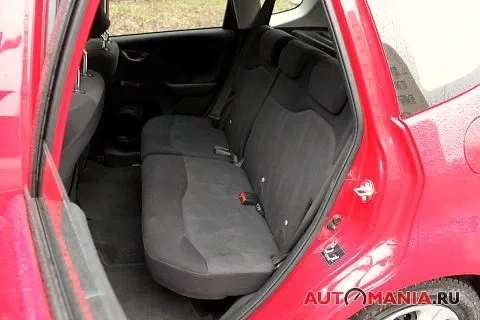
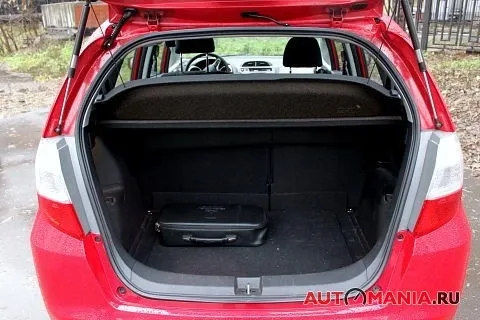
During the test, I happened to buy a floor skirting board. I leave the store with an armful of two-meter-long, twenty-centimeter-wide sticks in one hand, open the rear door with the other, and mechanically prepare for the usual procedure: lift the cushion, fold the backrest... and where to put the skirting? The ground is dirty, so I'll have to balance it on the toe of my shoe. But no! I pulled the lever at the top of the backrest — and half of the sofa lowered entirely, becoming a flat continuation of the already low trunk floor. And if you fold the entire sofa, you get a cargo area 1,720 mm long — enough to load three mountain bikes with 26-inch wheels without even disassembling them. And if you tilt the front seat forward, the trunk length grows to 2.4 meters — almost like in a VW Tiguan. A refrigerator or a large TV will fit without problems, and you can even set up a sleeping place — whatever you prefer. And the "magic" is also that the sofa cushions can be placed vertically — then space appears for transporting, say, a tall ficus. The pleasant little things don't end there: getting in and out of the new Jazz has become easier. The rear doors, which open very wide, have three fixed positions, which is very convenient in tight city parking lots.
As soon as you get inside, you immediately feel the spaciousness of at least C-class, maybe even more: in front of your eyes is a panorama of the windshield and side windows, all-around visibility is excellent, but the front edge of the hood is not visible.
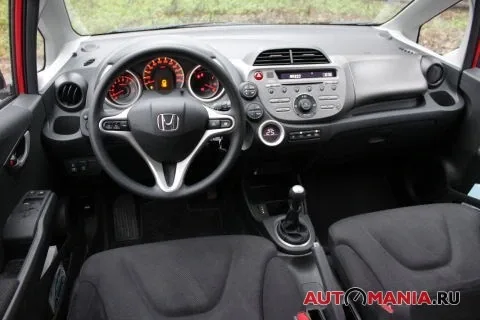
The interior has been seriously reworked: the seats greet you with dense, perfectly profiled embraces of velvety fabric. The front panel seems similar to the previous one and feels just as hard to the touch, but you don't think about it because visually everything looks high-level, and the stylish "aerospace" motif sets the tone, as in the Civic hatchback. From it also comes the three-spoke steering wheel with a mesh, but the instrument cluster is ordinary, with analog dials — not for beauty, but for information. The climate control unit with a round display pleases the eye, music can be controlled from the steering wheel, and if you want to listen to your own recording, the connector next to the gear lever allows you to connect and charge not only a USB player but also an iPod.
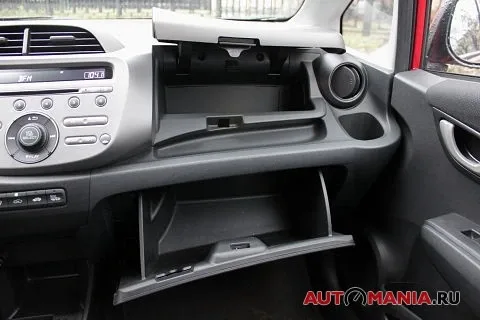
The interior is full of convenient compartments for small items and at least 10 cup holders: two in front on the center console, two behind the handbrake, one at each end of the front panel, and one in each of the four door panels. Special mention deserves two glove boxes — upper and lower, a pocket to the right of the steering wheel, a compartment in the center console, a pocket on the back of the front passenger seat, and in the corners of the dashboard — recesses for 0.5-liter bottles or aluminum cans. Everything is thought out and convenient.
A bit about the "hardware"
The previous Jazz had a single-camshaft 12-valve engine with a displacement of 1.3 liters and 83 hp, which worked in tandem with a manual transmission or a CVT.
Now the engine is new — 1,339 cc, with 4 valves per cylinder. Power is exactly 100 hp, but with automatic transmissions the situation is different: instead of a CVT, there's a 6-speed robotic gearbox iShift, while the manual remains the same. It was the manual that was on the test car, delighting with precise shifts, short throws, and a clear drive — you can shift even with your eyes closed. I liked the engine, but you shouldn't expect hurricane dynamics from it: in the city and on the highway, its capabilities are quite sufficient. And when after 1,000 kilometers of mixed-cycle driving my wallet had only lightened by 1,000 rubles, and the onboard computer showed consumption from 5.9 to 6.2 liters per "hundred," a satisfied smile appeared on my face on its own. Well done!
Notes of character
The suspension is clearly tuned for foreign roads: if the asphalt is good, the ride is comfortable, and if it's bad — then the comfort is corresponding... it doesn't like potholes, and the car doesn't hide it.
You'll have to get used to the brakes: deceleration is excellent, but the overly sensitive pedal seems to be a family trait of all Hondas. Lockup occurs almost immediately, and you need to modulate the force very carefully.
Immediately after turning the ignition key, the car starts beeping, "ding-donging," and visually reminding about the unfastened seatbelt. The modern level of safety is indicated by 6 airbags and a stability control system, which are already standard. So during the test, I could easily perform emergency maneuvers, avoiding a Gazelle standing in the left lane without parking lights and hazard lights, and a VAZ 2107 stuffed with boxes of vegetables sticking out, which "froze" right in the middle of the three-lane overpass of Borovskoye Highway...
On the scales
However, there was a fly in the ointment: this treasure trove of unconventional solutions is not cheap. Even Chinese assembly didn't save the situation — the price tags are biting: for the base version they ask from 615,000 rubles, and for the Elegance AMT with the "robot" — already 645,000 rubles. Those who choose a car based on the "price-picture" ratio will immediately say "no" — the worlds are too different. Around there are plenty of models that in the eyes of our car enthusiasts look larger, more prestigious, and more impressive. But the truth is learned in comparison: after a week spent with the Honda, this amount no longer seemed exorbitant. And one more thing: now the Jazz can be equipped with the proprietary Honda SSD Navigation. Unlike ordinary portable devices, it is integrated into the car at the factory level: the buttons on the steering wheel continue to work, and the accuracy of coordinate determination is improved by data from speed sensors and a gyroscope. The system is fully translated into Russian, has up-to-date POI databases, and covers Moscow, St. Petersburg, and other major cities in the European part of Russia. The package also includes a 200-watt audio system with a touchscreen and hands-free. The cost of such pleasure is 84,000 rubles.
Vladimir Palkin
Technical specifications
| Length, mm | 3 900 | |||
| Width, mm | 1 695 | |||
| Height, mm | 1 525 | |||
| Wheelbase, mm | 2 500 | |||
| Curb weight, kg | 1 043 | |||
| Gross weight, kg | 1 500 | |||
| Trunk volume (l) | 399 | |||
| Gearbox | manual 5-speed | |||
| Engine displacement, cc | 1 339 | |||
| Max. Power, hp | 100/6 000 | |||
| Max. torque, Nm | 127/4 800 | |||
| Max. Speed, km/h | 182 | |||
| Acceleration time (0-100 km/h) s | 11.4 | |||
| Average consumption (l) | 5.4 | |||
| Tank volume, l | 42 | |||
| Fuel | petrol | |||
Source – AUTOMANIA.RU