
Honda CR-V
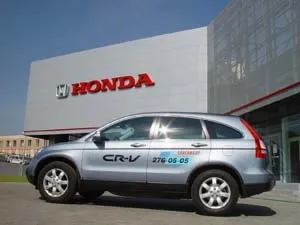
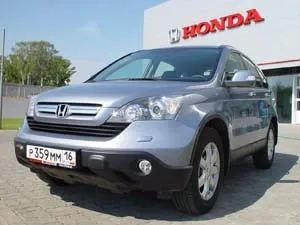
New CR-V
Under the hood is a petrol engine with a displacement of 1997 cubic centimeters.
Power — 150 horsepower at 6200 rpm.
Peak torque — 192 Nm, available at 4200 rpm.
Top speed — 190 km/h.
The sprint from standstill to 100 km/h takes 10.2 seconds.
Transmission — manual, six-speed.
Drive — front, rear axle engages automatically.
The car's appetite:
in the city — 10.4 l/100 km
on the highway — 6.7 l/100 km
in combined cycle — 8.1 l/100 km
Body dimensions
length — 4530 mm
width — 1820 mm
height — 1675 mm
Ground clearance — 185 mm
Tires — 225/65R17 102T
History of Honda
The history of the brand began in 1946, when Japanese engineer, inventor, and racer Soichiro Honda founded his company. Its current appearance and more than half a century of history are the merit of his bold, unconventional, and inventive mind. Honda was born into a poor family and, without finishing school, at the age of 16 became an apprentice at a Tokyo auto repair shop.
In 1938, he came up with a piston ring, and his company Tokai Seiki Heavy Industry, founded a year earlier, was engaged in producing these parts. In 1945, when the factory suffered greatly due to the war and an earthquake, Honda sold Tokai Seiki to Toyota Corporation for 450 thousand yen. Once, he attached a small motor to his bicycle, thus getting a moped, then assembled a dozen more for friends — and decided to seriously engage in their production.
By 1955, the company had become the largest motorcycle manufacturer in Japan, leaving many competitors behind. Honda participated in the first Japanese Motorcycle Endurance Road Race and won in the 350 and 500 cc classes, and also received a prize for design. New models hit the market — Benly JB, Dream SA, Dream SB-type.
In 1956, corporate principles appeared that the firm still adheres to. A service department was opened, and a one-year warranty was introduced on products. But Honda truly became famous in 1972, when the Civic model was released. It was from this that the brand's recognition as a manufacturer of compact, inexpensive, and high-quality cars began.
In 1973, Soichiro Honda officially left the post of president, but even after his resignation, he personally tested every new car.
In 1976, the Accord appeared, and Civic production exceeded one million units. A year earlier, the Civic took first place in economy tests conducted by the US Environmental Protection Agency and the Federal Energy Administration.
In 1978, the Prelude debuted, in 1979 the Tochigi test track opened, and in 1980 Honda entered the top three largest Japanese automakers. In 1981, power equipment production reached five million units, and the company's shares began trading on the London Stock Exchange.
In 1982, production of the Accord started at a plant in Ohio, USA.
In 1985, the Life, Integra, and Legend models were shown to the public for the first time. At the same time, the power equipment direction was developing — its total output reached 10 million units. The international network continued to grow. In 1986, development of the 4WS control system began, Accord production was launched in Canada, and Honda took three first places in the Paris-Dakar rally. The 4WS system already appeared on the Prelude in 1987, Honda became the fastest-growing company in the world and announced work on airbags. The five-millionth Civic was produced. In 1988, Accord Coupes assembled in the US began to be imported to Japan. Car and Driver magazine named the Accord one of the ten most popular cars in the States. The Concerto model appeared. The decade ended with a landmark event: Soichiro Honda became the first Asian inducted into the US Automotive Hall of Fame. Subsequently, the company paid more and more attention to environmentally friendly technologies. In 2000, Honda introduced the robot Asimo — it was conceived as a future home assistant. In 2001, a new compact model Fit was released, and the Accord again became the best-selling car in the US. Today, Honda is a dynamically developing company that produces cars, motorcycles, special equipment, engines, and power equipment. The innovations that the firm constantly introduces concern not only cars: these include navigation systems, construction of environmentally friendly plants, research in other areas, and participation in motorsport.
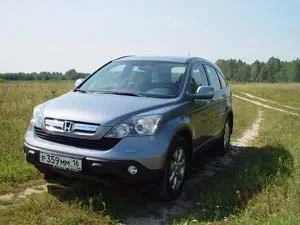
The new CR-V continues the traditions of the SUV class, but at the same time offers more "car-like" dynamics and style, increased comfort, and a luxurious interior, which meets the increased demands of buyers and the level of premium models in the compact SUV segment. The handling of the new CR-V has become even more like a regular passenger car. This was achieved by lowering the center of gravity by 35 mm, widening the track by 30 mm, large 17-inch wheels, as well as a number of small but important refinements in the steering mechanism and suspension geometry.

Vadim. We already got acquainted with the previous generation CR-V (see www.autoclub-kazan.ru), and it left a very pleasant impression. We expected only positives from the new version, because both the engine and the electronic connection of the rear axle remained the same.
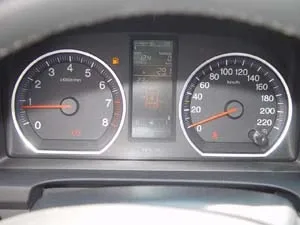
Exterior and interior. You can argue, but for me the most beautiful remains the 2001 CR-V — it has an honest "square" appearance of a real SUV. Solid and strict. The next generation had too smooth lines, but the current new product surprises with a mixture of smooth and jagged lines. Underground! Judging by the number of CR-Vs on the streets of Kazan, many people liked this style. Well, as they say, the main thing is that everything inside is decent. And inside, everything is indeed neat and comfortable. Each of the three sections of the rear sofa adjusts the backrest angle, plus there is a folding armrest that turns into a cup holder with one movement. The only drawback is that on our potholes and bumps, it noticeably rocks in the back, but on a normal surface you get just super comfort. Behind the wheel, the abundance of too small numbers is upsetting. However, the most important scales — speed and revs — are read well.

Alfred. Stop, stop, stop! Not so fast, let's go into more detail, because one paragraph contained both the design, the driver's seat, and the rocking on potholes. I would dwell on some things separately. I'll start from afar. This is one of the most anticipated cars on our market. Now, it seems, the queue for it is until February. So what attracts buyers to this car? Let's try to figure it out. From the first seconds of acquaintance, the dimensions are striking. Huge doors open almost 90 degrees, providing access to equally large openings. When getting in, your trousers won't touch either the wheel arches or the sills. Inside there is a lot of space — both in height and width. You can arrive at a masquerade ball in a top hat and not take it off in the cabin. The rear row can easily accommodate three, and there will be enough width for each. Legs are also spacious — thanks to the absence of a cardan shaft tunnel and a flat floor. The rear seats have a good range of adjustment both in backrest angle and cushion travel, so it's comfortable to ride in the back. But in front it's even more comfortable: convenient armrests allow you to ride relaxed and at ease, especially since the suspension allows it. The backrest folds very easily with a lever — something similar was on our classic models: you pull the lever, lean back, and the seat turns into a reclining one. Very convenient. At the driver's seat, I note the convenient interface for managing various functions, as well as the instrument panel, oversaturated with small details. Some readings are not immediately clear. For example, the running strip turned out to be an instantaneous fuel consumption indicator. And the empty scale is nothing more than a fuel level indicator. A visually impaired person will definitely experience discomfort. The adjustments for reach and tilt of the steering wheel are frankly small, but the wheel itself fits well in the hand and is pleasant to hold. It is well loaded, and with its help the car steers surprisingly well, which turned out to be unexpected for a crossover. I especially note the operation of the gearbox and brakes. The former is excellent, the latter not so much. Gear changes are clear, the convenient short-throw lever located directly on the front panel will appeal to many. But the brakes are somewhat soft, lacking informativeness; the car is big, and for confidence you want to feel the force on the brake pedal with your foot.
Vadim. I especially want to praise how the clutch pedal is made. Sorry for the details, but they show the essence perfectly. At that time, my left leg hurt, and in my car with a manual transmission, every trip turned into torture. In the Honda, I completely forgot about my problem! Everything works surprisingly softly and precisely.
Alfred. When I returned to my car after the Honda, I immediately felt how heavy the pedal was. As for the appearance, praising or scolding it is a thankless task, so I'll just say my impression. Rather "yes" than "no". Although I admit, I expected something more, especially after the design of the Civic simply blows the mind.
Vadim. Suspension left me pondering. In corners, the car holds confidently, without excessive body roll. Broken asphalt or a simple dirt road — it handles all of it softly and comfortably, without any fuss. But when the potholes get a bit deeper, you immediately feel a lack of energy capacity. It seems the soft suspension was deliberately paired with a modest ground clearance: comfort is in place, and handling is up to par. The flip side of this compromise is the limited suspension travel, which simply can't absorb serious impacts. Honestly, I like this setup much more than the stiff, stool-like suspension of the RAV4.
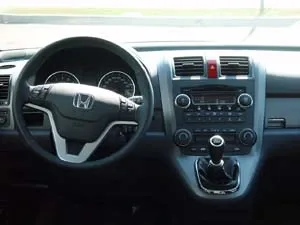
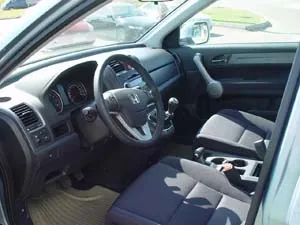
Alfred. I'm ready to agree with some things unconditionally, but I'll argue with certain points. Here, the settings are more soft than stiff. On any road and with any surface, moving in this car is a pleasure. On bumps and in potholes, you feel equally good. The car seems to glide smoothly over all irregularities. Excellent! And at the same time, it doesn't rock, and in corners it doesn't lean like a typical SUV. Its character could have been sporty, if not for one "but." I'll tell you about that later, but for now, I want to continue talking about the car's behavior. The absence of body roll is largely due to the car being wider, shorter, and lower. A ground clearance of 18.5 cm (without driver) might seem small for a crossover, but let's honestly define what this car is for. First, it's a purely urban dweller, and a taiga farmer won't suit it. So why would such a car, sitting on 17-inch wheels, need high ground clearance? It would raise the center of gravity and, with such a comfortable suspension, make the car less stable. To compensate, you'd have to stiffen the suspension, turning the cabin into a "kidney shaker." If someone likes that option, there's the RAV4. Personally, I would choose exactly this character of settings, like the CR-V.
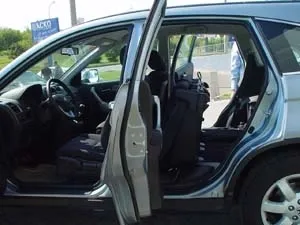
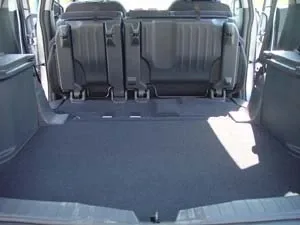
Vadim. Drivetrain. The CR-V stays true to itself: front drive is permanent, and the rear engages automatically. For the city, that's what you need: fuel savings and the familiar behavior of a front-wheel-drive car, but with the safety net of all-wheel drive in case of wheelspin or a dangerous situation. There's no forced 4WD, let alone locking differentials. With this, the manufacturer clearly states: you'll drive safely and comfortably on slippery or bad roads, but it's better not to venture into serious mud.
Alfred. Still, we couldn't resist and turned onto a dirt road — memories of how the previous CR-V behaved on such a road were too fresh. The situation is very similar, but still a bit different. The suspension has become slightly stiffer, but it's still very good and comfortable: I accelerated to 60 km/h, and there was no shaking or bouncing.
Engine. Now about that "but" — the engine, or rather its characteristics. It will definitely disappoint those Honda fans who are used to the sporty nature of these cars. You'll have to constantly push it, there will be a lot of noise, and the effect — not impressive. Still not as you'd like.
Vadim. The good old two-liter engine with variable valve timing. In promotional materials, Honda says that millions of such engines have been produced, which speaks to their reliability. That's true: over the years, the engine has been refined, and all childhood diseases have been cured. But there's another side to the coin: over time, it has ceased to be the most modern and technologically advanced. The maximum 150 hp at 6200 rpm and peak 192 Nm at 4200 rpm already yield to current figures (150 hp at 6000 and 200 Nm at 3500). As is known, the strong point of engines with variable valve timing is excellent low-end torque. We tried to test this on the CR-V by simulating a couple of standard situations. First, overtaking on the highway, in 6th gear, a truck crawling up a slight slope at 70 km/h. Alas, we had to shift to 3rd gear: neither 5th nor 4th provided the necessary safe acceleration. Then, at the same speed, we tried to overtake a truck on a flat road — 4th gear was enough. Realizing that 6th gear is only for very high speeds, we continued experiments with 5th. We drop the revs to 2000 and try to accelerate in three different ways: pedal to the floor; smooth pressing; pressing in "pumps." It's the latter method that has always been the most effective accelerator for me on any car, but on the CR-V it turned out to be absolutely useless! At first, I didn't believe my senses, tried again and again — but to no avail. And another surprising moment: a sharp press "to the floor" at low revs usually gives the worst acceleration, but here it turned out to be the best. Unfathomable are your ways, CR-V! Finally, it's worth conveying Alfred's feelings, who sat in the back as the "boss." So, with all three acceleration options, he couldn't even tell whether we were accelerating or moving at the same speed. Adding my mini-tests in the city to my conclusions, I realized: it's not worth dropping the revs below 3000. Strange behavior for an engine with variable valve timing.
Having read all this, you've probably decided that I didn't like the engine at all. If such an engine were in a C-class car, where dynamics and maneuverability are important, then yes, I wouldn't like it. For a D-class car, such an engine is quite acceptable, but only paired with a soft suspension, because together they should create a feeling of unhurried and comfortable driving. And for the CR-V crossover, this 2.0 is almost ideal: hardly anyone is going to race in it. On the other hand, its direct competitor, the RAV4, was also supplied to Russia for a long time only with a 2.0, and only later did a 2.4 appear. By the way, the CR-V also has a 2.4 version, it's just not yet certified for our market.
Every car has its own "soul," and you need to understand it (preferably before buying, so you don't regret it later), and if your tastes coincide with that "soul," then you simply can't find a better car.
Alfred. And on the way back to the dealership, we drove through the city unhurriedly and enthusiastically chatted with Vadim about something unrelated. At some point, we both realized how convenient and stress-free this car is. You drive calmly, and it responds with care for your comfort and convenience. We were just driving, forgetting that we were "on duty," and enjoying what was happening.
Maintenance cost:
Service interval — 15000 km.
TO1 (15k km) — 4.5–5 thousand rubles.
TO2 (30k km) — 7 thousand rubles.
TO3 (45k km) — 12–15 thousand rubles.