
 Comments (9)
 Together with Toyota, Honda stood at the origins of creating soft-roaders – cars for the city with the ability to go out into nature. However, the approach of the Japanese was different: if Toyota started with a funny three-door RAV4 aimed at young people, and only later added a five-door modification, then Honda immediately released a full-fledged five-seater car with a spacious trunk for family people. With such a bet on a more adult audience, Honda earned itself a reputation as a "pensioner's" brand – after 15 years, it, along with Volvo, ended up among the oldest brands and is now paying for this positioning. While the Russian market has not yet fully embraced this image, the Japanese are trying to breathe youth and emotions into the model range – just look at the new Civic hatchback or the scorching Type R.
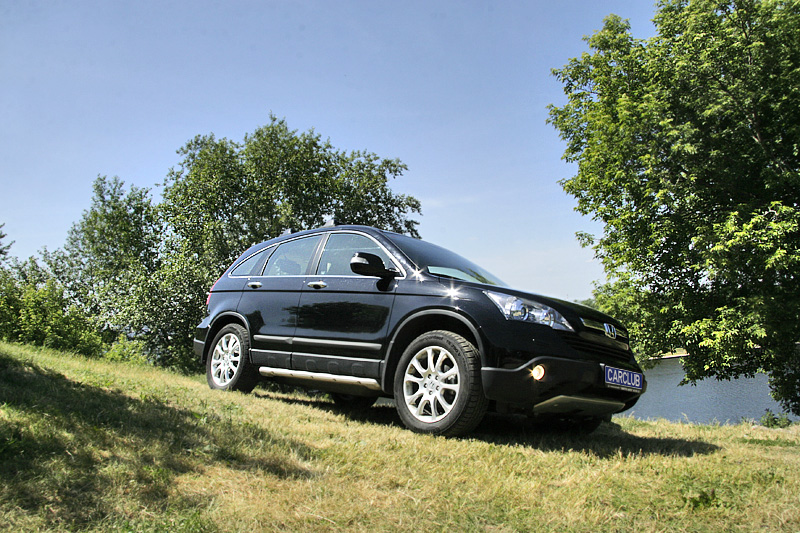
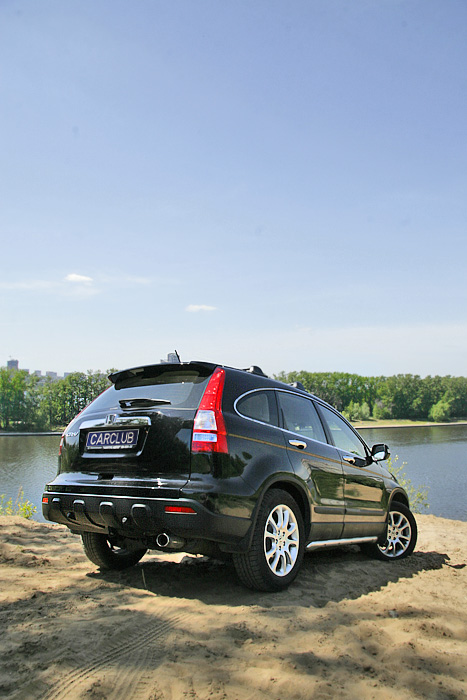
The new CR-V, unfortunately, cannot boast such dynamics. Honda's recognizability in traffic is one hundred percent, but there is no talk of energy. The exterior has acquired a cartoonishness uncharacteristic of the brand and at the same time excessive fullness. Behind the wheel of such a car, it is hard to imagine a slim girl, and a plump lady is unlikely to want to emphasize her forms with such a choice. True, the black color slightly hides the true proportions of the CR-V. The only thing that catches the eye is the expressive window line.
The interior does not echo the exterior at all. It is strict and taut in the Japanese style, although it could use a dose of extravagance from the Civic. During the day, the noble beige trim attracts attention, and in the evening neon dominates – it illuminates the rims of the instrument panel and the footwell. The plastic is hard everywhere, which somehow does not fit with a price tag of almost 40 thousand dollars. But the combination of "black top, light bottom" looks quite respectable. Stylish details add gloss: lever handles on the doors and a mesh insert on the lower steering wheel spoke.
The instrument panel is also laconic, but with one miscalculation: the central display is raised too high, and its instantaneous fuel consumption scale is blocked by the steering wheel. Why this is done is unclear, especially since at the bottom of the screen, right before the driver's eyes, an unnecessary serial number is displayed. It seems as if the shield was installed incorrectly, and the factory marking accidentally ended up in view.
Experiments with the shape of the handbrake are a long-standing passion of Honda designers. On the previous CR-V, it was vertical and stood on the console; now it has returned almost to its usual place, but the handle is turned across the car and resembles a ship's tiller – stylish and convenient. But the seat heating buttons, located next to the cup holders and the phone pocket, are a clear miss. They are pressed accidentally from time to time, which is especially unpleasant in the heat.
The rear row of seats is fully transformable: parts of the sofa move forward and backward, the backrests adjust in a wide range, and in the center there is a huge folding armrest, more like a table with cup holders. Three adults can easily fit across the width of the rear seat, and the floor is completely flat. By the way, there is no central tunnel in the front either. If the box between the front seats were removable, it would be possible to arrange a passage for children back and forth.
The "automatic" selector stands on the protrusion of the central console and switches like a bolt – with short, sharp clicks. Alas, the gearbox itself lacks such clarity: the five-speed "automatic" is deprived of a manual mode and categorically refuses to brake with the engine. I don't even want to remember the delays. The transmission's operation is especially disappointing against the background of such decent handling.
Precise steering with a noticeable reactive force is a hallmark of Honda, and the CR-V is no exception. You don't even expect that a soft-roader can be so exciting to drive. The creators of the Nissan Qashqai tried to achieve something similar, but they clearly lacked the polish that Honda got. In the parking lot, the steering wheel is light, but by 40 km/h it fills with perfectly calibrated effort, and turning it is a pleasure. Body rolls are quite moderate by SUV standards; the car can be driven on the edge of tire grip while maintaining full control. In a limit turn, the CR-V demonstrates understeer, but attempts by a tall soft-roader to go into a slide are unlikely to please. The electronics do not engage immediately during a skid, leaving the driver the right to have a little fun and scare the passengers.
It's just that the mentioned "automatic" does not contribute to such drive. To get traction on the exit of a corner, you have to press the gas in advance, giving the gearbox time to shift down a couple of gears, and only then can you expect acceleration. The engine matches the transmission – it also does not strive for records. The two-liter "four" with the proprietary VTEC system has nothing in common with truly hot Honda engines. It lazily accelerates the SUV, making it clear that for dynamics it is better to go to the Type R, not to family models. But the CR-V pleased with moderate appetite: 11-12 liters per "hundred" is quite decent for a modern soft-roader in city traffic.
The flip side of handling is, of course, comfort. The CR-V's suspension faithfully shakes passengers on asphalt joints, but does not allow even a hint of rocking. High-profile 18-inch wheels 225/60 R18 do not save from jolts. By the way, the test CR-V was somehow shod with winter non-studded tires, although it was summer outside.
On the country highway, the CR-V also does not shine with dynamics: the last gear is incredibly stretched, and the "automatic" is lazy to shift to the powerful third, so when overtaking it often has to be urged with the pedal to the floor or by turning off over-drive – fortunately, there is a convenient button right on the selector. The only joy is the solid reactive force on the steering wheel, allowing you to trace turns like with a compass.
For storming off-road, the new CR-V, like a true soft-roader, has no additional devices. An electronically controlled hydraulic clutch is responsible for connecting the rear axle. On loose soil, you can also turn off the traction control system. All hope is on the solid ground clearance and short overhangs. But on a dirt road, the car with a stiff long-travel suspension and tall wheels allows you to rush at a decent speed, avoiding breakdowns and rocking.
Weighing all the pros and cons, it turns out that Honda has made a very interesting "soft-roader." It's just that the exterior design is a matter of taste... But the fact that the car lacks youth and dynamics is a fact. And if the design causes only affection, and the pursuit of Schumacher's laurels and the racing helmet have long been hung on a nail, then the CR-V will be a quite successful purchase. A convenient and spacious car that will not get lost on the road, but also does not catch the eye, and is also capable of delivering driving pleasure. What else is needed for leisurely trips around the city and weekend trips to the dacha? A pensioner's dream...
Text: Leonid Pavlov.