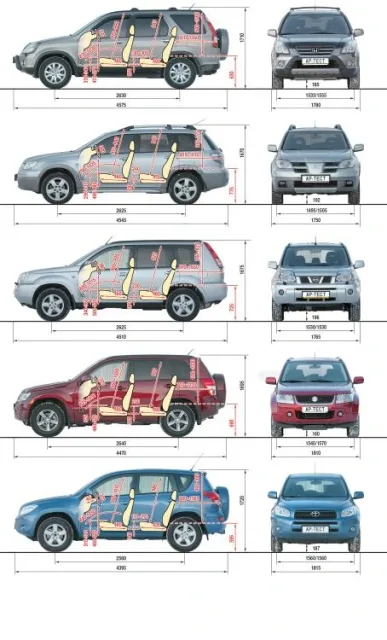
The Toyota RAV4 crossover, which debuted in 1994, once caused a real stir. No one really understood what kind of beast it was and who needed it. But time put everything in its place: the car turned out to be in demand by millions. Following Toyota, all Japanese manufacturers developed and put their versions of such cars on the assembly line. Let's talk about them. The reason to bring them together is the appearance in Russia of a new, already the third generation of RAV4.
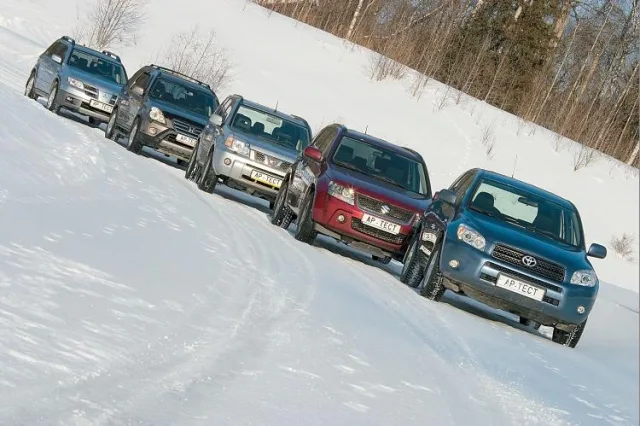
For the test, we chose cars in the most popular trim levels — with automatic transmissions and the most powerful engines available on our market. The company gathered Honda CR-V 2.0, Mitsubishi Outlander 2.4, Nissan X-Trail 2.5, Suzuki Grand Vitara 2.0, and, of course, the newcomer — Toyota RAV4 2.0.
The RAV4 holds confidently: even on the eve of the generation change last year, Russian dealers sold 6,335 such cars — this is second place in the compact crossover class. The first was the Nissan X-Trail with a result of 7,420 units.
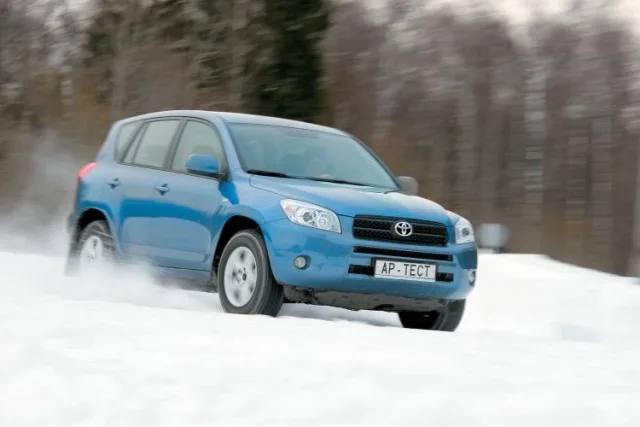
On slippery surfaces, the Toyota RAV4 is reliability itself. The non-switchable stability control system, together with the "intelligent" all-wheel drive, carefully corrects all driver mistakes
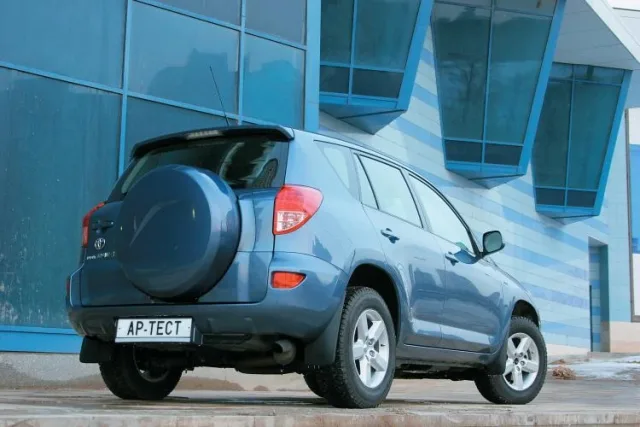
Can you make a great car even better? Judging by the exterior, there is nothing left to improve: the new RAV4 repeats the features of its predecessor in both shapes and proportions. True, the increase in dimensions made it visually heavier, which made it a bit more boring. Some of the charm of the first two "Rav4s" has evaporated, but the car looks more solid — this is noticeable when the brake lights come on from behind: now they are LED! Previously, such lights were found only on expensive cars.
 |
 |
 |
| To the right of the steering wheel is the center coupling lock button | The optitronic instruments are beautiful, and all information in the display window is in Russian | The two-tier central console is a successful find by Toyota designers and ergonomists |
Inside, it has become much more interesting — the two-tier front panel is simply magnificent. It's not just about beauty: using the blocks placed on the "ledges" of the console is easy and convenient. On top is an audio system with a six-disc changer (mp3 is also supported), below is a two-zone climate control panel with separate temperature settings for the driver and front passenger. And all this is already in the base! And the optitronic instrument cluster wins not only with its design and informativeness, but also with the fact that the data on the display is now output in Russian. You turn the key — a welcome message "Welcome" appears on the panel. You didn't close the door — the computer will tell you which one. Error messages, trip computer readings — everything in your native language. Nice.
 |
 |
|
| The re-tuned four-speed automatic works smoother | Two-zone climate control and CD/mp3 changer — in the base RAV4 configuration | Between the seats is an armrest box and mirror adjustment keys. In the parking lot, the mirrors can be folded by pressing a button |
| On the left steering wheel spoke are audio system control buttons | Now the RAV4 has two glove boxes | At the bottom are buttons for heating the windshield in the wiper area and the hill descent control system |
As befits a crossover, the RAV4 is higher than a regular sedan, but there are no problems with entry — low sills provide easy access to the cabin. Inside are comfortable seats with three mechanical adjustments, and the steering wheel adjusts in two directions. Almost anyone can get comfortable, except, perhaps, drivers taller than 190 centimeters.
The most similar to the Toyota in our five is the Grand Vitara. True, the "Vitara" has not yet been taught Russian, but its seats are even better — both in profile and in adjustment ranges. The central console is without architectural excesses, but everything necessary is there: a CD changer, climate control, and a display with a clock and thermometer. The instruments, recessed into three deep wells, look and read excellently — both day and night. And in terms of material quality, Toyota and Suzuki are birds of a feather.
 |
 |
| Sitting is comfortable — only lumbar support adjustment is missing | The rear seats of the RAV4 are equipped with adjustments for length and backrest angle. By folding down the armrest, you can transport long items |
 |
 |
| In the underfloor are spacious niches | The "barrier" net is a useful accessory |
Next to it stands the champion of last year's sales in Russia — the Nissan X-Trail. And that's not surprising! After all, for a car with a two-liter engine, automatic transmission, and leather interior, some dealers at the beginning of the year asked for $35,850, while competitors for similar money offered two-liter versions with fabric seats. Now the X-Trail with a 2.5-liter engine costs $39,630. It looks more solid than its classmates — a real full-size SUV. Moreover, the X-Trail offers the highest driving position: getting into the cabin is a bit more difficult, but visibility is better. The driver sees the mighty hood and therefore feels the front dimensions well. The leather-trimmed seat has electric adjustments, but their ranges are more modest than the Suzuki's — a driver 190 cm tall is already a bit cramped here. The main features of the interior are many compartments on the front panel and the instruments. The instruments themselves are unremarkable, but their location is unusual — above the central console. This layout is becoming traditional for Nissan — remember the Primera or Micra. Original, but less convenient for the driver: reading the readings, you have to be more distracted from the road.
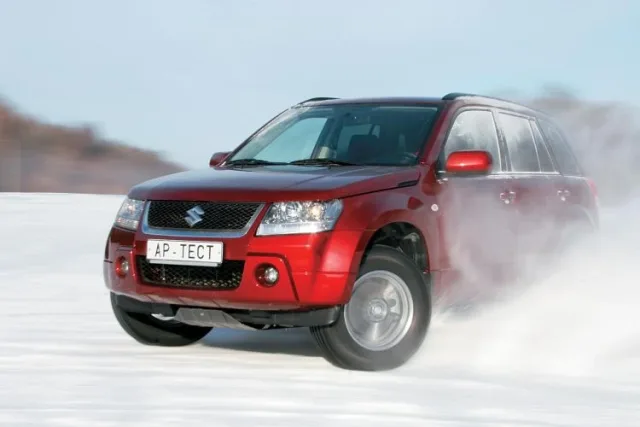
In a slippery corner, the Grand Vitara behaves ambiguously — either understeer or oversteer. And there is no stability control system…
There are also complaints about the automatic selector — moving the lever along the flat groove, it's easy to miss the Drive position.
The complete opposite is the Mitsubishi Outlander. It looks more like a station wagon, and the driving position is purely car-like. Fans of active driving will enjoy the instruments with white dials, sequential gear shifting mode, low seating, and dense seats with pronounced side support bolsters. It's a pity that drivers taller than 185 cm won't share this joy: the Outlander is too cramped for them. Also, against the background of the other test participants, the Mitsubishi's interior, although trimmed in leather, seems "bare": on the central console there are only a clock and simple climate control knobs. A "native" stereo is not offered even for the most expensive versions.
 |
|
| The Suzuki interior is good — modern design and excellent ergonomics | It's convenient to store CDs here |
 |
 |
| The instruments set a sporty mood, but the weak engine won't support the spirit | The rear headrests can be recessed to improve visibility |
At first glance, the Honda CR-V looks decent among its classmates, but there are questions about ergonomics. The seats are comfortable, but the "steering wheel-pedals-seat" arrangement is not ideal. Short people find it hard to reach the steering wheel, as it lacks reach adjustment. Tall drivers, on the other hand, lack available ranges: the seat lacks length adjustment, and the steering wheel lacks height adjustment. The automatic gear selector under the steering wheel is a specific feature that might appeal only to fans of American cars. To engage Drive or Reverse, you need to apply noticeable force each time, and there's a risk of missing the desired position. The handbrake lever, disguised as a brace on the center console, is also a questionable solution: you have to pull it toward you and down. However, the optitronic instrument cluster in the Honda is a sight to behold.
 |  |
| The seats fold in sections, freeing up the trunk with a flat floor | The door is held open by a gas strut |
 |  |
| Suzuki's automatic resembles Toyota's in both selector layout and shift smoothness | The seating position is the most comfortable of the five |
The rear seats in all five crossovers are fundamentally similar. The backrests are split into two unequal parts and recline. In the Honda and Toyota, the rear seats also slide forward and backward: if you move the seat forward, the trunk becomes larger, but sitting becomes quite uncomfortable.
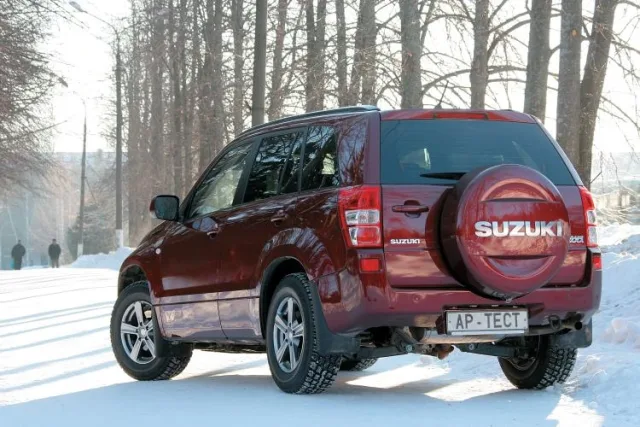
However, in terms of ease of entry and exit, space geometry, presence of armrests, and small-item compartments, the rear rows of the Honda, Suzuki, and Mitsubishi look best. In the Nissan, the high threshold and narrow opening get in the way. In the RAV4, getting in is easy, but there's slightly less legroom than in competitors, and the seat cushions are positioned too low.
Now for the trunks. The Honda CR-V offers a decent volume. Plus, the rear window opens separately, which is convenient for loading small items in a tight parking spot. And to be fully convinced that the Honda's trunk is the best, just lift the mat: there you'll find a folding table. An excellent bonus for road trippers!
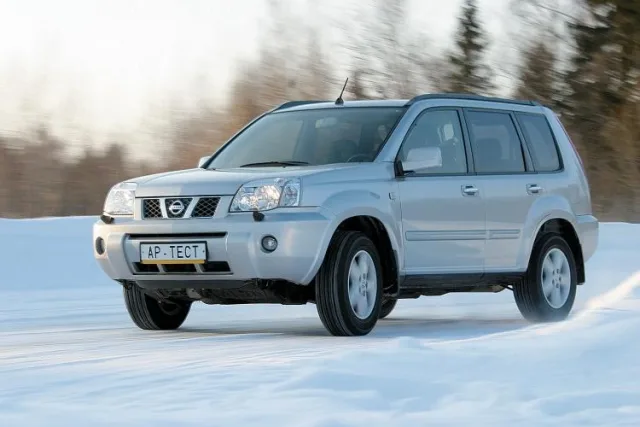
In a slippery corner, the Nissan X-Trail exhibits understeer, which the stability control system successfully combats
The Nissan and Toyota have comparable cargo volumes—like the Honda, they have underfloor compartments, but no table. The Suzuki's trunk is more modest, and you can't increase it by sliding the rear seats. The smallest compartment is in the Mitsubishi, but it also has the highest loading height.
 |  | |
| The Nissan gives the impression of a real SUV: high seating position, huge hood... But the instruments in the center are a controversial solution | Climate control and audio system are standard equipment | When engaging Drive, it's easy to miss and skip to mode 2 or 1 |
 |  | |
| Only the Nissan offers a front-wheel-drive mode for the transmission (2WD) | The main glove box is a bit small... | ...but in front of the driver there are two more compartments |
All cars can transform the cabin from five-seat to two-seat with intermediate options. This is best implemented on the new RAV4. To fold one of the seats, just pull a handle: the cushion automatically slides forward, and the backrest lowers onto it. Almost no effort is needed, and you can fold the seat either from the cabin or from the trunk, where there are special levers. Another movement, and the seat returns to its original position. Very well thought out!
 |  |
| Leather upholstery and power adjustments are in the Premium Pack version | Under the hard cover is a full-size spare tire |
 |  |
| Spacious in the back, but entry is complicated by a high threshold and narrow opening between the pillar and seat | With the seats folded, the Nissan X-Trail turns into a van with a flat cargo floor |
An attentive reader might notice an inconsistency: three cars are equipped with two-liter engines, while the Mitsubishi and Nissan have larger engines. The question is reasonable, especially since both of these cars are also sold with two-liter engines. But from a buyer's perspective, our choice is logical—you'll agree, when for the same money or with a small surcharge a more powerful version is offered, it would be strange to refuse.
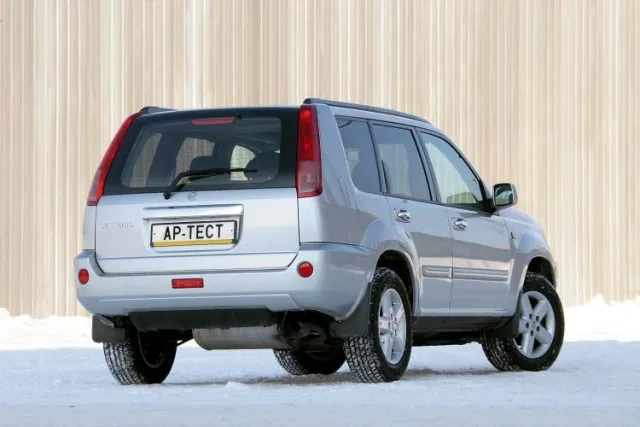
Unsurprisingly, the Mitsubishi and Nissan were ahead in acceleration dynamics. Both easily exceed 190 km/h, but more importantly, both respond lively to throttle input in normal driving and please with quick, timely automatic shifts. This gives confidence both in the city and on the highway. Due to the spring-winter road conditions, we didn't take dynamometer measurements, but by feel, the Nissan is slightly quicker, although its gearbox is "stretched": second gear pulls up to 130 km/h, and third up to 190. For the Mitsubishi, these figures are 110 and 155 km/h, respectively. Perhaps the weight plays a role—the X-Trail is 100 kg lighter. However, the Mitsubishi's automatic has a manual mode, which we gladly used on slippery surfaces.
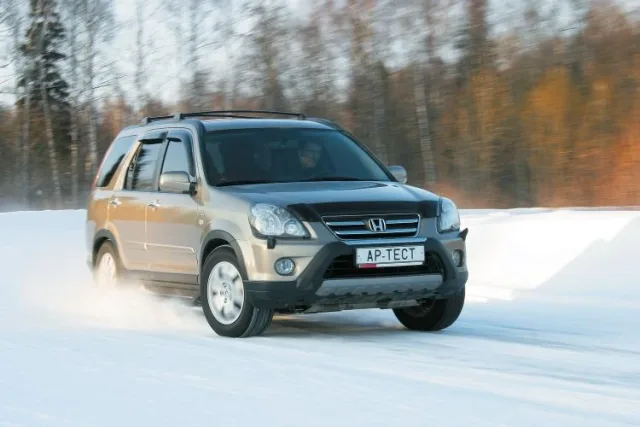
Honda CR-V: the "thoughtful" gearbox spoils not only acceleration dynamics but also handling. Good thing stability control is standard here
Among the "two-liter" cars, the Toyota RAV4 is the undisputed best. The engine with VVTi variable valve timing provides very confident acceleration in the mid-range, making it easy and pleasant to manage power in everyday driving. Of course, the automatic plays a significant role—it's not as quick as the Mitsubishi's, but it works smoothly and gently.
 |  |  |
| The selector lever under the steering wheel might appeal to fans of American cars, but we found it inconvenient | The seats are mediocre—both in profile and adjustment options | The optitronic instrument cluster is the main decoration of the Honda's interior |
The Suzuki's automatic also performs decently, but the engine lets it down—it seems weak compared to rivals. In everyday driving, there's enough torque, but when you floor the pedal, it feels like the car accelerates with strain, without spark. The Honda CR-V accelerates even worse. In terms of peak performance, the Honda and Suzuki are roughly equal, but when it comes to ease of controlling acceleration, the Honda loses. The culprit is the sluggish automatic and muted throttle pedal: where in the Toyota you'd overtake without hesitation, in the Honda it's better to wait for a more suitable moment. You'd expect completely different dynamics from a Honda…
 |  |  |
| The trunk is spacious, and its floor transforms into a folding table | There is enough space in the back — the seats in the CR-V can be slid forward or the backrest angle adjusted | |
We had no complaints about the braking systems of the Toyota, Nissan, and Honda crossovers. The Mitsubishi's pedal is overly sensitive — in urban conditions, it's difficult to precisely modulate deceleration. But on the highway, everything is fine. As for the Suzuki, the pedal sinks deeper than expected — it feels like there's air in the system.
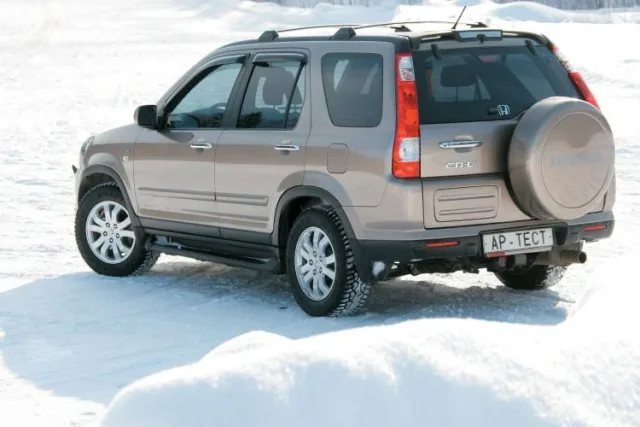
We tested the cars' behavior on both dry asphalt and slippery surfaces, where the settings of the all-wheel-drive transmission play a key role. The undisputed favorite is the Toyota RAV4. On asphalt, the excellently tuned chassis allows confident control of the trajectory even at high speeds, and the Toyota enters sharp corners easily, without frightening body roll. If the tires lose grip, the non-switchable VSC stability control system intervenes delicately. But the biggest surprise awaited us on the snowy roads of the test site. Where extreme effort was needed to get other cars into a turn, the Toyota driver only had to turn the steering wheel — and the car entered the corner easily, playfully! And, importantly, it exited just as willingly along the desired trajectory. Delight! In addition to the ideal coordination of the suspension and steering, the Integrated Active Drive system played a huge role. It redistributes torque between the front and rear axles to ensure the maximum possible cornering speed. Moreover, the electric power steering can 'weaken' the return force depending on the situation, helping the driver more precisely adjust the steering angle. Everything works very organically — no 'synthetic' feel, no irritation from intrusive intervention in such a delicate process as driving a car through a slippery turn. A flashing light and a buzzer remind you that the tire grip limit has been exceeded. Not thrilling, but extremely safe behavior! Or maybe... maybe the opposite — dangerous? After all, if a driver accustomed to the 'Rafik' gets behind the wheel of another car, they might fly off the road in the first slippery turn! But if we think that way, we'll never see progress in active safety.
The Mitsubishi Outlander doesn't have a stability control system even in top trims — that's unlikely to please those who aren't too confident behind the wheel. But an experienced driver races along a snowy winding road as if the Outlander were a well-tuned rally car. Drift through a corner? With pleasure! And on asphalt, the Outlander behaves like a solid passenger car, not an SUV. Quick responses, minimal body roll.
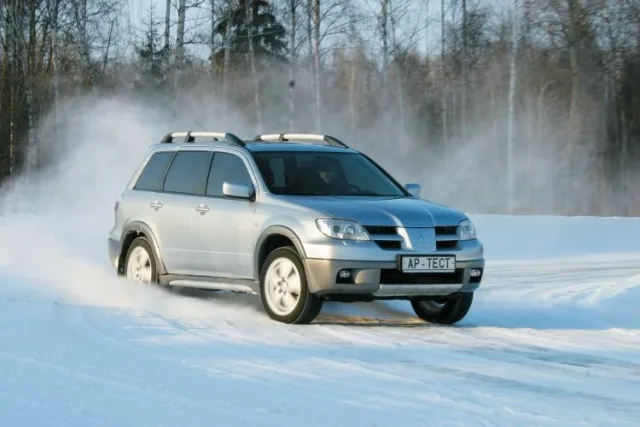
The Mitsubishi Outlander holds the road superbly on slippery surfaces: for an experienced driver, it's the most thrilling car! But beginners will have a hard time — there's no stability control
The Nissan is a classic SUV. In corners, the body rolls, and on bumps it sways, which reduces steering precision. However, moderate sensitivity and excellent reactive force allow you to handle the car even at high speeds. On slippery roads, the X-Trail exhibits understeer, which hinders turn-in, and it's harder and less pleasant to control the car in slides than with the Mitsubishi. But here there is a stability control system that will reliably back you up in case of a serious mistake.
On asphalt, the Grand Vitara resembles the RAV4 — almost the same sensitivity, the same moderate body roll. But in sharp corners, the Suzuki driver lacks reactive force on the steering wheel. And on slippery roads, the Suzuki and Toyota are completely different cars! When entering a turn, the Suzuki behaves unpredictably: it either breaks into a slide or understeers. And there's no help to be expected — there's no stability control here. Also, the engine's power is sometimes insufficient to break the wheels into a slide in time.
 |  |  |
| The Mitsubishi interior looks 'empty' — there's not even a standard radio | The white dials of the Mitsubishi look attractive, but at night the scale readings blur | The most successful selector. And the 'automatic' works flawlessly |
The Honda's handling pleased us even less. In normal modes, everything is decent, but as soon as you enter a corner faster, the car rolls, sways, and the steering loses feedback. On slippery surfaces, the reactions to the steering wheel and throttle are so vague that all actions have to be done in advance — turn earlier, add or release the throttle earlier. And it's not always possible to account for the delay: miss by a fraction of a second — and the car slides past the turn. Only the stability control system saves you. Although it doesn't work as well as in the Toyota, it's much calmer with it.
Now about comfort. The 'Rafik's' suspension handles small bumps excellently, and there's no pitching on road waves. It's pleasant to drive the Toyota even on a broken dirt road. The acoustic idyll is disturbed only by the engine, and only after 4000 rpm. The Toyota RAV4 is the most comfortable car in our five.
The Nissan X-Trail also pleased with its ride smoothness: the suspension 'absorbs' small bumps perfectly and boasts enviable energy intensity. But the Nissan is noisier: the engine is audible across the entire rev range, tires add their voice, and at speeds of 100 km/h and above, wind whistle joins in.
 |  |  |
| The climate control is a bit simple | There are two sunroofs in the roof, but only the front one opens |
The Honda pleased with acoustic comfort in the cabin, but didn't impress with ride smoothness. The suspension here combines seemingly incompatible things: on asphalt waves, the body noticeably sways at speed, but on small joints and seams, it seems overly stiff, as if the tires are overinflated. We checked the pressure, though — it was normal.
The Suzuki's suspension suffers from insufficient energy intensity. On smooth surfaces, the car rides quite decently, ignoring small cracks, but on larger bumps, the body starts to bounce. And the most annoying source of noise in the cabin turned out to be the engine.
Mitsubishi clearly sacrificed comfort for handling. In city traffic, the Outlander meticulously follows the road surface, not missing a single seam, but on the highway it opens up: the stiff suspension at speeds from 100 to 160 km/h reliably resists pitching. Even on ramps, you don't have to slow down — the car confidently leaves the ground and lands softly. If you don't believe it, look at the photos in AR No. 11 for 2003: the Outlander hangs half a meter above the road. In terms of noise level, the Mitsubishi is almost on par with the Suzuki and Nissan.
Everyone knows that crossovers aren't meant for serious off-roading. It's also known that this has never stopped us. But this time, we decided not to play heroes and limited ourselves to driving onto snowy virgin soil. The Suzuki Grand Vitara and Nissan X-Trail handled the task best. The former has a low-range gear, which the competitors lack. The latter takes it with a powerful engine and the largest ground clearance.
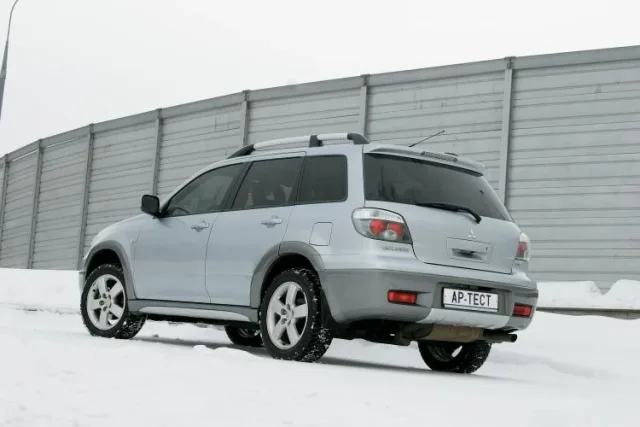
The Outlander also didn't let us down, despite the lack of additional transmission modes. It's a quite capable 'off-roader', but only in the version with the 'automatic'. With the manual gearbox, you just need to miss slightly — and the clutch starts to slip; we tested this in practice.
The Honda clearly wasn't impressed by the snowy Russian field. A couple of times we had to pull it out with the Suzuki. However, there's nothing to be surprised about: essentially, it's a front-wheel-drive car that transfers torque to the rear wheels only when the front ones slip. There's no hard locking of the coupling, as in the Nissan or Toyota.
And how did the RAV4 perform off-road? It performed better than the Honda, but far from perfectly. It seemed that, like the Nissan, it had an electronically controlled clutch in the rear-wheel drive that could be locked. That's true, but on snow, the non-switchable traction control system spoiled everything. It strangled the engine and braked the wheels at the most inopportune moments. The RAV4 got stuck in a completely harmless situation: the left front and right rear wheels were spinning, and the electronics, instead of transferring torque to the other wheels, only limited the revs to 1500 rpm. It's commendable that the traction control protects the transmission from overloads, but when you get stuck in such triviality, you start cursing all that automation. By the way, we tried to drive onto virgin snow without engaging the clutch lock — and within a couple of minutes, a warning about its overheating lit up on the display. The manual advises stopping and waiting for the working fluid to cool down. And if you don't stop? After a hundred meters, the RAV4 stopped, having dug its front wheels into the snow. The electronics simply switched off the rear-wheel drive, as indicated by the '2WD' indicator. We want to warn future owners, especially female owners of new 'Rav4s', in advance: carefully study the transmission section of the manual and don't forget to press the clutch lock button every time you leave the asphalt.
This little adventure, of course, slightly spoiled the excellent impression of the new RAV4. But on asphalt, where crossovers spend 99% of their lives, the Toyota RAV4 is unrivaled. This car has again raised the bar for safety and comfort to a height that competitors are unlikely to reach in the near future. It's also pleasing that prices have hardly changed: the base version with a manual transmission has risen by only $600 and now costs $33,000.
However, calling the other test participants obvious outsiders is hard: each has its own strengths.
The Suzuki Grand Vitara, despite its 'crossover' look, feels great off-road. And thanks to the low-range gear, this car will pull not only itself but also others out of trouble — tested in practice. The Nissan X-Trail pleases with a powerful engine and, accordingly, excellent dynamics. The Mitsubishi Outlander — with sporty handling and a moderate price tag: the two-liter base version can be bought for $26,650.
The Honda CR-V, even having formally taken last place, is not without its merits. Take, for example, the spacious trunk or the picnic table...
| Expert assessments of Autoreview | ||||||
| Parameter | Max. score | Honda | Mitsubishi | Nissan | Suzuki | Toyota |
| Design | 160 | 120 | 120 | 125 | 130 | 135 |
| Exterior | 80 | 60 | 60 | 60 | 65 | 65 |
| Interior | 80 | 60 | 60 | 65 | 65 | 70 |
| Ergonomics | 160 | 130 | 130 | 135 | 150 | 145 |
| Driver's workplace | 80 | 60 | 65 | 65 | 75 | 75 |
| Visibility | 80 | 70 | 65 | 70 | 75 | 70 |
| Driving performance | 330 | 240 | 270 | 275 | 255 | 270 |
| Acceleration dynamics | 80 | 55 | 70 | 70 | 60 | 65 |
| Braking dynamics | 100 | 90 | 85 | 90 | 80 | 90 |
| Handling | 80 | 55 | 65 | 60 | 60 | 70 |
| Off-road capability | 70 | 40 | 50 | 55 | 55 | 45 |
| Ride comfort | 180 | 135 | 130 | 135 | 135 | 155 |
| Ride smoothness and vibration protection | 70 | 50 | 50 | 55 | 50 | 60 |
| Acoustic comfort | 60 | 50 | 45 | 45 | 45 | 50 |
| Climate control | 50 | 35 | 35 | 35 | 40 | 45 |
| Interior comfort | 170 | 145 | 125 | 135 | 135 | 140 |
| Passenger seats | 70 | 60 | 60 | 55 | 60 | 55 |
| Trunk | 60 | 55 | 40 | 50 | 45 | 50 |
| Interior transformation | 40 | 30 | 25 | 30 | 30 | 35 |
| Total | 1000 | 770 | 775 | 805 | 805 | 845 |
What costs how much?
Toyota RAV4 can't be called cheap (from $33,000 for the version with a manual transmission), but even in the initial R1 trim, there is a stability control system, seven (!) airbags, climate control, and an audio system with a CD changer. For the Russian market, only one engine is available — 2.0 liters with 152 hp. The surcharge for the 'automatic' is $1,400 (that's the car for $34,400 that participated in the test). And for $37,800, they offer the top R2 version with cruise control, rain sensor, leather interior, Smart Entry central locking, and keyless engine start.
Suzuki Grand Vitara is more affordable — the base five-door with a two-liter engine (140 hp) and a manual transmission will cost $29,300. The equipment includes climate control, heated seats and mirrors, and two airbags. For the 'next level' version with 17-inch wheels, 'automatic', CD changer, and six airbags, you'll have to pay an extra $2,600 — that's the Grand Vitara that participated in our test. And at the top of the range is a version with keyless start, cruise control, sunroof, leather interior, and xenon headlights with washers for $35,130.
Suzuki can also be purchased with a three-door body — but only with a 1.6-liter engine (106 hp) and a simplified transmission without a center differential lock and low-range gear. Prices range from $25,300 to $27,000.
Honda CR-V in the base trim ($32,400) is equipped with a stability control system, air conditioning, heated seats and mirrors. For climate control, alloy wheels, and body-colored bumpers, you need to pay an extra $2,000. The version with an 'automatic' is another $1,000 more expensive (that's the car we took for the test). The most expensive trim — with a sunroof and leather interior — costs $36,900.
The choice of powertrains and body variants is limited: only a five-door version with a two-liter engine producing 150 horsepower is available.
Mitsubishi Outlander is the most budget-friendly option among our comparison participants: the starting price for the 2.0 Invite version with a manual transmission is $27,190. However, for this money, the equipment is modest — air conditioning, a couple of airbags, heated seats and mirrors. Modifications with a 2.4-liter engine are priced from $30,590, and they already include climate control, fog lights, and side airbags. For an automatic transmission, you'll have to pay an extra $1,260. The test Outlander 2.4 AT Instyle, equipped with a leather interior, 17-inch alloy wheels, and two sunroofs, cost $35,290. Notably, even in the most expensive trims, there is no standard audio system — only preparation for it.
The turbocharged version of the Outlander with 200 hp and a manual transmission is priced by dealers at $37,690.
Nissan X-Trail stands out favorably with a balance of price and equipment. The initial 2.0 Columbia version for $29,900 already includes climate control, heated seats, an audio system with a CD player, and four airbags. The Sport version with 16-inch alloy wheels, fog lights, and a spoiler on the tailgate costs from $31,850. A sunroof is an option for $600, an automatic transmission for $1,700. The surcharge for a more powerful 2.5-liter engine (165 hp) is $4,000. Elegance versions with a leather interior, power-adjustable front seats and mirrors start from $35,800 for a two-liter car with an 'automatic'. Our test featured the most expensive option — the X-Trail 2.5 AT Elegance for $39,630.
In addition to petrol versions, a 2.2-liter diesel (136 hp) is available for the X-Trail, with prices starting from $35,010.
All five models from our test are covered by a warranty of 3 years or 100,000 km.
| Honda CR-V 2.0, Mitsubishi Outlander 2.4, Nissan X-Trail 2.5, Suzuki Grand Vitara 2.0, Toyota RAV4 2.0 (manufacturer data) | |||||
| Vehicle | Honda | Mitsubishi | Nissan | Suzuki | Toyota |
| Body type | 5-door wagon | ||||
| Number of seats | 5 | 5 | 5 | 5 | 5 |
| Trunk volume, l | 527/952* | 420/1100* | 410/1841* | 398/1396* | 586/1469* |
| Curb weight, kg | 1513 | 1580 | 1450 | 1595 | 1505 |
| Gross weight, kg | 1960 | 2070 | 2000 | 2070 | 2110 |
| Engine | petrol, with distributed fuel injection | ||||
| Location | front, transverse | front, transverse | front, transverse | front, longitudinal | front, transverse |
| Number and arrangement of cylinders | 4, in-line | 4, in-line | 4, in-line | 4, in-line | 4, in-line |
| Displacement, cm³ | 1998 | 2378 | 2488 | 1995 | 1998 |
| Compression ratio | 9.8 | 9.5 | 9.5 | 10.5 | 9.8 |
| Number of valves | 16 | 16 | 16 | 16 | 16 |
| Maximum power, hp/kW/rpm | 150/110/5500 | 160/118/5750 | 165/121/6000 | 141/104/6000 | 152/112/6000 |
| Maximum torque, Nm/rpm | 192/4000 | 216/4000 | 230/4000 | 183/4000 | 194/4000 |
| Transmission | automatic, 4-speed | ||||
| Gear ratios | |||||
| I | 2.68 | 2.84 | 2.79 | 2.82 | 3.94 |
| II | 1.53 | 1.53 | 1.55 | 1.49 | 2.19 |
| III | 1.08 | 1 | 1 | 1 | 1.41 |
| IV | 0.7 | 0.71 | 0.69 | 0.68 | 1.02 |
| reverse | 2 | 2.48 | 2.27 | 2.7 | 3.14 |
| final drive | 4.56 | 4.04/4.41 | 4.09 | 5.12 | 3.29 |
| Drive | all-wheel, with multi-disc clutch in rear wheel drive | permanent, all-wheel, with center differential, locked by viscous coupling | all-wheel, with multi-disc clutch in rear wheel drive | permanent, all-wheel, with center differential lock and reduction gear | all-wheel, with multi-disc clutch in rear wheel drive |
| Reduction gear | — | — | — | 1.00/1.97 | — |
| Front suspension | independent, spring, McPherson | independent, spring, McPherson | independent, spring, McPherson | independent, spring, McPherson | independent, spring, McPherson |
| Rear suspension | independent, spring, multi-link | independent, spring, multi-link | independent, spring, McPherson | independent, spring, multi-link | independent, spring, double wishbone |
| Front brakes | disc, ventilated | disc, ventilated | disc, ventilated | disc, ventilated | disc, ventilated |
| Rear brakes | disc | disc | disc | drum | disc |
| Tires | 205/65 R16 | 215/55 R17 | 215/65 R16 | 225/70 R16 | 215/70 R16 |
| Maximum speed, km/h | 167 | 191 | 178 | 170 | 175 |
| Acceleration time 0—100 km/h, s | 13.1 | 11.2 | 11.1 | 13.6 | 12 |
| Fuel consumption, l/100 km | |||||
| urban cycle | 12.3 | 13.8 | 12.7 | 12.1 | 11.6 |
| extra-urban cycle | 7.6 | 8 | 7.9 | 7.9 | 7.4 |
| combined cycle | 9.3 | 10.1 | 9.6 | 9.4 | 9 |
| Fuel tank capacity, l | 58 | 60 | 60 | 66 | 60 |
| Fuel | petrol AI-95 | petrol AI-95 | petrol AI-95 | petrol AI-95 | petrol AI-95 |
| * With rear seats folded | |||||
| Equipment of vehicles participating in the test | |||||
| Honda CR-V | Mitsubishi Outlander | Nissan X-Trail | Suzuki Grand Vitara | Toyota RAV4 | |
| Base price of vehicle, $ | 32400 | 27190 | 29990 | 29300** | 33000 |
| Front airbags | + | + | + | + | + |
| Front side airbags | + | o | + | + | + |
| Inflatable "curtains" | o | – | – | – | + |
| Driver knee airbags | – | – | – | – | + |
| ABS | + | + | + | + | + |
| Dynamic stability system | + | – | o | – | + |
| Automatic transmission | + | o* | + | o | o |
| All-wheel drive transmission | + | + | + | + | + |
| Power steering | + | + | + | + | + |
| Adjustable steering column by height | + | + | + | + | + |
| Adjustable steering column by reach | – | – | – | – | + |
| Multifunction steering wheel | + | – | + | + | + |
| Leather-wrapped steering wheel | – | o | o | – | + |
| Central locking with keyless entry system | + | +*** | + | + | + |
| Anti-theft system with immobilizer | + | + | + | + | + |
| Power adjustment and heating of exterior mirrors | + | + | + | + | + |
| Auto-folding mirrors | – | – | o | – | + |
| Automatic power windows | + | + | + | + | + |
| Front seat adjustment | |||||
Full or not full?
 The Suzuki Grand Vitara has the most serious transmission of all test participants, with three modes. In the standard situation (4H), torque is distributed between the axles in a 50:50 ratio, and the center differential is not afraid of any surface. If the road is slippery or you have to drive off-road, you can engage the lock (4H Lock), and for towing a trailer or very heavy conditions, a reduction gear (4L Lock) is provided.
The Nissan X-Trail in everyday life is a single-drive, that is, front-wheel drive (2H). On slippery surfaces there is a 4 Auto mode, when the rear is connected automatically: the electronic multi-disc clutch transfers torque to the rear as soon as the front wheels begin to slip. For off-road, the clutch can be locked forcibly (4 Lock).
The Toyota RAV4 also has a multi-disc clutch with electronic control, but it always works in automatic mode, adding torque to the rear axle as needed. Moreover, the degree of locking is determined not only by front wheel slip: the stability system also affects the clutch operation, which actively participates in handling on slippery roads. Off-road, while speed does not exceed 25 km/h, the clutch can be locked with the Lock button on the front panel.
The Honda CR-V also has a multi-disc clutch in the rear wheel drive, which is connected by electronics when the front axle slips.
The Mitsubishi Outlander is a permanent all-wheel drive with a symmetrical center differential, which is locked by a viscous coupling. No additional modes are provided in the transmission.