
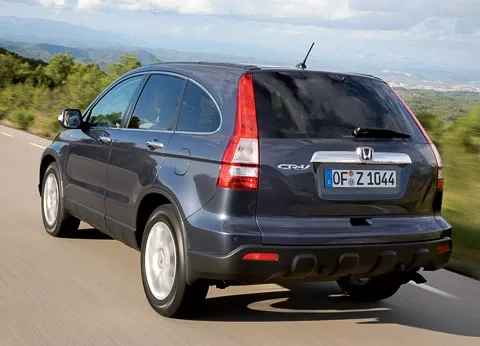
The interior has also become much more interesting. In the previous CR-V's cabin, only the original parking brake lever stood out from the general grayness. Now everything is different: an instrument panel with a pleasant blue backlight, a steering wheel familiar from the new Civic, solid trim materials and comfortable front seats. The cabin feels noticeably fresher and more expensive. The "handbrake" itself hasn't gone anywhere and has again become a highlight — now it has an L-shape.
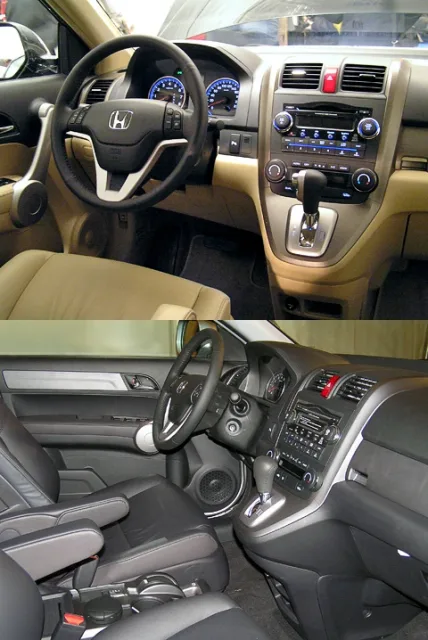
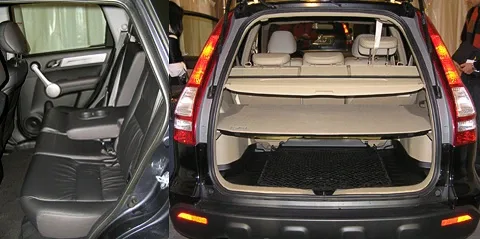
Getting in and out of the car has become easier thanks to doors that open almost 90 degrees. In the trunk, whose volume is 556 liters, an additional sliding shelf has appeared — for light items (you can put heavy things on it, but there is a risk it won't hold). Rear passengers no longer have to press their knees into the front seat backrest — there is plenty of space. And if the trunk is empty, you can recline the rear seat backrest and settle in with maximum comfort.
The equipment is also pleasing. Already in the base Comfort trim for $33,800, there are VSA and TSA stability systems (the first is responsible for vehicle stability, the second for behavior with a trailer), six airbags, air conditioning, heated front seats and a 6-speed manual transmission. The top is the Executive version with leather interior, power-adjustable driver's seat, dual-zone climate control, xenon headlights, 5-speed automatic, 18-inch wheels, parking sensors and cruise control. Such pleasure costs $39.5 thousand — only 2.5 thousand more than the previous top version cost. The first cars will appear at dealers at the end of February.
All this is certainly good: striking appearance, excellent interior, rich list of options. But the main question is how the car behaves on the road? After all, the second generation CR-V was not famous for outstanding handling or dynamics. And here the new model pleasantly surprises — at least, that's the impression left after a short test that the organizers conducted on snowy and icy tracks in Luzhniki.
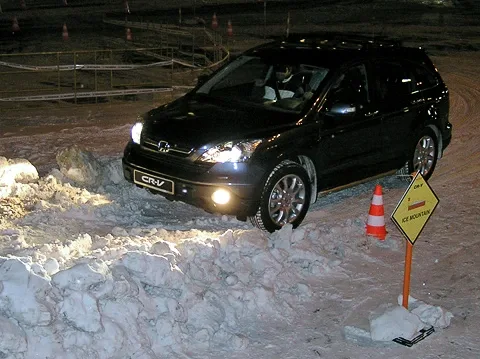
The crossover handles very pleasantly: reactions to steering wheel turns are almost instantaneous, without delays. The brakes also pleased — they are effective and informative. A significant role in this behavior was played by the lowered center of gravity by 35 millimeters and the increased track. On ice, another plus emerged: the Real Time 4WD all-wheel drive system now connects the rear axle much faster, and the car confidently starts on all four wheels at once. In the previous CR-V, these pauses were clearly noticeable. But there is also a serious drawback, and it is related to the engine.
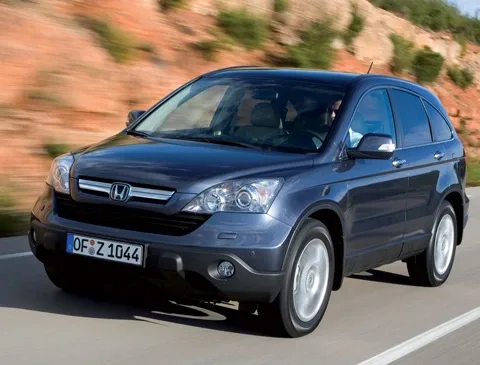
The two-liter engine with the i-VTEC system is not bad in itself: it revs briskly and sounds pleasant. But 150 horsepower is clearly not enough for a one-and-a-half-ton all-wheel-drive vehicle. And if you add an automatic transmission to this, the situation becomes quite sad... Such a chassis, precise steering and excellent brakes simply beg for a more powerful unit. And this is perhaps the most significant drawback of the new CR-V. Oh, if only it had the 190-horsepower engine from the Accord!
Of course, in such a short acquaintance, much remained behind the scenes, but one thing is certain — the new CR-V has become better than its predecessor in all respects. And in terms of design, it even stands out among its faceless competitors. However, young and active buyers, for whom, judging by the appearance, the new model is intended, may be put off by the somewhat weak engine. It remains to hope that Honda will fix this flaw and offer Russian buyers a version with a more powerful gasoline unit.