
| Specifications | Honda CR-V 2.4 |
|---|---|
| Body | |
| Number of doors/seats | 5/5 |
| Length, mm | 4530 |
| Width, mm | 1820 |
| Height, mm | 1675 |
| Curb weight, kg | 1595–1631 |
| Gross weight, kg | 2080 |
| Trunk volume, l | 442 |
| Engine | |
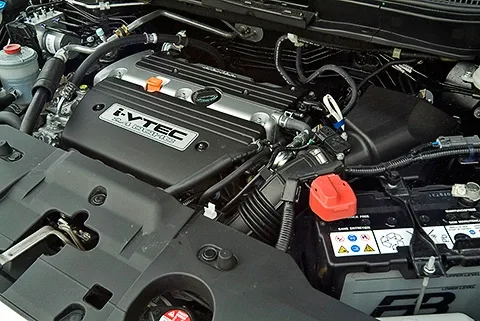
| Type | Petrol, with distributed injection |
| Location | Front, transverse |
| Number and arrangement of cylinders | 4, in-line |
| Number of valves | 16 |
| Displacement, cm3 | 2354 |
| Max power, hp/rpm-1 | 166/5800 |
| Max torque, Nm/rpm-1 | 220/4200 |
| Transmission | |
| Gearbox | Automatic, five-speed |
| Drive | Front permanent, rear plug-in |
| Chassis | |
| Front suspension | Independent, McPherson |
| Rear suspension | Independent, double wishbone |
| Front brakes | Disc, ventilated |
| Rear brakes | Disc |
| Performance characteristics | |
| Maximum speed, km/h | 190 |
| Acceleration time from 0 to 100 km/h, s | 11 |
| Fuel consumption, l/100 km | |
| Urban cycle | 13.1 |
| Extra-urban cycle | 7.4 |
| Combined cycle | 9.5 |
| Toxicity standard | Euro-4 |
| Fuel tank capacity, l | 58 |
| Fuel | AI-95 |
- Front airbags
- Side airbags
- Side curtain airbags
- ABS
- Traction control system
- VSA stability control
- 18-inch alloy wheels
- 4 electric windows
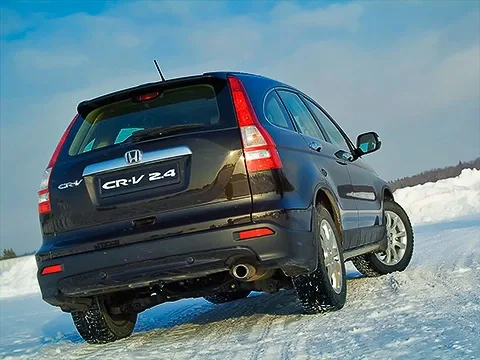
Honda CR-V: a crossover that knows comfort
When it comes to a versatile car for the city and light off-road, the Honda CR-V always ranks among the top candidates. This Japanese has long won the sympathy of Ukrainian drivers, and I decided to check how justified such love is. The test drive was eventful: there were highways, snowy fields, and even an attempt to beach the car. But let's take it in order.
First acquaintance: exterior and interior
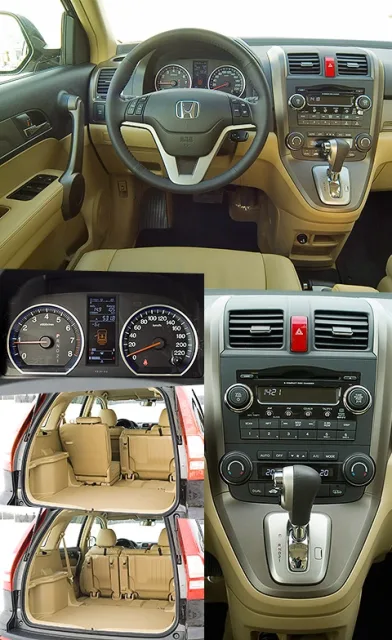
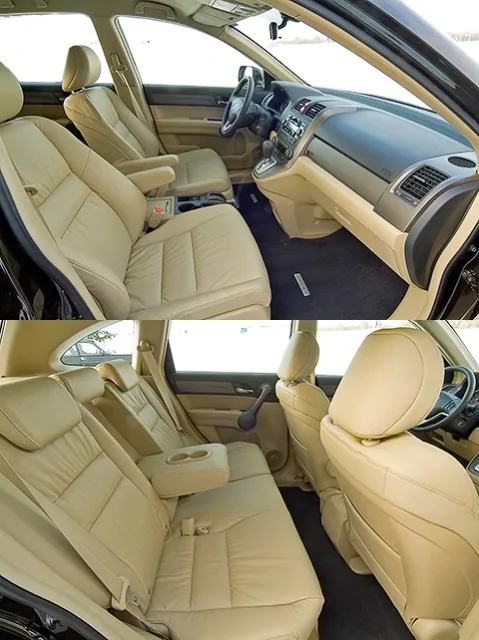
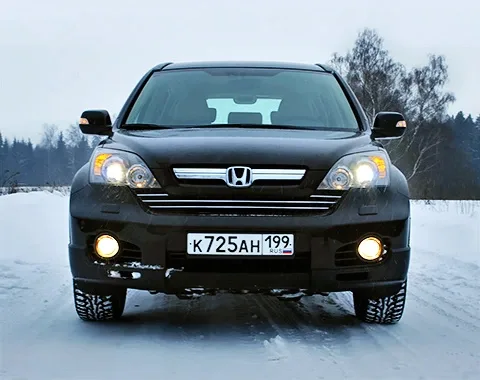
The CR-V is hard to call a handsome car, but it has its own charm. The car looks solid and expensive, though without any special design frills. Inside, it's spacious and comfortable. Quality materials, thoughtful ergonomics, and leather-trimmed seats greet the driver with comfort. I was especially pleased with the power-adjustable front seat — finding a comfortable driving position takes just a couple of seconds. Rear passengers won't have anything to complain about either: the seatback angle is adjustable, and there's plenty of legroom.
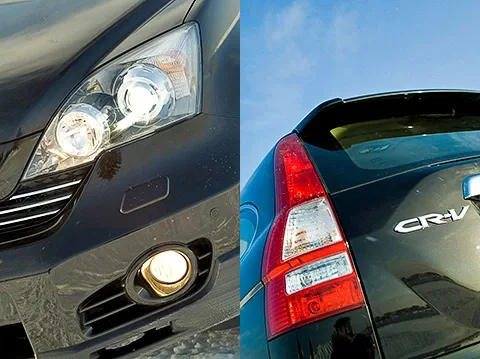
The equipment of the tested car is impressive. It includes xenon headlights with washers, front and rear parking sensors, and dual-zone climate control. Power-adjustable and heated mirrors are a nice bonus for our winter. Rain and light sensors add comfort to daily driving. The audio system with a six-disc changer and subwoofer will please music lovers, and cruise control will please those who often drive on highways.
The cost of such pleasure is 1,079,000 rubles (approximately $44,185). The base version will be slightly cheaper — 1,049,000 rubles ($42,956).
Model History
The CR-V debuted in 1996 with a two-liter engine producing 128 horsepower. Just three years later, the engine was boosted to 147 horsepower. The second generation, released in 2002, for the first time received a 2.4-liter engine, but only for the American market. The rest of the world had to make do with a two-liter gasoline engine, to which a turbodiesel was later added.
Competitors: Who Else Is Vying for the Buyer's Wallet
The CR-V's main rival in our market is the Toyota RAV4, the undisputed leader of the segment. With a 170-horsepower 2.4-liter engine, it's available in the Sol trim for 1,102,500 rubles. The equipment almost mirrors the Honda's, but the automatic transmission here is four-speed, and there's no xenon. Nevertheless, 22,856 buyers chose the Toyota, though most of them opted for simpler versions with a two-liter engine.
The Mitsubishi Outlander XL also started confidently — 15,223 cars sold in 2007. Interestingly, most buyers preferred the three-liter versions, which appeared first. The strengths of the Japanese car are its stylish design, sporty character, and attractive price. The base 2.4-liter version (170 hp) with a CVT starts at 974,180 rubles in the Invite trim. The top Intense version with a Rockford Fosgate audio system, leather interior, and sunroof costs 1,055,000 rubles. And for 1,082,000 rubles, you can get a three-liter 220-horsepower car with a six-speed automatic, climate control, and a simple stereo.
The Opel Antara and its twin, the Chevrolet Captiva, with a five-speed automatic, cost even less — from 925,000 rubles for the American and plus 12,000 for the German. But the 2.4-liter engine produces only 140 horsepower. The base includes ESP, climate control, a CD/MP3 stereo, cruise control, parking sensors, and 17-inch wheels. Paying an extra 37,000 rubles for the Captiva gets you wheels an inch larger, a CD changer, and a tow hitch. And for 1,086,000 rubles, a version with a 3.2-liter V6, leather, and heated windshield is available.
The Nissan X-Trail with a 169-horsepower 2.5-liter engine and CVT starts at 988,000 rubles. The SE trim includes climate control, 17-inch alloy wheels, ESP, and a stereo with a CD changer. A version with a panoramic sunroof and xenon will cost 1,069,000 rubles.
Fans of American cars should take a closer look at the Jeep Liberty. The base trim with a 170-horsepower engine and CVT costs 862,000 rubles. It includes 17-inch alloy wheels, air conditioning, and cruise control. The top Limited P2 version for 960,400 rubles adds a tire pressure monitoring system, leather, and a Boston Acoustics audio system with nine speakers.
Off the Asphalt: Off-Road Test
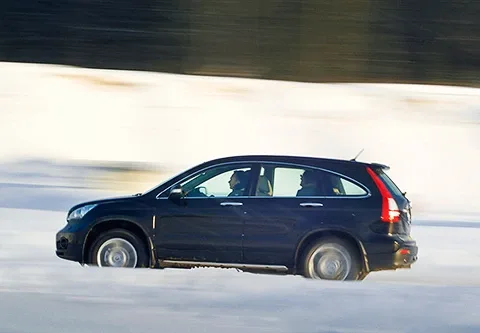
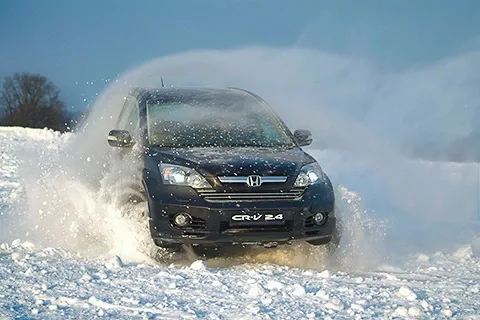
Our crew didn't limit itself to calm driving on asphalt — we decided to test the CR-V on Russian off-road. First, a truck got stuck on a narrow incline. An old Land Cruiser simply drove around it through the snowdrifts, but the Honda, being a crossover rather than an SUV, got out differently — it carefully slipped along the snowy shoulder on the other side. A decent result.
But then we did get the car stuck. On a narrow field road, a colleague unsuccessfully attacked a pile of snow, and at speed, the car slid onto the shoulder. The CR-V couldn't get out on its own — it's not an SUV, there are no lockers. But the car honestly spun its wheels, trying to grip something solid. We were ready to push (there were five of us), but a support vehicle came to the rescue — a Land Rover Defender from the Camel Trophy competition. The rescue operation took only five minutes, and we continued on our way.
An interesting fact: our car covered this route twice instead of the planned once, and on the second lap, we noticed exactly the same tracks of a slide-off about fifty meters further than ours. It seems our colleagues also got distracted by something at that moment.
In the end, the Honda CR-V left the impression of a solid, comfortable, and well-equipped crossover that feels confident in the city and on light off-road, but you shouldn't expect feats in the spirit of real SUVs from it.