
Everything came together: the flashy looks, and the Engine Start button to the left of the steering column… Before me is not just a Honda Civic hatchback, but the freshest three-door Civic Type R! And ahead — many kilometers of Spanish roads and the former "Formula" track in Estoril.
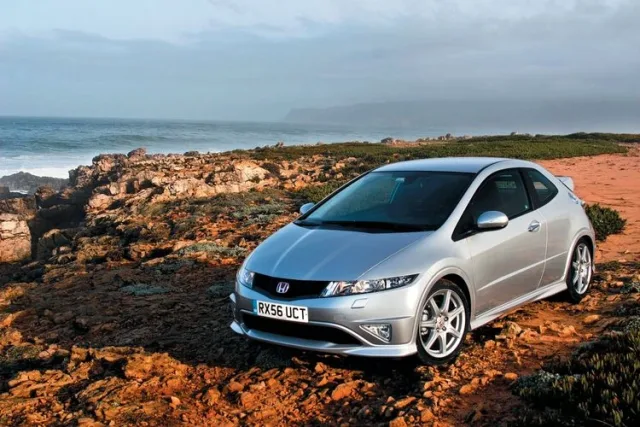
At first, I frankly stalled for time: leisurely unpacked my luggage, examined the Bridgestone Potenza 225/40 R18 tires… Savored the anticipation. And was a bit nervous. I recalled how in my student years in a racing team I gazed in awe at the "extra" VTEC rocker arms on an old circuit Civic, how I first fiddled with multi-link suspensions on my own. And then our, essentially production, Civic dealt with the meanest "eights" of that time. A wolf in sheep's clothing…
Now there's no trace of the "sheep's clothing" — the three-door (and there won't be a five-door Type R) looks stunning. Compared to the already familiar five-door version, there are more developed spoilers, an aggressive air intake, and the usual faux radiator grille instead of the mirror-like "chandelier." Design frills would simply hinder the powerful engine from breathing.
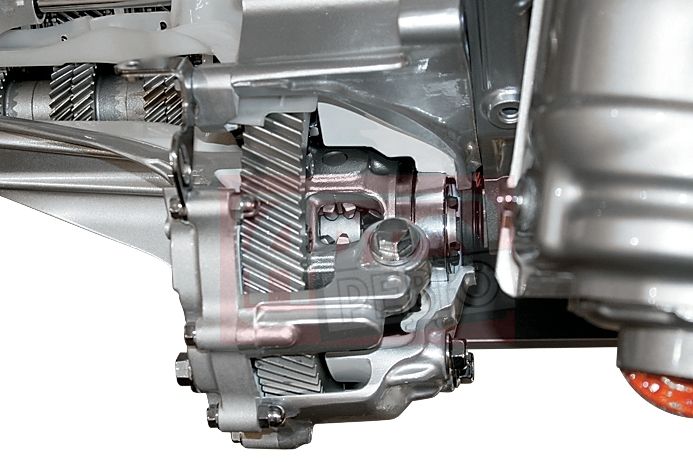 | |
| The 2.0-liter engine 2.0 i-VTEC received a new control program and balance shafts to reduce vibrations | The final drive of the six-speed manual became "shorter" (5.06 vs. 4.76), and the differential remained free — the Type R has a limited-slip diff only on the Japanese and American markets |
The engine — that's the heart of the Honda Civic Type R hatchback! And it also raises the most questions. How will Honda respond to the "horsepower race" of competitors, who are becoming more powerful with turbocharging? For example, the Ford Focus ST gained a whole 55 hp with the generation change and now produces 225 hp, while the class leader in power, the Mazda 3 MPS, has a whopping 260 hp!
But Honda remained silent in response. The two-liter "four" from the old Type R became more powerful by just one "pony": 201 instead of 200 hp. And torque even dropped slightly — by 3 Nm (to 193 Nm).
— Perhaps "torquey" turbo engines are more convenient in everyday driving, but the spirit of racing is more important to us. And that necessarily means high revs, — the Japanese continue to stick to their "naturally aspirated" line.
But they could have… Honda does have "turbo experience" — recall the City Turbo hot hatch from the mid-eighties or the latest American crossover Acura RDX. And even without forced induction, Japanese engine builders were extracting 120 hp per liter of displacement eight years ago on the S2000 model (see AR No. 10, 1999).
But, according to engineers, even if you ignore all environmental regulations, the ceiling of the current engine (internal factory code K20Z3) is 250 hp. And the Japanese spared the money earned last year (worldwide Honda car sales grew by 4.6%) for a new engine. Likewise, they spared it for a multi-link rear suspension — the Civic Type R, like the regular five-door, makes do with a simple "twist beam."
But is that so scary in light of modern technologies and the possibilities of tuning even simple suspensions?
Let's check now!
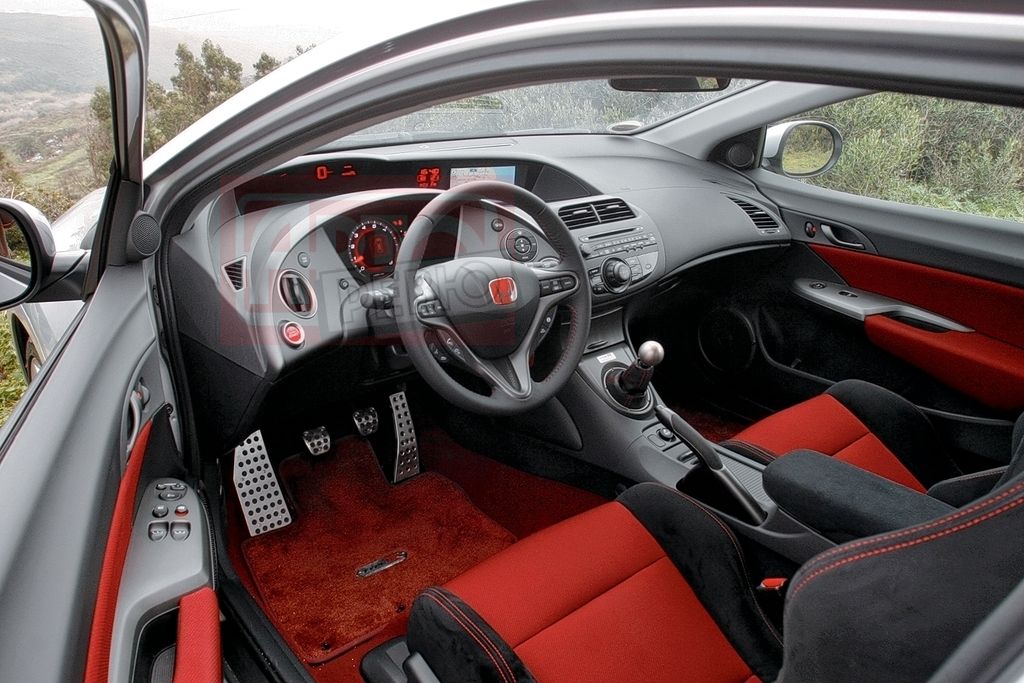 | 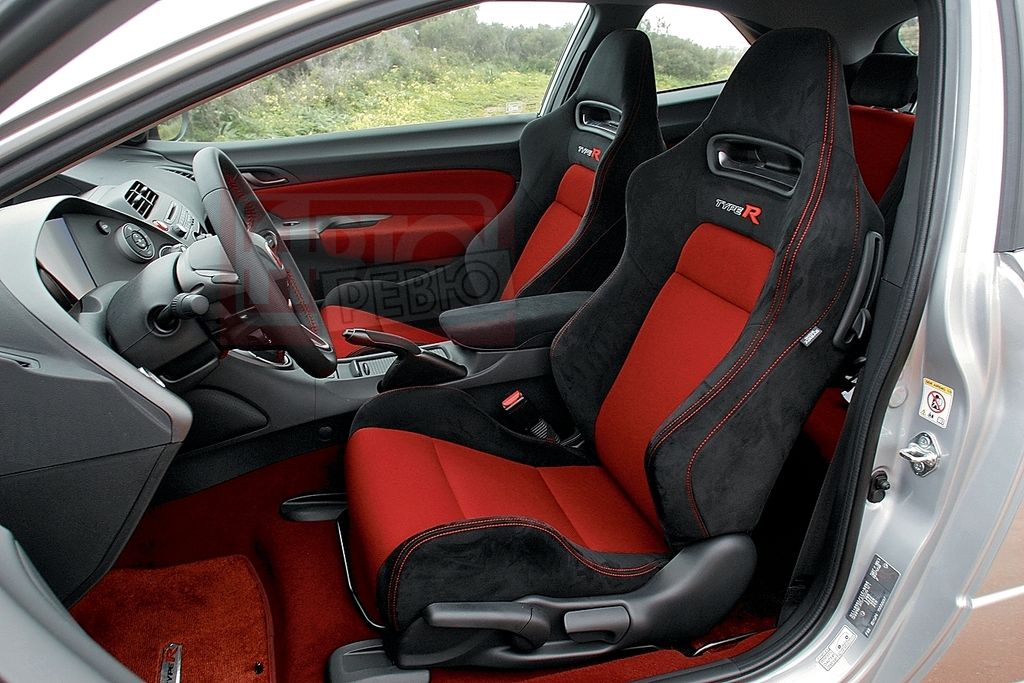 |
| Ergonomics are typically sporty: on the left — the Engine Start button, on the right — the gearshift knob ball. And in the center — the tachometer | The sporty "bucket" seats are magnificent, the main thing is to be able to reach the seat belt |
The front "buckets" with red inserts and holes for racing belts are magnificent — with a large range of longitudinal adjustment and firm Alcantara embraces. The intricate gearshift lever handle has given way to a simple aluminum ball — well, could anything be more convenient? The perforated pedals, as on the regular Civic, are just right here. The sporty spirit is woven with a red thread into the leather of the steering wheel and gearshift boot, fills the instruments with a red glow. The red zone of the tachometer starts at 8000 rpm!
The engine, as on the "civilian" Civic, starts strangely: first, you need to turn the key to switch on the ignition, and only then press the red "starter" button. The spirit of the S2000 roadster?
On first gear, I didn't even have time to understand anything. And on second, I got carried away by the sound… and immediately hit the limiter! In terms of sound, the Civic Type R most resembles a sportbike, evoking a single association — speed. The engine responds instantly to the accelerator pedal, and you really do need to shift more often here: to compensate for the almost 100 kg that the new Civic Type R has gained compared to its predecessor, the final drive of the six-speed manual had to be "shortened."
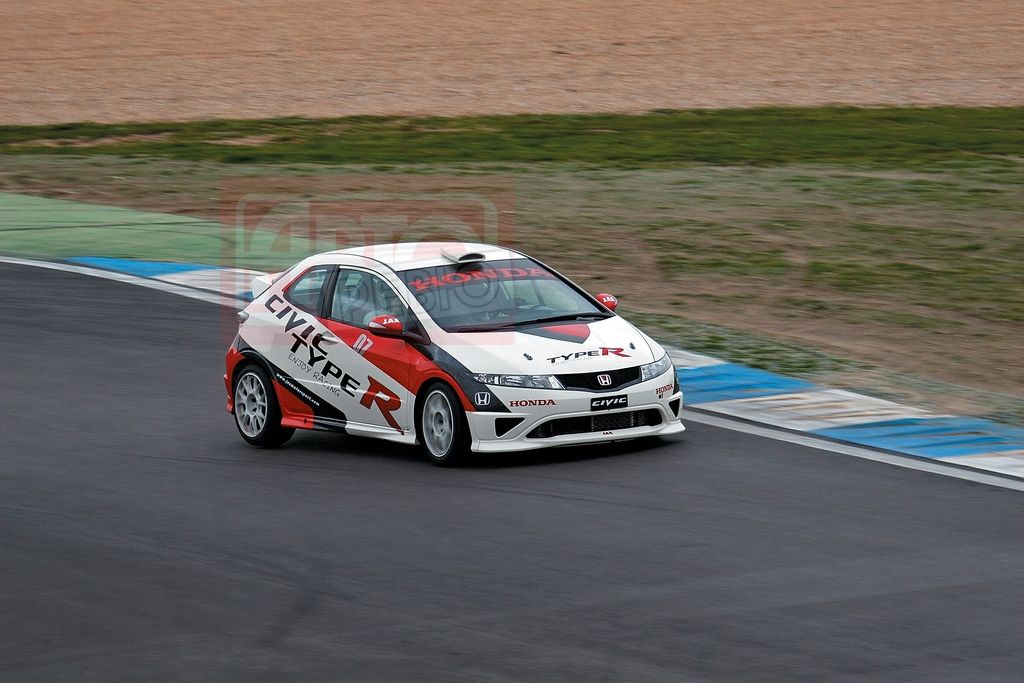 | 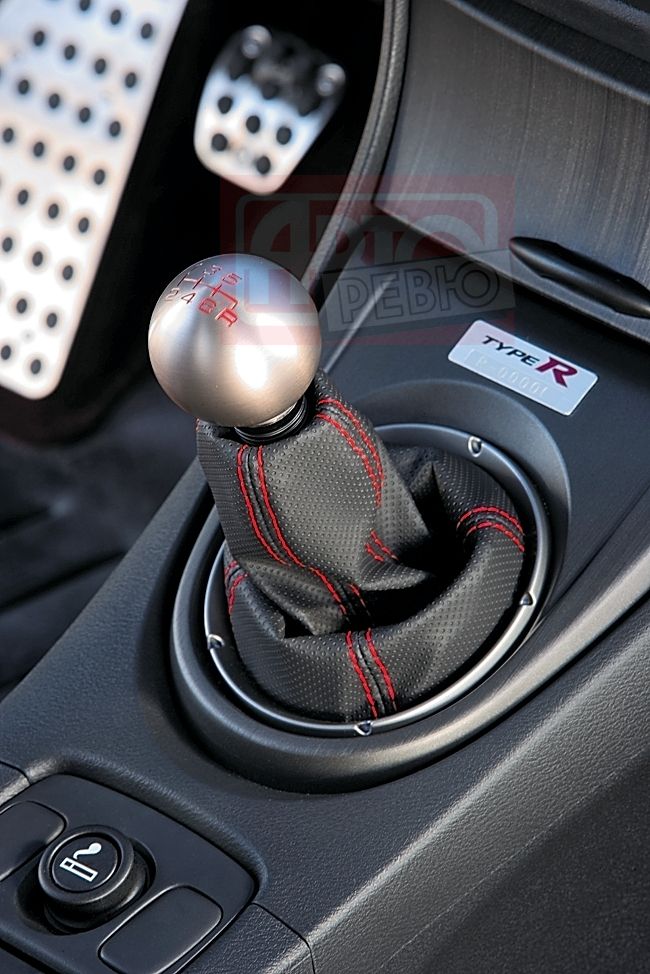 |
| On this Civic, prepared by the Italian firm JAS Motorsport, I was driven by Honda's "Formula" test driver Christian Klien. He drove fast. But note the rear wheel: the turn is almost complete, and it continues to hang in the air! According to racing regulations, the rear suspension design remained unchanged — here is the same "twist beam" as on the "civilian" car | Gears engage smoothly and precisely. And how pleasant the aluminum ball feels to the touch… |
As a result, the Civic remained just as fast: according to official data, it accelerates to 235 km/h, and reaches 100 km/h in 6.6 seconds. That's 0.2 seconds slower than the Opel Astra OPC, and the same amount faster than the Focus ST.
But where is the famous "dual-character"? Where is the "explosion" of thrust at high revs? Where is what inspired us before? Remember: "Here it is, the Honda high! Here it is, the flight! After four thousand — a hurricane!" (see AR No. 20, 2001)?
It was — and it's gone.
The engine was nevertheless reworked by Honda — they added balance shafts to reduce vibrations (which, according to engineers, cost 5 hp) and rewrote the engine control programs in general and the i-VTEC system in particular. Peak power is now achieved at higher revs (7800 rpm vs. 7400), and peak torque, on the contrary, at lower revs (5600 vs. 5900 rpm). But the main thing is that the transition from "low-rev" to "high-rev" cam profiles of the i-VTEC system has become smoother, with a barely perceptible liveliness around 5500 rpm. In the press release, this engine character is called "more harmonious." But is this harmony? It turns out that in response to the "turbo threat," the Civic Type R only moderated its ardor. Did it tuck its tail?
However, tearing around in the three-door is still pleasant, especially on a race track. It's a pity we were only allowed onto the Estoril track in a "train" behind the pace car. But I managed to enjoy the hatchback's composure in corners, quick and precise reactions to steering inputs, and excellent balance. At the limit, the Civic Type R demonstrates almost neutral handling: add gas — the trajectory straightens out, lift off — the car willingly screws into the corner. The Type R version differs from the "just Civic" also by a "stiffened" body: the front suspension mounting points and the floor under the front occupants' feet are reinforced, and a cross member appeared in the engine bay. In addition, the steering mechanism became "shorter" (2.4 turns lock-to-lock), and the "rack" mounts are stiffer. Naturally, different characteristics of the electric power steering, springs, dampers, and anti-roll bars are selected. The rear track "widened" by 20 mm, and the ground clearance decreased by 15 mm.
On the perfect surface of the famous circuit, the "budget" nature of the rear suspension initially even seems like a blessing —
no rear-wheel steering effects, a smooth, predictable character. But if you "plunge" into a corner too fast, the Civic will first lift its leg (the inner rear wheel) and immediately start sliding with the rear axle. This was especially evident during the rides to the right of Honda's "Formula" test driver Christian Klien. He fully used this feature of the car to "set it" in corners: he raced in a rally style, cutting curbs and scattering grass across the track.
By the way, on the track we were tearing around in a Civic Type R lightened by 40 kg — almost without sound insulation, without an audio system and air conditioning. Honda addresses such cars to professional racers for subsequent preparation for competitions: participants of the Russian Honda Civic Cup will soon switch to them.
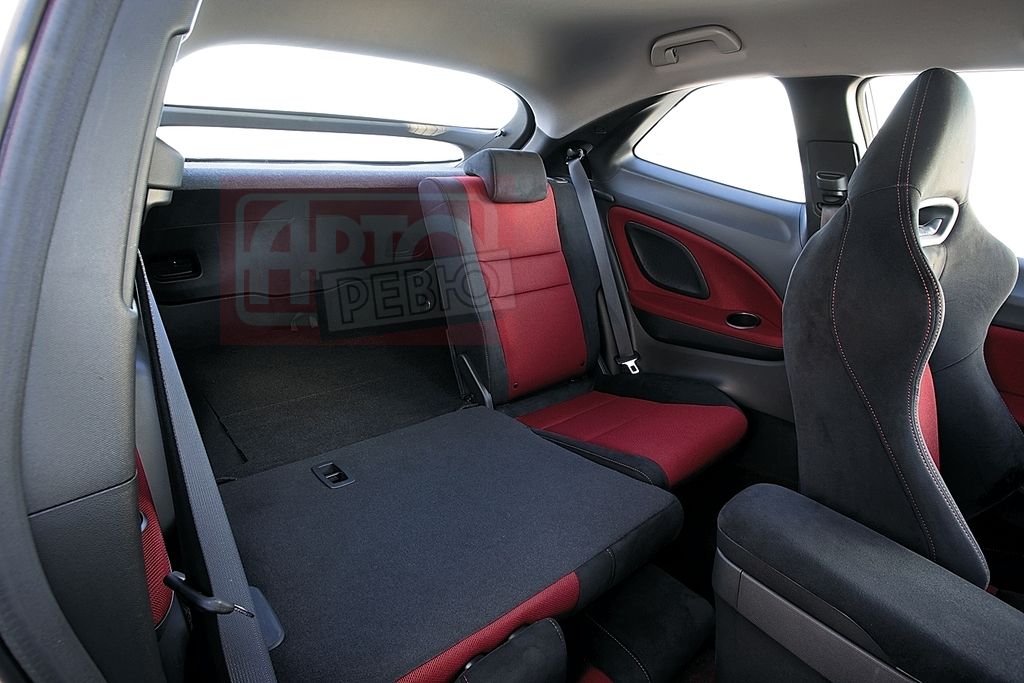 | 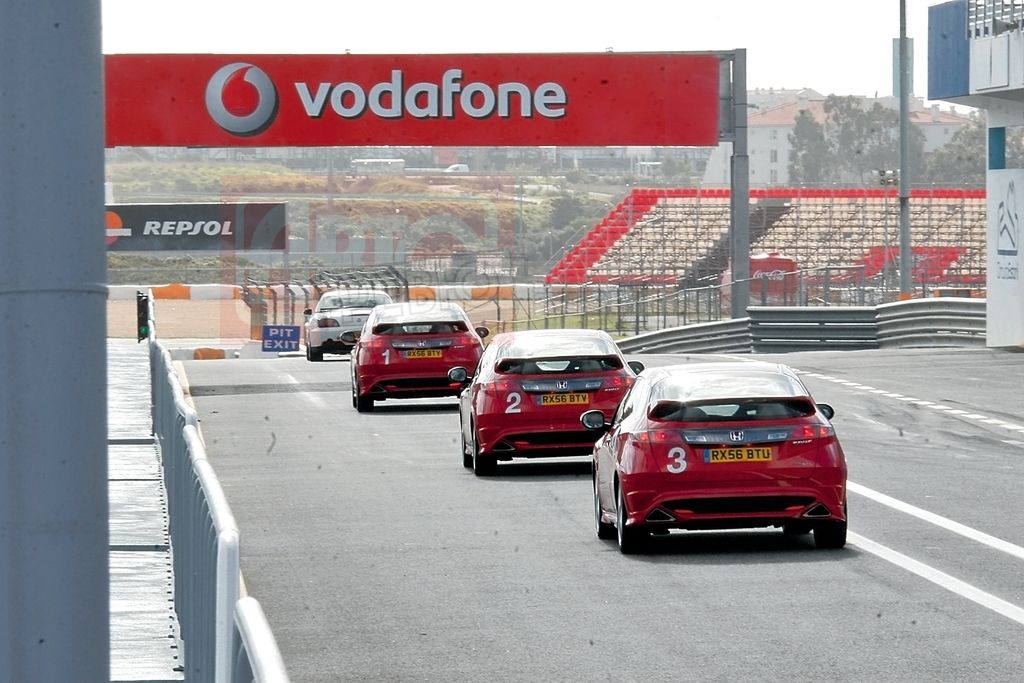 |
| The rear seat folds in parts, the cargo volume varies from 485 to 1352 liters. The trunk floor has a double bottom | Behind the wheel on the Estoril track, unfortunately, you could only race in a "train" — following the pace car Honda S2000 |
How much the "civilian" version of the Civic Type R with climate control, CD player, and navigation loses in dynamics to its track-oriented relative, I do not know. But one thing is clear: it is much calmer in terms of noise. On rough asphalt, tire roar is noticeable, but not as intrusive as in the Mazda 3 MPS. Especially since the main voice in this duo is the engine. Its singing is pure delight for the ears! And how flawlessly the gearshift mechanism works: seven-six hundred — third gear, r-r-r, seven-six hundred — fourth. When there is no VTEC surge, the only consolation is the high-revving symphony of the engine.
I deliberately looked for worse roads around Estoril — like at home. And the "hot" Civic performed excellently — it shakes, but does not rattle your soul. It seems the stiff springs work in tandem with moderately "tight" dampers. The feeling of energy capacity reserve disappears only when you fly over potholes, not sparing the car at all.
The three-door Civic Type R is assembled at Honda of the UK Manufacturing in Swindon (England) — the same place where its predecessor was produced, which sold 35,190 units worldwide. By the way, the three-door Civic Type S (not R, but S!) launched in Europe earlier — with a retuned chassis, wider rear track, and a choice of two 140-hp engines: petrol 1.8 i-VTEC and turbodiesel 2.2 i-CTDi. However, the Type S is unlikely to appear in Russia: its predecessor did not gain popularity here, like non-alcoholic beer.
But about a hundred Civics with the Type R badge were sold in Russia. Over 500 orders for the new Civic Type R have already been placed worldwide, and this year Honda plans to produce 5,000 "hot" hatchbacks. In our country, the fiery three-door will appear in May — and will be noticeably more expensive than its turbo classmates. For example, if the "base" Mazda 3 MPS costs $31,800, then prices for the Civic Type R will fall in the range of $35,000–40,000. A bit pricey. Especially considering the loss in power. If only we could get the 220-hp Civic Type R sedans with "limited-slip diffs" that are available to the Japanese and Americans… If only!
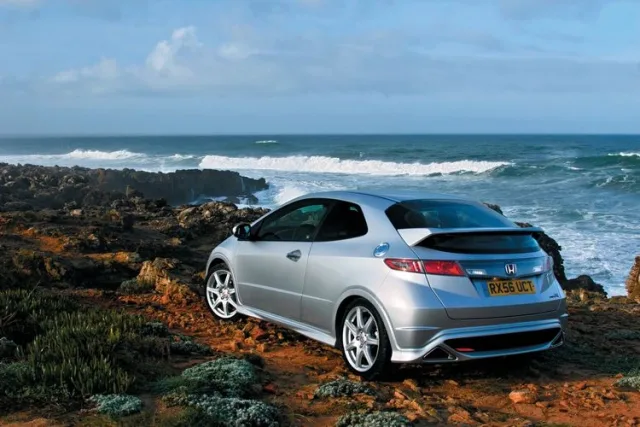
But as it is, we have just a wonderful car — integral and balanced. It can be swift — and will delight the soul of a discerning driver. It will delight, but no longer burn — the "hot" Civic has become much more everyday. Although its roar remains the same.