
Once upon a time, simplicity reigned in the golf class: Europeans set the fashion, Japanese bet on reliability, and Koreans offered the cheapest and most utilitarian transport without pretensions.
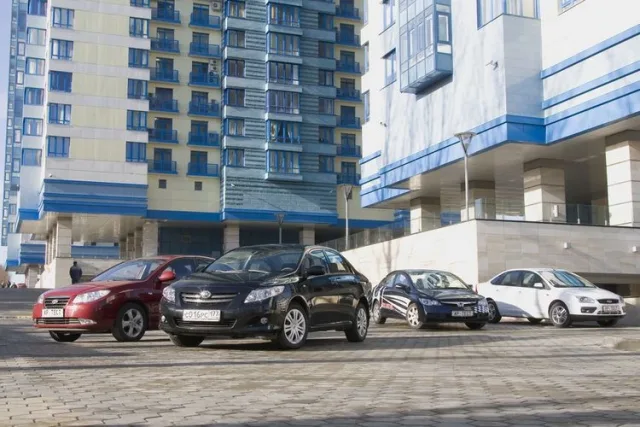
But times are changing, and we have seen this for ourselves by comparing four C-class sedans. The main premiere is the Toyota Corolla with a 1.6 engine (124 hp) and a robotic transmission. The competitors were the Ford Focus, Honda Civic, and Hyundai Elantra — all with automatic transmissions.
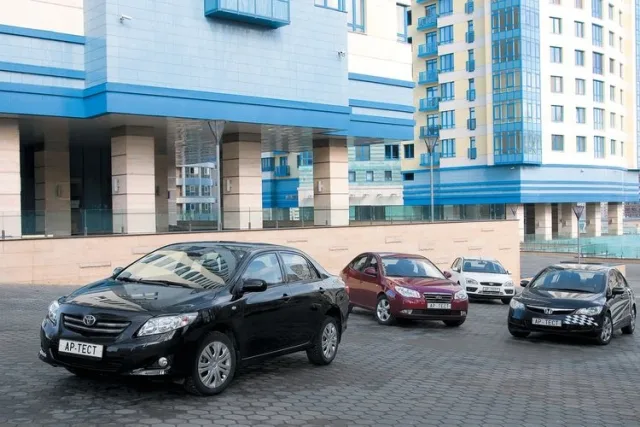
Previous Corollas long claimed the title of the most bland and forgettable cars in the golf class. Although no, the sixth generation of 1987 looked quite nice. But all the others — neither this nor that. Even the previous Corolla, which at first seemed fresh and almost European, quickly became outdated and dissolved among its faceless brethren.
Now — the new Corolla.
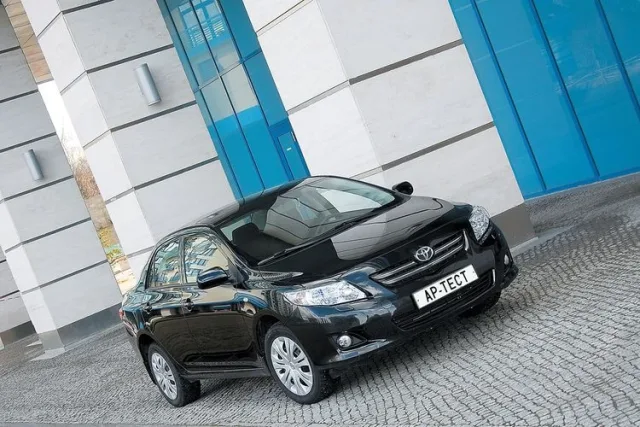
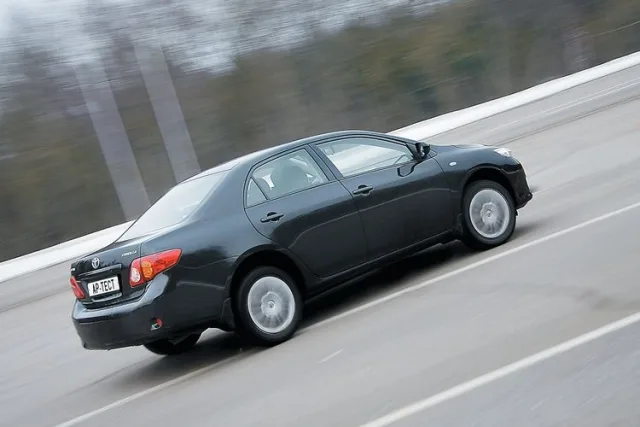
You can't call it beautiful either. But at least it catches the eye because it resembles a slightly reduced Camry. And because it matches our ideas of a modern Japanese car: slightly slanting headlights, some pretentiousness, and an oriental touch in the lines of the front and rear... A kind of J-factor in metal and plastic.
But perhaps Toyota should remain a bit "ordinary" and down-to-earth to sell in hundreds of thousands of units?
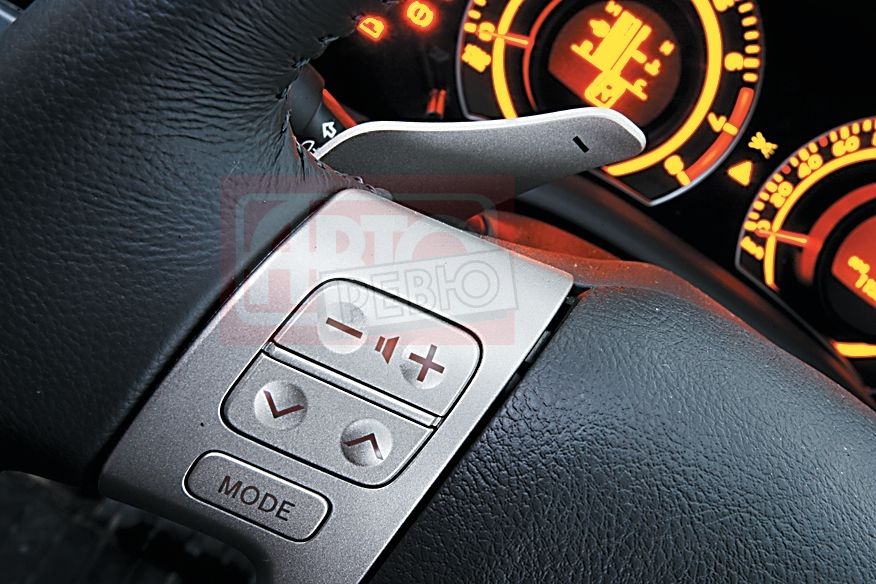 | 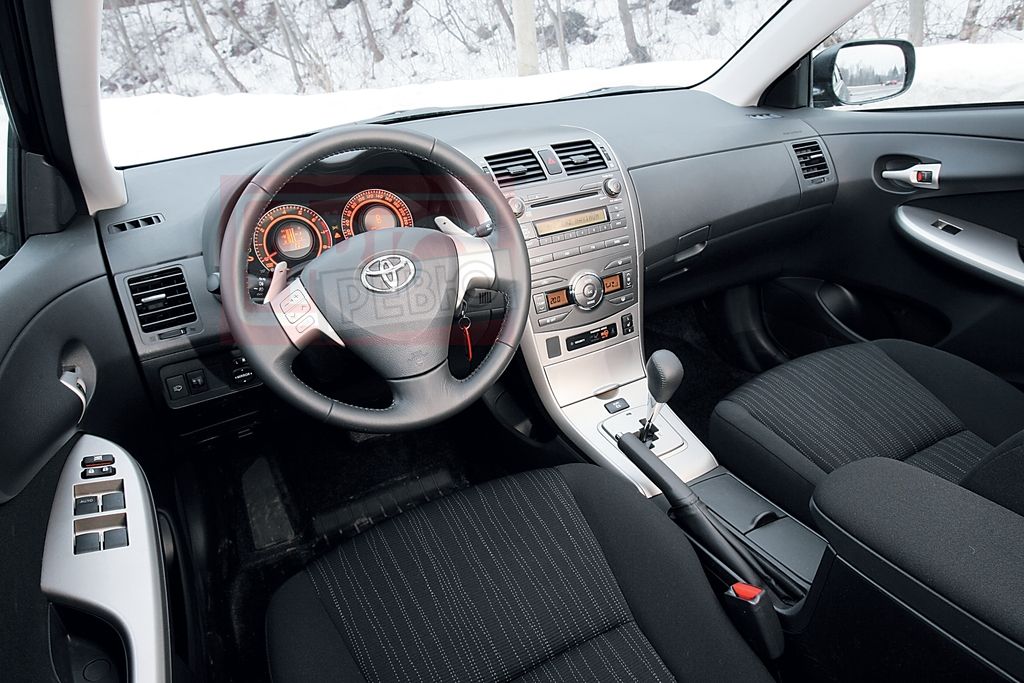 |
| On the left spoke — music control buttons | New Toyota Corolla: beautiful, solid, high-quality, cozy, and comfortable. The MultiMode "robot" gears are shifted via cast paddle shifters |
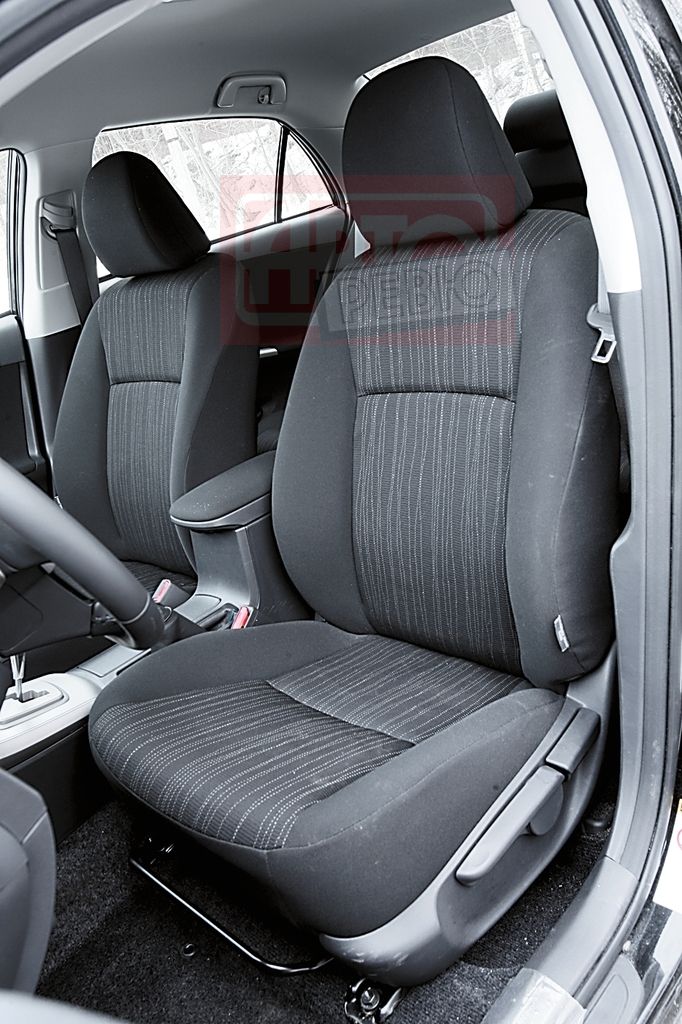 | 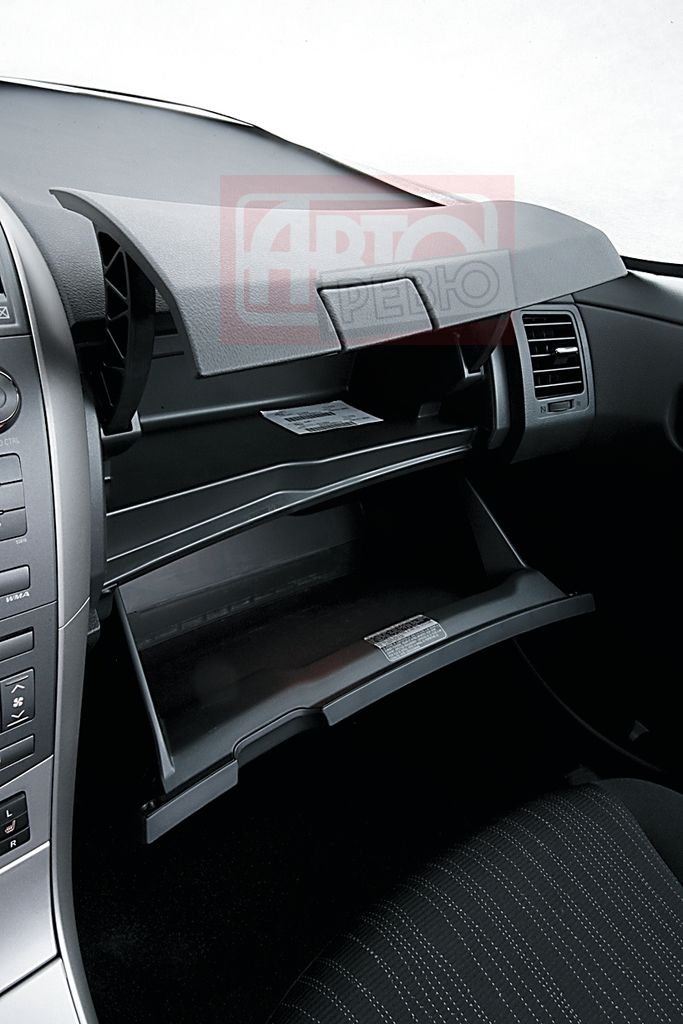 |
| The seats are very comfortable — except for the awkward height adjustment of the cushion | In terms of the number and volume of compartments for small items, the Corolla yields only to the Civic |
That's right. And for those who crave pure European lines — the Ford Focus, strict and modern. The Honda Civic is an alternative for those who want to see their car more swift and dynamic.
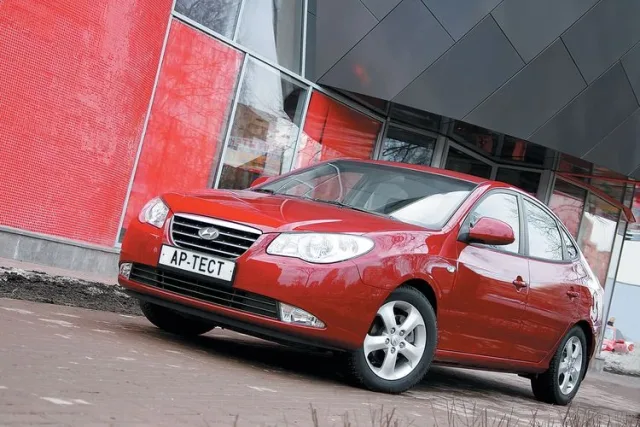
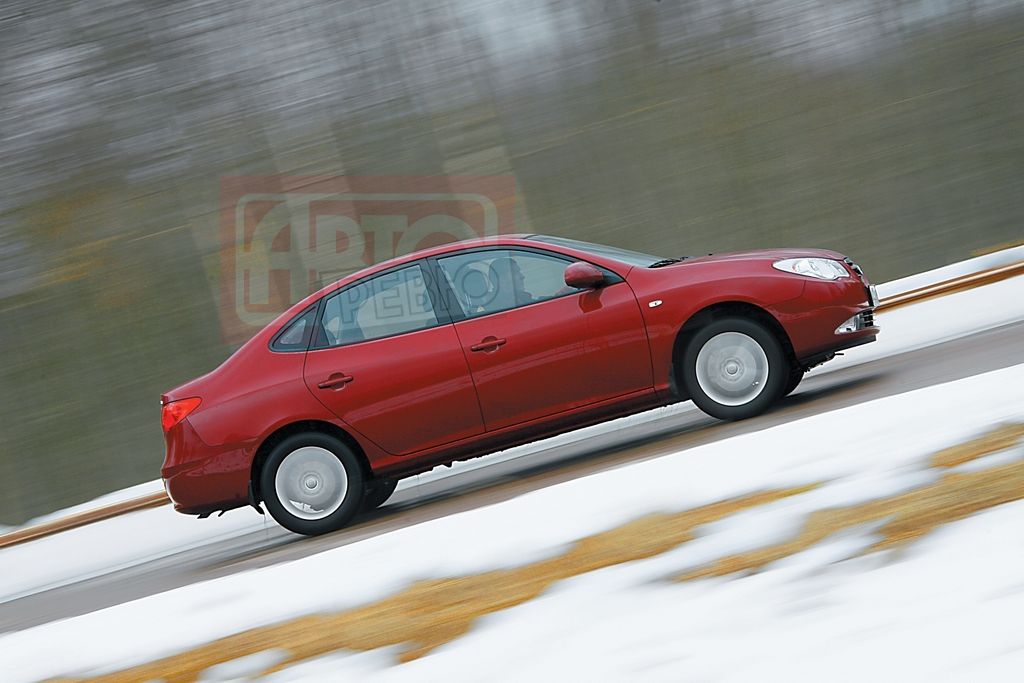
But who is the new Elantra addressed to — this round-awkward, formless-faceless something? People who suddenly felt drawn to beauty after their old Accent?
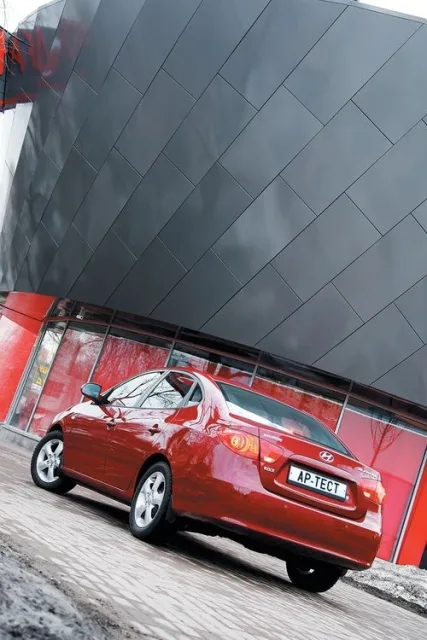
| Toyota Corolla | Hyundai Elantra |
 |  |
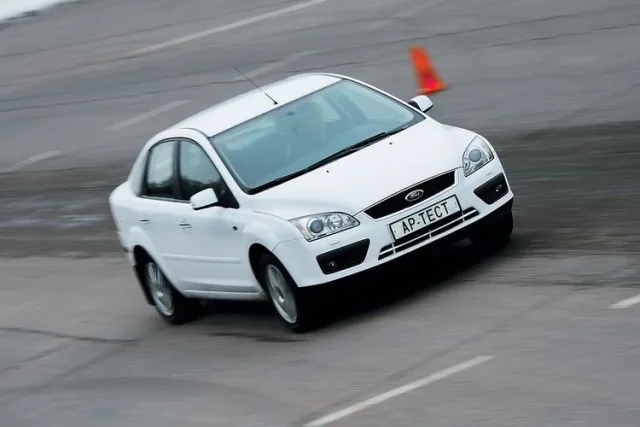
| Ford Focus | Honda Civic |
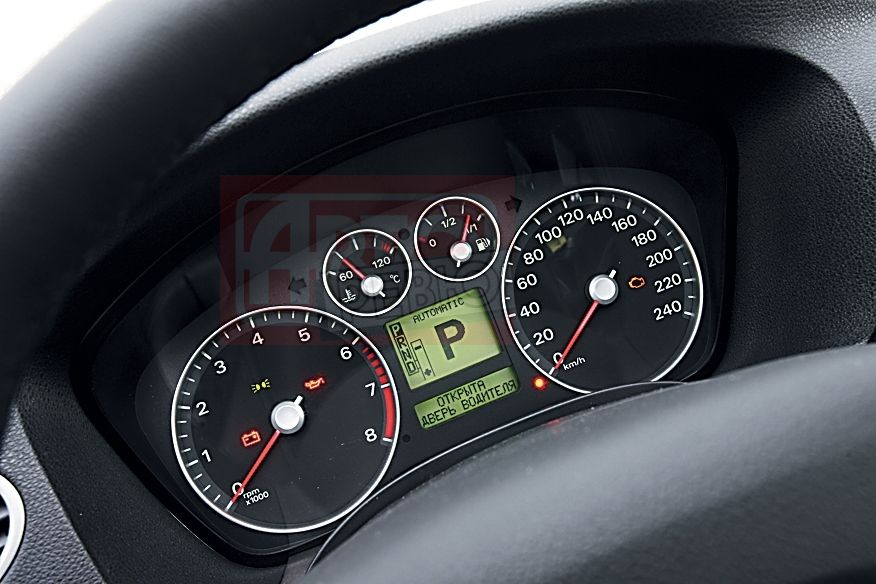 | 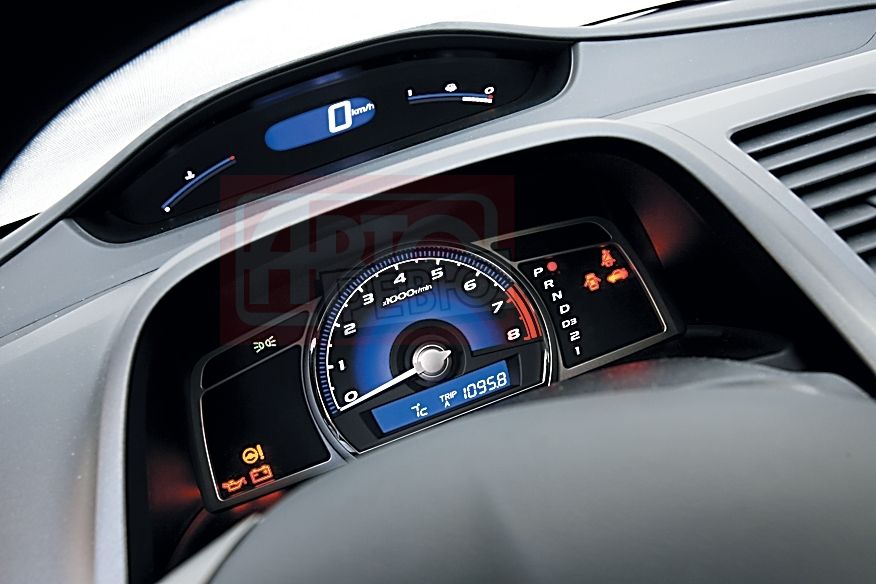 |
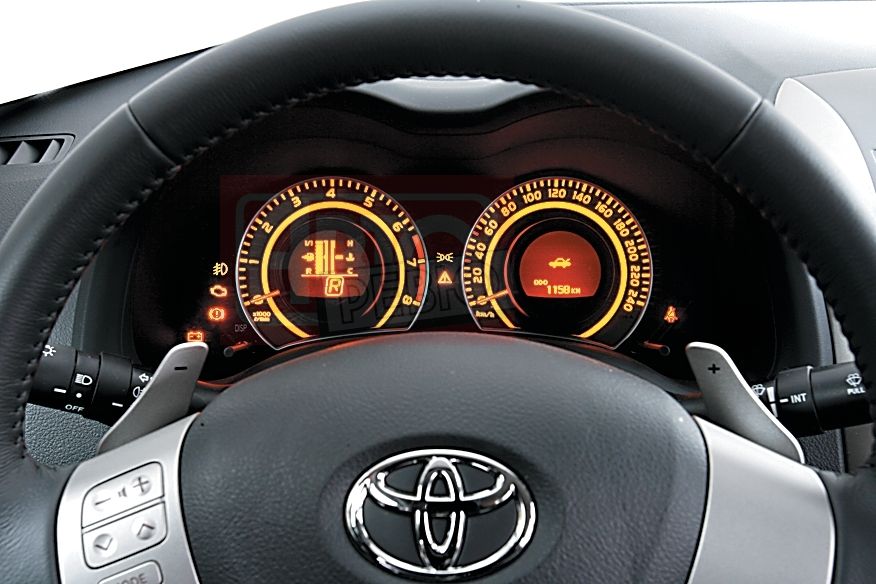
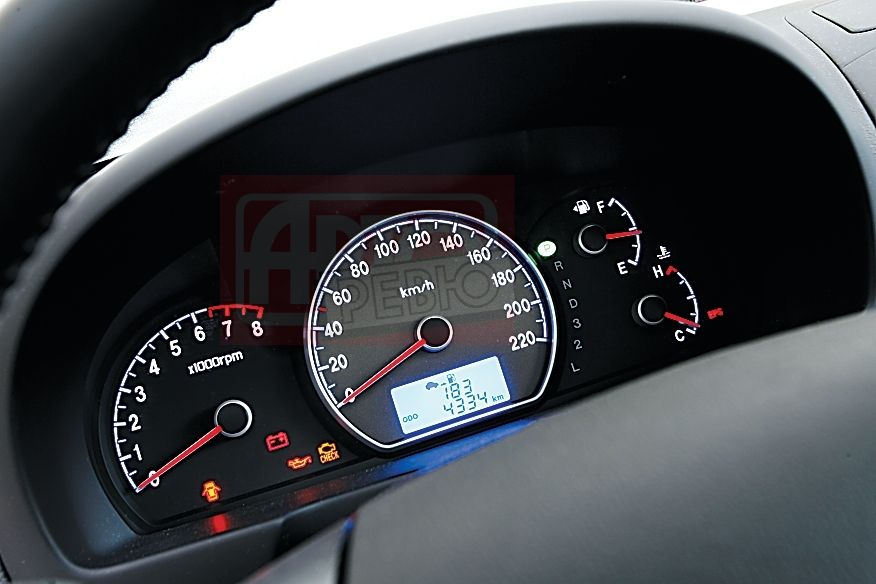
| The most interesting instruments are in the Japanese cars: the Corolla sports two large displays in the center of the dials, while the Civic surprises with a digital speedometer at the edge of the windshield. Both the Focus and the Elantra look like simpletons against this background | |
Apparently, the new Elantra is a car from the old design era "before Thomas Bürkle," when anyone was in charge of Hyundai's style. Just look at the interior. Yes, there are hints of design. Or rather, not hints — attempts. Milky-white buttons on the "bulge" of the center console, an oval display glowing with strange blue light with small unreadable numbers and symbols, multi-textured and absurdly matched plastic... This is a concept car! Moreover, clearly from early stages — as if made by intern students and accidentally put into production.
That's another matter with Honda and Toyota.
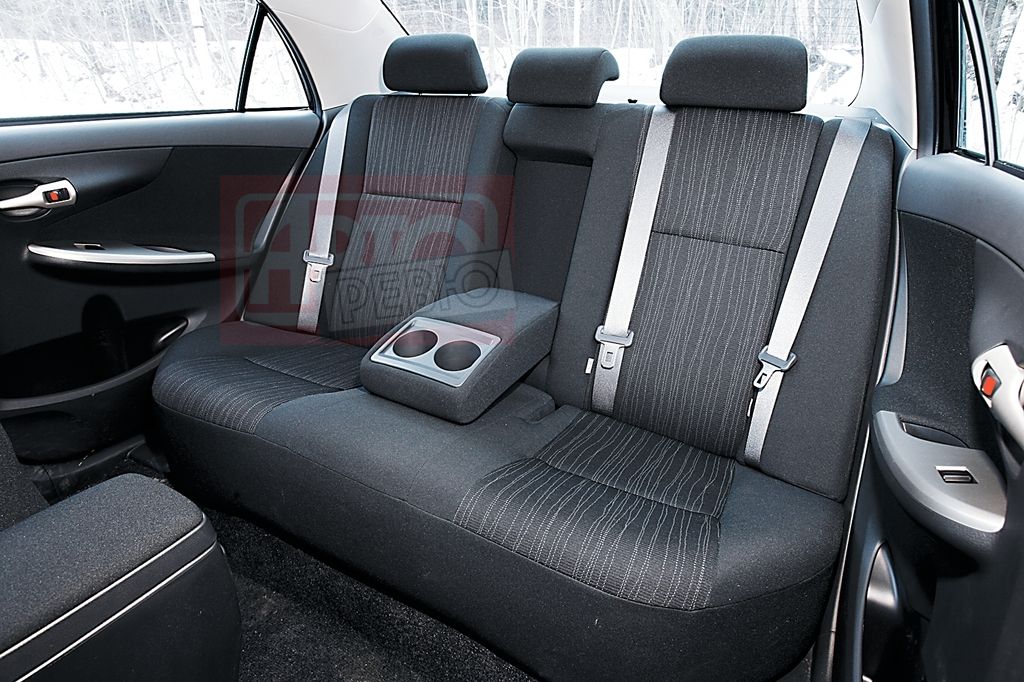 | 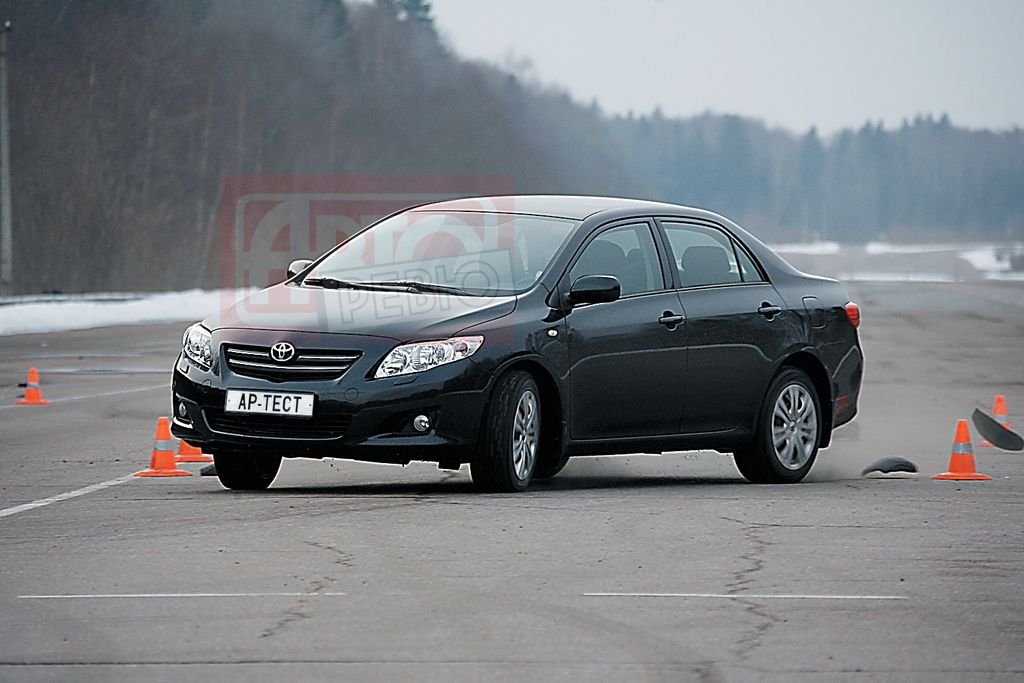 |
| In the back of the Toyota, there is space and coziness — plenty of knee room, comfortable armrests and door panels | The tendency to oversteer is high, but the steering wheel is informative and doesn't "stiffen" during fast rotation |
The new Corolla inside — calm lines, silver plastic panels familiar from other Toyotas, large liquid crystal displays illuminated in yellow, convenient round knobs... This interior breathes not only the usual Toyota calmness but also a certain style. For example, four elongated horizontal keys on the sides of the climate block on the center console are "underlined" with transparent strips that flash orange when turned on. And the same pleasant amber glow emanates from the two circles in the center of the speedometer and tachometer dials: in fact, these are beautiful displays that also show words in the native "great and mighty" Russian language.
The Civic's interior is no less interesting. There, of course, is a different mood — cosmic-driver-like. A driver-oriented cockpit with a turned console, futuristic steering wheel, and "split" instruments with their unearthly blue-violet glow. And when you move from the Corolla or Civic into the Focus with its black grainy plastic, ordinary instruments, and trivial interior architecture, a strange feeling arises — the Ford looks like a car from the past. And the Corolla and Civic — cars from the future!
Maybe the Japanese cars are inferior to the Focus in ergonomics? No — in some ways they even surpass it.
| Toyota Corolla | Hyundai Elantra |
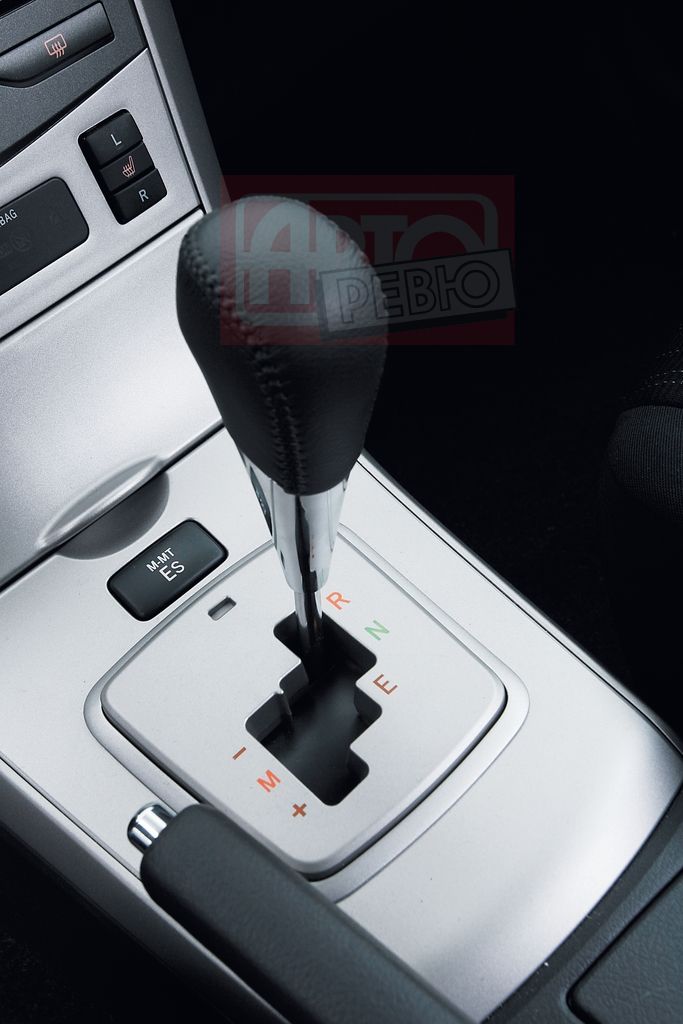 | 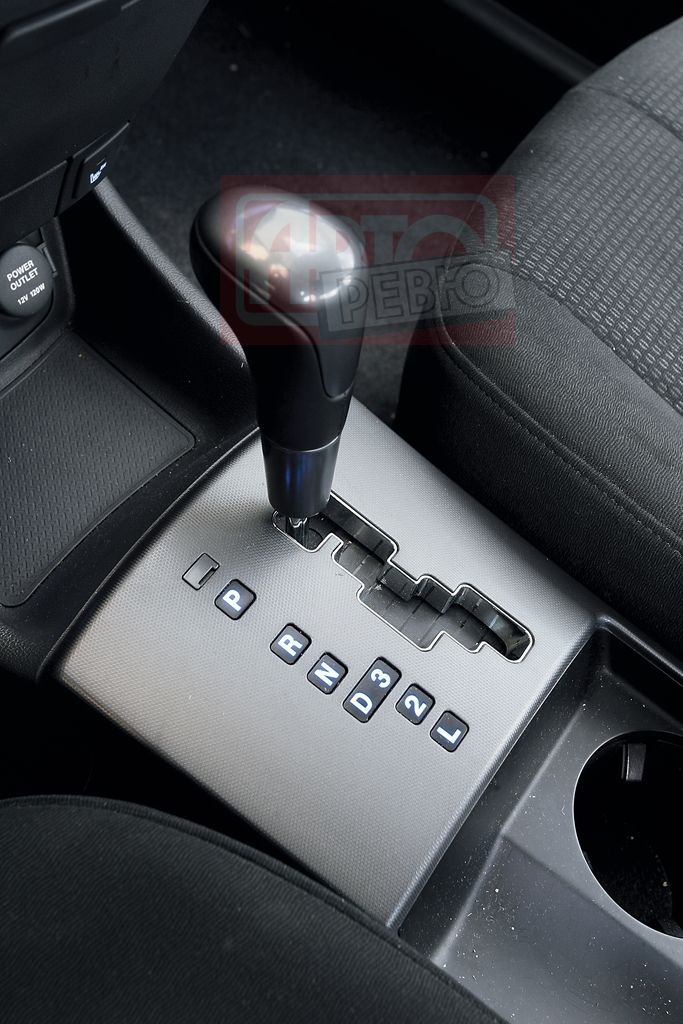 |
| MultiMode is one of the best "robots," but without throttle blipping during gear changes, you can't get rid of the jerks | Hyundai's four-speed "automatic" shifts sluggishly and illogically, and the selector lever lacks a lock |
| Ford Focus | Honda Civic |
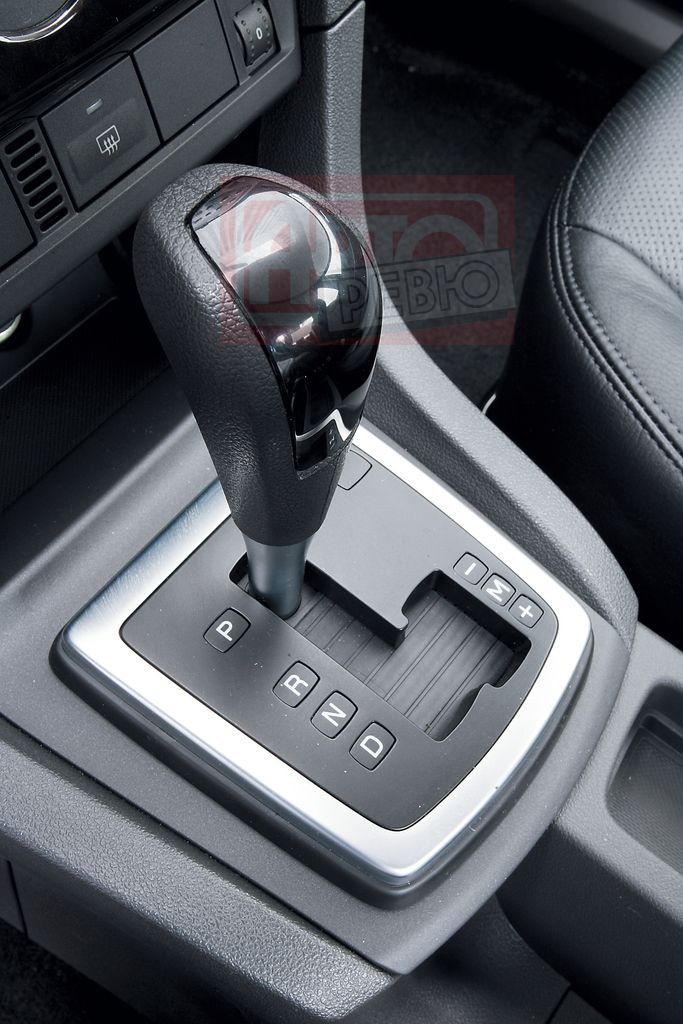 | 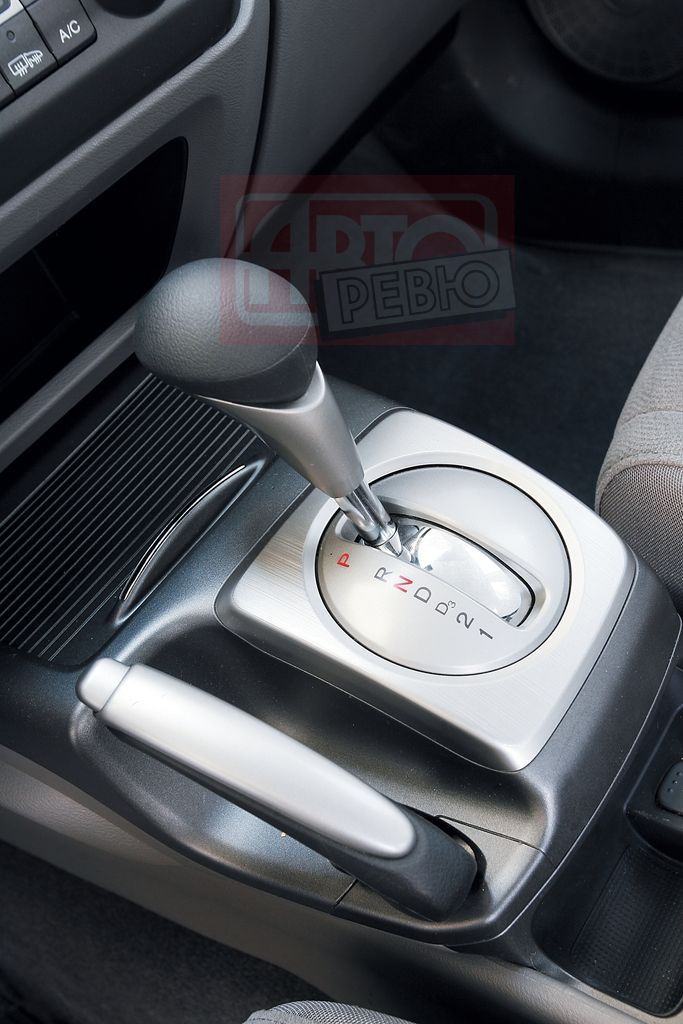 |
| The Focus also has a four-speed "automatic," but it works very well — softly, smoothly, and with adaptive logic | Honda's gearbox, alas, does not support the degree of sportiness — at the slightest opportunity it shifts "up" |
Toyota's seats are the most "hospitable" in this quartet: thanks to their shape and pleasant upholstery fabric, they hold the body excellently. The seating geometry, however, is not without sin: when adjusting the driver's seat height, the angle of the cushion changes simultaneously. But only short people who prefer a low "sporty" seating position may experience discomfort — when the seat is lowered, the front edge of the cushion rises and interferes with pressing the pedals. Lovers of a "vertical" seating position will also not be fully satisfied — the backrest adjustment range is insufficient. But otherwise, everything is excellent. A neat steering wheel with a leather rim (two degrees of adjustment freedom) and keys on the spokes, excellent instruments covered by a "double-hump" visor, large and logical buttons and knobs on the console, an excellent selector lever for the robotic gearbox...
If the seating in the Corolla tends to be high and "urban," then in the Civic it is, on the contrary, low and "sporty." Honda's seats are the hardest and hug the occupants more tightly, resembling sport "buckets." It's a pity that lumbar support is lacking. The steering wheel is small and comfortable, with futuristic decorative "meshes." The instruments — a tachometer strip at the bottom and a digital speedometer window at the top, closer to the edge of the windshield: a quite readable option.
Small items in this Civic — a real expanse! You can find all sorts of things: compartments on the center console, a niche near the seat heating keys, a spacious box under the armrest, large pockets in the doors. In terms of space organization, Honda is beyond competition. That is, the Japanese car is strong not only in its striking interior and atmosphere but also in its thoughtful ergonomics.
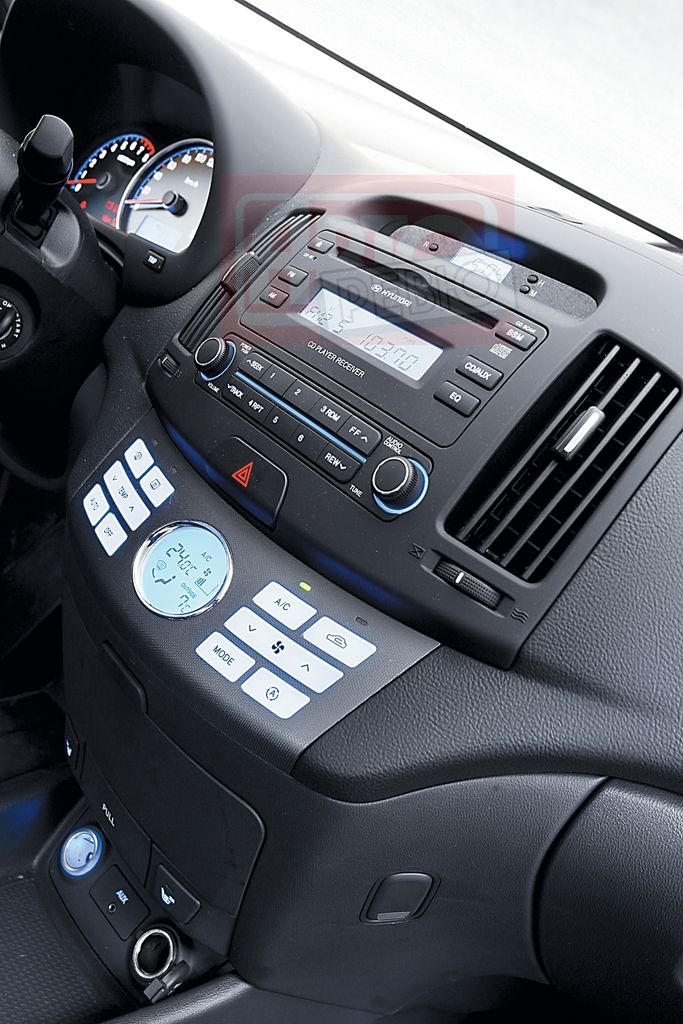 |  |
| In the dark, the milky-white Hyundai keys are illuminated by a strange purple light; the climate control works poorly |
But the Focus, against the background of the "Japanese," fell short. No, Ford's ergonomics are still impeccable. But the inexpensive seat leather turned out to be slippery, and the side support bolsters were not as pronounced as in the Honda and Toyota: it feels like sitting on a flat chair, even despite the lumbar support adjustment. With the "correct" seating geometry, the right shin constantly presses against the plastic slope of the center console. There are also fewer compartments for small items here. And another thing — why does the Ford smell so strong? The phenolic aroma of the interior plastic panels is very sharp and strong.
The Hyundai Elantra, in terms of ergonomics and seating comfort, is at the very bottom of the list. The seat is the softest and most shapeless, the steering wheel with a "plastic" rim is uncomfortable to hold, and the automatic transmission lever can be moved out of "P" mode without pressing the brake or a button on the knob. No lock at all!
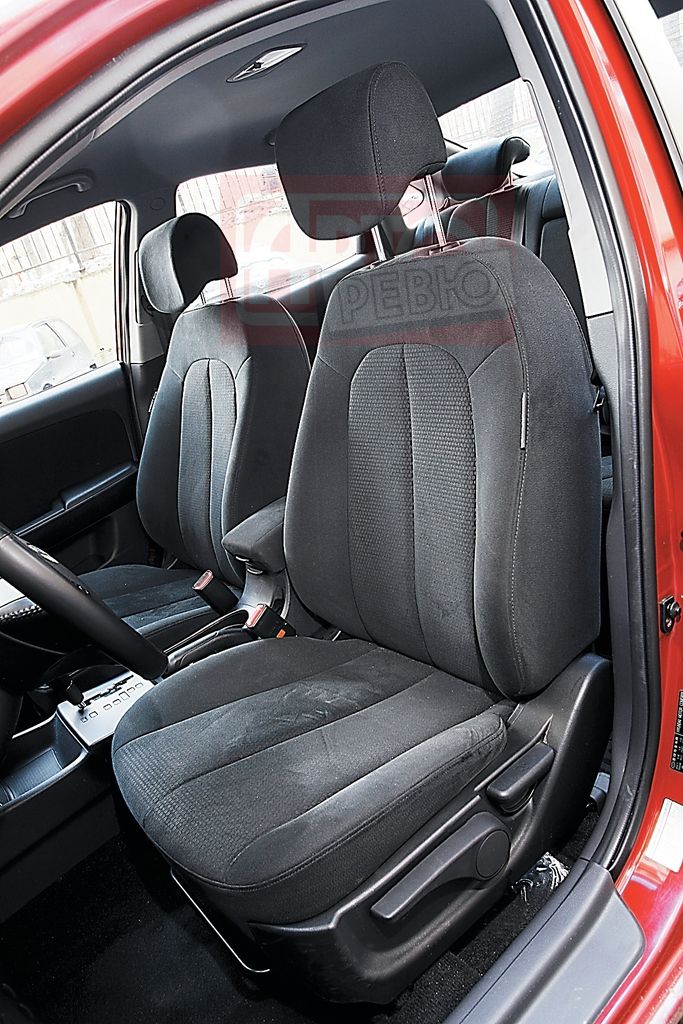 | 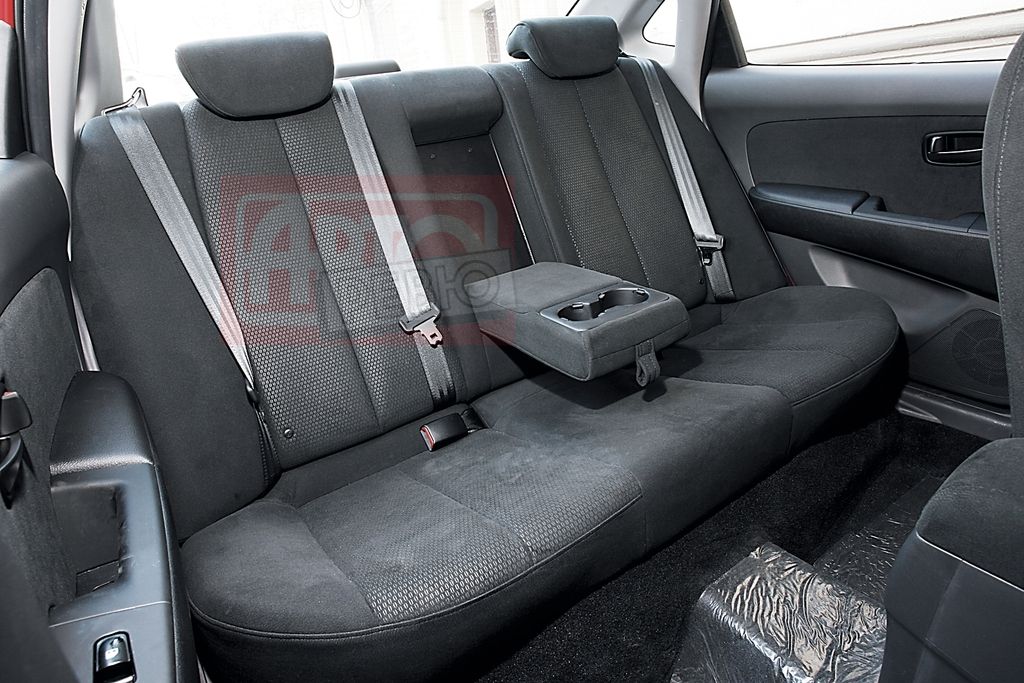 |
| Hyundai seats are the most uncomfortable: soft and shapeless | In the back, the Elantra is more spacious than the other three sedans — this is perhaps its only advantage |
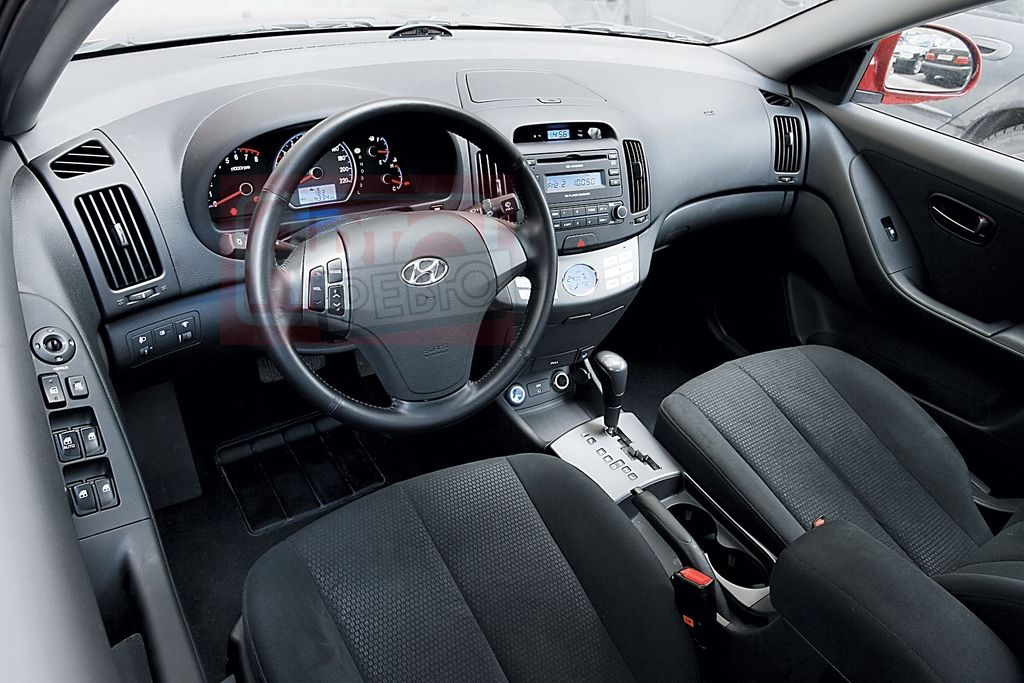 | 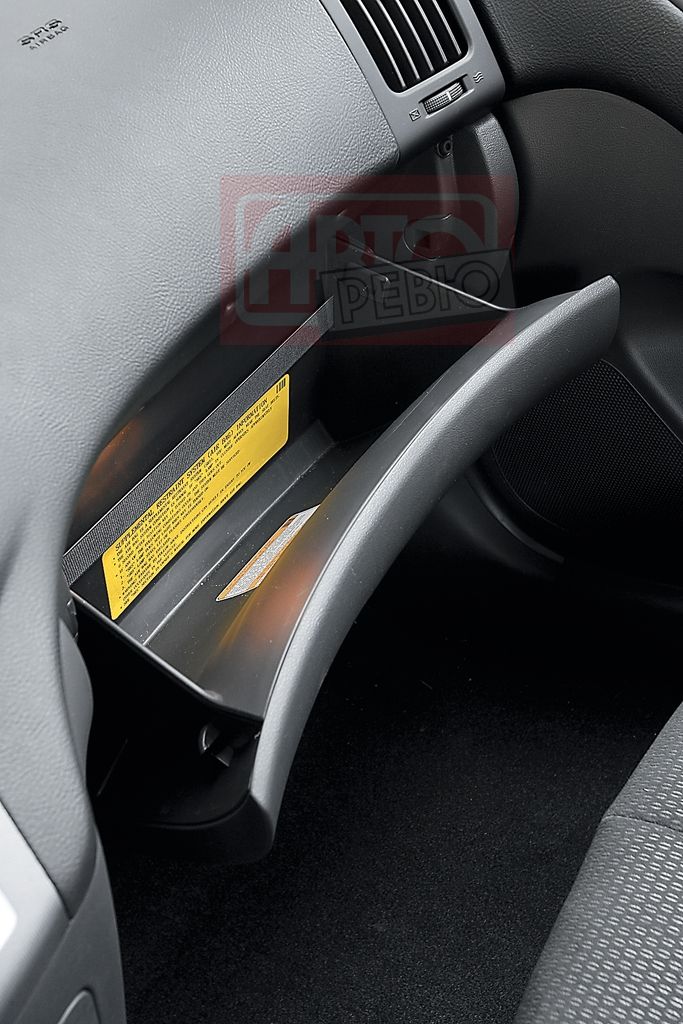 |
| The Korean interior — with a claim to design, but with the carelessness typical of demo cars | The "glove box" is small |
But in the back, the Elantra is the most spacious: three people can sit without problems. Only the Ford has a wider cabin, but there the outer passengers already press their heads against the roof pillars. The Civic and Corolla have more sloping roofs — the outer passengers are even less comfortable.
However, all four sedans can quite well be the only car in a family. The interiors are spacious, the trunks too... It's just surprising that the Honda's trunk lid is unlined, and the Focus sedan after the 2007 facelift lost the interior handle for closing. It would seem a trifle, but it "lowers" the impression of the car.
However, the main thing in a car is not the trunk handle, but how it drives. Agree?
The new Corolla drives very well. The highly boosted 1600-cc engine produces 124 hp — in terms of liter power, Toyota engineers have matched Honda's engine builders (the same 77 hp per liter). The engine is lively and torquey — even the "thoughtful" gas pedal doesn't spoil the impression of acceleration. You press the gas — the drive wheels break into wheelspin, the Corolla starts briskly... And reaches 100 km/h in 12.4–13.0 s depending on the mode of the robotic gearbox.
Moreover, the "robot" here is one of the best: it shifts gears on time, promptly, and almost without jerks. But avoiding nose dives during sharp throttle release during intense acceleration is not easy: you have to anticipate the moment of gear change and release the accelerator a moment before the electronics do it.
The "robot problem" is fully solved only in manual mode, when the driver shifts gears — using large, convenient, and very beautiful paddle shifters. Moreover, you can shift up or down at any moment, even in "drive": the gearbox will obediently execute the command and after a while return to automatic mode. But, of course, at this time you need to synchronously ease off the gas. If there were a regular "automatic" instead of the "robot," there would be no such problems at all!
Although what is better — a good robotic "manual" or a bad hydromechanical "automatic" — is still a question. For example, the Civic's transmission is not very good. The more powerful 1800-cc 140-hp engine helps the Honda reach a hundred in just 11.2 s after the start. But the five-speed automatic, although it shifts smoothly and quickly, suffers from a clear algorithm disorder. For instance, it is in no hurry to engage a lower gear in kick-down mode and at the first opportunity jumps back to higher gears. No sportiness at all! And at the same time — a sharp, overly nervous accelerator drive: sometimes even a calm press on the gas pedal causes a sharp jerk, especially unpleasant on lower gears.
The Ford Focus is the complete opposite. The "automatic" here is old, four-speed, but works excellently! Upshifts are almost imperceptible, downshifts are prompt: with minimal jerks and almost no delays. The two-liter engine with 145 hp is also not bad, but...
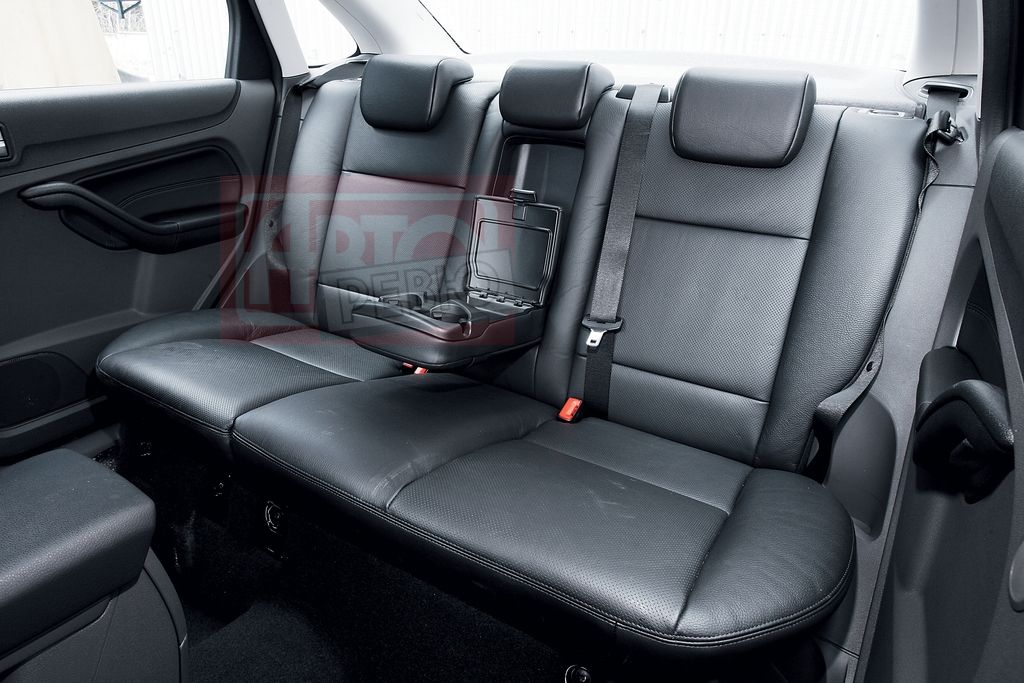 | 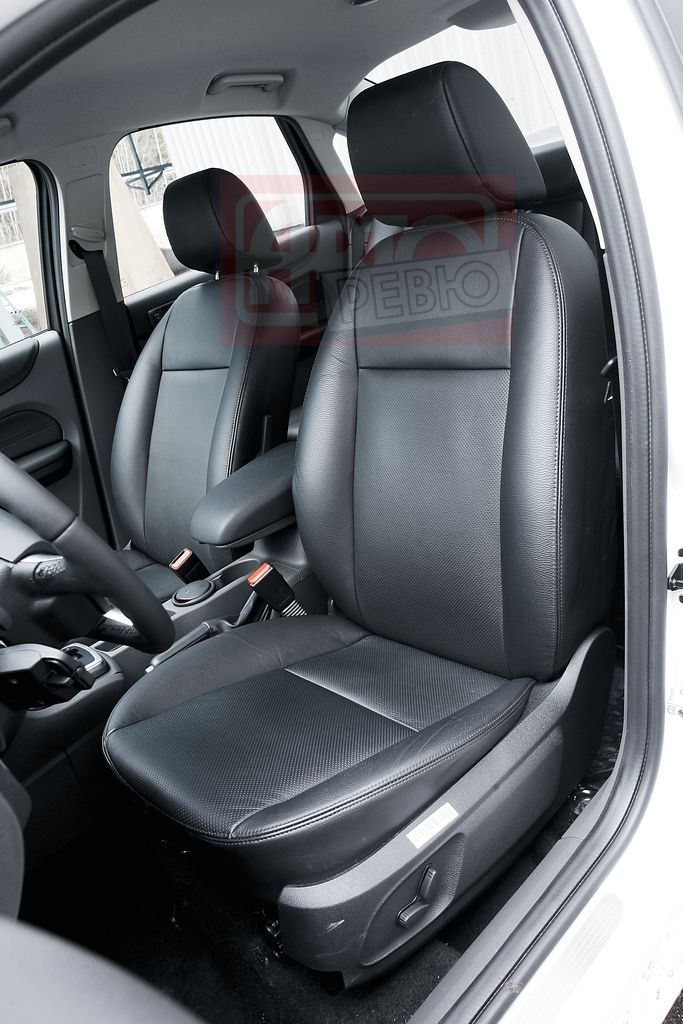 | 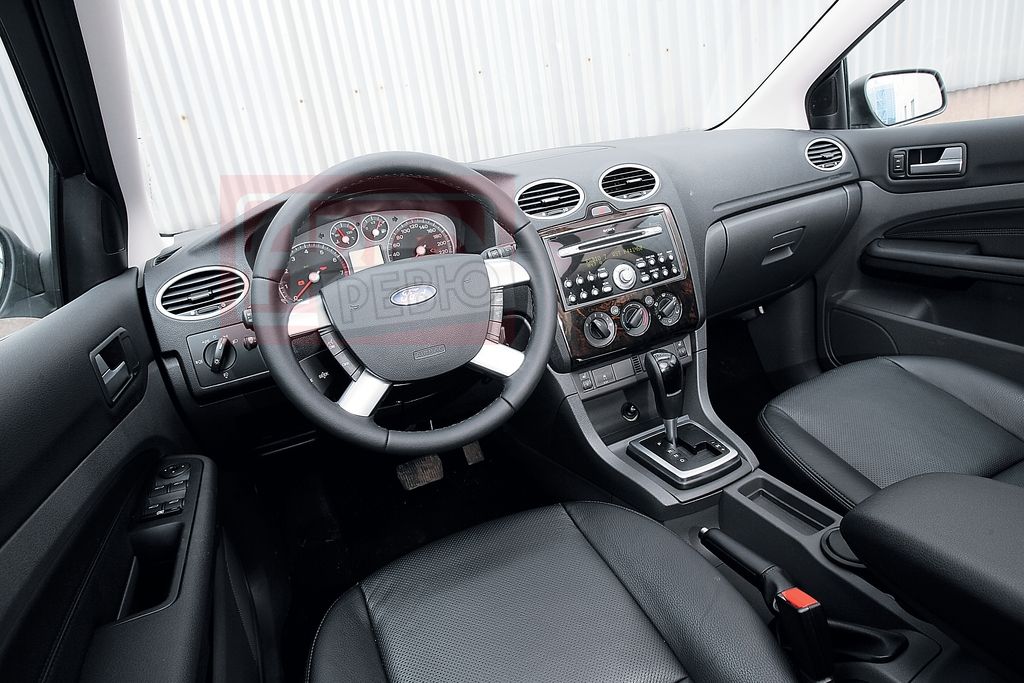 |
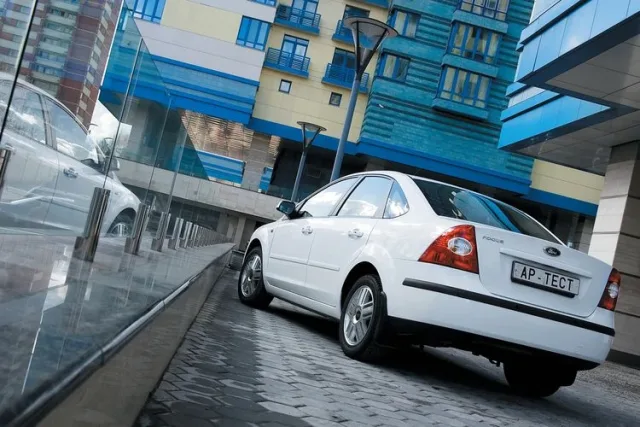
| The Focus's rear seat is the widest, but only it lacks Isofix child seat anchors | Cheap leather, flat profile... Uncomfortable | The Focus is simple, strict, and traditional: there is no place for experiments here |
By the way, we did not take the 1600-cc 100-hp Focus with an "automatic" for the test for two reasons. First, because it is 100 kilograms heavier than the Japanese competitors and frankly "loses" in acceleration: if compared to the Corolla, we are talking about a three-second loss in the time to reach a hundred (15.4 s)! And second, the Focus 2.0 is even cheaper than the Corolla 1.6.
So: although the two-liter Ford, according to our measurements, is more dynamic than the 1600-cc Toyota, there is no Toyota-like ease and briskness in its acceleration. What creates this impression — the stiff gas pedal, the softening effect of the automatic's torque converter, the lack of low-end torque? Most likely, all together. But it feels as if the Focus is slower than it actually is. And therefore, in the "acceleration dynamics" column, we give the Focus and Corolla equal ratings.
And the Elantra gets even less. Its 1.6-liter engine is also not weak — 122 hp. Moreover, the Elantra is even slightly lighter than the Corolla. But the unsuccessful "automatic" instead of the Toyota's "robot" — and the Hyundai loses to competitors and lags behind the claimed acceleration time by almost two seconds.
And in terms of feel, the Elantra is downright slow. Despite the fact that responses to the gas pedal are quite quick, the four-speed "automatic" shifts very, very smoothly, slowly, and unpredictably. In response to a sharp press on the gas pedal, the Hyundai hesitates so much that you begin to doubt: will the lower gear even engage? At the same time, on constant throttle, the gearbox unexpectedly starts shifting up and down, as if trying to select the most suitable gear. And you can limit the "automatic" in the freedom of such fluctuations only in one way — by switching to the "lowering" modes "3" and "2."
No, better a good "robot," like the Corolla's, than the Elantra's bad "automatic."
And better a good chassis — again, like the Toyota's!
A very pleasant and friendly car. It stands confidently on a high-speed straight, reacts to steering deviations with moderate sharpness and smoothness, while not forgetting to fill the steering wheel with quite informative effort. During sharp lane changes, the Corolla only reacts slightly sharper than expected at the first moment, but then, as if catching itself, it settles onto the set trajectory. Perhaps it's the winter tires — on summer tires the reactions will be even better.
And if you exceed the speed in a corner? Nothing terrible — when you lift off the gas, the Corolla goes into a slide, but quite smoothly. Of course, you need to know how to react here — and the driver can oppose nothing but this knowledge to the slide, since Russian Corollas are decided not to be equipped with a stability system. But there is no reason to reproach Toyota for insufficient active safety.
Of course, ideally the Corolla could be even better, with even more refined driving manners. But then... It would be a Honda!
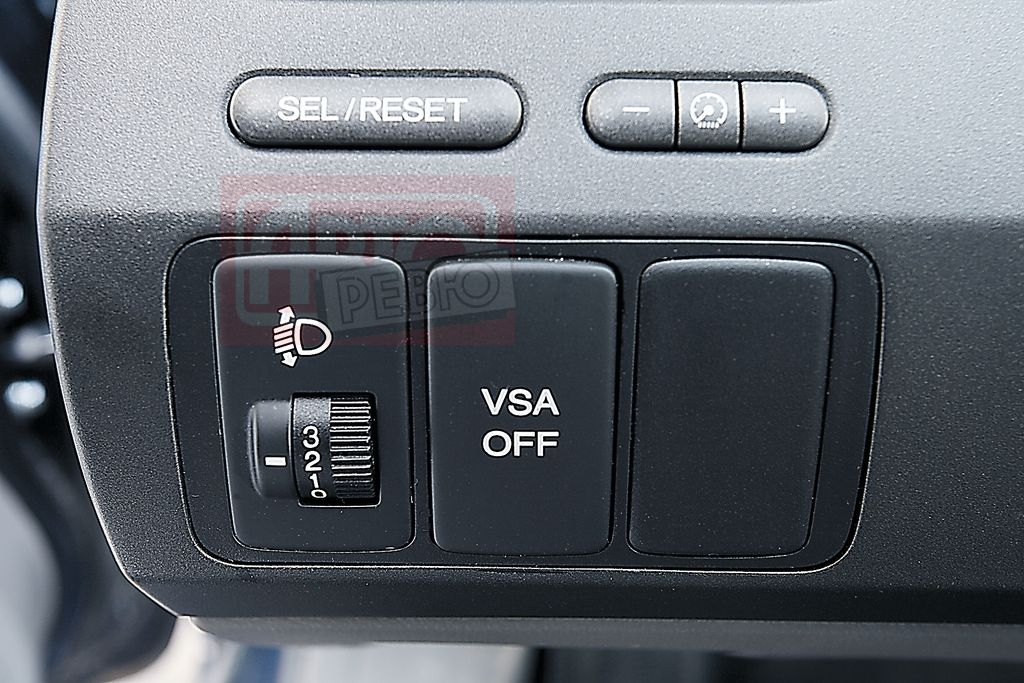 | 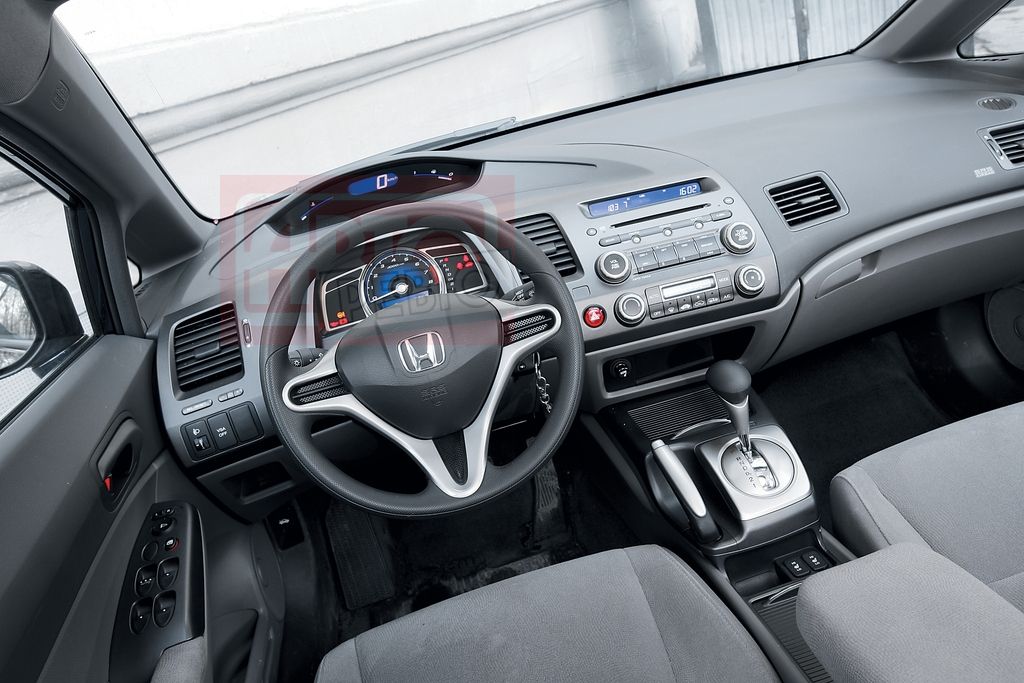 |
| The switchable VSA stability system works brilliantly! | A real cockpit: everything around the driver, all buttons within direct reach, all displays perfectly visible… |
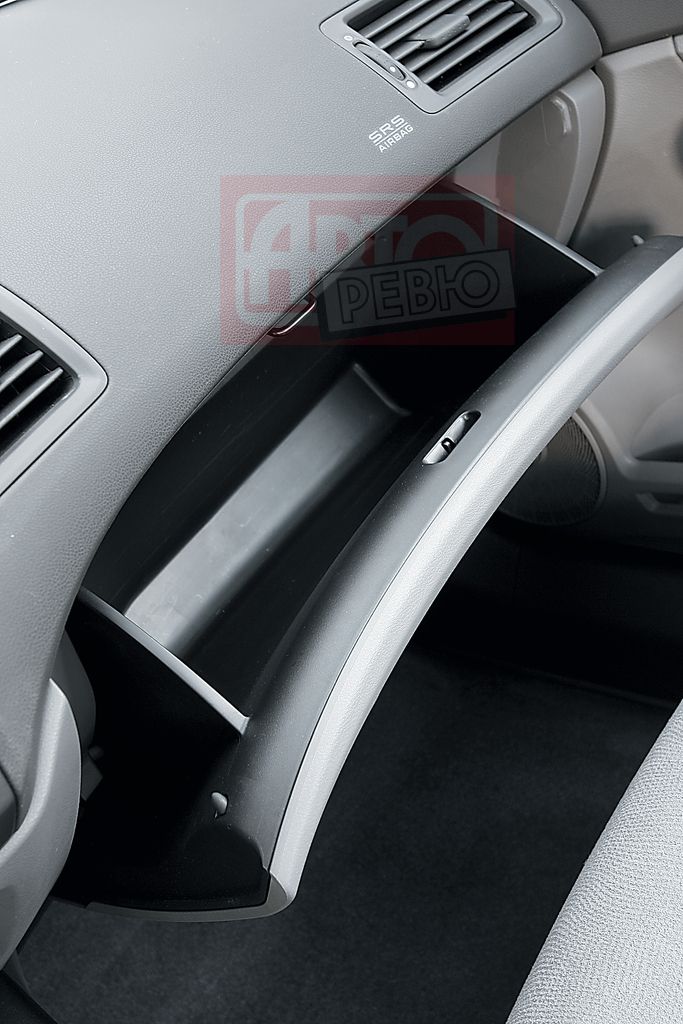 | 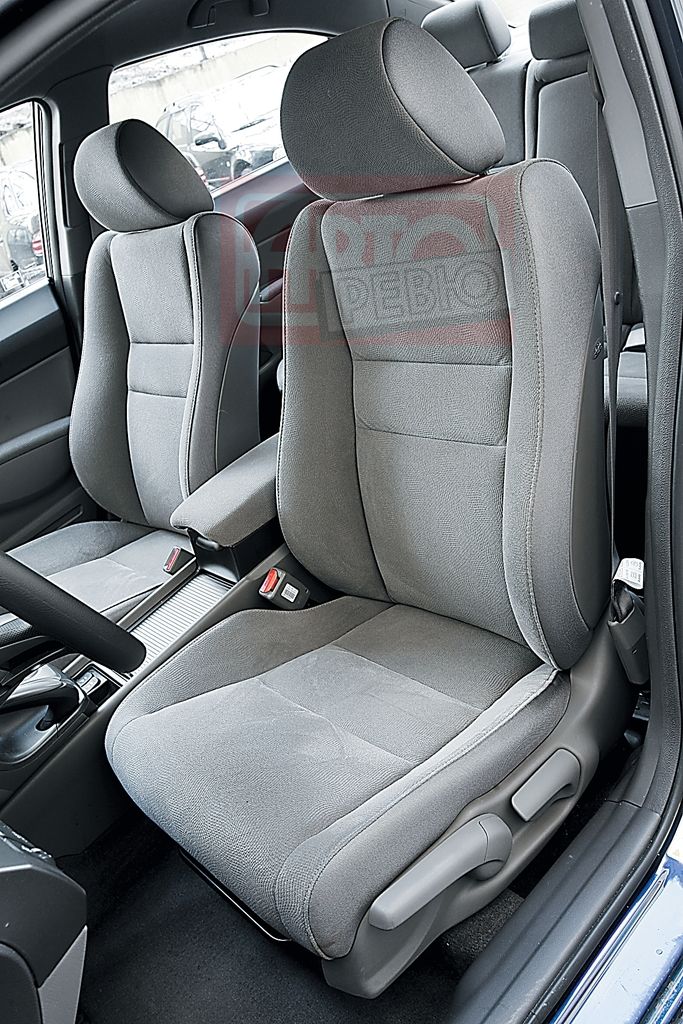 |
| In terms of small-item storage volume, the Civic leads | The sport seats lack only better lumbar support |
The Civic's chassis clearly has a driver-oriented character. The suspension is tuned stiffer, and the steering wheel distinctly feels a "zero" that guards a sharp build-up of effort. Just turn the wheel a little — and you already want to hold it with both hands. The sharpness of reactions also prevents relaxation: on the highway, the Honda starts to wander on any unevenness, instantly responding to every steering movement.
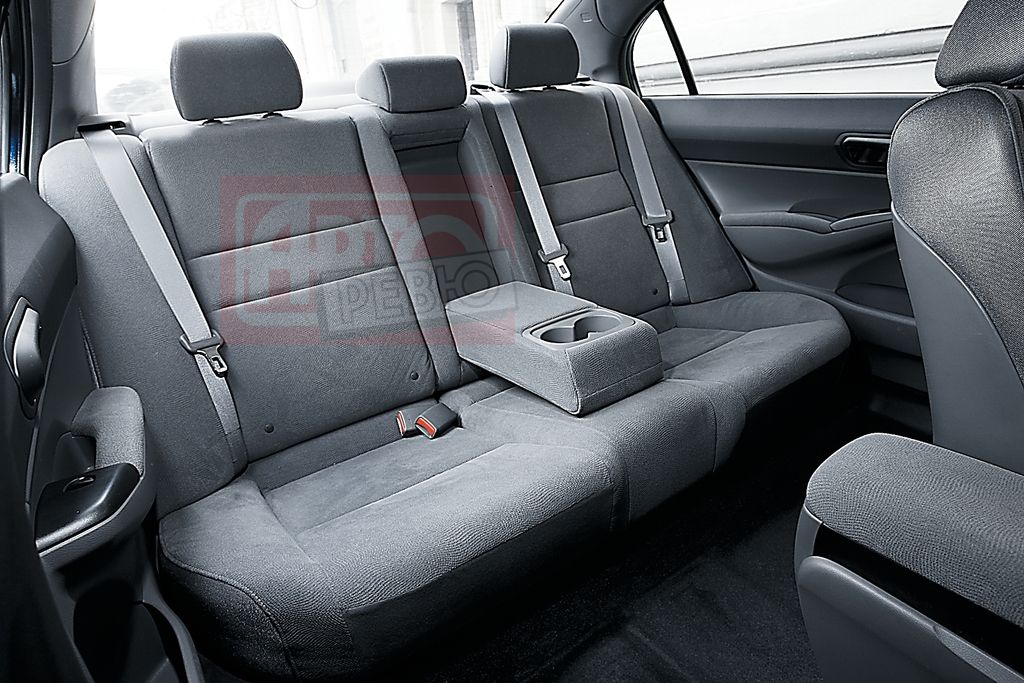 |
| The Civic's rear seats are spacious, but there is little headroom |
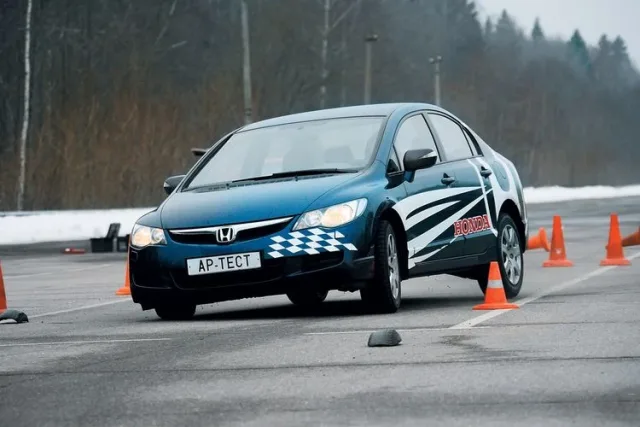
Despite all this, at high speeds during lane changes, the Civic holds its line better than the others — even on soft winter Goodyear UG 500 tires. In a limit corner, the Honda gently slides with all four wheels, smoothly winding up and going into a very mild oversteer. And if the car is more richly equipped, it has a VSA stability system that brakes slides imperceptibly and correctly, but persistently and confidently.
And here the question arises: where do such noticeable body rolls come from? You don't expect them from a car with a stiff suspension and quick reactions. But the Honda literally leans over to the side simultaneously with an energetic turn of the steering wheel! Together with the "thoughtful" automatic transmission, these rolls destroy the already almost formed "driver's" image of the Civic. It's a pity!
The Focus, against the Civic's background, hardly rolls at all. But in essence, it is closer to the Corolla — there is no sportiness in its behavior. At high speed, the Ford stands very confidently and calmly — perhaps best of all in this quartet. True, the reactive effort on the steering wheel is not as "transparent" as in both Japanese cars — in the "zero" position, the wheel seems a bit stiff. By the way, switching the electro-hydraulic power steering to "sport" mode in practice gives little benefit — the steering simply becomes heavier, but not more informative.
There is no polish in reactions either: in corners, the Focus on winter tires noticeably "steers" too sharply into the arc. And if you enter a slippery corner too abruptly and lift off the throttle — be on alert: the Ford is ready to sharply "plunge" into a deep oversteer without warning! And it will be much harder to control than the Corolla. We gave the Focus the same 80 points for handling as the Corolla, only because our Ford had the IVD stability system, which usually costs an extra $690.
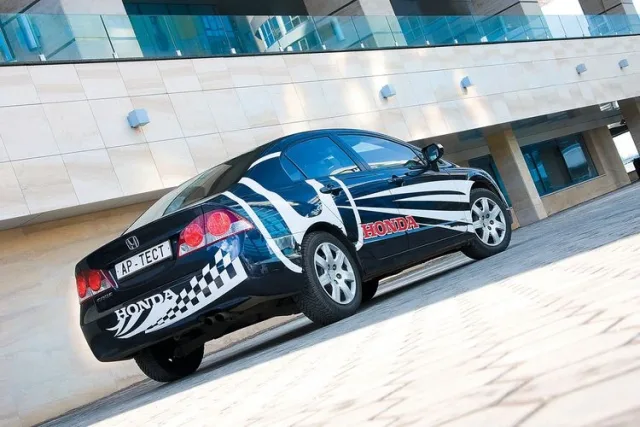
And who is the worst in chassis tuning? Alas, again the Elantra…
It has the "dullest" steering and the most unnatural reactive effort. With such characteristics, sluggish reactions are a blessing. In deeper turns, at some point the effort on the steering wheel increases abruptly — and then remains unchanged again, but at a new level. Add to this a well-perceptible additional steering that occurs during sharp lane changes: the Elantra "wiggles" so much that sometimes you even need to "unwind" the steering wheel. And the tendency to oversteer is no less than that of the Toyota. But coping with oversteer due to the ephemeral connection with the car is harder here, and there is no stability system: it is installed only on versions with two-liter engines.
The Elantra's brakes, by the way, also have complaints: the Hyundai "over-brakes" with a constant pedal position. The Focus and Corolla are slightly hindered by the long travel of the brake drive. And only the Civic is practically sinless in managing deceleration — but it has the longest braking distance in measurements.
Is ride comfort important for such cars? If this is your family transport, it is very important!
The undisputed leader is Toyota. It passes small and medium irregularities slightly stiffer than desired, but this drawback disappears with increasing speed — just as youth fades over time. And large potholes and gentle waves are handled very nobly by the suspension: the engineers found the only correct settings when the body has not yet started to sway, but has already stopped annoyingly repeating the road profile.
And the Corolla is also slightly quieter than the others: road noise, a pleasant engine voice, aerodynamic rustles — everything is balanced so as not to irritate the ear or interfere with conversation or music. Except that stones and sand drum on the wheel arches a bit loudly.
The Honda is stiffer — it overcomes small and medium irregularities worst of all, transmitting the entire micro-relief of the asphalt to the body. And the engine is a bit noisy, since its perky voice cannot be called a song, alas.
The Focus is similar to the Civic in comfort. It quite confidently overcomes small and medium irregularities, decently "swallows" a long wave. But on a series of irregularities, a low-frequency "suspension" vibration arises that can shake the souls out of the occupants! Another trouble is a pressing resonant noise originating in the rear of the cabin even at low speeds. Weak sound insulation of the rear arches?
So finally the Elantra is not last — it yields to the Corolla in comfort, but is still better than the Honda and Ford. The Hyundai's problems are a "sluggish" suspension that allows bottoming out and rocking on gentle waves, and engine noise along with the knocking of stones on the arches and underbody.
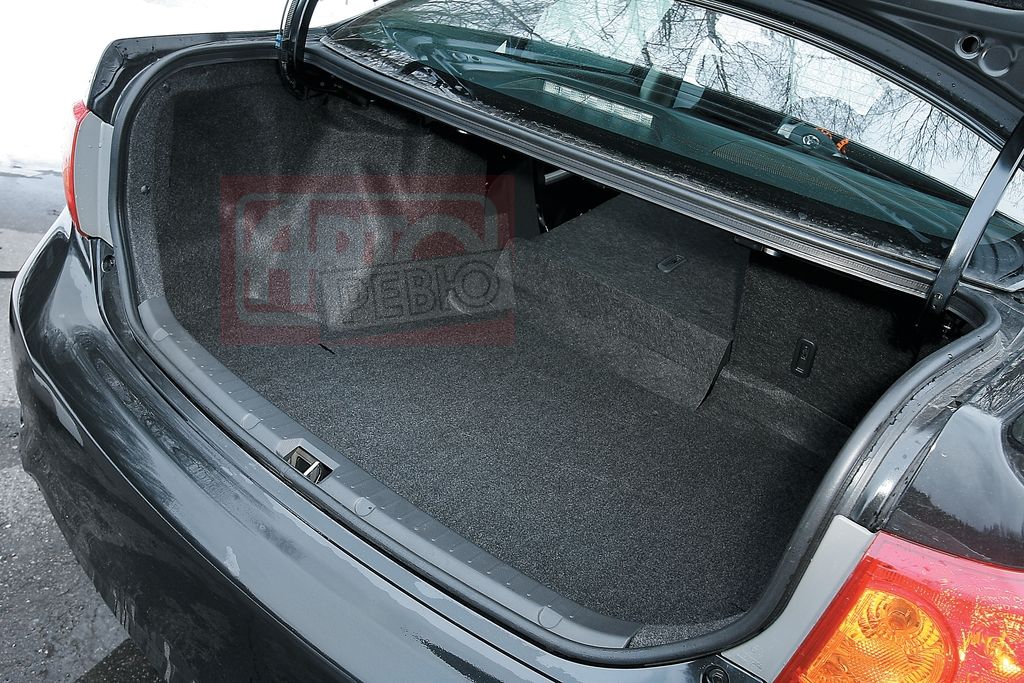
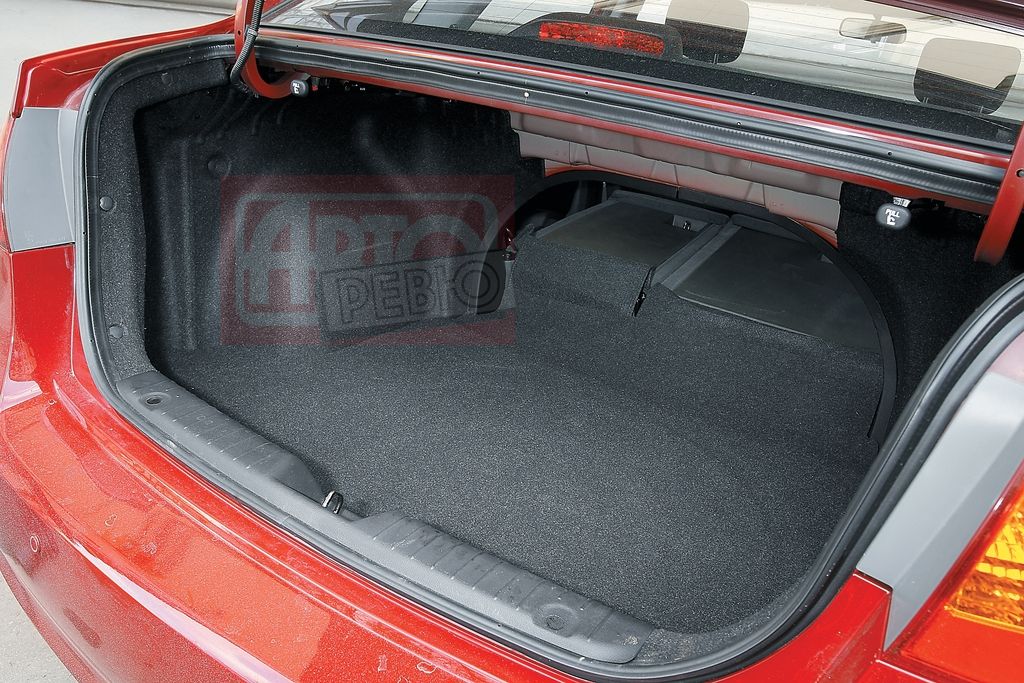
| Toyota Corolla | Hyundai Elantra |
 |  |
| Ford Focus | Honda Civic |
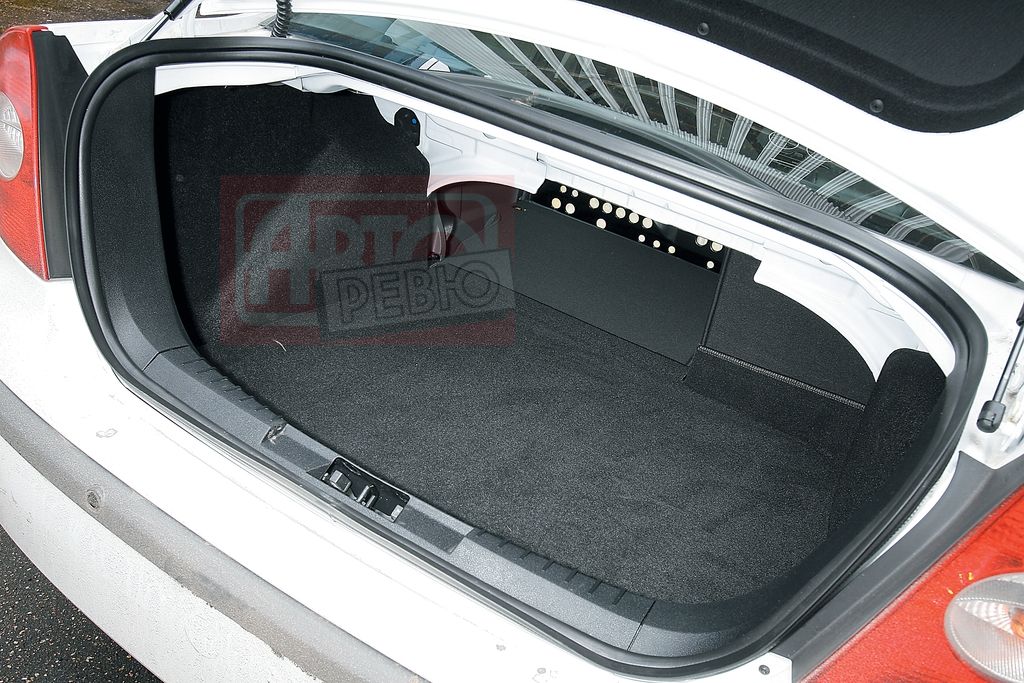 | 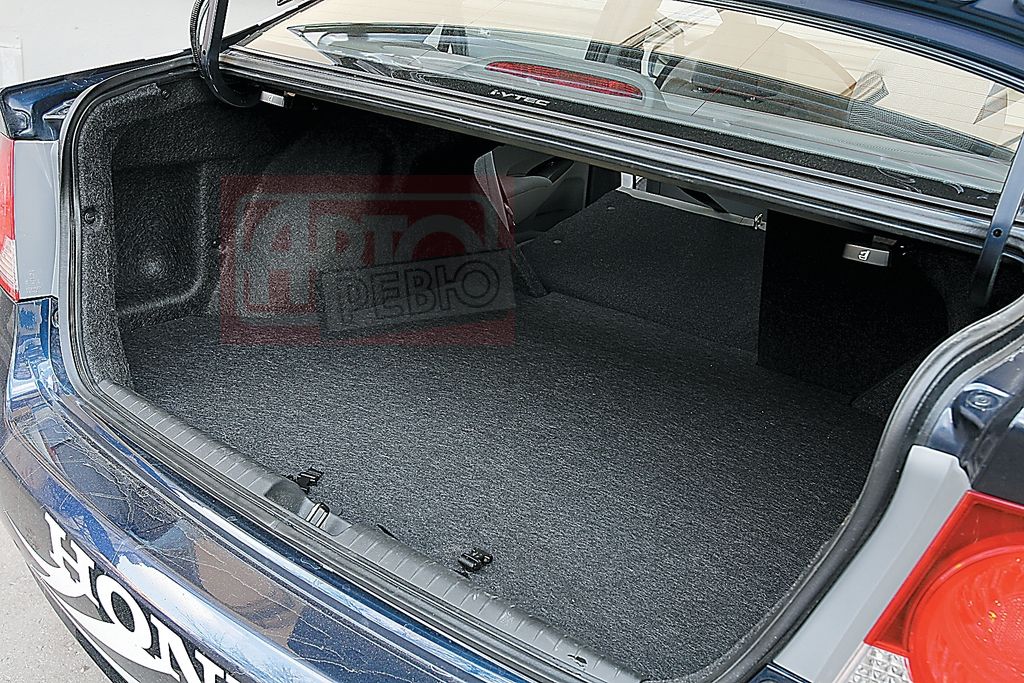 |
| The most spacious trunk is in the Focus; the smallest and most inconvenient is in the Civic. And the Corolla and Elantra offer trunks of approximately the same average volume. However, the Focus and Civic, with the rear seat folded, provide a cargo compartment with a flat floor without a step, unlike the Corolla and Elantra | |
So, an unconditional victory is celebrated by… the "Japanese"!
If you choose a family sedan with a sufficiently powerful engine, automatic transmission, and a good level of equipment, then the prize of our sympathies is shared by Toyota and Honda. To be more precise, the Corolla 1.6 Elegance with MultiMode gearbox for $22,700 and the Civic Executive for $23,900. Moreover, Toyota in terms of price-to-options ratio is in the lead.
The Ford Focus against the background of Japanese cars is a "solid middle-class". Even despite all its European design. By the way, its price advantage is quite ephemeral: if you equip the base Focus 2.0 with an "automatic" for $19,010 with all options, it will turn out to be only slightly cheaper than the Corolla and Civic. But only Ford offers such joys as dual-zone climate control or, for example, a heated windshield.
The new Elantra is more expensive than the Focus — $20,000–25,000 for a life-size mock-up of a modern golf-class car as it was seen in South Korea about two years ago. And since then, much has changed. We hope that the new Hyundai i30 hatchback, a platform mate of the beautiful Kia cee'd, will soon rehabilitate the Korean brand. But the Elantra was made at the junction of times — in an era of change, when European brands still hold priority in design and image by inertia, but are losing the initiative before our eyes.
What's next?
| Specifications | ||||
| Parameters | Vehicles | |||
| Ford Focus | Honda Civic | Hyundai Elantra | Toyota Corolla | |
| Body type | four-door sedan | four-door sedan | four-door sedan | four-door sedan |
| Number of seats | 5 | 5 | 5 | 5 |
| Trunk volume, l | 526 | 389 | 460 | 450 |
| Curb weight, kg | 1385 | 1221 | 1172 | 1245 |
| Gross weight, kg | 1820 | 1700 | 1680 | 1760 |
| Engine | petrol, multipoint injection | petrol, multipoint injection | petrol, multipoint injection | petrol, multipoint injection |
| Location | front, transverse | front, transverse | front, transverse | front, transverse |
| Number and arrangement of cylinders | 4, in-line | 4, in-line | 4, in-line | 4, in-line |
| Displacement, cm³ | 1999 | 1799 | 1591 | 1598 |
| Cylinder bore/piston stroke, mm | 87.5/83.1 | 81.0/87.3 | 77.0/85.4 | 80.5/78.5 |
| Compression ratio | 10.8:1 | 10.5:1 | 10.5:1 | 10.2:1 |
| Number of valves | 16 | 16 | 16 | 16 |
| Max. power, hp/kW/rpm | 145/107/6000 | 140/103/6300 | 122/90/6200 | 124/91/6000 |
| Max. torque, Nm/rpm | 185/4500 | 174/4300 | 154/4200 | 157/5200 |
| Gearbox | automatic, 4-speed | automatic, 5-speed | automatic, 4-speed | manual, robotic, 5-speed |
| Gear ratios | ||||
| I | 2.81 | 2.67 | 2.92 | 3.55 |
| II | 1.49 | 1.53 | 1.55 | 1.90 |
| III | 1.00 | 1.02 | 1.00 | 1.31 |
| IV | 0.72 | 0.72 | 0.71 | 0.97 |
| V | — | 0.52 | — | 0.82 |
| reverse | 2.64 | 1.96 | 2.48 | 3.25 |
| final drive | 4.20 | 4.44 | 4.38 | 4.31 |
| Drive | front | front | front | front |
| Front suspension | independent, coil spring, McPherson | independent, coil spring, McPherson | independent, coil spring, McPherson | independent, coil spring, McPherson |
| Rear suspension | independent, coil spring, multi-link | independent, coil spring, multi-link | independent, coil spring, multi-link | semi-independent, coil spring |
| Front brakes | disc, ventilated | disc, ventilated | disc, ventilated | disc, ventilated |
| Rear brakes | disc | disc | disc | disc |
| Tires | 195/65 R15 | 205/55 R16 | 185/65 R15 | 205/55 R16 |
| Maximum speed, km/h | 195 | 200 | 183 | 195 |
| Acceleration time 0—100 km/h, s | 10.7 | 10.6 | 11.6 | 12.1 |
| Fuel consumption, l/100 km | ||||
| urban cycle | 11.2 | 9.5 | 8.8 | 8.5 |
| extra-urban cycle | 6.1 | 5.1 | 5.4 | 5.9 |
| combined cycle | 8.0 | 6.6 | 6.7 | 6.9 |
| Fuel tank capacity, l | 55 | 50 | 55 | 55 |
| Fuel | petrol AI-91—95 | petrol AI-95 | petrol AI-91—95 | petrol AI-95 |
| Measurement results obtained by Autoreview | |||||
| Parameters | Vehicles | ||||
| Ford Focus | Honda Civic | Hyundai Elantra | Toyota Corolla | ||
| Maximum speed, km/h | 187.5 | 190.5 | 170.2 | 184.8 | |
| Acceleration time, s | 0—50 km/h | 3.8 | 3.9 | 4.4 | 4.7/4.5* |
| 0—100 km/h | 11.3 | 11.2 | 13.5 | 13.0/12.4 | |
| 0—150 km/h | 26.7 | 26.2 | 34.7 | 30.3/29.2 | |
| at 400 m | 18.0 | 18.0 | 19.2 | 18.9/18.5 | |
| at 1000 m | 32.9 | 32.7 | 35.2 | 34.2/33.7 | |
| 60—100 km/h (III) | — | — | — | 7.7 | |
| 60—100 km/h (IV) | — | — | — | 12.0 | |
| 80—120 km/h (V) | — | — | — | 17.3 | |
| 60—100 km/h (D) | 6.8 | 6.7 | 7.9 | 7.4 | |
| 80—120 km/h (D) | 8.7 | 9.3 | 11.4 | 9.6 | |
| Coast-down, m | from 50 km/h | 720 | 646 | 578 | 636 |
| 130—80 km/h | 1036 | 1026 | 941 | 941 | |
| 160—80 km/h | 1569 | 1548 | 1432 | 1425 | |
| Braking from 100 km/h | distance, m | 55.2 | 56.2 | 54.3 | 54.2 |
| deceleration, m/s² | 7.0 | 6.9 | 7.1 | 7.1 | |
| * Drive/ES position | |||||
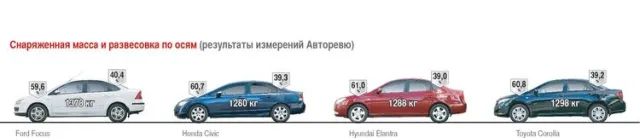
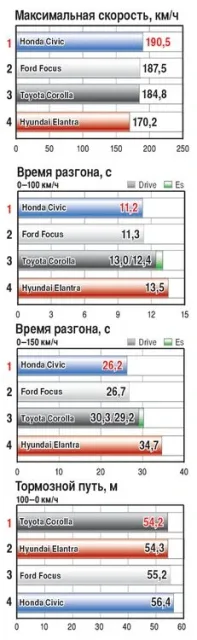
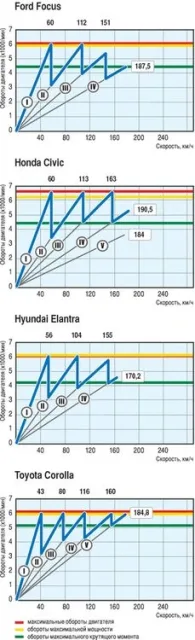
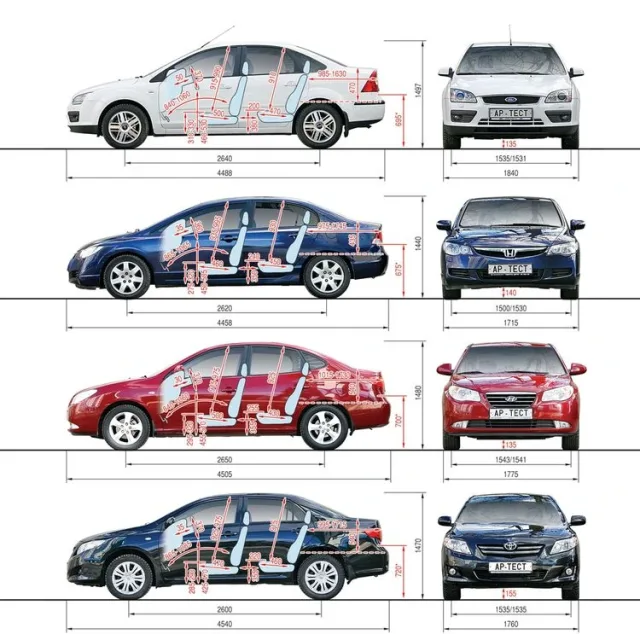
Black indicates manufacturer data, red indicates Autoreview measurement results * Loading height
| Equipment of cars participating in the tests | ||||
| Equipment | Cars | |||
| Ford Focus | Honda Civic | Hyundai Elantra | Toyota Corolla | |
| Price of base version, $ | 16910 | 19900 | 17790 | 19950 |
| Driver and passenger airbags | + | + | + | + |
| Front side airbags | O | + | O | + |
| Driver knee airbag | – | – | – | O |
| Inflatable curtains | – | O | O | O |
| ABS | O | + | + | + |
| Traction control system | O | O | – | – |
| Stability control system | O | O | – | – |
| Power steering | + | + | + | + |
| Automatic transmission | O | O | O | O* |
| Paddle shifters on steering wheel | – | – | – | + |
| Multi-function steering wheel | O | – | O | O |
| Steering column tilt adjustment | + | + | + | + |
| Steering column reach adjustment | + | + | O | + |
| Leather steering wheel | O | – | O | O |
| Power driver seat | O | – | – | – |
| Heated front seats | O | + | + | + |
| Central locking (with remote) | O | + | O | + |
| Security alarm | – | – | O*** | – |
| Air conditioning | + | + | + | + |
| Single-zone climate control | – | O | O | O |
| Power and heated exterior mirrors | O | + | O | + |
| Front power windows | + | + | + | + |
| Rear power windows | O | + | + | O |
| Folding rear seat (partial) | + | + | + | + |
| CD audio system | O | + | O | + |
| CD changer | O | – | – | – |
| On-board computer | O | + | O | + |
| Rear parking sensors | O | – | O*** | – |
| Leather interior | O | – | – | – |
| Wood trim interior | O | – | – | – |
| Remote trunk lock | +** | + | +** | + |
| Remote fuel filler flap lock | – | + | + | + |
| Xenon headlights | – | – | O*** | – |
| Cornering headlights | O | – | – | – |
| Front fog lights | O | – | O | O |
| Headlight washers | O | + | – | + |
| Alloy wheels | O | – | O | – |
| Full-size spare wheel | + | + | – | + |
| Metal engine protection | – | – | O*** | – |
| Metallic paint | – | O | + | + |
| Price of tested car, $ | 23565 | 23100 | 23716 | 22700 |
| * Robotic manual | ||||
| ** Additionally with button on key fob | ||||
| *** Option installed by dealer | ||||
| (+) Included in base version | ||||
| (–) Not available in base version | ||||
| (O) Options installed on cars participating in the test | ||||
| Cost of scheduled maintenance with consumables and parts* | |||||
| Scheduled maintenance | Cars | ||||
| Ford Focus | Honda Civic | Hyundai Elantra | Toyota Corolla | ||
| Cost per hour | 52 | 50 | 40 | 62 | |
| Mileage, km | 7500 | — | 96 | 173 | — |
| 10000 | — | — | — | 162 | |
| 15000 | — | 217 | 279 | — | |
| 20000 | 100** | — | — | 327 | |
| 30000 | — | 392 | 296 | 162 | |
| 40000 | 100** | — | — | 597 | |
| 45000 | — | 355 | 305 | — | |
| 50000 | — | — | — | 162 | |
| 60000 | 100** | 392 | 318 | 327 | |
| 70000 | — | — | — | 162 | |
| 75000 | — | 217 | 279 | — | |
| 80000 | 100** | — | — | 597 | |
| 90000 | — | 561 | 404 | 162 | |
| Total | 400** | 2230 | 2054 | 2658 | |
| * Prices are in US dollars | |||||
| ** Base cost | |||||
| Approximate prices for original parts from Moscow dealers* | ||||
| Parts | Cars | |||
| Ford Focus | Honda Civic | Hyundai Elantra | Toyota Corolla | |
| Oil filter | 11 | 15 | 7 | 17 |
| Fuel filter | — | 23 | 33 | — |
| Air filter | 22 | 27 | 28 | 20 |
| Cabin filter | 24 | 40 | 52 | 51 |
| Spark plug | 10 | 37 | 6 | 26 |
| Front brake pads | 77 | 115 | 96 | 122 |
| Rear brake pads | 77 | 81 | 69 | 72 |
| Front shock absorber | 142 | 150 | 146 | 141 |
| Rear shock absorber | 127 | 131 | 135 | 70 |
| Front headlight | 109 | 332 | 300 | 287 |
| Rear light | 78 | 91 | 166 | 106 |
| Front fender | 234 | 412 | 231 | 237 |
| Front bumper | 329 | 639 | 327 | 336 |
| Hood | 442 | 467 | 404 | 401 |
| Windshield | 241 | 593 | 462 | 354 |
| * Prices are in US dollars | ||||
| Speedometer accuracy | |||||||||
| Cars | Speedometer readings, km/h | ||||||||
| 40 | 60 | 80 | 100 | 120 | 140 | 160 | 180 | 200 | |
| True speed, km/h | |||||||||
| Ford Focus | 37 | 56 | 76 | 95 | 113 | 132 | 151 | 170 | 189 |
| Honda Civic | 37 | 57 | 76 | 95 | 113 | 133 | 150 | 170 | 188 |
| Hyundai Elantra | 37 | 56 | 74 | 93 | 111 | 129 | 148 | 167 | — |
| Toyota Corolla | 40 | 58 | 77 | 96 | 113 | 133 | 153 | 173 | — |
Autoreview readers' forecast
Before this test, we asked visitors of the website www.autoreview.ru to answer the question: "Which of the cars participating in the next Autoreview test would you choose?"
The votes were distributed as follows:
Ford Focus 34.18%
Honda Civic 33.95%
Toyota Corolla 27.35%
Hyundai Elantra 4.52%
14,348 people voted
Autoreview expert assessments
| Expert ratings from Autoreview | |||||
| Evaluated parameters | Max. score | Cars | |||
| Ford Focus | Honda Civic | Hyundai Elantra | Toyota Corolla | ||
| Design | 160 | 135 | 145 | 120 | 135 |
| Exterior | 80 | 70 | 70 | 60 | 65 |
| Interior | 80 | 65 | 75 | 60 | 70 |
| Ergonomics | 160 | 135 | 135 | 135 | 140 |
| Driver's workplace | 80 | 70 | 75 | 65 | 70 |
| Visibility | 80 | 65 | 60 | 70 | 70 |
| Dynamics | 290 | 230 | 245 | 210 | 235 |
| Acceleration dynamics | 90 | 70 | 75 | 60 | 70 |
| Braking dynamics | 100 | 80 | 85 | 80 | 85 |
| Handling | 100 | 80 | 85 | 70 | 80 |
| Ride comfort | 210 | 145 | 155 | 160 | 175 |
| Ride smoothness, vibration protection | 80 | 55 | 55 | 60 | 65 |
| Acoustic comfort | 70 | 50 | 50 | 55 | 60 |
| Climate control | 60 | 40 | 50 | 45 | 50 |
| Interior comfort | 180 | 135 | 125 | 130 | 125 |
| Passenger seats | 70 | 50 | 50 | 55 | 50 |
| Trunk | 60 | 50 | 40 | 45 | 45 |
| Interior transformation | 50 | 35 | 35 | 30 | 30 |
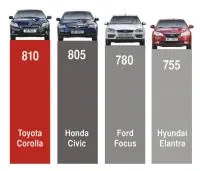
| Total score | 1000 | 780 | 805 | 755 | 810 |
Final Autoreview ratings
Spring, emergency situation…
The "moose test" reproduces a situation where the driver is forced to sharply avoid a collision, go around an obstacle, and return to their lane. Since all four sedans were fitted with winter studded tires, we did not determine the maximum speed of this maneuver, but limited ourselves to half the program: five drivers each went through the corridor once at a standard 65 km/h, trying not to hit a single cone. This check shows how easily and predictably the car behaves in an abnormal road situation.
In the Honda with the VSA system, two out of five drivers completed the task without errors. The car pleases with sharp reactions, a clear steering wheel, and well-tuned electronics that instantly suppress an incipient skid without waiting for driver actions, but at the same time does not interfere with maintaining the desired trajectory. However, the other three participants who hit cones complained about overly sharp responses and frightening body rolls, which made it difficult to steer confidently at a critical moment.
The Focus performed worse — only one driver out of five passed the corridor cleanly. Everyone praised the excellent feedback, but unanimously criticized the stability control system: at the moment of its intervention, the car seemed to freeze and not obey the steering wheel. Although it is worth admitting that the electronics did everything possible to keep the skid-prone car on course.
The Corolla showed the same result as the Ford — success accompanied only one driver. At the same time, the steering here has decent reactive effort, but the steering sensitivity is not high enough, plus again there is a tendency to skid. And the main drawback is that in the Toyota, the driver is left alone with such problems, because it has no stability control system.

But no one managed with the Elantra. The emergency maneuver is hindered by both the sluggish steering wheel with weak reactive effort and low sensitivity. But the main trouble is a strong tendency to skid: the car starts "wagging its tail" immediately after going around the obstacle. At the entrance to the third corridor, when it is necessary to return to one's lane, the driver simply lost control of the car, unable to cope with a deep skid. This is truly dangerous!
| "Moose test" on the first attempt at 65 km/h* | |
| Car | Maneuver completed |
| Ford Focus | 1 driver out of 5 |
| Honda Civic | 2 drivers out of 5 |
| Hyundai Elantra | 0 drivers out of 5 |
| Toyota Corolla | 1 driver out of 5 |
| 5 drivers out of 5 took part in the tests | |
Visibility
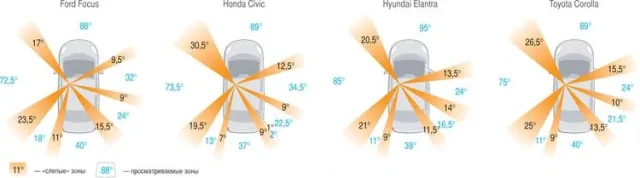
The Corolla has the smallest viewing sector — 260.5 degrees, but it has excellent exterior mirrors and a large windshield wiper cleaning zone. The Elantra also has large mirrors, the left wiper cleans the glass all the way to the pillar, and the total viewing angle is 270.5 degrees. The Focus stands out with the smallest side mirrors and massive bases of the front pillars, but the view through the interior mirror is good, and the total figure of 274.5 degrees is the best in the test. The outsider was the Honda: with a large overall sector (271.5 degrees), the left pillar blocks as much as 30.5 degrees, and the right wiper does not reach the pillar by 7–8 centimeters.
Are they safe?
In Russia, it was the Focus that turned out to be the most modestly equipped in terms of safety — both active and passive. The base version is content with just one airbag. The passenger and side airbags appear only in the top Ghia trim, and ABS and the IVD stability control system are exclusively for an extra charge. The European hatchback with "curtains," which Russian cars do not have, was tested in EuroNCAP crash tests. Such a Focus easily received five stars, as well as a high rating for the protection of child passengers. However, pedestrian safety leaves much to be desired — only two stars out of four possible.
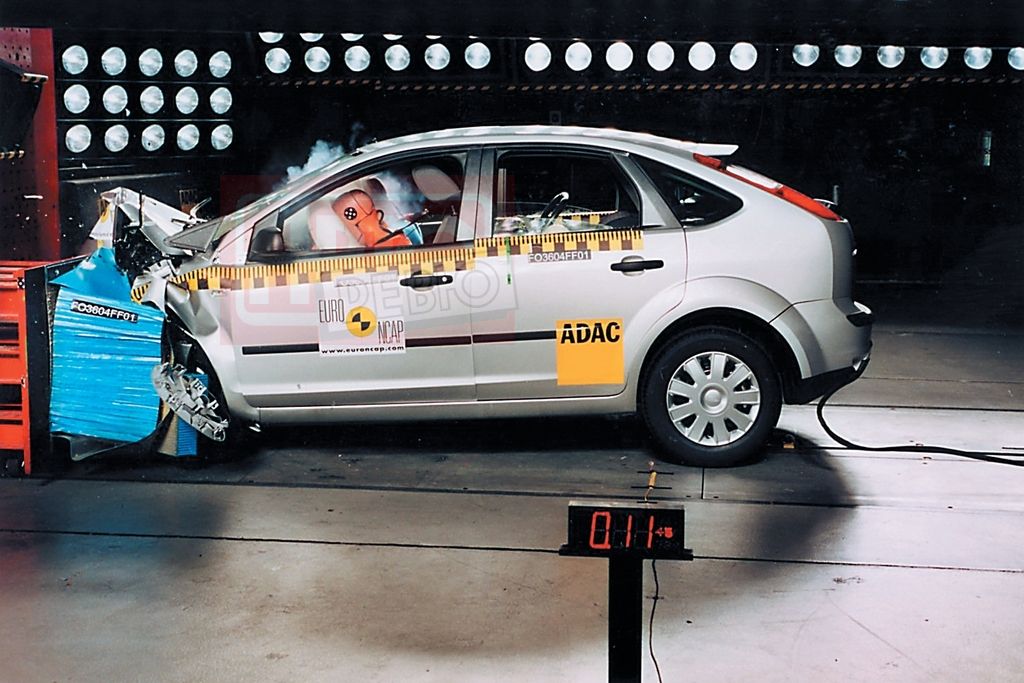 | Ford Focus* | ★★★★★ |
| Overall rating | 35 | |
| Frontal crash test | 16 (100%) | |
| Side crash tests | 18 (100%) | |
| SBR** | 2 | |
| Protection of child passengers | 40 (82%) | |
| Pedestrian protection | 15 (42%) | |
| Curb weight | 1248 kg | |
| * Tests were conducted according to EuroNCAP rules | ||
| ** Seat belt reminder | ||
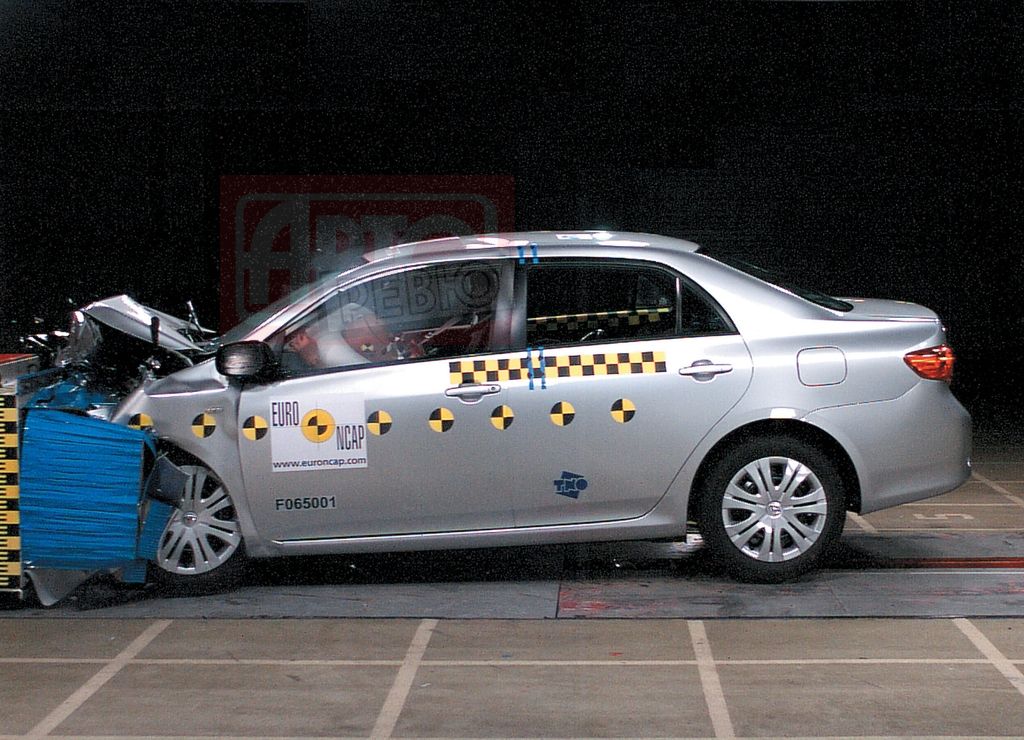
Base Corollas are equipped with four airbags, ABS, and electronic brake-force distribution. More expensive versions add "curtains" and a "knee" airbag for the driver. It was in this configuration that the Toyota passed EuroNCAP tests, where it slightly lost to the Focus but earned the same five stars. However, in pedestrian protection, the Corolla was ahead — the pliable hood provided three stars out of four.
 | Toyota Corolla* | ★★★★★ |
| Overall rating | 34 | |
| Frontal crash test | 15 (94%) | |
| Side crash tests | 17 (94%) | |
| SBR** | 2 | |
| Protection of child passengers | 40 (82%) | |
| Pedestrian protection | 23 (64%) | |
| Curb weight | 1290 kg | |
| * Tests were conducted according to EuroNCAP rules | ||
| ** Seat belt reminder | ||
The base Honda Civic already has front and side airbags in the starting version, plus an anti-lock braking system. If you choose a more expensive option, side curtain airbags and a stability control system are added. The Civic sedan was tested in Japan under the JNCAP protocol, which includes two frontal impacts (head-on and with 40% overlap) and one side impact. Overall, the car performed well, providing reliable protection for the dummies, but for pedestrian safety, the Honda received only the third level out of five possible.
| Honda Civic* | |
| Overall driver protection rating | 90% |
| Overall passenger protection rating | 93% |
| Driver protection in frontal impact | 89% |
| Passenger protection in frontal impact | 93% |
| Driver protection in frontal offset impact | 88% |
| Passenger protection in frontal offset impact | 97% |
| Driver protection in side impact | 93% |
| Curb weight | 1240 kg |
| * Tests conducted according to JNCAP rules | |
The base Hyundai Elantra sedan is equipped with two airbags, ABS, and electronic brake-force distribution. Side airbags, curtain airbags, and stability control are available only in higher trim levels. The Elantra was tested according to the methodology of the U.S. National Highway Traffic Safety Administration (NHTSA). The Korean sedan passed the frontal impact against a concrete wall flawlessly, but the side crash test earned it only four out of five stars.
| Hyundai Elantra* | |
| Driver protection in frontal impact | 5 stars |
| Passenger protection in frontal impact | 5 stars |
| Driver protection in side impact | 4 stars |
| Rear passenger protection in side impact | 4 stars |
| Rollover rating | 4 stars |
| Curb weight | 1305 kg |
| * Tests conducted according to NHTSA rules | |
What costs how much?
The Ford Focus sedan in the base Ambiente trim (one airbag, front power windows, power steering, no ABS) with the 80-hp 1.4 engine starts at $14,010. More powerful engines come in the Comfort trim, which already includes air conditioning. Thus, the Focus with the 1.6 engine producing 100 hp is priced at $16,330, and the automatic transmission costs an additional $1,240. Versions with the 1.6 (115 hp) and 1.8 (125 hp) engines are available only with a manual gearbox and start at $16,820 and $17,140, respectively. The two-liter Focus (145 hp) starts at $17,760, and with an automatic transmission from $19,010. The lineup also includes a 1.8-liter turbodiesel (115 hp), with prices starting at $18,930. The Trend version costs $250 more and adds fog lights and an onboard computer, while the Ghia trim requires an extra $1,050 — but it includes four airbags, power accessories, and heated mirrors. The three-door hatchback is $1,020 cheaper than the sedan, the five-door is $490 cheaper, while the wagon is $660 more expensive. Dual-zone climate control costs $450, a CD player $460, and ABS $400. Dealers accept payment in rubles at the Central Bank rate or in dollars. Some trims may require waiting up to four months.
Warranty — 2 years or 100,000 km. Ford's dealer network includes 148 locations.
The Hyundai Elantra is more expensive than the Focus but also better equipped. The sedan in the base GL trim with the 1.6 engine (122 hp) sells for $17,790 — the list already includes two airbags, air conditioning, power windows, ABS, electronic brake-force distribution, and heated front seats. The GLS version for $18,690 adds a CD player, onboard computer, and power-adjustable heated mirrors. An automatic transmission costs an additional $1,300, while a package with climate control, side airbags, curtain airbags, alloy wheels, and fog lights costs another $2,300. The top-of-the-line Elantra — with a two-liter engine (143 hp), automatic transmission, and stability control — costs $24,890, but most dealers calculate at a rate of 26.9 rubles per dollar. If recalculated at the current Central Bank rate, the price rises to $25,770* — that's $3,330 more than a similarly equipped Focus! The Elantra with a manual transmission arrives in three months, while the automatic version requires waiting two months longer.
Warranty — 3 years or 100,000 km. Hyundai is sold by 79 dealers in 48 Russian cities.
The Toyota Corolla 1.4 (97 hp) in the Comfort trim is offered at $18,600. The impressive equipment list includes four airbags, air conditioning, front power windows, power-adjustable heated mirrors, ABS, EBD, CD player, and heated front seats. A similarly equipped Corolla 1.6 (124 hp) costs $19,950, and for an additional $1,050, a robotic MultiMode gearbox is offered. The Elegance version ($22,700) additionally includes curtain airbags and a driver's knee airbag, climate control, rear power windows, and fog lights, while the top-of-the-line Corolla Prestige for $24,600 features cruise control, light and rain sensors, alloy wheels, and a push-button engine start system. Toyota dealers calculate the amount at the Central Bank rate, adding 1% to it. You'll have to wait from two to four months for the ordered car, depending on the trim.
Warranty — 3 years or 100,000 km. Toyota cars are sold by 35 dealers in 20 Russian cities.
The Honda Civic is sold in Russia only with a 1.8-liter engine (140 hp). The base Comfort trim (four airbags, air conditioning, ABS, CD player, power accessories, heated mirrors) with a six-speed manual gearbox costs $19,900, with an automatic transmission — $20,900. The top Executive trim for $23,900 includes six airbags, climate control, cruise control, stability control, CD changer, and alloy wheels. Prices for the Honda Civic hatchback start at $25,200. Most dealers accept payment at the current Central Bank rate, and only some sellers add 1% to the amount. The queue for the Civic stretches at least seven months, and some dealers may require waiting over a year for the ordered car.
Warranty — 3 years or 100,000 km. Honda cars are sold by 26 dealers in 14 Russian cities.
* At the exchange rate of $1=25.98 rubles.
What else?
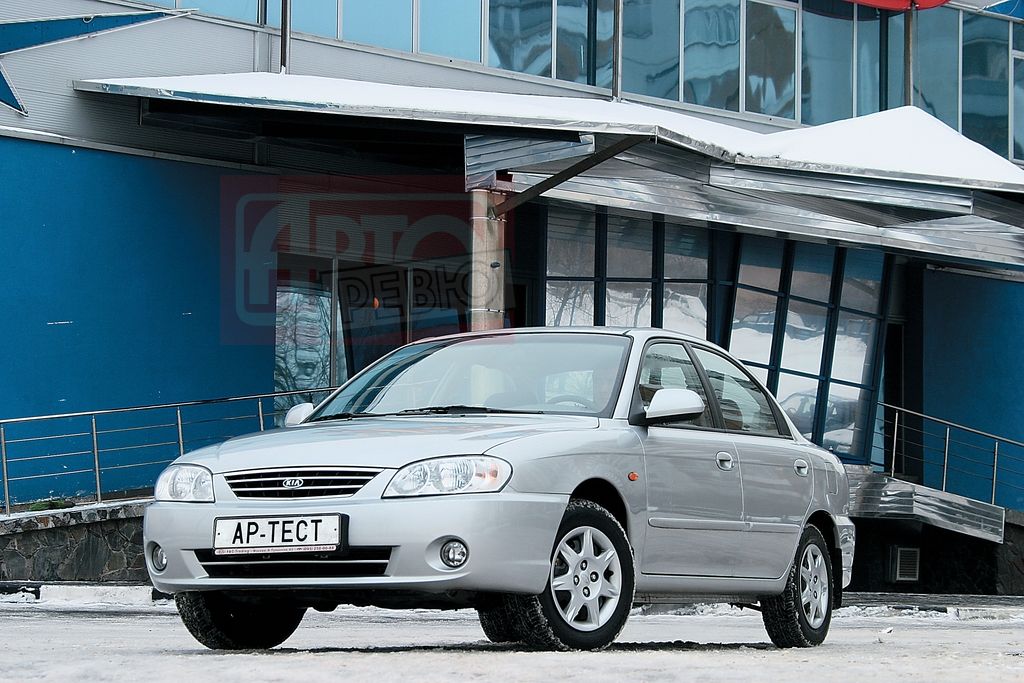
If you're choosing among golf-class sedans equipped with an automatic transmission, the most affordable option is the Kia Spectra (1.6 L, 101 hp) assembled in Izhevsk, priced from 409,000 rubles ($15,740). The car, however, is old-fashioned; its overly soft suspension allows rocking on waves and shaking on sharp bumps, and the archaic four-speed automatic annoys with jerks and delays during shifts. Details — in AR No. 21, 2004 and AR No. 22, 2006.
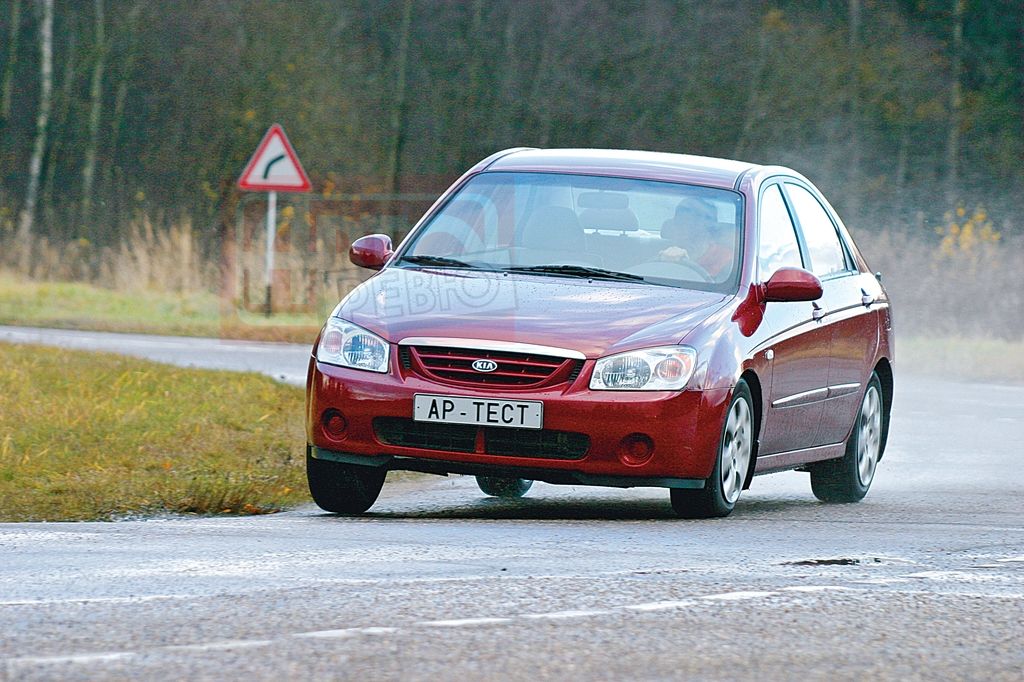
The Kia Cerato is more modern but more expensive — the sedan with the 1.6 engine (105 hp) and four-speed automatic is offered for 499,000 rubles ($19,210). This is a well-balanced car — nothing outstanding, but without obvious flaws and with a well-tuned chassis (see AR No. 21, 2004).
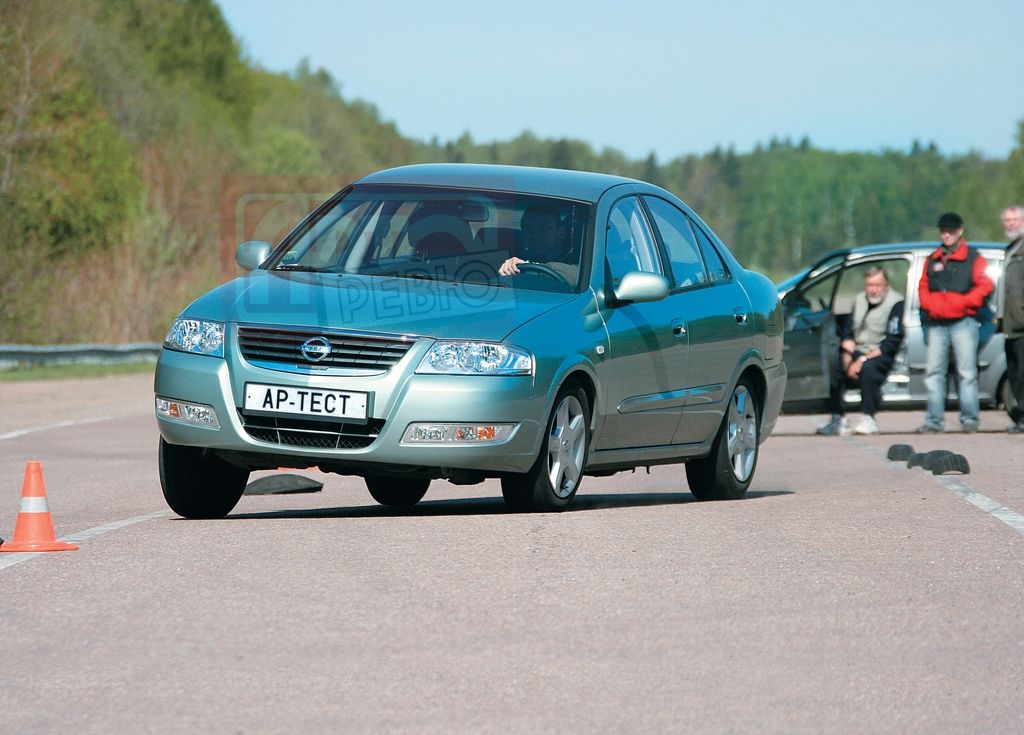
The Nissan Almera Classic (1.6 L, 107 hp) with an automatic can be bought for $16,840. The sedan produced in Korea is not new, modest and somewhat cramped inside, especially in the rear seats. But the suspension provides decent comfort, and the four-speed gearbox pleases with responsiveness. Details — in AR No. 11, 2006.
 |  |
| Kia Spectra | Kia Cerato |
 |  |
| Nissan Almera Classic | Chevrolet Lacetti |
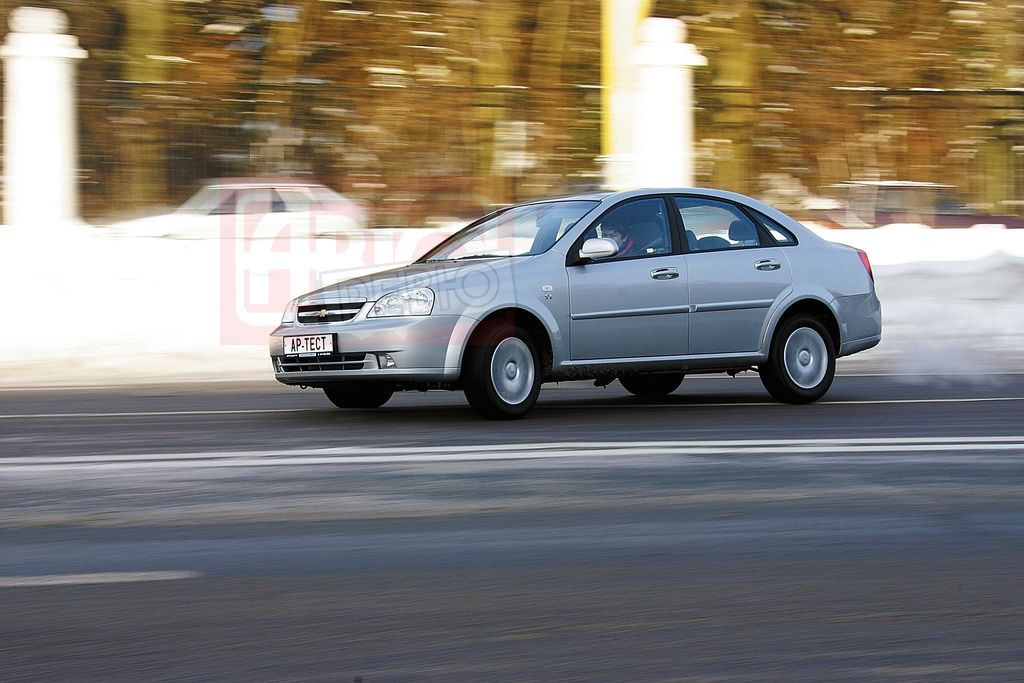
The Chevrolet Lacetti 1.6 (109 hp) with a four-speed automatic can be bought for $17,750, while the version with the two-liter engine (122 hp) is offered for $20,650. The interior, like the bodywork by the Italian studio Pininfarina, is done in a restrained style. Overall — a decent, solid car, but the automatic's operation algorithm is not optimally tuned, and the suspension is somewhat stiff. Details — in AR No. 3, 2005.
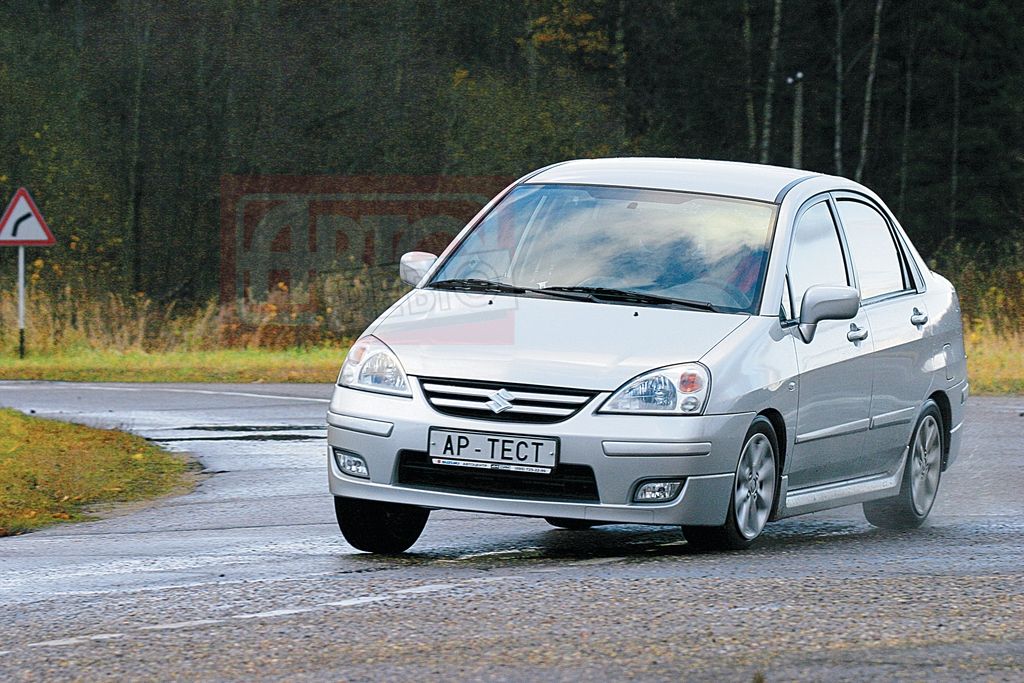
The Suzuki Liana (1.6 L, 106 hp) is soon to be discontinued: the version with a four-speed automatic costs $18,420 and $20,100, respectively. The plain sedan is relatively compact (only 4,350 mm in length) with cramped rear seats, but it has a spacious trunk and available all-wheel-drive versions. Details — in AR No. 21, 2004 and AR No. 17, 2006.
The Renault Megane sedan with a 1.6-liter engine producing 115 horsepower paired with a four-speed automatic transmission is priced at $19,250. As for versions equipped with the two-liter engine producing 135 hp, their prices start at $24,700. Cars of Turkish assembly boast an excellent level of comfort, cabin quietness, and spaciousness — a detailed description can be found in issues AR No. 7, 2004 and AR No. 23, 2005.
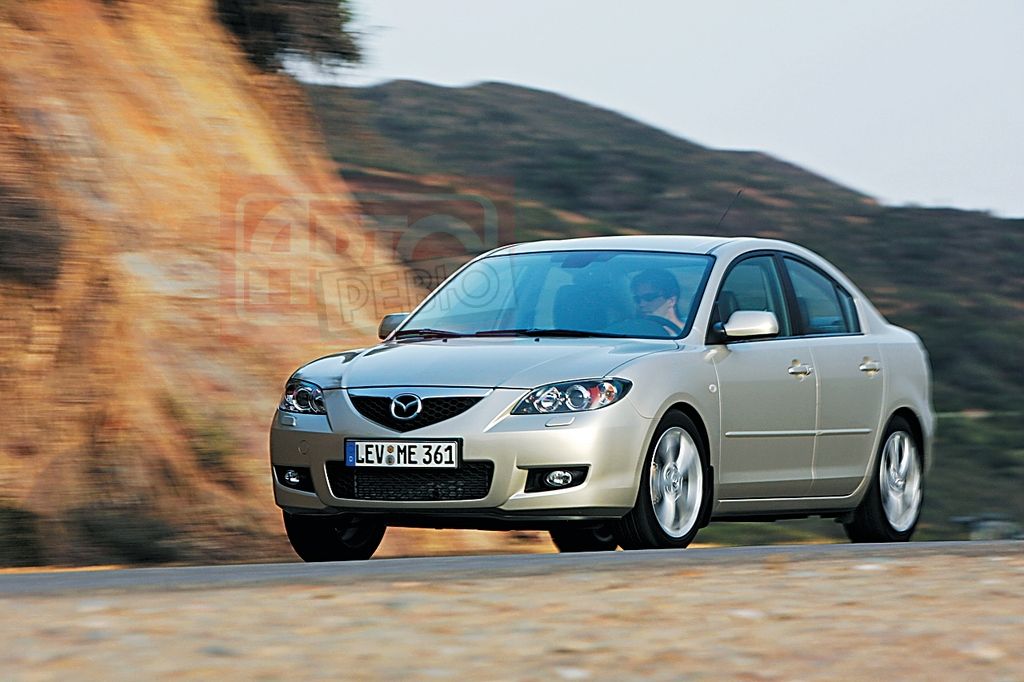
For the Mazda 3 sedan, the manufacturer offers the automatic transmission exclusively paired with the 1.6-liter engine (105 hp), and such a car will cost at least $21,300. Compared to the Ford Focus, the "three" feels more spirited and driver-oriented, but loses to its rival in terms of sound insulation and rear seat space. Details are in AR No. 3 and AR No. 7 for 2004.
 |  |
| Suzuki Liana | Mazda 3 |
 |  |
| Mitsubishi Lancer | Hafei Princip |
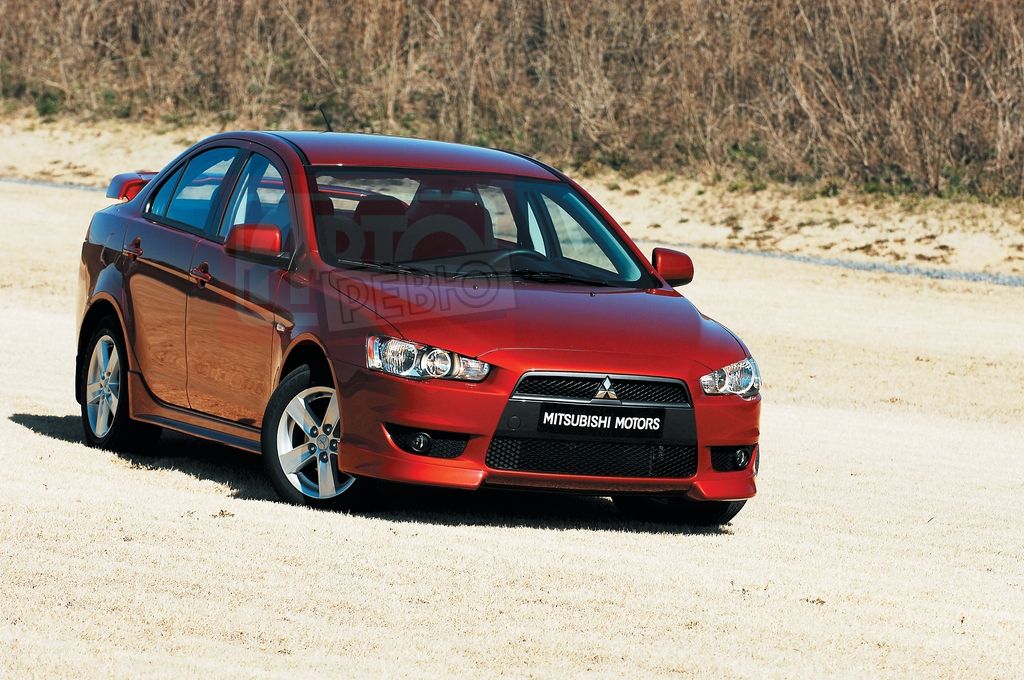
Mitsubishi Lancer 1.6, developing 98 hp, with an automatic transmission is still available from $18,020. For the modification with a two-liter engine producing 135 hp, you will have to pay from $22,650. Nevertheless, the manufacturer has already announced prices for the next-generation Lancer. Thus, the sedan with a 1.5 engine (109 hp) and a four-speed automatic will sell for $20,280. As for the version with a two-liter unit (150 hp), instead of a classic "automatic" it will get a belt-driven CVT, and such a car is priced at $22,380.
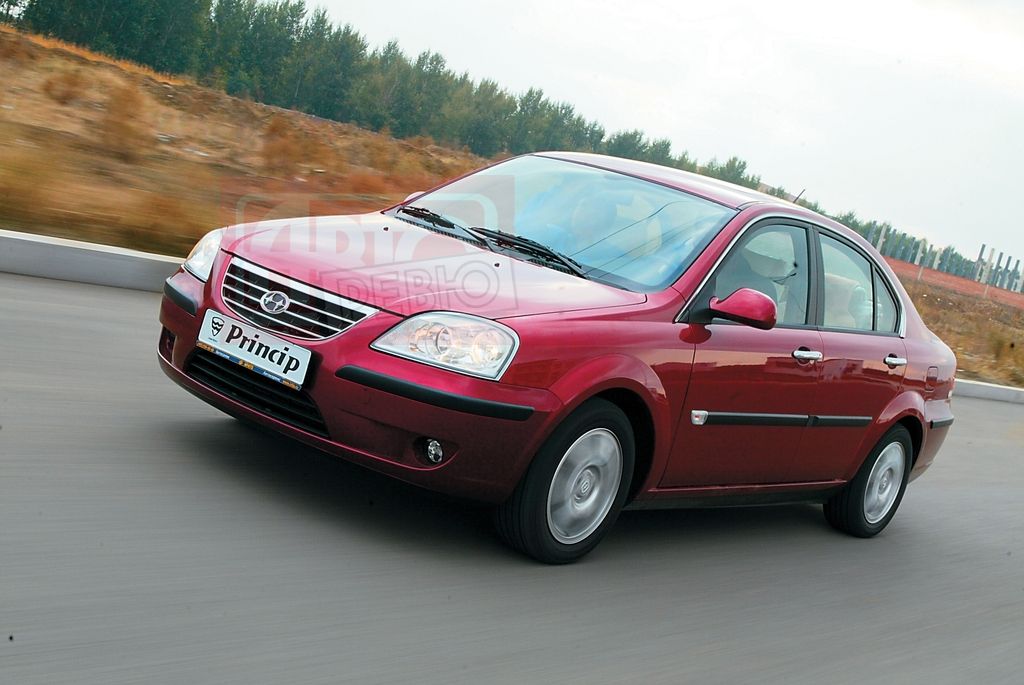
Another representative of the golf class among sedans is the Chinese Hafei Princip. The version with a 1.6 engine producing 101 hp and a four-range automatic transmission is offered for $19,530.