|
 If you set aside the superfluous, it's not hard to guess that I dubbed the Ford Mondeo a "middle European." With the other three participants, everything is clear — their origins are obvious, but with the Mondeo the situation is more complicated. By its very nature, Ford is an American brand. However, most of the models are assembled in Genk, Belgium, and the Ford of Europe office (and the Mondeo is designed primarily for the Old World) is based in Cologne, Germany. So I suggest that for the duration of reading this material, we consider the Mondeo a German. Especially since, as our test showed, in character this sedan is closest to German cars. If you set aside the superfluous, it's not hard to guess that I dubbed the Ford Mondeo a "middle European." With the other three participants, everything is clear — their origins are obvious, but with the Mondeo the situation is more complicated. By its very nature, Ford is an American brand. However, most of the models are assembled in Genk, Belgium, and the Ford of Europe office (and the Mondeo is designed primarily for the Old World) is based in Cologne, Germany. So I suggest that for the duration of reading this material, we consider the Mondeo a German. Especially since, as our test showed, in character this sedan is closest to German cars. |
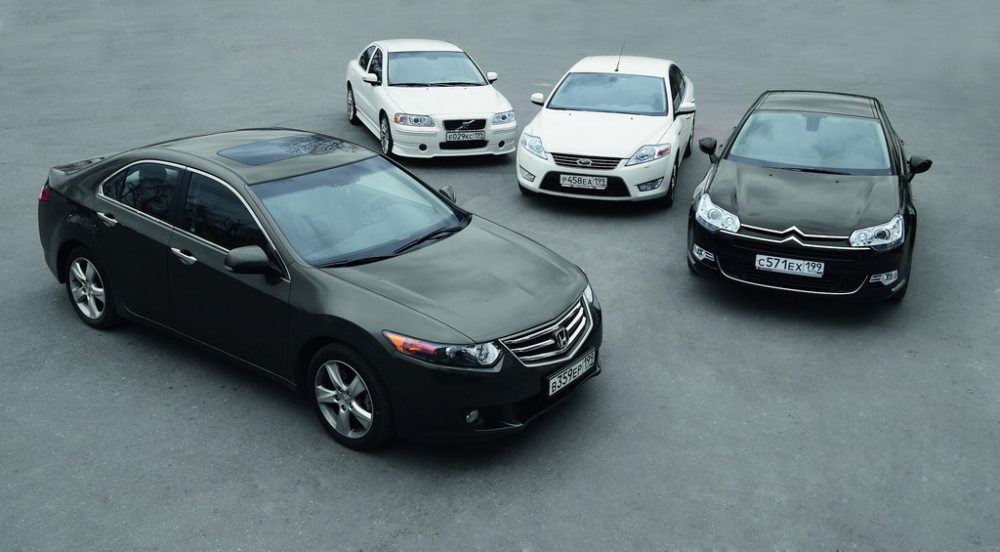
 For the tests, we took four D-class sedans in maximum trim. Two of them — the Honda Accord and Citroen C5 — have recently entered the Russian market. Their rivals were the popular Ford Mondeo and the time-tested Volvo S60. All cars are front-wheel drive, except the Volvo — the 2.5T version comes exclusively with AWD all-wheel drive. But the engines are to suit every taste. The Honda has a naturally aspirated 2.4-liter engine, the Citroen has a V6, also without turbocharging. The Volvo and Ford received a "corporate" inline five-cylinder with a turbo. Despite the different designs, the difference in peak power was only 19 hp — from 190 hp in the Accord to 220 hp in the Mondeo. For the tests, we took four D-class sedans in maximum trim. Two of them — the Honda Accord and Citroen C5 — have recently entered the Russian market. Their rivals were the popular Ford Mondeo and the time-tested Volvo S60. All cars are front-wheel drive, except the Volvo — the 2.5T version comes exclusively with AWD all-wheel drive. But the engines are to suit every taste. The Honda has a naturally aspirated 2.4-liter engine, the Citroen has a V6, also without turbocharging. The Volvo and Ford received a "corporate" inline five-cylinder with a turbo. Despite the different designs, the difference in peak power was only 19 hp — from 190 hp in the Accord to 220 hp in the Mondeo. |
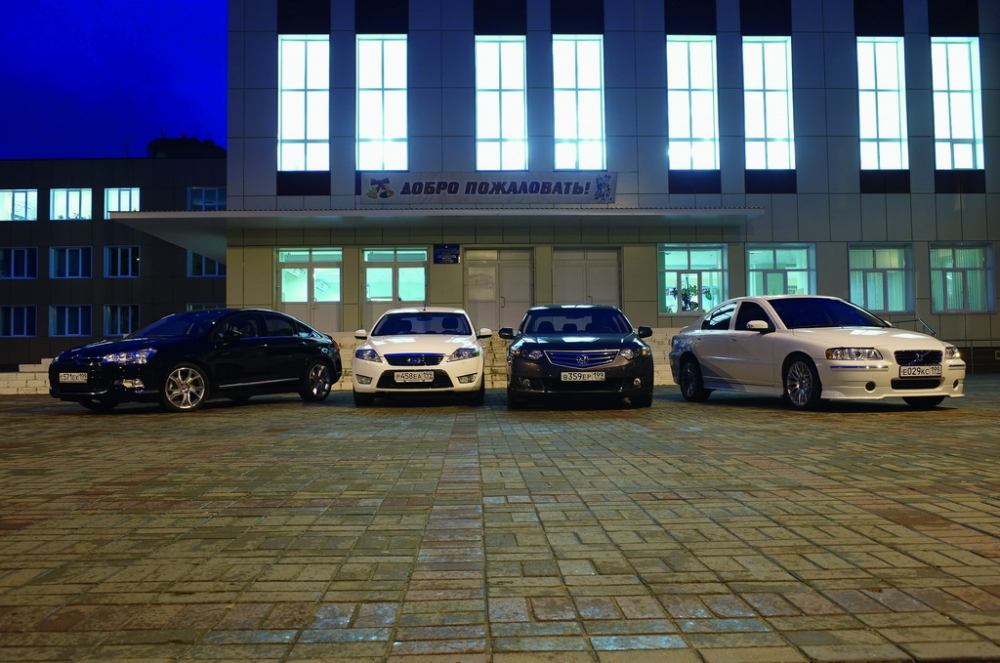
 They say a theater begins with a coat rack, and a car begins with the sound of a closing door. Here, the Citroen is beyond competition. The doors close with such a solid sound that you immediately feel the monumentality. The Volvo is not far behind — the massive door also pleases. The only drawback is that the handles are uncomfortable to grip. But the doors of the Accord and Mondeo disappointed: it seems as if a little gnome has taken up residence inside, drumming on a tin can. By the way, by the sound of the door you can judge the overall sound insulation — this was confirmed during the test. Appearance is a matter of taste. What is good for a shoemaker is bad for a tailor. But there's no arguing that the Honda and Citroen look fresher and therefore more interesting. The Accord also looks very dynamic. The swift silhouette inherited from the previous generation appeals to many. They say a theater begins with a coat rack, and a car begins with the sound of a closing door. Here, the Citroen is beyond competition. The doors close with such a solid sound that you immediately feel the monumentality. The Volvo is not far behind — the massive door also pleases. The only drawback is that the handles are uncomfortable to grip. But the doors of the Accord and Mondeo disappointed: it seems as if a little gnome has taken up residence inside, drumming on a tin can. By the way, by the sound of the door you can judge the overall sound insulation — this was confirmed during the test. Appearance is a matter of taste. What is good for a shoemaker is bad for a tailor. But there's no arguing that the Honda and Citroen look fresher and therefore more interesting. The Accord also looks very dynamic. The swift silhouette inherited from the previous generation appeals to many. |
 And the Citroen, as is customary for the French, is unusual. Here you have the original front end with huge headlights and a wide double chevron, a concave rear window, and plump sides. It catches the eye. The Ford's design, which a year ago seemed almost avant-garde, has now become familiar and no longer surprises. Moreover, it cannot hide the dimensions of the "overgrown" D-class, even in white. However, the Mondeo still looks quite elegant. And the Citroen, as is customary for the French, is unusual. Here you have the original front end with huge headlights and a wide double chevron, a concave rear window, and plump sides. It catches the eye. The Ford's design, which a year ago seemed almost avant-garde, has now become familiar and no longer surprises. Moreover, it cannot hide the dimensions of the "overgrown" D-class, even in white. However, the Mondeo still looks quite elegant. |
Well, Volvo is always Volvo. A classic for those who value tradition, but in our case, they added an excellent aerodynamic body kit and nice wheels. It turned out sporty!

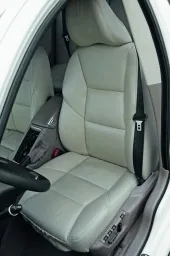
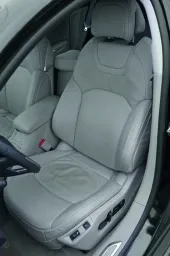
The Swedish character is also supported by the interior. The instrument cluster with soft greenish backlighting and metallic dials looks great and is easy to read. The thick steering wheel rim feels pleasant in your hands. And the center console, littered with buttons, is a real greeting from the past. The analog radio tuning knobs, which, by the way, don't even understand MP3, are something else. However, convenience doesn't suffer from this, and the signature "little man" regulating air flows is still genius. The seats in the S60 are the coziest and highest quality in this quartet. You sit in a soft, high seat like in an armchair by the fireplace, ready to forgive its weak lateral support. Peace and quiet. It's just that there's not enough space, especially in the back. A tall person will be frankly cramped there.

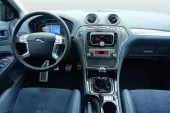
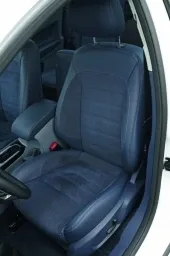
The Mondeo looks simpler. The silver plastic on the panels bears little resemblance to the aluminum it imitates, and when pressed, it noticeably flexes and may even creak. The instruments look somewhat toy-like, and I didn't find the color HMI display between them useful. If only there were navigation... But that's not German style. However, the trim uses quality dark blue soft plastic, and the leather steering wheel is almost perfect in cross-section. The seats with combined upholstery match the trim. The lateral support bolsters are well-developed on both the cushion and backrest, but the shoulders still lack support. But in one thing, the Ford is unrivaled — in rear passenger space. You sit and cross your legs. And it's clear why: the Mondeo has the longest wheelbase at 2850 mm.

The C5's interior aspires to originality. The fixed steering wheel hub, separate airflow adjustment for driver and passenger, unusual instrument cluster with interesting graphics, elegant automatic gear lever with a winding slot, and most importantly — luxurious seats, the best here. They are quite firm and mounted low, which is rare for the French. A highlight for passengers with a stooped back is that the upper part of the backrest reclines separately. This allows the seat to be adjusted to almost any body shape. In terms of material quality and panel fit, the new C5 is a huge step forward compared to the previous one. There's plenty of space. By the way, the Citroen is also a big one: its wheelbase is only 35 mm shorter than the Mondeo's. But in the back, it's noticeably more cramped.

I get into the Honda and feel like I've entered a spaceship. The small three-spoke steering wheel with a recessed hub is like a helm. And behind it are paddle shifters for the automatic. A direct hint at sport! The instruments with silver rings glow enticingly in red. But I can barely see them: the lower part of the steering wheel rim covers the speedometer from 60 to 220 km/h and the entire working zone of the tachometer. The front panel is spread open like wings. The Accord's interior is as sharp as its exterior. You can feel that everything was cut with one hatchet, then processed with a chisel and plane. All would be fine, but in terms of quality, Honda lags behind. There's a lot of hard plastic, and this "silver paint" is just unacceptable. The car has only about 7000 km on the odometer, but the interior already looked worn, and the seats constantly pushed into the back much higher than the lower back.

The Honda's exterior fully matches its content. The swift, pointed appearance directly speaks of a sporty character. On one hand, that's a plus. The Accord's steering wheel is the most informative, with the most effort, but smoothly increasing. Acceleration, despite the "weakest" engine (201 hp), gets the blood boiling. The automatic in sport mode shifts faster than all, but sometimes holds high revs too long, and you can only upshift manually. On smooth asphalt, the suspension works excellently: the sedan dives into corners with almost no body roll, holds the line perfectly, and at the limit shows a slight but rather sharp understeer, which is easily corrected by lifting off the throttle and steering.
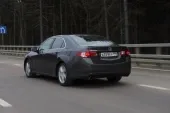
In our quartet, the Accord is the sharpest in handling. But the payback comes as soon as the good surface ends. You feel even the road markings, not to mention the more serious potholes, which we have plenty of. It shakes so much that your insides swap places. In ruts, the steering wheel constantly jerks, and you have to catch the car. I also didn't like the floor-mounted gas pedal: to press it to kickdown, you almost have to lay it on the floor. It's inconvenient, especially with a small foot size. There are also complaints about the brakes: after free travel, they engage too abruptly. This is especially annoying in traffic jams at low speeds. But when braking from speed, there are no problems — deceleration is perfectly dosed on the verge of ABS activation.

The Volvo is the complete opposite of the Honda. A soft, calm car. The adaptive Four C suspension in Comfort mode (stiffness level can be adjusted via the onboard computer menu) gently rocks passengers on asphalt waves, creating a serene mood. The cabin is quiet, with sound insulation among the best in the class. And suddenly — "bang!". And the pothole wasn't even serious. We're already familiar with this Volvo trait. Sharp irregularities deliver noticeable impacts to the suspension and steering wheel. Over time, you stop noticing, but it's still unpleasant. The muted steering doesn't spoil you with information. In Sport mode (activated by a button on the console), body roll and dive noticeably decrease, but the S60 still remains very comfortable. At the same time, 210 hp with the five-speed automatic quickly and smoothly accelerate the car under the muted growl of the engine, and all-wheel drive noticeably adds stability, especially on slippery roads.
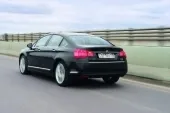
The Citroen has 5 hp more, and it has a V-shaped "six". The engine's only plus is a beautiful baritone, barely audible thanks to excellent sound insulation. But in acceleration, the C5 loses to its rivals. The blame lies with the heavy mass and the lazy automatic, even in sport mode. But it works smoothly, almost imperceptibly. With the Hydractive 3+ hydropneumatic suspension, the Citroen is the most comfortable car of all here. But there's no such thing as a free lunch: in normal mode, you constantly feel some looseness. Something below seems to live its own life, although it handles the main task — not shaking — perfectly.

In Sport mode, the suspension becomes more composed and elastic, but the feeling of disconnection from the car doesn't go away. That doesn't mean you can't take corners quickly in the C5. You can, but the low steering feedback and, again, the mass get in the way. Also, on uneven surfaces, dull impacts appear. In short, racing circuit exercises are not for it. This is confirmed by the stability control system, which cannot be turned off at speeds above 50 km/h. But the C5's brakes are magnificent: they stop quickly and allow precise force modulation. The Citroen is a long-hauler. It's ideal for speeding over long distances.

The Mondeo turned out to be the most balanced. The least "synthetic" car of the four, lively. Of course, credit goes to the manual gearbox and the powerful 220-hp engine (this is a modification of the Volvo five-cylinder engine). But to be fair: the clutch pedal travel and gear lever throws on the Ford are a bit long. However, the lever shifts crisply, and you quickly get used to the clutch. It's not even about that pair. The Mondeo's character is defined by the compromise suspension and steering, which, with less effort than the Accord, gives no less information. The suspension compromise is that even on 18-inch wheels, it allows you to race over potholes where the Citroen and Volvo would rumble loudly, and the Accord would shake your soul out.

Of course, the Ford also reacts to ruts and joints, but it does so much more smoothly. In corners, the Mondeo behaves eagerly, noticeably steering with the rear axle. With stability control off, slight understeer appears first, then easily controlled four-wheel drift. The picture is slightly spoiled by noise at high speed (remember the talk about doors at the beginning?). And the engine's voice is heard more distinctly than in the Volvo. But with such a character, it's even fitting.

Now, perhaps, we've told the joke to the end. Like most such stories, it may not have turned out very funny, but it's fair and topical. The cars are truly different, and it seems to us that with the right choice, any of them will become a reflection of the owner's character and values. Everyone will decide for themselves what's closer: the rigidity and pronounced sportiness of the Japanese Accord, the homey comfort of the Swedish Volvo, the original appearance and French refinement of the Citroen, or the German balance and the lowest price of the Mondeo. And those who can't live without specifics and numbers, we refer to our ratings.











 If you set aside the superfluous, it's not hard to guess that I dubbed the Ford Mondeo a "middle European." With the other three participants, everything is clear — their origins are obvious, but with the Mondeo the situation is more complicated. By its very nature, Ford is an American brand. However, most of the models are assembled in Genk, Belgium, and the Ford of Europe office (and the Mondeo is designed primarily for the Old World) is based in Cologne, Germany. So I suggest that for the duration of reading this material, we consider the Mondeo a German. Especially since, as our test showed, in character this sedan is closest to German cars.
 For the tests, we took four D-class sedans in maximum trim. Two of them — the Honda Accord and Citroen C5 — have recently entered the Russian market. Their rivals were the popular Ford Mondeo and the time-tested Volvo S60. All cars are front-wheel drive, except the Volvo — the 2.5T version comes exclusively with AWD all-wheel drive. But the engines are to suit every taste. The Honda has a naturally aspirated 2.4-liter engine, the Citroen has a V6, also without turbocharging. The Volvo and Ford received a "corporate" inline five-cylinder with a turbo. Despite the different designs, the difference in peak power was only 19 hp — from 190 hp in the Accord to 220 hp in the Mondeo.
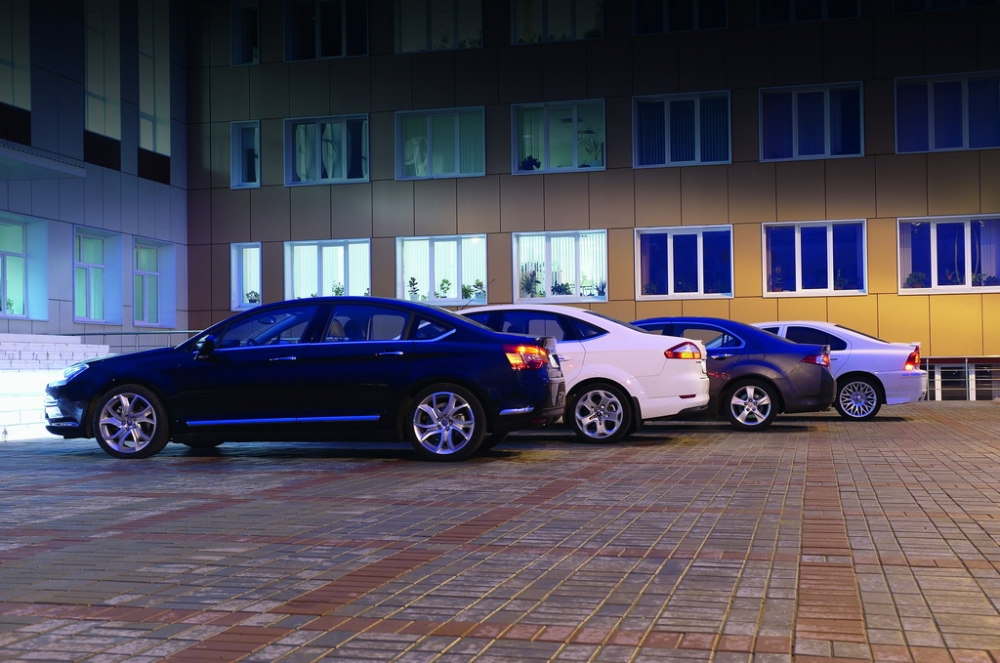 They say a theater begins with a coat rack, and a car begins with the sound of a closing door. Here, the Citroen is beyond competition. The doors close with such a solid sound that you immediately feel the monumentality. The Volvo is not far behind — the massive door also pleases. The only drawback is that the handles are uncomfortable to grip. But the doors of the Accord and Mondeo disappointed: it seems as if a little gnome has taken up residence inside, drumming on a tin can. By the way, by the sound of the door you can judge the overall sound insulation — this was confirmed during the test. Appearance is a matter of taste. What is good for a shoemaker is bad for a tailor. But there's no arguing that the Honda and Citroen look fresher and therefore more interesting. The Accord also looks very dynamic. The swift silhouette inherited from the previous generation appeals to many.
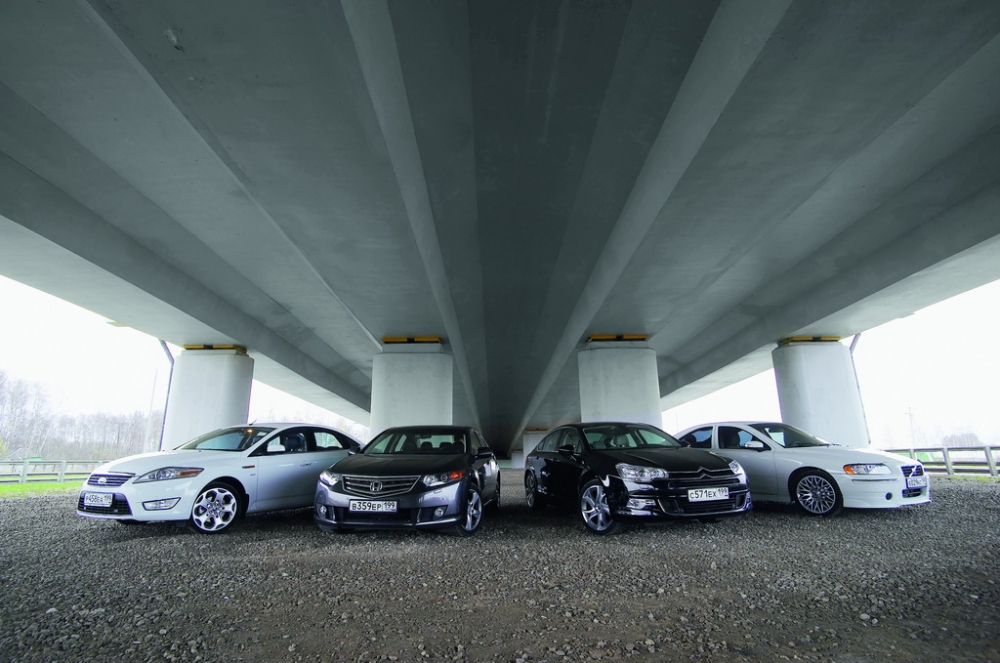 And the Citroen, as is customary for the French, is unusual. Here you have the original front end with huge headlights and a wide double chevron, a concave rear window, and plump sides. It catches the eye. The Ford's design, which a year ago seemed almost avant-garde, has now become familiar and no longer surprises. Moreover, it cannot hide the dimensions of the "overgrown" D-class, even in white. However, the Mondeo still looks quite elegant.