
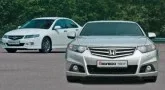
Honda Accord VII. Price: from 864,000 RUB. On sale: since 2003.
Honda Accord VIII. Price: from 965,000 RUB. On sale: since May 2008.
It is rare when an update of a popular model is accompanied by a radical change of course: a new version of a bestseller usually becomes a logical continuation of its predecessor. However, the Honda Accord is an exception to this rule. To understand how much the habits of the old and new Accord differ, we conducted a comparative test.
Accord VII 864,000 RUB
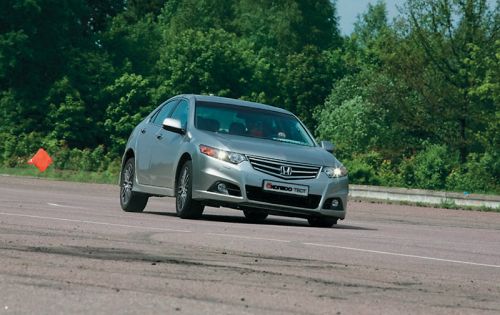
This D-class sedan, one of the most sporty and dynamic in its segment, has gained a huge army of fans and devoted followers in Russia over five years. Stiff suspension, incredibly sharp steering, almost racing-like, and at the same time quite affordable price — this is the recipe that turned the Accord into a real hit of the Russian market.
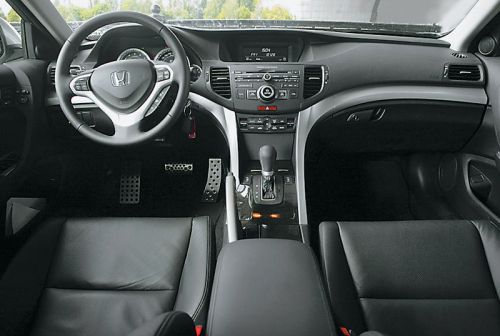
Accord VIII 965,000 RUB
The new model aims to compete with premium leaders: BMW 3-series, Mercedes-Benz C-class, and Audi A4. This determined the change in the car's character in favor of comfort. The new Accord has become less adventurous and more solid, as if it has matured five to ten years along with its target audience.
***
The update of the Accord was awaited in Russia, as elsewhere, for a long time and with great impatience. Back in 2007, when the updated "American" debuted in the States, the most impatient fans of the model on this side of the Atlantic were already guessing what the new Japanese-European Accord would be like. It was clear that the "European" would have little in common with the "American." But few expected that the newcomer would also have not much in common with its direct ancestor — the European seventh-generation Accord that Russians had come to love. Therefore, as soon as the new model reached Russia, we immediately headed to the Dmitrov test track to identify the main differences in the characters of the old and new Accord.
The first thing you notice — or rather, hear: the acoustic comfort of the new car is noticeably higher than that of its predecessor. At idle, the engine is not heard at all; you can only guess that the engine is running by the slight trembling of the tachometer needle. The suspension has also become much more comfortable. There is no trace of the former excessive stiffness and bottoming out that plagued the seventh generation. The new dual-circuit suspension swallows bumps with an appetite completely uncharacteristic of the previous model. This, perhaps, is the main difference between the "eighth" Accord and its predecessor. If the suspension of the seventh generation primarily had to satisfy the sporty character of the car and only then think about D-class comfort, in the "eighth" Accord everything is the opposite!
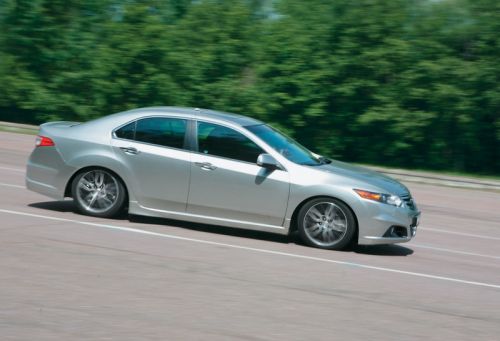
However, for comfort, of course, you have to pay with the loss of steering sharpness. The new Accord certainly does not reach the semi-racing handling of the "seven." The only exercise in which the younger brother turned out to be faster than the older one is the high-speed lane change. With the ISO test, the wider and more powerful "eighth" Accord copes better than its predecessor: 134.7 vs 131.6 km/h. But in other handling tests, the old horse still sets the tone. Changes in suspension characteristics and the increased weight of the car by 120 kg, coupled with a change in weight distribution towards loading the rear axle, led to an increase in lateral rolls and understeer of the new Accord. As a result, the car has somewhat lost in steering sharpness. But these losses are far from as critical as one might expect, given the clear bias towards comfort. Both in the VDA "moose test" (dry lane change at medium city speed) and when passing the slalom, the new Accord, if it yields to the old one, is only by a tiny margin — no more than 1–2 km/h. The only test in which the new Accord really lost to its predecessor is the high-speed lane change on a wet track: at the exit, the speed difference was 12 km/h. But here we can quite talk about measurement error, since the "eighth" generation car had wider wheels, which noticeably increase the tendency to aquaplaning on wet asphalt.
The braking test did not reveal any significant differences. Only when stopping from a speed of 170 km/h, the greater inertia of the new Accord led to an increase in braking distance by 5 m. But in the sprint from standstill to 100 km/h, the heavier "eight" still somewhat yields to its predecessor: 9.7 vs 9.1 s. Even the increased power of the 2.4-liter engine by 11 hp does not help. However, it should be noted that all these "micron" lags fade into the background when it comes to the huge difference in comfort. Here the new Accord is head and shoulders above the previous one!

Summing up the track tests, it should be noted that the point is not that the new Accord is fundamentally better or worse than its predecessor — it simply became different both in character and in target audience. One might say, the Accord has matured along with its admirers. If the previous version of the car was mainly designed for young people from 25 to 30, the new Accord is intended to meet the demands of a more mature and sophisticated audience — those over 30.
The goal of the car's repositioning is clear as day: the Japanese are trying to bring their flagship to a new level. And preparing the Accord for fierce competition with the German legion that sets the tone in the premium D-class segment, Honda decided to carry out some academization of the car. If the previous Accord had a pronounced sporty orientation to the detriment of comfort, resembling the BMW 3-series in character, the new car has become a clear step towards the Mercedes-Benz C-class.
Honda designers tried to find a golden mean between the sporty character of BMW and the academism of Mercedes. The degree of success of the new Accord both on the Russian and pan-European markets will depend on how well they managed to do this.
Customer opinion
Alexey Malyshev, executive director of a communication agency, owner of a Honda Accord 2003
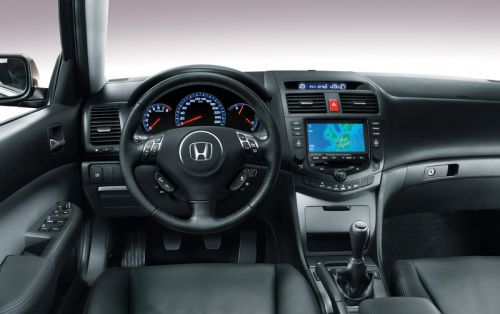
What I liked most about the new Accord is the seats with excellent lateral support. They are much more comfortable than in the old car. The interior design has certainly become more modern, but for me it is not too relevant. The first impressions of driving the car were very positive, but as I got used to it, some aspects appeared that began to frankly irritate. Compared to its predecessor, the Accord has clearly lost in steering sharpness. And the appearance of kick-down, which forcibly shifts gears down when sharply pressing the gas pedal, is somewhat deceptive. The dynamics of emergency acceleration are not impressive. In this regard, the old Accord was more honest. However, in terms of comfort, both acoustic and ride, the new Accord is beyond competition!
Our verdict

The Accord VIII generation has become less adventurous and a more mature family car. It is quite possible that in its new incarnation it will turn out to be even more in demand on the market. But at the same time, the new Accord will still somewhat disappoint fans of the previous generation who are inclined to a semi-sporty driving style. The drive and youthful style in the car have clearly diminished. Overall, in terms of feel, the Accord turned out to be in some ways very similar to the new Audi A4. At the same time, the "Japanese" is more spacious, cheaper, and, even despite the change in priorities, sharper in handling.
Honda Accord VII — Honda Accord VIII
Technical data
- Number of cylinders — 4
- Power, hp/rpm — 190/6800 — 201/7000
- Displacement, cm3 — 2354 — 2354
- Maximum torque, Nm/rpm — 223/4500 — 230/4200-4400
- Drive — front
- Transmission — automatic, 5-speed

Chassis
Tires of the tested cars — Bridgestone Potenza RE040 225/45R17 91W, Pirelli PZero-Nero 235/45ZR18 98Y
Body
- Curb weight, kg — 1465 — 1587
- Payload capacity, kg — 465 — 443
- Length/width/height, mm — 4665/1760/1445 — 4726/1840/1440
- Wheelbase, mm — 2670 — 2705
- Turning circle left/right, m — 11.5/11.7 — 11.4/11.1
- Trunk volume (VDA), l — 459 — 464
- Fuel tank capacity, l — 65 — 65
Interior
- Interior width front/rear, mm — 1500/1480 — 1550/1545
- Interior height front/rear, mm — 1010/950 — 965/940
Price, RUB
In the base version, the car is priced in the range from 864,000 to 965,000 rubles.Impressions from road tests
Acceleration and speed
From standstill to 80 km/h, the car accelerates in 6.1–6.7 seconds. To 100 km/h — in 9.1–9.7 seconds, and to 160 km/h — in 23.2–24.6 seconds. The maximum speed achieved was 227 km/h.
Braking
From 100 km/h on cold brakes and without load, the car stops in 38 meters. If the car is loaded, the distance increases to 39 meters — in both cases, the figures are the same for all versions.
Noise
Outside, when accelerating from 50 km/h, the noise level is 72 dB(A). When driving at a constant speed of 80 km/h — 74–76 dB(A). Inside the cabin at 80 km/h, audibility is estimated at 62–60 dB(A), at 130 km/h — at 69–68 dB(A), and at idle — at 39–36 dB(A).
Driving performance
Maneuverability
In the slalom between cones with an 18-meter distance, the car shows a speed of 65.4/65.2 km/h in one modification and 64.8/63.5 km/h in another. In the ISO handling test, the results were 131.6/129.0 and 134.7/131.6 km/h, respectively.
Lane changes and stability
In the VDA lane change test, the entry speed reached 73/71 km/h, and the exit speed — 52/52 km/h. For the second variant, these figures are 71/70 and 50/50 km/h. On wet asphalt during a double lane change, the car entered the maneuver at 107 km/h and exited at 91 km/h; for the other version — 104 and 89 km/h. Cornering stability on wet surfaces was tested at a speed of 71 km/h.
Test date: July 17, 2008
Author: Vladimir Makkaveev
© 5 Koleso