
Great Wall Hover
Powertrain: 4G64S4M
Displacement: 2.4 L
Peak torque:
200 Nm at 2800 rpm
Power output: 130 hp at 6000 rpm
Top speed: 200 km/h.
Transmission: 5-speed manual.
Fuel consumption:
city — 13 L per 100 km
highway — 10 L per 100 km
Body dimensions:
Length — 4620 mm
Width — 1800 mm
Height — 1710 mm
Ground clearance — 220 mm
Curb weight
— 1830 kg
Payload
— 475 kg

Rishat Gaptelkhaevich Sadykov — head of the car audio studio “AudioMaster”, 24 years behind the wheel.
Although I had been visually familiar with this car for a long time, I only got to drive a car from China for the first time just now.
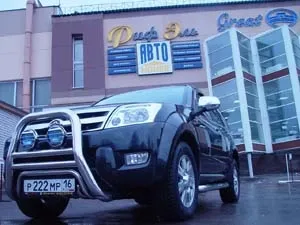
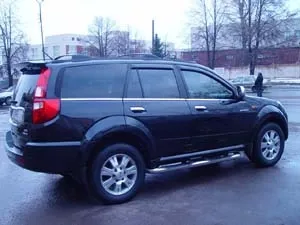
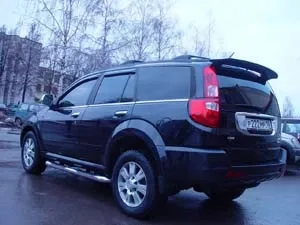
The Hover's exterior looks solid and reliable, and because of the rear spoiler, it strongly resembles the Rexton.
After just a couple of hundred meters, I realized that this car provokes a leisurely, measured driving rhythm. True, personally, I would have liked the front seats and the rear bench to be raised a bit higher off the floor. Inside, it's quite quiet: the engine, gearbox, and transfer case don't bother with extraneous sounds. However, sound insulation for the rear wheel arches would clearly not hurt — that's easy to fix. Gear shifts are pleasingly precise. The only drawback in the operation of the units is vibration that reaches the gearshift lever.
The clutch pedal is not ideal: you need to press it with noticeable effort, and it engages only at the very end of the travel — it feels like the disc is already worn. But the car is new, the mileage is negligible, so it's just factory calibration. But the steering wheel pleased: sharp, informative.
Overall, I like the car. And considering the price of 670 thousand rubles — it's a great deal.

Vadim, 9 years of driving experience.
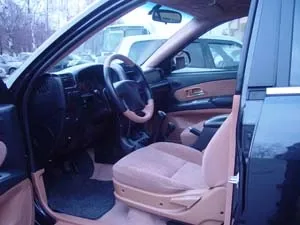
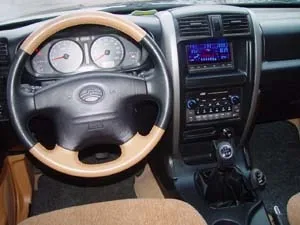
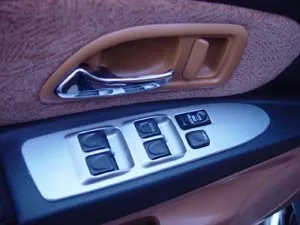
The car looks beautiful, large, and dynamic — you simply can't walk past it on the street. And the price pleasantly surprises: 670 thousand rubles. I immediately mentally give it a big plus and move on to a detailed inspection. I had no doubt that both the paintwork and the gaps would be up to par: the Chinese know how to do well in this price segment. But the sound insulation of the rear wheel arches is a weak point. Looking ahead, I'll say: extraneous sounds barely penetrate the cabin, even the clicking of studs is not audible, but there is a whistling wind in the area where the rear seat belts are attached. Now about the interior. The door trim is not just high-quality, but, I dare say, luxurious: leather, soft plastic, and brown velour. But as soon as you shift your gaze to the dashboard — your mood spoils: it looks frankly cheap, hard, and overly black. And at the bottom, at the feet of the driver and passenger, leather appears again, as if it were specially hidden from view. The front seats are comfortable, moderately soft, with good lateral support. Let's go!
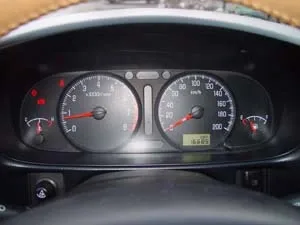
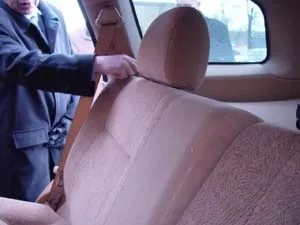
The car's character directly depends on the driving style. Rishat drove it professionally smoothly — I could have driven like that forever! With Alfred, there was some jerkiness in shifts and acceleration. I think I didn't do any better. The most comfortable place in the cabin is the rear row. Here the width is excellent, there's plenty of legroom, the seat is soft, and the backrest adjusts to three positions. Most importantly, there's an abundance of quality materials, like in expensive European or Asian cars. This is an ideal place both for city bustle and for a long road. The driver's seat is also well organized: the instruments are perfectly readable, all buttons and levers are in familiar places. It's clear that expecting racing handling or explosive acceleration from a body-on-frame SUV is silly. But the suspension here is not soft, but elastically firm, so the body doesn't roll excessively either in corners or during lane changes. The hardest part was resisting comparison with a regular “crossover”. I understand with my mind that these are completely different cars, but my hands and feet themselves ask for almost car-like dynamics. The car responds briskly to the gas pedal, although its mass is serious — 1830 kg! Plus four passengers. Like any car, it has its own clutch and gearbox characteristics. The clutch here is quite stiff, engaging at the very bottom of the pedal. It somewhat resembles the behavior of a dying disc on old cars with an initially soft pedal. But the car is new, the mileage is tiny, so it's just a setting. Gears engage clearly — something between sporty firmness and Toyota softness. The only thing I didn't like was that if you keep your hand on the gearshift lever, you feel a slight vibration. To be fair, I note: on one of the Japanese cars we tested, the lever didn't just vibrate, it wobbled. Anything happens. In my opinion, the turn signal lever is fixed too tightly.
And a few words about the engine. This is a licensed 2.4 unit from Mitsubishi with 130 hp. Just don't immediately claim that this is not enough and that modern 1.8s produce more. Let's remember: this is a body-on-frame SUV. That means the main thing for it is low-end torque. And here everything is in order: 200 Nm at 2800 rpm. Already from 1500 rpm, a confident reserve is felt. We didn't go off-road, but in the city the engine calmly pulls in fifth gear at 60 km/h, and the throttle response remains light. Personally, I really enjoyed driving 60-80 km/h in fifth. Amazing smoothness, you sit high — you can see far, and there's absolutely no desire to overtake or cut anyone off.

Alfred, 11 years of driving experience.
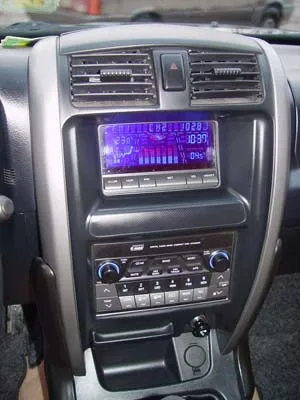
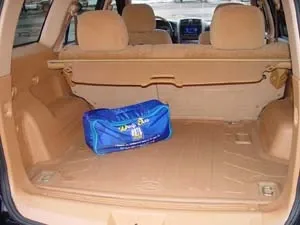
The Hover test was long overdue: there was so much hype around it, fueled by scarcity and huge queues of buyers. The very concept of such a car is not bad. It falls into the upper segment of compact SUVs. It's noteworthy that the manufacturer itself calls the Hover nothing less than a CUV — Comfort Utility Vehicle! No more, no less! The Chinese claim that the model is fully licensed. In reality, it's a cocktail of Japanese solutions. The chassis is from the 1989 Toyota 4Runner, the engine from the 1991 Mitsubishi Pajero, and the body from the 1999 Isuzu Axiom. True, the body wasn't just copied, as is often done in the Middle Kingdom, but slightly refined. But it looks impressive — that can't be taken away. Upon closer inspection, the quality of assembly, painting, and finishing makes a pleasant impression. The interior evokes mixed feelings. The light tones of the trim make you doubt their practicality, but how soft and cozy it is to be in the cabin, especially in the back seat. It's very spacious here, even a tall passenger won't press their knees into the front seats. The plastic is good in some places, and so-so in others — they could have not saved money and made everything more or less decent. It's hard to write unambiguously about the Hover's interior. On the one hand, for a “Chinese” car, it's very good. The cabin is assembled neatly: no burrs on the plastic, no noticeable gaps, everything opens and closes without play or extra effort (except for the glasses holder). And the design of the front panel is quite successful — no utilitarianism. True, the instrument lighting doesn't match the lighting of the stock stereo (and whose does?). On the other hand, the choice of materials is poorer than one would like for that kind of money. And opening the door of a car with such an impressive exterior, you expect more. But if you're interested, go to the showroom and see for yourself. And pay attention to the space for rear passengers. As they say, design is design, but don't forget about the mother-in-law. So, as is my tradition, I start with the back seat. The first thing that came out of my mouth: “this is just a soft wagon”! Rear passengers are very well off here. The car turned out to be quite quiet, only in the area of the seat belt attachment, somewhere above the ear, there was an incomprehensible whistle of air.
Getting behind the wheel, you immediately notice the unusual layout: your legs are stretched almost horizontally, the steering column is lowered low, and the seat back is vertical. This contradicts my usual idea of how the driver's seat in an SUV should be arranged, but one could come to terms with it if the driver's space weren't so cramped. In addition, the seat is located very close to the floor, and it's impossible to adjust its height.
The steering initially surprised with its sharpness, but soon this feeling was replaced by disappointment due to its lack of information. On the highway, the wheel doesn't fill with pleasant heaviness, which makes the car somewhat dangerous, although this car is clearly not designed for speed records, and perhaps I'm exaggerating somewhat. The clutch pedal is stiff, manly hard, and engagement occurs at the very end of the travel — you need to get used to it. The brakes also require noticeable effort. Here, disc brakes are installed on all wheels, supplemented by ABS and EBD systems, so from a braking safety standpoint, there should be no complaints.
The gear shift lever moves with some looseness, but it works precisely and doesn't let you make a mistake in selecting a gear. At the moment of start, you feel the entire mass of the car — it pulls away rather sluggishly, but after that, acceleration becomes easy, even in fifth gear from 60 km/h. The engine produces 130 horsepower, which can hardly be called an impressive figure, but its main advantage lies in the torque. The motor doesn't like high revs, despite four valves per cylinder, and behaves like a purely tractive unit. Confident pickup begins at 1500 rpm in all gears except first, and the gear ratios in the gearbox are evenly matched, although first gear seems excessively short. Because of this set of gears, the Great Wall Hover struggles to launch from a standstill, but already in second gear it reaches dynamics that many a modern crossover would envy.
The flip side of such a transmission is efficiency. With this setup, fuel consumption should be moderate, and it indeed amounts to about 13 liters in the urban cycle. This time we didn't test the car off-road, and, in my opinion, that was a mistake. I'm almost sure the car would have shown a fighting character there. This is felt both in the suspension's work, which holds up to impacts with a solid four out of five, and in the presence of forced engagement of the front axle. However, there are also limitations. The low-hanging front bumper doesn't allow you to enter deep ditches without caution — it's easy to damage it when exiting. And on slopes, due to the high center of gravity, you'll feel uneasy. That, perhaps, is where all the drawbacks end. Overall, the Hover's off-road capability deserves high praise, especially considering that externally it's an elegant "crossover," but unlike its pampered brethren, it stands on a full frame.
After reading all the above, one might think that the drawbacks outweigh the advantages. However, that's not the case: surprisingly, overall, the ride in the Great Wall Hover left a pleasant aftertaste. The cabin is quiet, and the ride is smooth. The suspension deserves a separate mention. Up front, it's torsion-bar, independent, on double wishbones, and at the rear — spring, dependent, five-link. The torsion bars can be adjusted endlessly, there are few replacement bushings, and ball joints are replaced separately from the arms. The whole design is simple, potentially reliable, and durable. It's almost impossible to find fault with it.
It's not easy to give a definitive verdict on the Great Wall Hover's right to exist... The overall feeling can be described as: not bad. Not good, but precisely not bad, that is, a solid four. On the plus side — a two-year warranty and inexpensive maintenance. As for competitiveness, despite all my skepticism, the Hover is being bought, and quite willingly. It seems that for potential owners, its appearance, dimensions, and smooth ride outweigh all the drawbacks.
P.S. During the test, I heard colleagues drawing parallels between the Hover and the Volkswagen Touareg. I understand them to some extent! Apparently, this is prompted by the gigantic dimensions and the suspension's behavior!
Maintenance costs:
1000-2000 km — labor 2910 rub. + parts 1500 rub. (approximately);
10000 km — labor 3080 rub. + parts 2000 rub. (approximately);
20000 km — labor 4160 rub. + parts 8000 rub. (approximately);
30000 km — labor 3230 rub.