
Imagine walking into a showroom and seeing a Toyota Land Cruiser Prado for just $23,900. The numbers on the price tag don't lie, but in front of you is not a "Japanese" at all, but a Chinese Dadi Shuttle that merely mimics a Toyota. Next to it might be a Great Wall Hover — its "donor" was the Isuzu Axiom model. To understand what lies behind this tinsel, we enlisted a more renowned classmate — the Korean Kia Sorento.
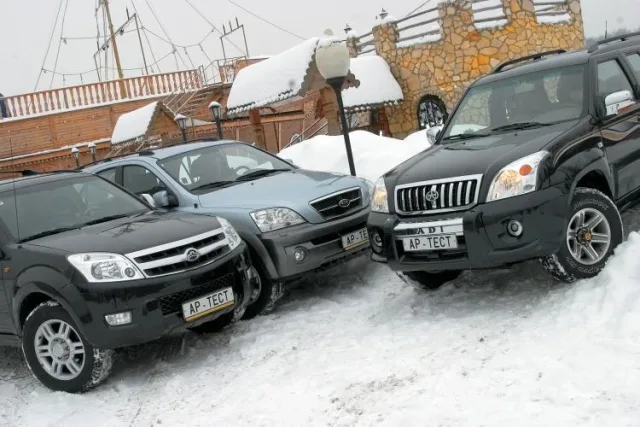
If you set aside the exterior gloss, all three cars share a serious off-road base: a ladder frame, all-wheel drive with a plug-in front axle, and a low-range gear. The transmission is a five-speed manual, with 2.4-liter gasoline engines. Here the palm goes to the Kia — its engine produces 139 hp. The "Chinese" cars, on licensed Mitsubishi 4G64 units, are absolutely equal — 130 hp each.
 Upon closer inspection, the "Chinese Land Cruiser" disappoints: it seems as if the smooth contours of the Prado were stretched over the angular body of an old Opel Frontera. The picture is also spoiled by the absurdly protruding spare tire at the rear — apparently a legacy of the military past of Baoding Dadi, which until 1988 made exclusively army vehicles.
The Shuttle's interior follows the same philosophy: the leather on the seats is stitched haphazardly, and the plastic panels fit unevenly. The promotional brochure calls the trim "imitation peach wood." This plastic "weed" has sprouted not only on the doors and dashboard but also on the steering wheel — in as many as five places. The lighting is a separate story: you turn the key, and the instruments flash blue, the climate control block green, and the radio buttons red. And in the rearview mirror, the air temperature inside and outside lights up in bright yellow digits. A real carnival!
 |  |  |
| The Dadi's interior impresses not with quality but with gypsy-like gaudiness. The huge display — the kind sold at radio markets — is simply inserted into the panel: you have to slide it out manually | Blue digits on a dark blue background seem blurry | The indication of interior and outside temperature is placed inappropriately |
 | |
| Above the Shuttle's rear bench — an additional ventilation system | The trunk is large, but inconvenient to use |
The Shuttle's ergonomics are a separate pain. Due to the high floor and low roof, the driver is forced to sit in a "racing" position with outstretched legs. This doesn't add comfort: the seat is stingy on adjustments and has an unfortunate shape, there's nowhere to rest the left foot, and the right one constantly gets stuck between the tunnel and the gas pedal. The steering wheel, as in the other two cars, adjusts only for height — American-style, and with a large step at that.
 |  |  |
| Gears engage clearly, but the lever throws are too long | In the back of the Dadi there's plenty of space, but comfort is not great | The seat shape is unfortunate, with minimal adjustments |
But the Shuttle does have a rearview camera with a color display! You can change the viewing angle, brightness, and even the volume of the audible warning signal for obstacles. Great! True, the camera looks into the distance and doesn't notice obstacles right under the bumper, and the display still has to be slid out of the console manually.
 For rear passengers, there's an additional heater with temperature and fan speed adjustment. But the air ducts are placed oddly — right above the occupants' heads. And although there's plenty of room in the back, sitting is uncomfortable: the blame lies with the poor backrest profile and the lack of an armrest. The backrest, like in competitors, can be folded entirely or in parts. However, in the Dadi this is the hardest to do: to fold the cushion, you have to pull the strap with such force that you fear tearing it. And the backrest itself folds with a creak — the leather rubs against the door armrests.
Completing the list of complaints about the interior and trunk is the poor design of the rear door: before opening, you have to fold away the spare tire bracket. The fifth door opens only with a key, and to close it you have to grab the dirty edge — there's simply no handle on the inside.
 The Great Wall Hover is a different story. First, its prototype is the Isuzu Axiom, which until 2004 was assembled at the Subaru-Isuzu joint venture in Indiana, USA. This model is almost unknown in the Old World, so even in the Chinese version (with a modified front end), the Hover looks fresh and distinctive. Perhaps there's just a bit too much chrome on it.
Second, the interior already shows some style. The color scheme of the cabin is better chosen than in the Dadi. And the Hover is assembled more neatly, though it's still far from the Kia Sorento's level. The Chinese "color music" hasn't gone away: the green-red instrument lighting coexists with the neon glow of the climate control display, and the audio system's equalizer delights with red-white "thermometers."
 |  |
| The Hover's interior is better executed than the Shuttle's, but worse than the Sorento's | The Hover's gearbox is decent, but when engaging odd gears, your hand tends to hit the center console |
 |  |
| The instruments are simple and easy to read | The glovebox is medium-sized |
The Hover's driver sits just as low as in the Shuttle. And the seat is also unlucky: its shape doesn't allow for proper body support, and there aren't enough adjustments. However, it's harder to "get tangled" in the Hover's pedals, and visibility is better here — thanks to a more effective rear wiper and the absence of a spare tire on the door.
 |  |
| The seats in the Hover are slightly better than in the Dadi | Two in the back is fine, three is a bit cramped |
 |  |
| Under the hood of the "Chinese" cars is the same gasoline "four" (2.4 L, 130 hp) | In terms of ease of loading and unloading cargo, the Hover is in second place |
Sitting three in the back is cramped: the roof sloping at the sides and the massive tunnel on the floor get in the way. But two people are more comfortable here than in the Dadi. The backrest, though flat, can take two positions — "normal" and "sleeping." Folding the backrest completely is noticeably easier than in the Dadi. The trunk unlocks via the key fob, cargo is hidden under a cover, there's a light, a 12-volt socket, and a convenient handle for closing. In short, almost everything is like in the Kia!
Let me start by saying: against the backdrop of the "Chinese," the Sorento looks almost aristocratic, although we have criticized its design more than once for being derivative. Inside, the Kia is not as flashy as the Hover, but it pleases with neat assembly and solid, albeit inexpensive, trim materials. Ergonomics are in perfect order: the driver's seat adjusts mechanically in five directions, so even a tall person will sit comfortably behind the wheel. Unlike its Asian competitors, here you can easily figure out the climate control, and the only visual nitpick is the too "small" speedometer markings, which distract from the road.
The rear row in the Sorento is the most spacious of the trio: three people can sit here freely. Passengers have access to cup holders and a 12-volt outlet. Folding the seatback is not difficult, and the trunk reveals a spacious underfloor compartment. I was also pleased with the opening rear window—it's very convenient for tossing bags in a tight parking lot.
On the move, the Kia behaves much more pleasantly than the "Chinese." The engine revs more easily and pulls almost to the redline without giving up mid-rev. The engine isn't elastic, but the "short" transmission helps: in second gear, the Sorento reaches a maximum of 80 km/h, and in third, it doesn't quite reach 130 km/h. For comparison, the "Chinese" figures are 88 and 138 km/h, respectively.
 |  |
| The Kia's interior is not flashy but neat | The glovebox has a shelf |
 |  |
| On the ceiling—a pair of sunglasses holders and an altimeter | The mile markings are distracting |
From a standstill, both "Chinese" SUVs accelerate no worse than the Sorento, but at speed, the lack of torque becomes obvious: at a hundred kilometers per hour in fifth gear, you can't accelerate anymore; you have to shift down to third. The gearboxes on both cars work quite clearly, but the lever throws are simply huge. In the Hover, when engaging odd gears, your elbow sometimes hits the center console!
All three have no problems with brakes, which can't be said about handling.
 |  |  |
| The driver's seat pleases with its profile and adjustments, and under the passenger seat there's a pull-out drawer | The Sorento's rear seats are the most spacious | The lever throws are still shorter than in the "Chinese" |
 |  |  |
| In Low mode, the front axle and low range are "activated" | The trunk has a "basement" | The Sorento's trunk is more convenient, and the rear window can open separately |
The Shuttle's chassis is tuned well: it stands confidently on a straight line and holds its line in corners. But the whole impression is spoiled by the too "soft" steering—reactions lag, and there's almost no feedback at the wheel, keeping the driver in constant tension. The Hover reacts a bit faster and is easier to steer. But again, the Sorento leads. Compared to the "Chinese," it's like a boxer from Vysotsky's song—"sensitive, collected, tense, and doesn't rush into trouble."
 It's telling that with better handling, the Kia also provides a better ride. The suspension absorbs waves excellently and doesn't let the body rock. Large bumps are passed without noticeable impacts, only occasionally a slight vibration from unsprung masses appears. The Great Wall, on the other hand, "notices" every little thing on the road—small jolts are transmitted to the floor, steering wheel, and seats. But the Hover's suspension handles waves without much discomfort, unlike the Shuttle. In the Dadi, passengers get shaken the most on bumps.
In terms of noise, the Sorento is also ahead. In the "Chinese," the engines are louder, and as speed increases, the wind howls more. The Hover turned out to be especially noisy—it's let down by the too "chatty" heater fan and a noisy engine.
What about off-road capability?
On snowy virgin soil, all three vehicles drive confidently. In the "Chinese," the front axle is engaged rigidly via the transfer case lever. The Hover can be sent off-road immediately—when selecting 4H mode, the wheel clutches lock automatically. But in the Dadi, the clutches need to be engaged manually, like in UAZs, which is not very convenient. In principle, you can lock them permanently, but then in "rear-wheel drive" mode, the front half-shafts and driveshaft will spin idle, creating extra noise and vibrations.
The simplest transmission scheme is in the Sorento with the TOD (torque on demand) system. A small wheel to the right of the steering wheel has two positions: Auto and Low. In automatic mode, the front axle is engaged by an electronically controlled clutch after the rear wheels slip. But the electronics seemed too slow to us—by the time the front engages, the rear axle might have time to "dig in." To avoid this, you need to forcibly engage the front axle by turning the wheel to Low mode—the low range will also engage simultaneously. This can only be done at a complete stop.
What's the bottom line?
First, let's look at prices. The most expensive is the Kia Sorento ($29,900). But it's also the best, and in almost every respect. The Hover in the "luxury" version recently cost $28,750—and the difference of just $1,000 didn't compensate for its shortcomings compared to the Kia. But Hover prices are falling fast: 2006 model year cars, already equipped in "base" with ABS and electronic brake-force distribution (EBD), are offered for $22,450! And this could well attract buyers.
But how to justify the price tag of the Dadi Shuttle ($23,900) is a big question. By the way, Shuttles, which have been assembled for several months at the "Derways" plant in Cherkessk, cost no less than the Chinese ones. So Dadi's prospects in Russia are still unclear.
What costs how much?
The Great Wall Hover is the most affordable car in our trio: prices start from $22,450 for the base version with a manual and a 130-hp Mitsubishi gasoline engine (2.4 L). Equipment includes power steering, ABS, electronic brake-force distribution (EBD), climate control, power windows, mirrors, and a six-disc CD changer. The luxury trim differs from the base with a leather interior, power-adjustable driver's seat, power sunroof, and a rear door spoiler (surcharge—$1,500). Since this year, both Hover versions have all-wheel drive, which previously required a $2,000 surcharge, and can be equipped with front airbags ($850) and a "winter package"—heated mirrors and front seats ($300).
Warranty—2 years or 50,000 km.
The Dadi Shuttle SUV, equipped with the same engine as the Hover, should go on sale in April at a price of $23,900. Equipment: power steering, climate control, power windows and mirrors, leather interior, CD/mp3/VCD player, rear-view camera with color screen. True, neither ABS nor airbags are provided yet. But a restyled Shuttle called Dadi City Leading ($24,300) will appear. Externally, it differs with front headlights in the style of the old Lexus RX300 crossover, a radiator grille "like BMW's," and rear lights à la Honda CR-V. Inside, the City Leading will have a third row of seats.
Warranty—2 years or 50,000 km.
The base version of the Kia Sorento ($28,990) is equipped with a 2.4 gasoline engine (140 hp), manual gearbox, front airbags, ABS, power steering, air conditioning, power windows, and heated mirrors. For an additional $1,000, you can get side airbags, climate control, heated front seats, and fog lights. And by paying $3,400 more to the 2.4 version, the buyer gets cruise control, leather upholstery, power-adjustable driver's seat, and a sunroof ($32,390). The lineup also includes a diesel modification 2.5 HDi with 140 hp (from $33,600 with a manual, from $35,300 with an automatic) and a 3.5-liter gasoline engine with 197 hp ($41,590, only with automatic).
The car's warranty is three years or 100,000 kilometers.
Autoreview readers' opinions
Before this comparative test, visitors to the autoreview.ru website were asked which of the test participants would be their choice. The votes were distributed as follows:
Dadi Shuttle: 1.2%
Great Wall Hover: 5.8%
Kia Sorento: 93.0%
Total votes: 3947 people
| Test vehicle equipment | |||
| Vehicle | Dadi | Great Wall | Kia |
| Front airbags | – | – | + |
| ABS | – | – | + |
| Power steering | + | + | + |
| Height-adjustable steering column | + | + | + |
| Leather-wrapped steering wheel | + | + | + |
| Central locking (remote) | + | + | + |
| Anti-theft system | + | + | + |
| Heated front seats | – | + | + |
| Power-adjustable and heated exterior mirrors | + | + | + |
| Power windows | + | + | + |
| Power-adjustable driver's seat | – | + | – |
| Driver's seat height adjustment | – | – | + |
| Climate control | +* | + | + |
| Split-folding rear seat | + | + | + |
| CD player | + | + | + |
| CD changer | – | + | – |
| Fog lights | + | + | + |
| Full-size spare wheel | + | + | + |
| Metal engine protection | + | + | + |
| Alloy wheels | + | + | + |
| Metallic paint | + | + | + |
| Leather interior trim | + | + | – |
| Sunroof | – | + | – |
| Retail price, $ | 23900 | 24250 | 29900 |
| *Dual-zone: front/rear | |||
| Autoreview expert ratings | ||||
| Parameter | Max. score | Dadi Shuttle | Great Wall Hover | Kia Sorento |
| Design | 160 | 100 | 120 | 125 |
| Exterior | 80 | 50 | 65 | 60 |
| Interior | 80 | 50 | 55 | 65 |
| Ergonomics | 160 | 110 | 130 | 140 |
| Driver's position | 80 | 45 | 55 | 65 |
| Visibility | 80 | 65 | 75 | 75 |
| Dynamics | 330 | 235 | 240 | 255 |
| Acceleration dynamics | 80 | 45 | 45 | 55 |
| Braking dynamics | 100 | 80 | 80 | 85 |
| Handling | 80 | 55 | 60 | 65 |
| Off-road capability | 70 | 55 | 55 | 50 |
| Ride comfort | 180 | 115 | 110 | 130 |
| Ride smoothness, vibration load | 70 | 40 | 50 | 55 |
| Acoustic comfort | 60 | 35 | 30 | 40 |
| Climate | 50 | 40 | 30 | 35 |
| Interior comfort | 170 | 100 | 120 | 140 |
| Passenger seats | 70 | 45 | 45 | 55 |
| Trunk | 60 | 35 | 45 | 50 |
| Interior transformation | 40 | 20 | 30 | 35 |
| Total | 1000 | 660 | 720 | 790 |
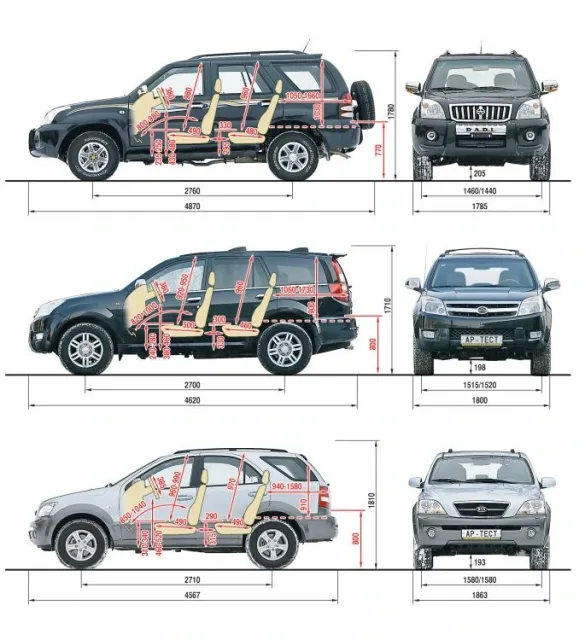
| Dadi Shuttle, Great Wall Hover, Kia Sorento (official data) | |||
| Vehicle | Dadi | Great Wall | Kia |
| Body type | 5-door wagon | ||
| Number of seats | 5 | 5 | 5 |
| Trunk volume, l | n/a | n/a | 420—1960* |
| Curb weight, kg | 1730 | 1830 | 1863 |
| Gross weight, kg | 2450 | 2305 | 2455 |
| Engine type | petrol | petrol | petrol |
| Layout | front, longitudinal | ||
| Number and arrangement of cylinders | 4, in-line | 4, in-line | 4, in-line |
| Number of valves | 16 | 16 | 16 |
| Displacement, cm3 | 2351 | 2351 | 2351 |
| Max. power, hp/kW/rpm | 130/95/5250 | 130/95/5000 | 139/102/5500 |
| Max. torque, Nm/rpm | 190/3000 | 195/2500 | 192/2500 |
| Gearbox | manual, 5-speed | ||
| Drive | all-wheel, with pluggable | ||
| front-wheel drive | |||
| Front suspension | independent, | independent, | independent, |
| torsion bar | coil spring | coil spring | |
| Rear suspension | dependent, | dependent, | dependent, |
| leaf spring | coil spring | coil spring | |
| Front brakes | disc, | disc, | disc, |
| ventilated | ventilated | ventilated | |
| Rear brakes | drum | disc | disc |
| Tires | 225/75 R15 | 235/65 R17 | 245/70 R16 |
| Maximum speed, km/h | 150 | 170 | 170 |
| Acceleration time 0—100 km/h, s | n/a | 11 | n/a |
| Fuel tank capacity, l | n/a | 74 | 80 |
| Fuel | AI-92 | AI-92 | AI-95 |
| * With rear seat folded | |||
| n/a — no data | |||