
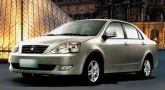
If you are tired of choosing between a used D-class car and a modest golf class, perhaps it is time to pay attention to the Geely Vision. This is exactly what the Chinese manufacturer seems to be counting on, having invited journalists to its plant to introduce the new model.
Now Geely proudly calls itself a "mirror of Toyota," basing its approach on the same principles: reliability, efficiency, and safety. However, less than five years ago, the company nearly lost a large sum due to a lawsuit from its current idol. The Japanese giant saw a resemblance in the Chinese brand's logo to its own trademark, but lost the case, and $1.7 million stayed with Geely. At the same time, the two emblems had far fewer common features than the new D-class sedan Geely Vision has with the previous Toyota Corolla. I wonder, did anyone have to pay this time?
In profile, the Vision indeed resembles a stretched Corolla — the same body contours, window and door lines. But even here, there are refinements: expressive stamping appeared on the side, moldings disappeared from the doors, and handles changed. The rest is already original. The front of the car looks confident: wide-open headlights, a chrome radiator grille, a massive bumper with "fangs" for fog lights. But the rear does not share this optimism — it turned out too high, heavy, and empty. Why spread the taillights so wide, exposing so much metal? Only a successful chrome strip on the trunk lid saves the rear.
But in the cabin, there is no imbalance or garishness: the interior is in a strict business style, clearly borrowed from the Japanese bestseller. The trim materials are, of course, not luxurious, but everything is done neatly and in its place. As for space, the car cannot be called spacious. Let's compare with the same Corolla: the Geely Vision is 217 mm longer (4602 mm), but the wheelbase is identical (2602 mm). So there is enough room in the front, but in the back seat, it's already "not great."
The Vision's dynamics evoke similar emotions: the car clearly lacks power. This is especially noticeable at low revs — acceleration is difficult for the car. And only at high revs does the 133-horsepower engine (1.8 L) paired with a 5-speed manual start to come alive a bit.
However, there are pleasant moments. Stability and handling left good impressions. A short drive showed that Chinese engineers taught the Vision to hold its trajectory and respond adequately to steering inputs. The brakes are also beyond reproach: deceleration is proportional to pedal effort, without yaw or pulling. But the body roll should be addressed — in sharp turns, the car literally leans over.
And for dessert: the model's price in Russia starts at 379,000 rubles. It sounds tempting, but will it be so in reality? On one hand, the car offers a modest price, decent standard equipment (ABS with EBD, two airbags, air conditioning), and build quality. On the other hand, there is only one version in the lineup, a weak engine, and traditional distrust of "Chinese cars." Which way the scales of popularity will tip is still unclear. But the wait won't be long: sales start this month.
September 2, 2008
Author: Vitaly Avdeev
© 5 Koleso