
The idea of putting a foreign engine in a Volga is not new — such experiments were tried back in the sixties, mostly known to us from export diesel GAZ-24s with Volga badges. However, for almost a year now, the Nizhny Novgorod plant has been stamping Volgas with an imported engine serially — it's a Chrysler gasoline inline four. Our Kyiv colleagues from Autoreview managed to get acquainted with such a car last spring, but we only got to it now. Let's try to figure out what the current GAZ-31105 is like: the one with the American unit and the one with the familiar ZMZ-406.
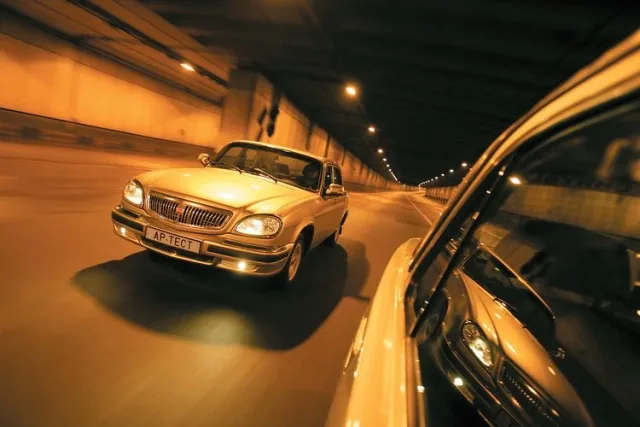
Externally, the "American" is only revealed by the exhaust pipe, which is slightly turned to the side. Otherwise, it's the same familiar Volga.
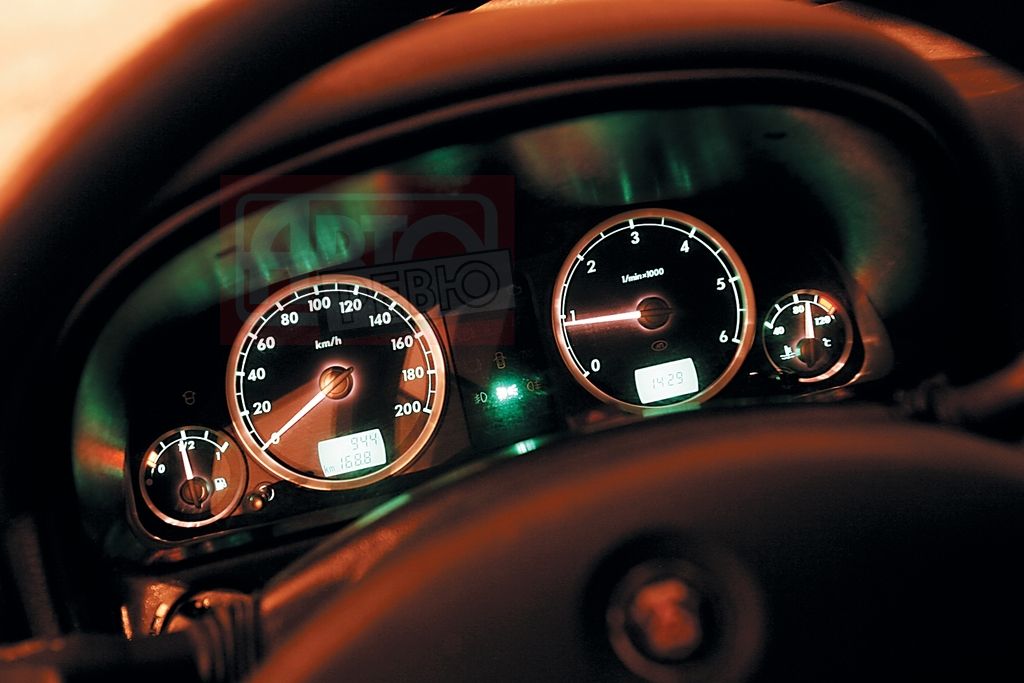
Inside, it's easier to tell: the car with the Chrysler engine has a new instrument panel with stepper motors. Compared to the old six mismatched gauges, this is a clear step forward.
 |
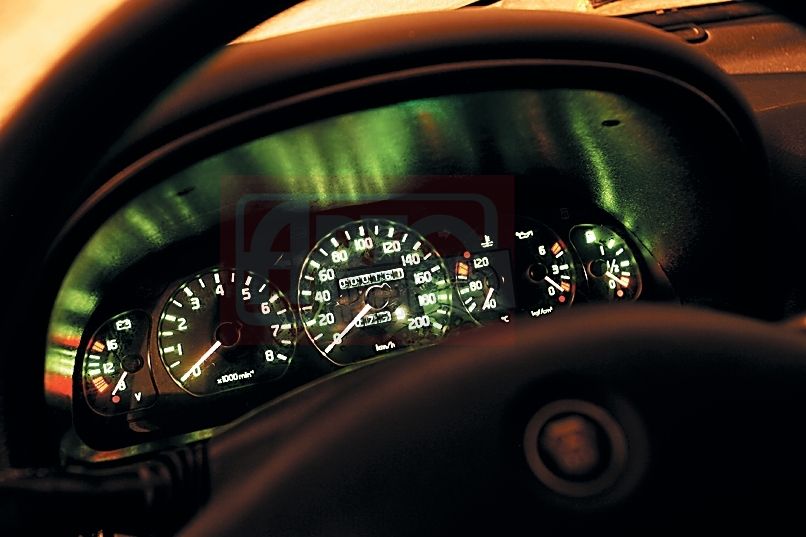 |
| The new instrument panel (left) is made by Vladimir's Avtopribor. It looks and reads much better than the old one | |
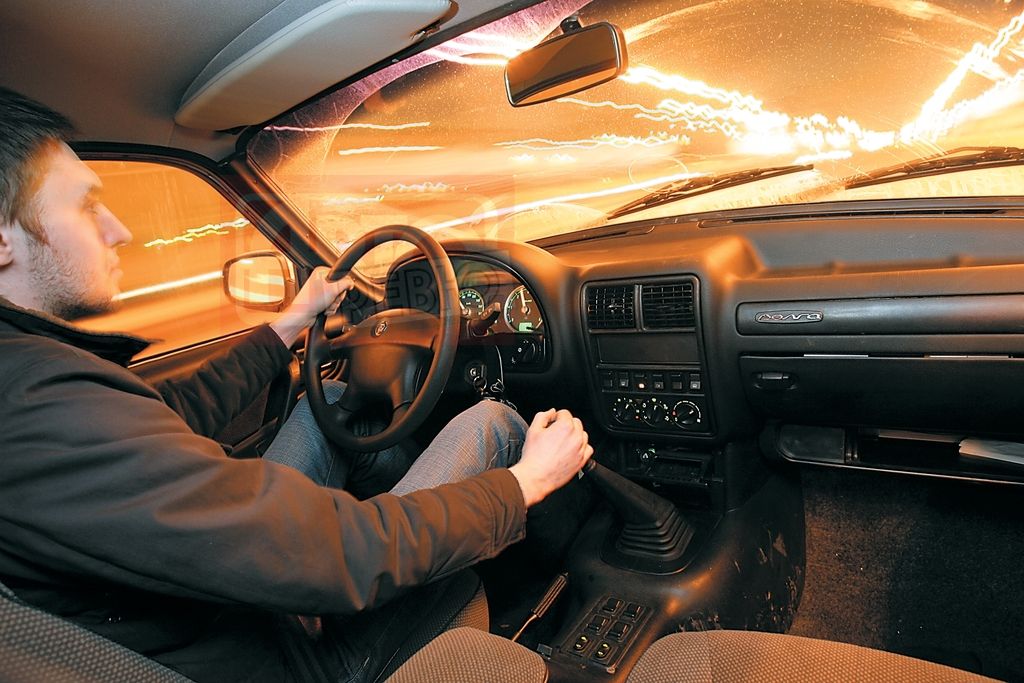
But everything else remains the same. As 37 years ago, a tall driver's head hits the ceiling, and he has to "hug" the steering wheel with his knees. A sharp smell in the cabin, the steering wheel is offset to the right, the pedals are high, the front seats barely move, the mirrors adjust over an insufficient range...
You turn the key — and both cars shudder, as if waking up. The Zavolzhye engine starts with its signature "voice," while the Chrysler engine is noticeably quieter and smoother at idle. That's a plus.
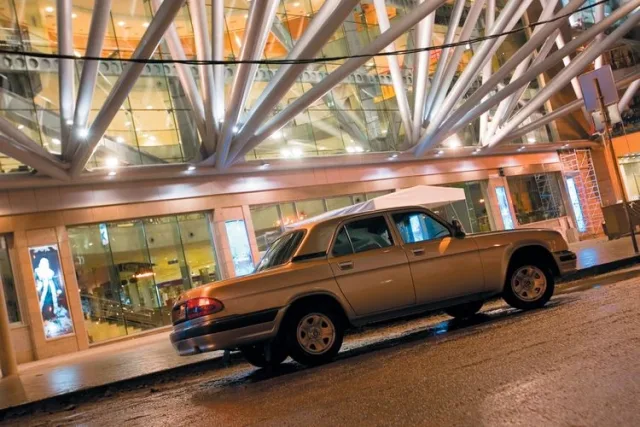
Clutch, first gear... Trouble! Although the "American" has a new clutch with a lighter diaphragm spring and a rigid driven disc (torsional vibrations are damped by a dual-mass flywheel), the gearbox remains the same — with a long lever that resists and transmits all the metallic "internals" of the transmission to your hand. Maybe it just needs to be broken in?
In the regular Volga, the effort on the lever is no less, and the clutch is also "wooden." The gas pedal is also strange: first you can't press it, then it "drops."
 |
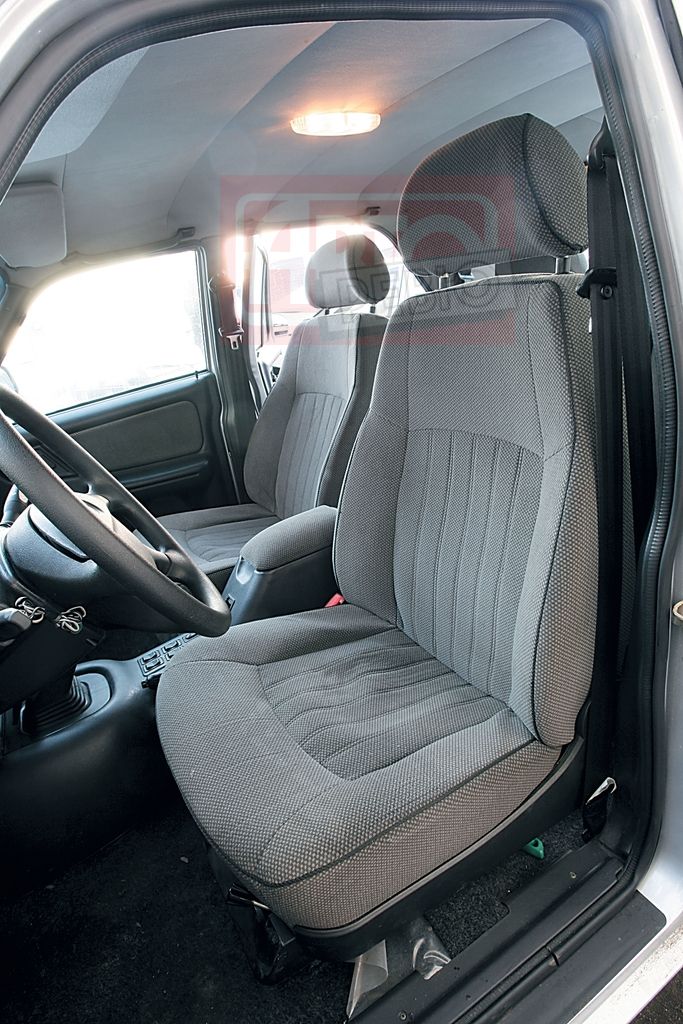 |
| The seating position is characteristic, the "wipers" are archaic with a small cleaning sector... This is a Volga | The seat is wide, soft, but without lateral support. Adjusting the backrest angle is convenient, but the lumbar support is not: you have to turn the tight knob a full five turns |
 |
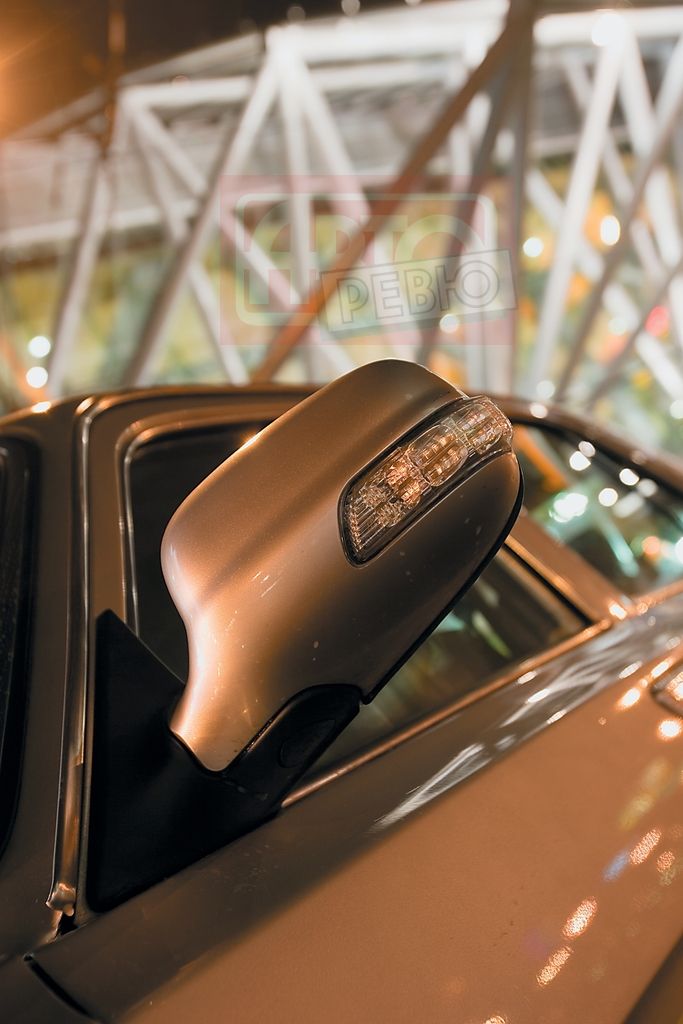 |
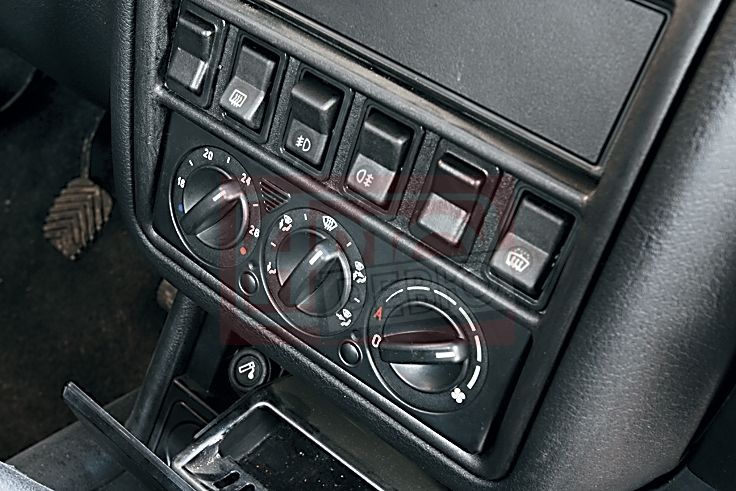
| Round climate control knobs have replaced the sliders — now on all Volgas. It's more convenient, but the heater itself works poorly: it either "bakes" or "freezes" | A fashionable touch: turn signal repeaters in the mirrors are now on all Volgas |
The ZMZ engine pulls moderately up to 2300 rpm, but then acceleration becomes more lively. However, the "American" quickly shows who's boss! Responses appear already from 1700 rpm. After 4000 rpm — a slight surge and... Despite the "off-season," we decided to measure acceleration on wet asphalt, fortunately there were almost no wheel spins. V-box measurements showed: the Volga with the Chrysler engine reaches 100 km/h almost two seconds faster. We couldn't measure the top speed, but according to the specs, it increased by 13 km/h.
True, the "American" responded to sharp throttle presses with an unpleasant jerk, and at high revs the overseas engine is no quieter than the Zavolzhye one. But the Chrysler engine is more elastic: it calmly pulls even in fifth gear, while the ZMZ "goes flat" already in fourth.
On the road, both cars behave the same — and, alas, equally poorly. They get tossed on straights, wander on bumps, lean in corners, scare with sluggish reactions and low stability limits. The chassis hasn't been seriously changed since 2003, when the kingpinless front suspension and rear stabilizer appeared. The "American" has a new power steering pump (with a separate cooling radiator), but this didn't affect feedback — the steering wheel became even "lighter" than usual. In a parking lot, you can turn it with one finger. But in corners, it becomes simply scary!
And ride comfort? The legends about the Volga's comfort are from Soviet times, when there was nothing to compare with. In reality, the car smoothly handles only small joints and bumps. On gentle waves, both rock; on broken roads, vibrations from unsprung masses spread through the body; and on deep potholes, the rear with its heavy solid axle jumps, and the spare tire in the trunk rattles. It lies there, on the shelf.
The gearbox still whines, the wind howls, the tires roar, and something clatters in the exhaust system.
Oh, "Volga-Volga"...
And reliability? On one of the cars (brand new, from the showroom), the washer didn't work. The heater periodically "went crazy" on both. On the "American" with only 800 km on the clock, the clutch was already slipping! Then, at full throttle, it started smoking, and the tachometer needle began to twitch... It turned out that the crankcase ventilation hose had come off the intake manifold — at the factory, they simply forgot to put on the clamp.
 |
 |
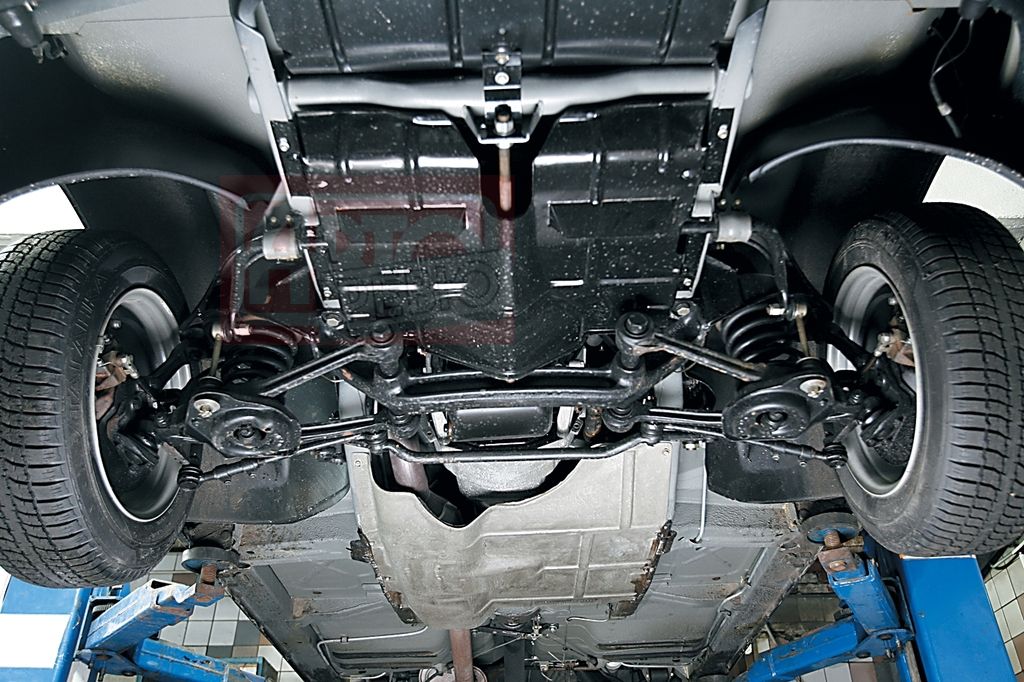 |
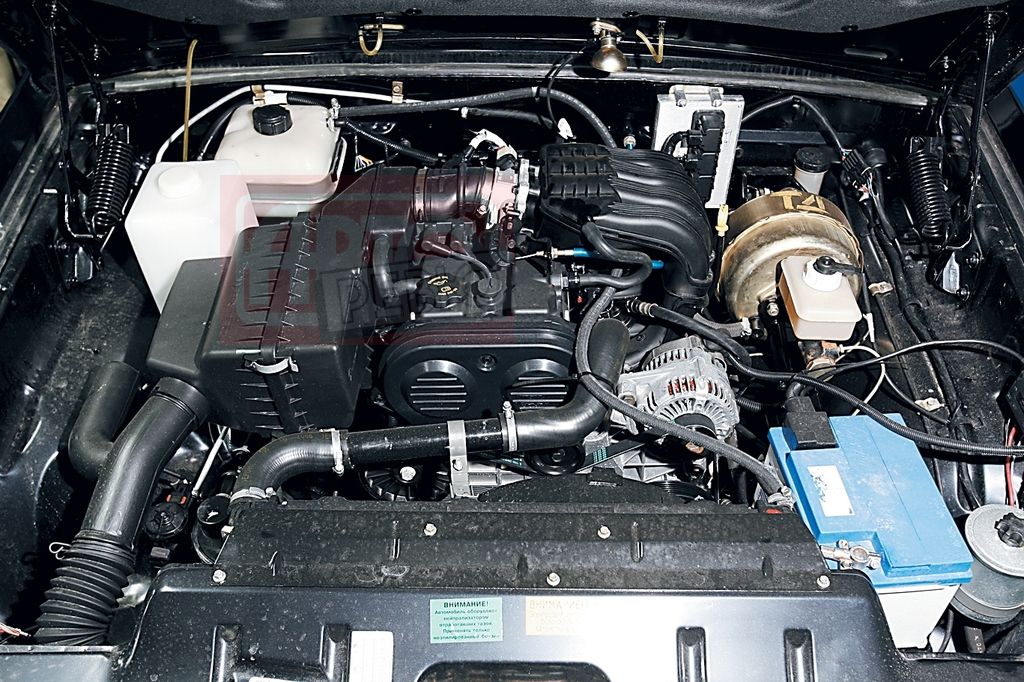
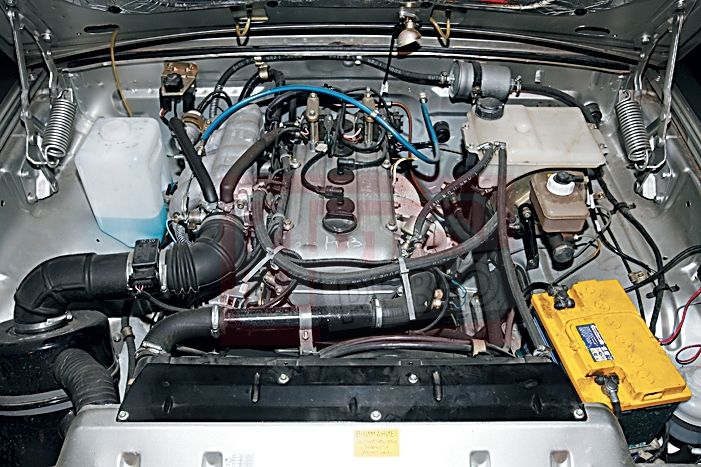
| Chrysler engine | ZMZ-406 engine | The American engine is taller than the Zavolzhye one, so the front suspension crossmember was lowered by 17 mm. The gearbox housing and catalytic converter are covered with a noise insulation shield |
| Although the layout is different (the intake and exhaust manifolds are mirrored relative to the ZMZ-406), the Chrysler engine fit into the engine bay without issues. The arrow shows that very hose without a clamp. "Check the completeness of the car," they said at the factory | ||
And Volga owners also complain about the cooling fan and fuel tank ventilation...
Yes, the Chrysler engine made the Volga GAZ-31105 better: it's noticeably faster, more elastic, and a bit quieter. According to the specs, fuel savings are also promised. Perhaps the $1000 surcharge is justified: the Volga with the American "heart" costs $9900, while the one with the ZMZ engine costs $8900. Plus, GAZ's plans to localize Chrysler engine production give hope that there won't be problems with parts and service, and it won't repeat the fate of the "Svyatogors" with Renault engines.
But where to put the rest of the "bouquet" of Volga charms? Isn't Russia ashamed to remain one of the few countries mass-producing forty-year-old cars — on par with India and Pakistan?
"We would take the Volga off the assembly line," the GAZ people assure. "But there's demand..."
The Volga is loved in the Russian hinterland! And when GAZ announced the end of production (the plant earns 6-7 times less on it than on the Gazelle), letters with requests and even threats poured into Nizhny Novgorod. Like, just try — we'll arrange terrorist attacks for you!
The inertia of thinking in our expanses is enormous. And it's fueled by the relative cheapness of the Volga. Who else for $10,000 will offer a big car with a 137-horsepower engine, power steering, four power windows, and power mirrors?
Volga: Life Goes On
Despite the fact that production volumes are decreasing, GAZ is not going to bury the Volga — the model will live for at least another couple of years, and with updates. Japanese specialists have already visited the plant, trying to implement that very kaizen system that has long taken root at TagAZ and UAZ. Already in April, a Volga with a new interior will be released: the steering column will become adjustable, other seats will appear, with longitudinal travel increased by 40 mm and vertical by 35 mm. The temperature sensor for the heating system will move from the center console to the ceiling, which should ensure correct operation of the automatic heating. On cars with the American engine, the clutch diameter has already been increased by 15 mm. Soon, they will also master grinding of gear teeth in the gearbox — it should become quieter, just as the rear axle became quieter after a similar procedure. They seem to have found a way to combat the annoying whine of the power steering. And ahead — the appearance of versions with a ZF automatic transmission...
Just thirty years ago, one could only dream of such things in the USSR, couldn't one?
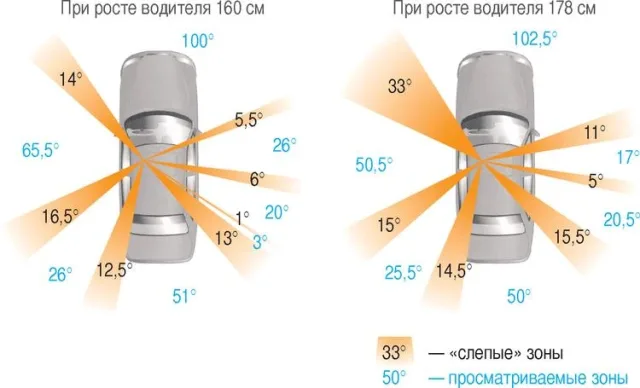
Due to the high seating position and low windshield edge, visibility in the "Volga" greatly depends on the driver's height. A short person is hardly bothered by the narrow pillars, while a tall driver's gaze slides over their connection points with the roof. The result is a total "blind" zone that is a third larger!
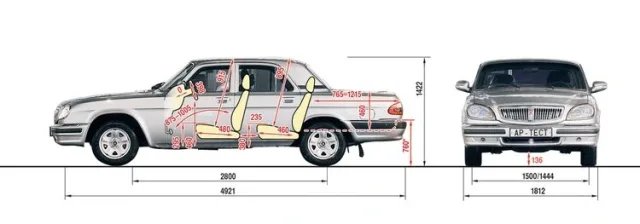
| Specifications | ||
| Parameters | Vehicles | |
| GAZ 31105-120 (ZMZ) | GAZ 31105-501 (Chrysler) | |
| Body type | 4-door sedan | 4-door sedan |
| Number of seats | 5 | 5 |
| Trunk volume, l | 500 | 500 |
| Curb weight, kg | 1400 | 1400 |
| Gross weight, kg | 1890 | 1890 |
| Engine | ZMZ-4062.10, gasoline, with distributed injection | Chrysler 2.4L EDZ, gasoline, with distributed injection |
| Location | front, longitudinal | front, longitudinal |
| Number and arrangement of cylinders | 4, in-line | 4, in-line |
| Displacement, cm³ | 2287 | 2429 |
| Cylinder bore/piston stroke, mm | 92.0/86.0 | 87.5/101.0 |
| Compression ratio | 9.3:1 | 9.5:1 |
| Number of valves | 16 | 16 |
| Max. power, hp/kW/rpm | 131/5200 | 137/5200 |
| Max. torque, Nm/rpm | 188/4000 | 210/4000 |
| Gearbox | manual, 5-speed | |
| Gear ratios | ||
| I | 3.78 | 4.05 |
| II | 2.19 | 2.34 |
| III | 1.30 | 1.40 |
| IV | 1.00 | 1.00 |
| V | 0.79 | 0.85 |
| reverse | 3.28 | 3.51 |
| final drive | 3.90 | 3.58 |
| Steering | "screw-ball nut", with power steering | |
| Front suspension | independent, coil spring, on transverse arms, kingpinless, with stabilizer | |
| Rear suspension | dependent, leaf spring, with stabilizer | |
| Front brakes | disc | disc |
| Rear brakes | drum | drum |
| Tires | 195/65 R15 | 195/65 R15 |
| Maximum speed, km/h | 165 | 178 |
| Acceleration time 0-100 km/h, s | 13.5 | 12.8 |
| Fuel consumption, l/100 km | ||
| at 90 km/h | 8.8 | 7.8 |
| at 120 km/h | 11.0 | 10.8 |
| in urban cycle | 13.5 | 13.7 |
| Fuel tank volume, l | 70 | 65 |
| Fuel | gasoline AI-92 | gasoline AI-92 |
| Equipment of the vehicles tested | ||
| Equipment | Vehicles | |
| GAZ 31105-120 | GAZ 31105-501 | |
| Engine | ZMZ-4062.10 | Chrysler 2.4L EDZ |
| Base price of the car, rub.* | 226000 | 257000 |
| Power steering | + | + |
| Adjustable steering column by height | – | – |
| Velour seat upholstery | – | + |
| Central locking | + | + |
| Immobilizer | – | – |
| Electric drive and heated exterior mirrors | + | + |
| Electric windows | + | + |
| Trip computer | – | – |
| Folding rear seat in parts | – | – |
| Audio preparation | + | + |
| Fog lights | + | + |
| Full-size spare wheel | + | + |
| Metal engine compartment protection | + | + |
| Alloy wheels | – | – |
| Metallic paint | + | + |
| "Child" lock of rear doors | + | + |
| Rear head restraints | + | + |
| Remote trunk lock | – | – |
| Price of the tested car, rub.* | 226000 | 257000 |
| * Price for 2006 model year cars | ||
| (+) Included in base version | ||
| (–) Not included in base version | ||
| (O) Options installed on the tested cars | ||
| Some measurement results of Autoreview | |||
| Parameters | Vehicles | ||
| Volga (with GAZ engine) | Volga (with Chrysler engine) | ||
| Acceleration time, s | 0-50 km/h | 4.8 | 4.7 |
| 0-100 km/h | 14.7 | 13.0 | |
| 0-150 km/h | — | 32.7 | |
| on 400 m distance | 19.5 | 18.9 | |
| on 1000 m distance | 35.7 | 34.4 | |
| 60-100 km/h (III) | 9.6 | 7.8 | |
| 60-100 km/h (IV) | 13.2 | 12.0 | |
| 80-120 km/h (V) | 23.4 | 16.9 | |
What is this Chrysler?
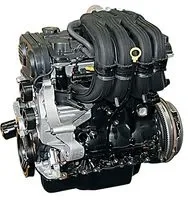 The Chrysler 2.4L unit, known under the index EDZ, has been produced since 1994. It could be found under the hood of Dodge Caravan and Chrysler Voyager minivans, Dodge Stratus/Chrysler Cirrus, Chrysler Sebring/Plymouth Breeze models, as well as Jeep Liberty and Jeep Wrangler SUVs and Chrysler PT Cruiser. The engine has a cast-iron cylinder block with thin walls, but the cylinder head is aluminum, sixteen-valve, with two camshafts. In design, it resembles the head of the Mitsubishi 4G63B engine from the Orion family — in those years, Americans and Japanese cooperated closely. The camshaft drive is a toothed belt, and at the bottom of the block hide two cast-iron balance shafts that rotate by chain. The oil pan is stamped, made of two-layer steel, and the intake manifold and valve cover are made of plastic. Fuel is supplied by distributed injection.
In the "Volga" with this engine, the "return" line was removed from the fuel system. The fuel filter here is a regular Volga one, but the air and oil filters are original American ones.
The engine from the USA weighs 179 kg, which is 8 kg lighter than the domestic ZMZ-406.
Background
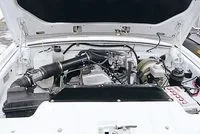 |
| Toyota 3RZ-FE engine in the engine compartment of the Volga (1998) |
Attempts to adapt foreign engines under the hood of the "Volga" began back in the sixties. For example, since 1960, on export GAZ-21s, at the initiative of the Belgian importer Scaldia Volga, Perkins diesel engines with a volume of 1.6 liters and a power of only 43 hp were installed. In 1962, they were replaced by Rover diesels (2.3 l, 65 hp). Later, two-liter naturally aspirated Peugeot-Indenor diesel engines with a power of 68 hp were installed on export cars. And on GAZ-24, French diesel engines began to be mounted from 1976 — such cars, distinguished by black plastic radiator grilles, also ended up in the USSR. On later models, one could find a Peugeot diesel (2.3 l) with a power of 69 hp — the same one installed on Ford Granada and Sierra.
But gasoline imported engines on "Volgas" were only experimental — at GAZ they were installed in single copies. For example, in 1973, a GAZ-24 with an in-line BMW "six" appeared, three years later — with a similar Mercedes-Benz engine with a volume of 2.6 liters, and in 1984, a Ford V6 engine (2.8 l) was put under the hood.
The history of installing foreign engines on "Volgas" dates back to the mid-nineties, when similar projects were undertaken by Moscow and Nizhny Novgorod tuning studios. The pioneer in 1995 was the GAZ-31029 with a Rover engine — a two-liter in-line "four" with 16 valves produced 136 hp and was paired with a five-speed manual gearbox or an "automatic" from the same donor. A little later, an option appeared to install a V8 with a volume of 3.9 liters and a power of 185 hp from Land Rover Discovery.
In 1997, Toyota units settled in the engine compartments of "Volgas": gasoline 3RZ-FE (2.7 l, 152 hp) and 5VZ-FE (3.4 l, 178 hp) from Land Cruiser, as well as a turbodiesel 2L-T (2.5 l, 92 hp) from Cresta and Crown models. Gearboxes — both manual and automatic — were also Japanese. Note that you can order a "Volga" with a Toyota engine even today: gasoline engines of 2.7 l (165 hp) and 3.0 l (255 hp) are offered, with the latter only paired with an "automatic".
In addition to tuning shops, the assembly of "Volgas" with Toyota and Rover engines was also carried out by the Small Series Automobile Plant (ZAMS), which was part of the GAZ structure — such cars had a factory warranty. In 2004, at ZAMS, another power unit was adapted for the GAZ-3110 — a Ford inline four-cylinder engine with a displacement of 2.3 liters and 147 hp, paired with a four-speed automatic transmission. True, the production run of such cars turned out to be quite modest.
Also noteworthy is the version with the licensed Steyr turbodiesel (2.1 liters, 95 hp), which was assembled in Nizhny Novgorod under the GAZ-560 brand in the late 90s. The project did not receive further development — the high price and complexity of the monoblock diesel design took their toll.
But the appearance of the American engine was the result of a loud conflict with the Zavolzhye Motor Plant (ZMZ), part of the Severstal group. The Zavolzhye plant raised prices for its products, and GAZ responded by stopping purchases and halting supplies of cast iron blanks for cylinder blocks. As a result, both enterprises came to a standstill, as did UAZ. The parties eventually reached an agreement, and ZMZ engines again went to Nizhny Novgorod, but the conflict only exposed a long-standing problem — the lack of a modern passenger car engine for the "Volga".
The solution was found in negotiations with DaimlerChrysler: GAZ received the drawings and the right to assemble four-cylinder engines of the Chrysler Sebring family from imported kits. The 2.4L EDZ engine is close in parameters to the ZMZ-406 and is suitable not only for transverse installation, as on the Sebring, but also for longitudinal installation — as on the Jeep Cherokee and Wrangler.
Adapting the engine for the "Volga" required tuning the injection system. The Americans themselves helped, to whom one car was specially taken. As a result, the power amounted to 137 hp against the factory 150 hp. The rest was done by GAZ employees on their own. The mounting points of the power unit were changed, the front suspension crossmember was lowered by 17 mm, part of the stiffening rib was removed from the inside of the hood, gears with different gear ratios appeared in the gearbox and rear axle, a submersible fuel pump and a new exhaust system were installed.
For now, engines are supplied from the Mexican plant in Saltillo, but with the launch of the Sebring assembly line, GAZ's own engine production will also begin to operate.
What's the price?
The base price of the "Volga" GAZ-31105-501 with the Chrysler engine is 259,800 rubles (approximately $9,900). The equipment includes power steering, electric mirrors and power windows on all doors, a velour interior, central locking, fog lights, athermal glass, two-layer "metallic" paint, and audio preparation. Some dealers give an alarm system as a gift. Air conditioning is available for an additional 15,600 rubles.
The GAZ-31105-120 version with the ZMZ-406 engine is cheaper — 232,800 rubles. The difference in equipment is a fabric interior and the old dashboard. Air conditioning here is more expensive due to installation features — 20,000 rubles.
Also available is a version extended by 300 mm — an additional 120,000 rubles. Thus, a "long" car with the Chrysler engine will cost 380,000 rubles (approximately $14,500).
The American engine is also installed on the "official" GAZ-3102 — 302,600 rubles in the base configuration, which is 27,000 rubles more expensive than the version with the ZMZ-406. Quite recently, "Gazelles" with the Chrysler engine also appeared at dealers.
Maintenance?
According to the rates of official service centers, maintaining a "Volga" with the Chrysler engine costs a little, but more than with the familiar engine. For example, the tensioner roller of the drive belt for auxiliary units for the American engine can cost up to 6,500 rubles, and replacing it together with the belt will cost about 1,000 rubles. Moreover, prices at different service stations vary noticeably. Another feature: on the Chrysler engine, the camshafts are driven by a toothed belt, whereas the ZMZ has a chain. A broken belt threatens the valves meeting the pistons, but dealers assure that such cases have not yet occurred.
Official GAZ stations are in no hurry to undertake serious repairs, offering, following Western practice, to simply replace the engine. If the case is not under warranty, a new engine will cost about 150,000 rubles plus about 6,000 rubles for labor.
| Cost of scheduled maintenance without consumables and spare parts* | |||
| Scheduled maintenance | Vehicles | ||
| GAZ 31105-120 (ZMZ-406) | GAZ 31105-501 (Chrysler) | ||
| Mileage, km | 1000 | 15—23 | — |
| 3000 | 91—111 | 87—111 | |
| 10000 | 84—106 | 57—99 | |
| 20000 | 111—133 | 120—171 | |
| 30000 | 84—118 | 80—101 | |
| 40000 | 111—129 | 120—190 | |
| 50000 | 84—108 | 57—125 | |
| 60000 | 111—129 | 120—228 | |
| 70000 | 84—118 | 57—125 | |
| 80000 | 111—129 | 120—197 | |
| 90000 | 84—118 | 84—125 | |
| Total | 970—1222 | 902—1472 | |
| * Prices are in US dollars | |||
| Approximate prices for original spare parts at dealers in Moscow* | ||
| Spare parts | Vehicles | |
| GAZ 31105-120 (ZMZ-406) | GAZ 31105-501 (Chrysler) | |
| Oil filter | 8 | 11 |
| Fuel filter | 9 | 13 |
| Air filter | 6 | 47 |
| Spark plug | 2 | 10 |
| Serpentine belt | 6 | 22** |
| Serpentine belt tensioner | 19 | 106** |
| Clutch (complete assembly) | 68 | 133 |
| * Prices are in US dollars | ||
| ** Not available at dealers, only on order | ||