
Ford S-Max. Wagon of Desires
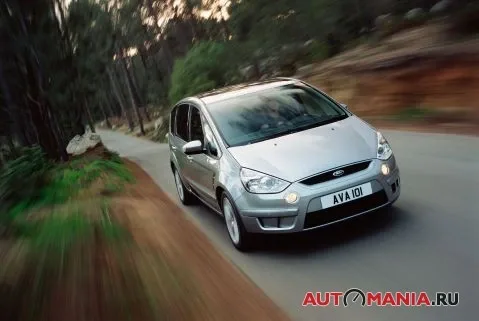
For Ford, mastering minivans is not new: in North America, the brand always has a similar model. But a European one-box of this size appeared in the lineup for the first time. In the minivan family, the S-Max took a niche between the compact Focus C-Max and the large Galaxy, closing the last gap in this segment. Such close attention to the buyer may seem excessive, but in reality, each of the three cars is so narrowly "tuned" to its tasks that they simply won't have to compete with each other. But rivals will have a hard time — the S-Max has something to surprise a potential owner.
The first thing it must use to hook the customer is its appearance. In essence, this car was tasked with testing the new "kinetic" philosophy of Ford design, whose main postulate is "movement in simple and familiar forms."
This is essentially the essence of its exterior. Looking at this minivan, hardly anyone will immediately say that it's a classic family one-box. Yes, here are familiar proportions, a high roof, huge door openings... But at the same time, the car looks dynamic, elegant, "muscular," and even expressive, although it doesn't scare off with ultra-modern stylistic frills. Rather the opposite — it attracts the eye, making you examine every centimeter of the body.
And, you must admit, the designers didn't invent anything supernatural: the market is full of cars with far more extravagant looks, claiming to be trendsetters. True, they mostly have nothing to do with family minivans, but the fact remains. In the S-Max's appearance, Ford gathered all the best that had been developed by them and their colleagues over years, and perhaps decades. The result is an original car with a modern and distinctive design that will surely appeal to brand fans.
However, stylistic preferences are a matter of taste, and the S-Max must have other trump cards. Take, for example, the huge trunk, where in addition to the 854 "nominal" liters, an optional third row of seats easily fits, or the sliding cargo platform ordered separately... And the five-seat cabin, where each passenger has their own separate seat, deserves the most flattering words. Each seat, by the way, can be easily adjusted to suit yourself. With the front seats, this is, of course, easier, but rear passengers won't be left out — there's no less free space here than in the business class cabin of a decent airliner. Not to mention the first row: a person of any build and height will sit there without problems, without interfering with those sitting behind.
The comparison with an airplane, by the way, is not accidental. These thoughts are prompted by the huge U-shaped lever on the center tunnel. At first, its purpose seems a mystery, but then you realize it's the handbrake — and imagination gives way to common sense.
However, the S-Max can evoke "flying" associations without any stylistic tricks — but only if we're talking about the version with the top 5-cylinder Duratec engine from the Focus ST and a 6-speed manual. A turbo that extracts 220 "horses" from 2.5 liters and delivers peak 320 Nm already at 1500 rpm — isn't that impressive?.. And acceleration to 100 km/h in 7.9 seconds? If that doesn't grab you either, then it's better to look at the Focus ST or something hotter. For a family minivan, such figures are more than enough. A brisk start from the traffic light, overtaking a truck that hesitated on an incline — all this is done easily and effortlessly, and the suspension, steering, and brakes work flawlessly. In extreme cases, ESP will intervene. But the main thing for which I want to praise the S-Max is its innate calmness. It doesn't provoke feats, but on the contrary, gently and unobtrusively sets a measured pace. And no matter how the driver tries to resist, in the end, the car dictates the conditions, returning the "homegrown Schumacher" from the race track to family values, snoring in the back seat. And the huge power reserve is that very "emergency reserve" that will come in handy at a critical moment.
On the other hand, it's unlikely that many S-Max buyers will covet this particular version. The piece is, of course, tasty, but the purpose of such a car is not at all to conquer space at maximum speed and tear from a standstill. Its element is the safe and most comfortable transportation of all passengers from point A to point B. Simply put, a calm family voyage, having nothing in common with either "royal races" or WRC stages. Therefore, I dare to assume that the most in-demand among our compatriots will be the 2-liter naturally aspirated petrol engine, the same one installed on the Russian-assembled Ford Focus. Developing 145 "horses," the engine, of course, won't pull the heavy minivan so briskly, but given the significant savings at purchase ($28,660 for the base version without options) and on maintenance, it's worth it. And it can't be called too "sluggish"...
By the way, this pair of engines limits the petrol range of the S-Max. But the buyer still has a choice — thanks to turbodiesels, of which there are also two. The first, with a volume of 1.8 liters, produces quite decent 125 hp for such a unit and, thanks to its traction characteristics, is unlikely to disappoint even "hot" drivers. As for the second, the 2-liter, there's nothing to say. True, it has two modifications — 140 and 130 hp. Moreover, the latter, unlike the other engines, is paired exclusively with a 6-speed "automatic," while all other engines, including petrol ones, work with a 5- or 6-speed "manual."
Whichever option you choose, one thing is indisputable: this car received the title deservedly. And it's not about the notorious political correctness. The S-Max has drawbacks, and some are quite significant (take, for example, the lack of a spare tire or weak base equipment). But overall, among competitors today, few can offer such an optimal and balanced set of qualities necessary for a modern car. That's what Europeans appreciated.
Yuri Goryachev
Technical specifications:
| Dimensions: | Ford S-Max |
| Length (mm) | 4770 |
| Width (mm) | 1885 |
| Height (mm) | 1660 |
| Wheelbase (mm) | 2850 |
| Weight (kg) | 1530 |
| Trunk volume (l) | 854/1170/2100 |
| Engine displacement (cm3) | 1999 |
| Max. power (hp) | 145 at 6000 rpm |
| Max. torque (Nm) | 185 at 4500 rpm |
| Max. speed (km/h) | 197 |
| Acceleration 0—100 km/h (s) | 10.9 |
| Avg. fuel consumption (l/100 km) | 8.1 |
| Price ($) | 28,660–37,960 |
Source – www.automania.ru