
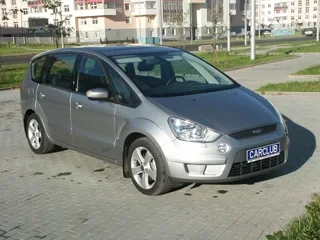
Concept cars sooner or later get a production life. And their creators, like all hotheads, become more respectable over time, start families, deal with everyday matters, and move from the left lane to the right—both in life and on the road.
Last year's Ford SAV concept is now produced as a production model. It is positioned as a car for those who are not ready to give up their driving ambitions, even after starting a family. As a driver who doesn't like passive driving, I went to the Ford showroom for the keys on a bicycle—anyway, the nearest weekend was to be spent behind the wheel of a sports minivan, and I didn't want to return to morning traffic jams on Monday.
The Ford S-MAX and its more modest sibling, the Galaxy, are Ford's first production models in the new "kinetic" design. As S-MAX chief designer Claudio Messale says, these cars embody "energy in motion." 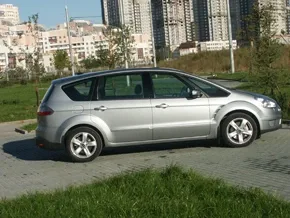 Even at a standstill, they should look as if they've just started moving. However, whatever meaning is put into the "kinetic style," at first glance you notice its resemblance to a reptile—the gill-like slits in front of the rear wheel arches (by the way, purely decorative) and the narrowed nose evoke persistent zoological associations. The S-MAX most resembles... a python. The intent, predatory gaze of the bi-xenon headlights with swiveling sections that improve nighttime visibility draws attention, and the round fog lights seem to hypnotize, like a snake with a rabbit. Whether the S-MAX has the right to such an aggressive look—I found out already behind the wheel.
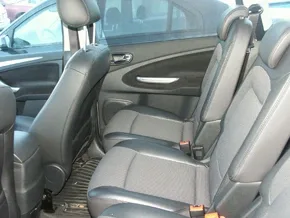
After removing the front wheel of my bicycle and placing it in the trunk, I realized there was room for a couple more such bikes. If you fold down the rear seats, even a racing kart will fit, or maybe two. It's unlikely anyone will measure the volume of this trunk with desks or bags of potatoes—the car is clearly designed for active drivers. With the rear seats folded, the cargo volume grows to two cubic meters, which everyone is free to use as they wish. But it's better to get behind the wheel.
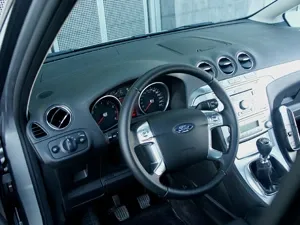
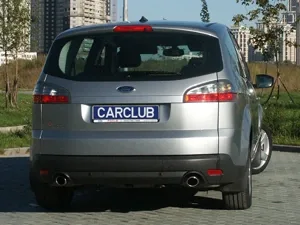 Sitting in the driver's seat, the first thing you notice is that there's noticeably more space, and instead of a gas pedal, there seems to be a real aviation thrust control lever... But wait, what does Subaru have to do with this, and how did I manage to confuse the handbrake with the gas pedal? Sorry, some kind of obsession, but the design of the dashboard and center console clearly hints at Subaru motifs, and the thing sticking out in place of the handbrake I've only seen at an airshow in Zhukovsky. The association with Subaru was probably also prompted by the rear end design. Even after the test, I still confuse the rear of the S-MAX with the back of the Subaru Tribeca. And the parking brake lever, under which the two-arm seat heating and ventilation buttons are located, is not exactly super convenient, but definitely original—so much so that you want to give it a nonexistent afterburner function. Although even without it, the S-MAX has plenty of thrust.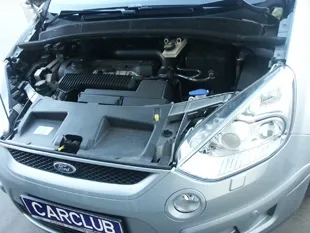
Under the hood of the sports minivan is the same engine as in the Ford Focus ST. It's a 2.5-liter five-cylinder with 220 hp, a low-pressure turbo and intercooler, which Volvo engineers gave to Ford. So I didn't expect much excitement about the dynamics—everything was obvious, but... What impresses in the S-MAX is not so much the acceleration as the engine's elasticity and the precision of the six-speed manual gearbox—also, by the way, from Volvo. Hence the smoothness of acceleration. A magnificent engine! If you didn't know about the turbo, its presence is almost imperceptible: no classic turbo lag, no sporty growl, although the exhaust is tuned so that others know about the car's capabilities. The first acceleration on the Moscow Ring Road so captivated me that I forgot about the car's dimensions and weight, and soon I was braking hard to the sound of ABS. After all, the S-MAX is not a hot hatch that can dart into a gap between cars, but a minivan for 5+2 seats, 4.8 meters long and with a curb weight of about 1700 kg.
 The turbo works incredibly diligently across the entire rev range, delivering maximum torque already at 1500 rpm. It seems the Volvo folks have even surpassed their compatriots from Saab, who are known as masters of boost—their engines reach peak only at 1800 rpm. The S-MAX has torque like a good diesel—a full 320 Nm—and it holds until 4800 rpm. On the straight of the Novorizhskoye Highway, the car accelerates elastically and imperceptibly to a maximum of 230 km/h, without straining the driver at all. Even in the 180–220 km/h range, it accelerates confidently, despite the tall body with a large frontal area. According to the specs, the S-MAX hits 100 km/h in 7.9 seconds! Sound insulation is excellent: wind noise appears only after 160 km/h, and the engine doesn't annoy either. The music system, though not hi-end, is also invigorating and perhaps even exceeds the car's price class. And soon, Ford promises to install a new generation of Hi-Fi stereo systems from Sony on the model.
The smooth character of the torquey engine allows you to play with the gear lever and even make mistakes: there's enough thrust for dynamic driving even if you engage sixth instead of fourth or fifth instead of third. Although the gearbox shifts so precisely that the chances of a real mistake are slim. The Volvo roots of the engine have benefited the minivan: you can drive it slowly, with effort, but you can. Not every car with such dynamics is so forgiving of an active driver's weaknesses. Behind the wheel of the S-MAX, you can safely skip gears or go straight to sixth after intense acceleration in second. The excellent aerodynamics of the body also contribute to the dynamics—even in heavy rain at 120–140 km/h, the side windows and "quarter windows" in front of the A-pillars remained clean.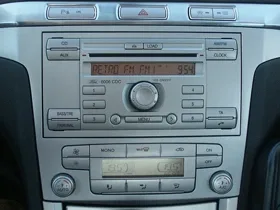
The suspension, fortunately, matches the engine. It confidently handles almost any surface—from fine gravel to large but shallow potholes. Muffling bumps, it virtually eliminates longitudinal and lateral body sway. True, in corners the S-MAX still leans, and even more than I'd like—the shock absorbers struggle to hold the tall body. On bends, understeer also shows: in sharp turns, the car starts to push, although the steering responses remain as precise as on a straight. But on gentle sweeping curves, the minivan is car-like light and even spirited. The endlessly smooth engine thrust adds charm, literally pulling the S-MAX into the corner. In case of a gross piloting error or an encounter with another active driver, you can count on protection from 10 airbags, but as someone who maniacally buckles up, three driver's airbags, including the knee one, should be enough. But let's not talk about sad things...
The explanation for the minivan's excellent handling can be found by looking underneath. Up front are MacPherson struts on an ultra-rigid subframe, providing excellent stability and handling. The rear wheels are connected to the body by a multi-link suspension, also mounted on a subframe. On my test car, the suspension behavior was managed by the optional IVDC (Interactive Vehicle Dynamics Control) system, which changes the settings of adaptive shock absorbers. Three buttons in front of the parking brake lever allow you to choose between sport, normal, and comfort settings, and when accelerating or braking, IVDC automatically stiffens the suspension, reducing sway and dive. Though, honestly, catching the moment of transition from one mode to another is as difficult as recognizing the turbo under the S-MAX's hood.
 The shock absorber characteristics change within seconds. IVDC also includes a hill launch assist function to prevent rolling back when starting on an incline—its advantages were fully revealed in the Sunday evening traffic jam on one of Moscow's seven hills. And here Ford didn't miss: even hyperactive drivers get tired, and the clutch with the "assistant" doesn't burn out.
It seems that Ford engineers have managed to create another interesting car for drivers, which, perhaps, won't become a replacement for the Focus ST in the garage of an active family man, but will definitely not let him completely sink into the routine of boring family cars. Almost a thousand kilometers spent behind the wheel of the S-MAX completely dispelled my doubts on this matter. Especially since the base version with a 2.0-liter 145 hp engine can be had for $24,630, and for the modification with the 220 hp engine, they ask from $28,140. The tested example with a large number of options is estimated at about $33,000. In addition to gasoline engines, the lineup includes a couple of turbodiesels with 125 and 143 hp, starting at $26,000. The only thing missing is an automatic transmission.
Leonid Pavlov