
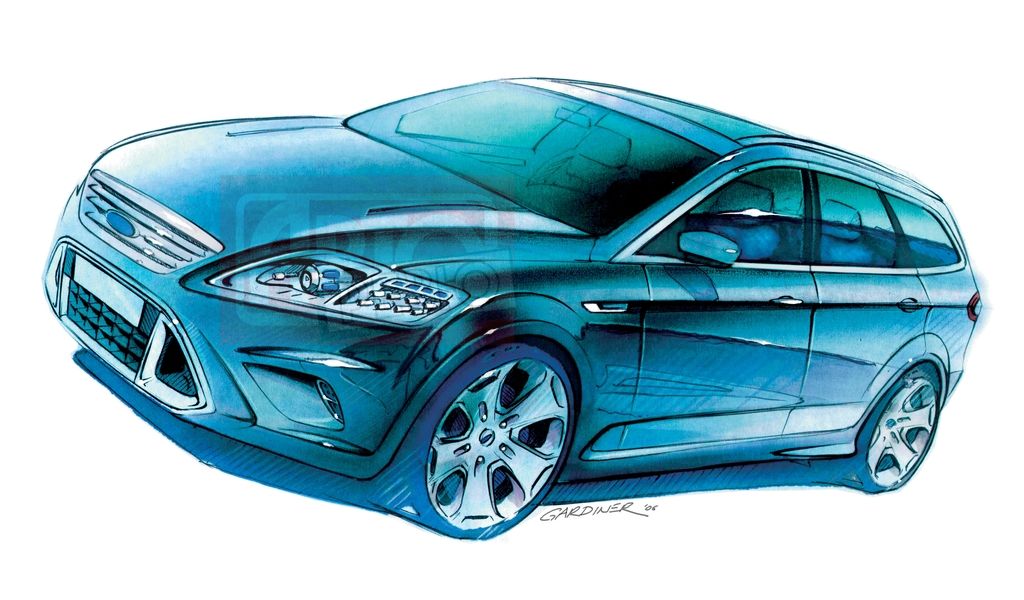
 Where did that seagull come from on our way? We had completed the main program without a hitch, and at the end we were in for a pleasant surprise — my partner from the magazine "Autosport" and I were given a car for half an hour that was not on the official list. It was a Ford Mondeo wagon
with a Japanese six-speed automatic from Aisin — this version will go on sale only in a few months. Interest in this gearbox did not arise out of nowhere. For almost a year, even before I acquired my cherished dream in the form of a Porsche 911, I drove the editorial Mondeo wagon with a two-liter petrol engine and a four-speed automatic. And everything would have been fine if not for this gearbox! Dull, capricious, and at a speed of 140 km/h it even panicked: you hold the gas pedal still, and it darts between third and fourth gear. The engine either howls, then goes quiet, then roars again, the car jerks, and so do I…
And so we, two handsome fellows, are rolling along Sardinia in a fresh cherry-red Mondeo with an automatic, with the sea to our right. I had already driven my part of the route, now Vadym is at the wheel. We enter another town, and a seagull is sitting in our lane, flapping its wings, about to take off. Vadym eases off the gas, the bird soars up and… I have seen a lot in my lifetime, but I have never screamed so loudly. Huge, its wings almost filling the entire windshield, it rushed straight at us, momentarily blocked the view, hit — and went up, leaving a smudge on the glass. I was screaming. Not at Vadym, but just wordlessly: "A-a-a-a…" My scream scared him more than the seagull itself.
— Misha, it's alive, I saw in the mirror, it limped off and flew away, alive! Look, there's not even blood on the glass!
— Why didn't you stop? You saw it, you could have braked!
— What if someone had rear-ended us?
— Let them! I don't care about this piece of metal!
Vadym, of course, was right. But I was as if unhinged. I recalled familiar seagulls and other birds. Bach's Jonathan Livingston, Aksyonov's diver that a rowdy Moscow musician shot with a stone in Crimea… And I was very scared for the people close to me, whom I thought about a moment before the collision. Where did this clumsy beauty come from on the road? What kind of sign is this? What is it for?
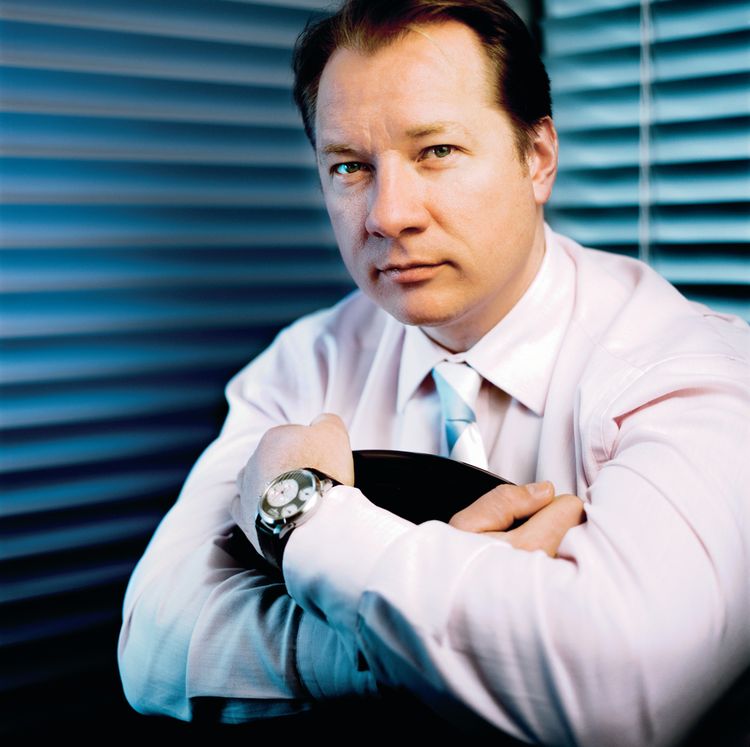 | Jens Ludmann — chief engineer of the so-called large cars of Ford's European division — these are cars on one platform: S-MAX, Galaxy, and now Mondeo. True, Ludmann took his current post about six months ago, so he cannot be fully considered the "father" of the Mondeo. But he did contribute to the fine-tuning. To the praise of the new Mondeo's driving qualities, Ludmann responds modestly: "We had an excellent chassis at our disposal, and the main task was to set it up correctly, to precisely select the elastic elements. No matter how much help computers give us, polishing the car's behavior to perfection is the task of testers and experts, and we spared neither time nor money on this work. That's the whole secret." |
— Michael, so how do you like the automatic? It's better than before, right?
— Better. Only there are minor glitches with the software: in manual mode at low revs, when you add gas and the gearbox itself drops one or two gears, the display still shows the number six, although in reality fifth or fourth is engaged. This is not always, but every other time. And the numbers themselves are small, "blind." Also, it would be nice to show the current gear in Drive mode as well. Otherwise, it's not bad, though not a masterpiece. Automatics have never been the strong point of European Ford…
| The successful design of all three versions has sharpened the already difficult choice. By feel, the hatchback drives best — perhaps the smaller rear overhang and, as a result, a smaller moment of inertia around the vertical axis played a role. But the "driving" difference between the hatchback and the sedan is so small that it can easily be offset by tire selection. From a practical standpoint, as a cargo-passenger vehicle, the hatchback also looks preferable to the sedan (although the sedan also has an excellent trunk), but in the hatchback, rear visibility is noticeably reduced — through the interior rearview mirror. In addition, the hatchback is about $500 more expensive than the sedan, and the hatchback with the "small" 1.6-liter engine, as well as the wagon with such an engine, will not be sold in Russia at all — only the sedan. The wagon is already $1000 more expensive than the sedan, but this surcharge looks like a very reasonable investment: even despite some loss in driving behavior, the Mondeo wagon is one of the most spacious in its class, with a low loading height, and now also one of the most stylish | ||
Jens Ludmann, the chief engineer of the Mondeo, was waiting if not for a different answer, then at least for a different tone:
— Michael, it seems I shouldn't have given you a car with an automatic.
— You shouldn't have.
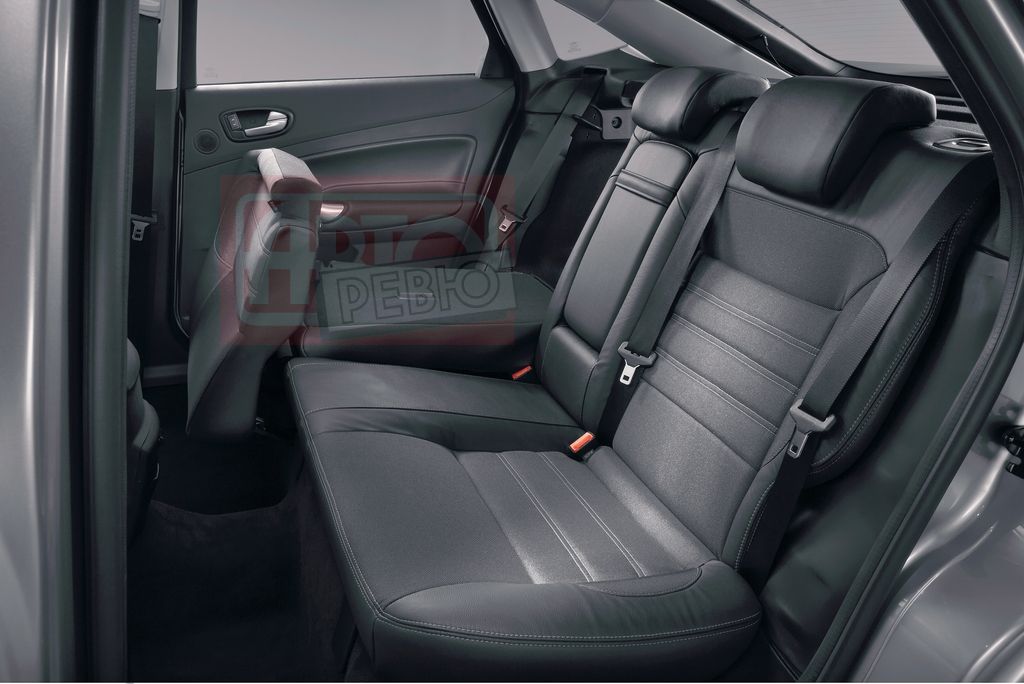 | 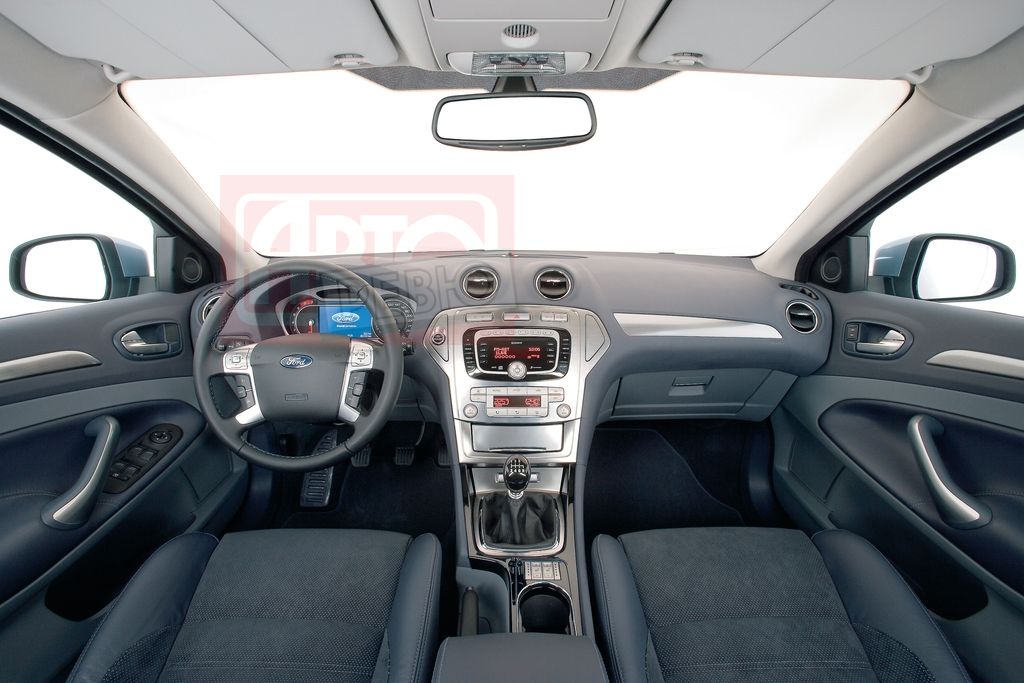 |
| The interior of the Titanium version (photo on the right) is the most stylish, and most importantly, it perfectly supports the mood set by the kinetic design of the exterior. The Titanium trim itself already implies quite rich equipment (including, for example, a large color monitor on the dashboard), and there is no point in decorating the car with other options: it has exactly what you need. And in no case be tempted by leather seats: compared to the "combined" ones (photo below), they hold the body so poorly in corners that it will not allow you to enjoy the excellent chassis settings of the Mondeo — the connection with the car is lost. The Mondeo in Ghia trim will cost almost the same as the Titanium, but this time Ghia is not a refinement, but bad manners, and the pseudo-wooden inserts here and there… For a Korean or American car it might still pass, but for a stylish Mondeo — it's completely unacceptable! In terms of dimensions, wheelbase, and most importantly, the amount of space in the cabin, including for rear passengers, the Ford Mondeo clearly outperforms many competitors in the D segment and can confidently play in a higher league — the E segment, at least in the "non-premium" subgroup | |
Coming to my senses, I forced a smile:
— You should have, Jens, you should have. Just not now, but six months ago: maybe I would have noticed something else, but I wouldn't have told anyone but you.
— And how do you like the new Mondeo overall?
— Undoubtedly, the best front-wheel-drive car in its class, I haven't had such pleasure from front-wheel drive in a long time.
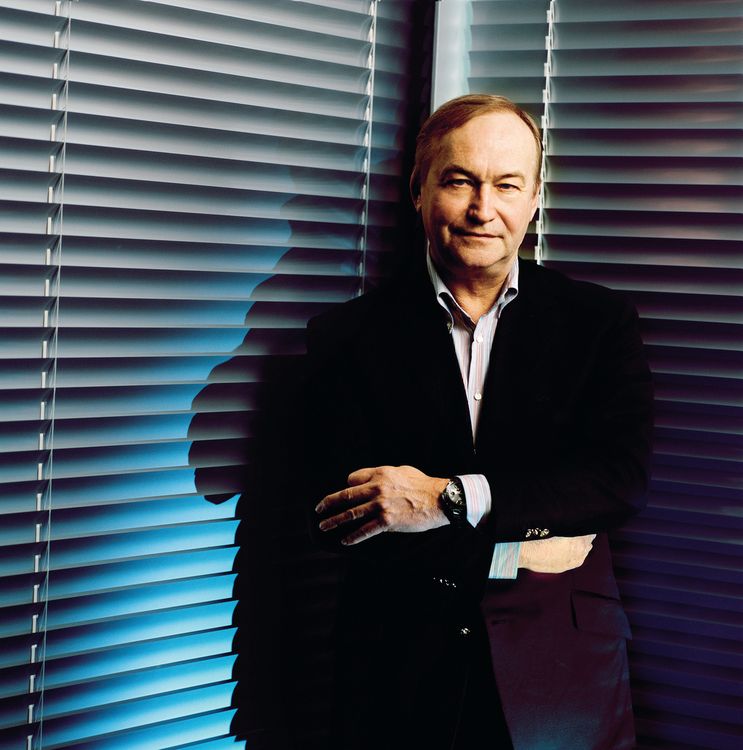 | Martin Smith is called the author and ideologist of kinetic design, which defined the appearance of Mondeo cars. When asked which of the three Mondeo body styles he likes most, Smith answers not immediately and uncertainly: "Maybe the hatchback…" And this is not feigned! Unlike Smith, many journalists liked the Mondeo wagon, but none of them said a bad word about the sedan or hatchback! There were no blunders. So the body type will most likely be chosen solely from practical considerations. There is also the "national factor." In France and Russia, sedans dominate in this segment, in Germany — wagons, and in England — hatchbacks |
This was no longer politeness, no apology for the recent prickliness.
The selection of cars in Sardinia was small, and what was even more annoying, the most relevant versions for Russia were not presented at all. Fortunately, all body styles were there — sedan, hatchback, and wagon, but there were only two engines: a Volvo 220-horsepower turbocharged petrol "five" (the fact of related borrowing did not prevent Ford from classifying this engine as their proprietary Duratec family), and also a two-liter 130-horsepower Duratorq turbodiesel (if you very loosely translate this as "bad torque," it will not be far from the truth). And that's all! There was neither the "entry-level" 1.6-liter petrol engine (125 hp), nor the two-liter (145 hp), nor the Mazda engine with a volume of 2.3 liters (161 hp). Although I am sure that in Russia it is the last two engines that will become the most in demand. And, of course, all the cars brought to Sardinia were stuffed to the brim.
Mondeo hatchback: emotions from first contact
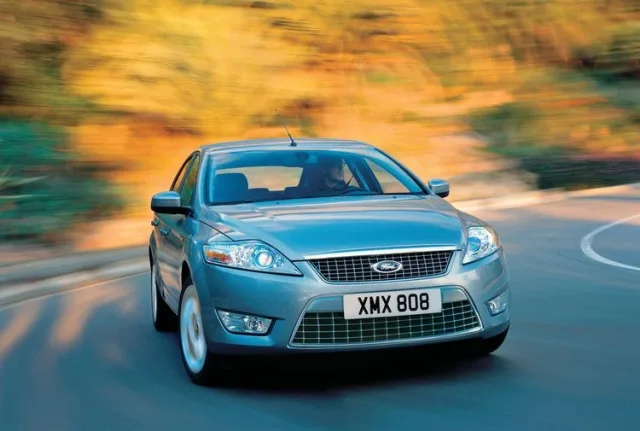
So, in front of me is a hatchback with a 220-horsepower turbo engine. The first thing that caught my eye when I looked into the cabin mirror was the narrow slit of visibility left by the heavily raked rear window. I immediately thought that parking would be a hassle. But as soon as the engine came to life, as soon as I moved off in first gear, shifted to second, then third… That's it! My critical mood instantly changed to pure delight — this is exactly what I love!
Tell me honestly, how often do you manage to get into an unfamiliar car and not make mistakes with braking or steering from the first meters? Have you ever, due to inexperience, stalled the engine, mixed up the gears, or released the clutch too abruptly? This has happened to me more than once, and I used to blame not myself, but the car's designers. So, driving the Mondeo, I didn't make a single mistake! My partner Vadim will confirm: I never made him jerk his head, never crunched the gearbox, never turned the steering wheel more than needed for the chosen trajectory. Moreover, on the serpentines, I never crossed out of my lane, although an inner voice was already screaming that the tires were about to break into a slide and I needed to pray that the oncoming lane was empty. An incredible feeling of complete unity with the car!
Of course, sometimes the corner turned out to be tighter than I expected, and the speed higher than the safe limit. At first, as a researcher, I relied on ESP. The system worked, but it wasn't the same! At the most thrilling moments, I lost the feeling that everything was under my control — the characteristic crunch of the stabilization spoiled everything. You can, of course, turn off ESP (a rare case — it turns off completely, with a single press), but I chose a different path: I started braking. And not before the corner, as any cautious driver would do, but already on the arc, trying to hold the desired trajectory. And each time a small miracle happened: the car under braking "turned in" exactly as much as I needed. Sometimes within the tire grip, sometimes with a slight drift of the rear axle. Everything soft, smooth, and comfortable. Not a single reproach!
The Mondeo is also very comfortable. I won't presume to judge how it will behave on Russian roads after our adaptation (the example with the Focus shows that surprises are possible), but on Sardinia... Only at the asphalt joints was there some stiffness, but that can be attributed to the 18-inch tires that were on our hatchback. Overall, the vibration-acoustic comfort is excellent. The steering wheel is "clean," almost without vibrations from the road, but at the same time exemplary informative. Interestingly, unlike the related minivans S-MAX and Galaxy, they kept a hydraulic power steering here, not an electric one. They say it's for better feedback, although there is an opinion that it was decided for packaging reasons. There are no vibrations on the gear lever either — thanks to the cable drive. No trembling on the floor. Even at speeds of 180–200 km/h, no aerodynamic noises are heard, the engine sounds soft, even when the tachometer needle approaches 7000 rpm, and the tires don't annoy with their hissing...
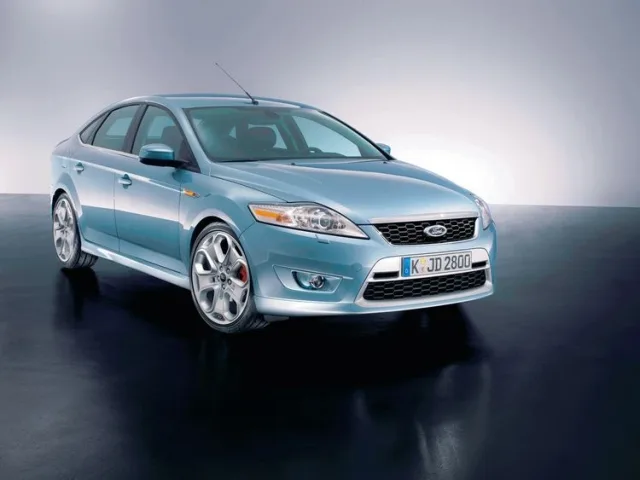
The share of "ordinary" cars in the D segment is falling both in Western Europe and in Russia. The way out is to move closer to the so-called premium segment of the class, where the BMW 3 Series, Mercedes C-Class, and Audi A4 dominate. That is, to offer not only a practical car but also a status symbol. And although the new Mondeo is still far from being a "status" car, the desire to gain membership in the elite club is evident. More precisely, on the face. The Mondeo looks no less respectable than the Audi A4. You can feel that it was the target of marketers and designers. It remains to consolidate this equality in the minds of buyers, which may take years, not to mention the millions spent on "repositioning"
The car is integral and organic. Gentle. One can only regret that the increased wheelbase (which is what allowed improving ride comfort and rear seat space) led to a decrease in maneuverability — because the steering angle of the front wheels of a front-wheel-drive car is limited by the "flexibility" of the constant velocity joints. Because of this, I experienced a few unpleasant moments. Having missed the right turn, I decided to turn around, but, contrary to expectations, the Mondeo couldn't do it in one go. I had to reverse, and a truck was bearing down on me... Thank God we passed.
Wagon: Beauty and Electronics
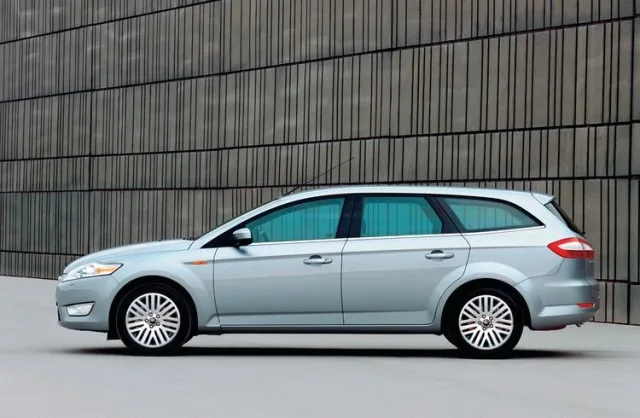
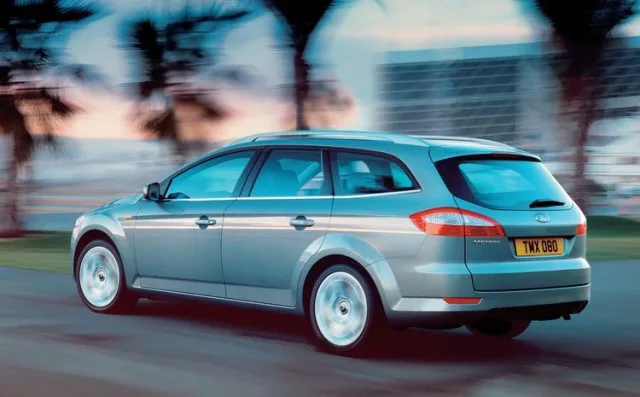
The hatchback is beautiful. But the wagon is even more beautiful. And it has nothing in common with that utilitarian Mondeo estate I drove a couple of years ago. Moreover, the trunk, contrary to the visual impression, has even become 30 liters larger. And let them say that the Passat wagon is more spacious! I parked the Mondeo next to the Passat: the Beauty and the Beast!
The wagon had a diesel engine. Western European colleagues, who have long switched to diesel, liked the engine. But I didn't. At least, the common claim that there's no difference between petrol and diesel doesn't work here. You can feel it! Vibrations, a rather narrow torque range... What interests me more is that the wagon was equipped with almost all the electronic-mechanical systems from the options list, which my colleague Yuri Vetrov described in detail in the previous issue of Autoreview.
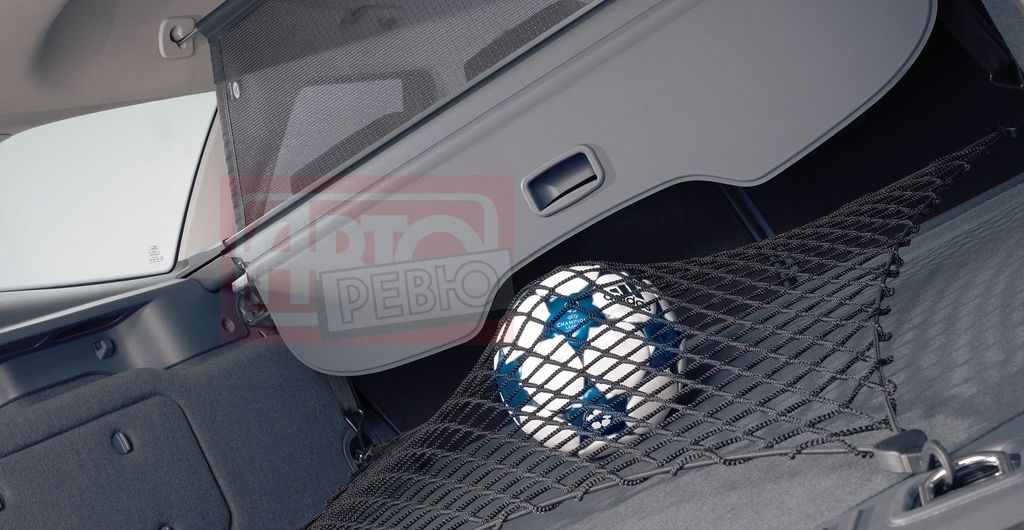 | ||
| In expensive Ghia and Titanium versions (pictured) there are additional air ducts designed to improve the microclimate in the rear seats | The sunroof is one of those pleasant but useless options. And it eats up headroom | You can secure things much heavier than a ball to the powerful hinges in the trunk |
Let's start with "keyless" access. Everything is as usual: the key stays in your pocket, the car opens itself, the engine starts with a button. Convenient, but perhaps not worth $700. I pressed the button — and the diesel started chattering. If it had been cold, I would have had to wait for the glow plugs to warm the air.
Now about the hill-start assist system — I had just stopped on an incline. First gear, I smoothly release the clutch, the car moves slightly and... stalls. Apparently, the system was holding the brakes too diligently and released them too late. Or I didn't add enough gas. Second attempt. The engine didn't stall, but I started with a jerk, like a novice. And why do I need this when the gas, clutch, and brake controls are already perfectly tuned? Ah, for the ladies? Then tell them once how to hold the car with the "handbrake" if they don't feel the clutch or don't understand why it's needed! Of course, $105 is not serious, but I don't need such an option even for free. At least on the Mondeo.
Let's go. Same roads, same corners... But something in our unity was broken, a false note appeared. Although the Mondeo wagon still does everything right: flawless steering, precise reactions, and body roll, despite the massiveness and higher center of gravity, has even become less. But that delightful, predictable elasticity that the hatchback conquered me with is no longer there. Why? It turns out it's about another electronic-mechanical option — a system that changes the shock absorber resistance every 0.2 seconds. And also a system that keeps the rear of the wagon at one level regardless of load. And here it is — a small, barely noticeable, but false note. Unnatural. And there's another "subsystem": in an inconvenient zone in front of the gear lever, there are three rectangular buttons. If you look closely, you can make out the inscriptions: Comfort, Normal, and Sport. Understood! Since there are electronically adjustable shock absorbers, it would be a sin not to give the owner the opportunity to play with three cars — soft, normal, and stiff. I play around, reaching my palm around the lever. Yes, the ride smoothness changes slightly. The body roll changes too. But, honestly, change the 16-inch tires to 17- or 18-inch ones — and the difference will be more noticeable. Why all this when there's such a magnificent "bare" chassis? Especially since for all this — almost $2000? I wouldn't take it even for $20.
— We debated this at length with our specialists. Some of them insisted that the Comfort mode should make the car similar to American or French ones, in Normal it would remain neutral, and in Sport it would resemble a Porsche. But in the end, we agreed that all three modes should preserve that very "Mondeo feeling," — says the same Ludmann.
Oh no. Excuse me, but this is pure profanation — "varying the stiffness of the Mondeo within the Mondeo." Although, if you think about it, why not squeeze another couple of thousand dollars out of a client who bought a Mondeo and asked for "the maximum"? Marketing.
And the adaptive cruise control made me laugh outright — we were proudly told that it would also be available to Russian buyers. Not needed! Not needed at all! This expensive toy could do more harm than good. Of course, the winding roads of Sardinia are not the best testing ground for such an "autobahn" function, but I still tried it. Just out of interest. A madhouse! On a straight road, it's tolerable. When it detects a car ahead and realizes the distance is dangerously closing, the system emits a sound signal and brakes the car itself. It's funny, but it's annoying: this thing constantly interferes in the process, either adding gas or slowing the car, and not always at the right moment or with the intensity I'd like. And as soon as you shift gears, everything turns off, except for the sound warning about approaching: you have to press the buttons on the steering wheel again. I understand that my actions take priority, and the system only insures against mistakes. But irritation builds up with every minute. And if there's a corner ahead... I see a car, and as usual, the driver slows down before the bend. Gritting my teeth, I do nothing — as if I've dozed off. And here's my Mondeo, when there are about ten to fifteen meters to the leader, starts braking. But as soon as it enters the corner, the Mondeo not only releases the brakes but also adds gas. Traitor! I, trusting it, decided to take a nap! There was only about half a meter left to the guardrail...
— You yourself understand that the system is not for such roads, — Ludmann instructs. — I, for example, drove on Swiss autobahns, and there everything worked perfectly, especially since in Switzerland, unlike Germany, the speed is limited. You set the limit to 120 or 130 km/h and drive calmly, actively intervening only before the needed exit. Very comfortable.
Let's say. Maybe Ludmann was comfortable (though I doubt it), but I don't get along with these cruise controls — whether radar-based or regular. Not my cruise. And it's not just words: for several years I drove an Audi Allroad, which also had cruise control, though without radar. I tried it a couple of times — and gave up. Although the Allroad, unlike the Mondeo, had an automatic transmission, and I didn't need to reactivate the system every time I changed, say, from sixth to fifth on an incline. There's also cruise control on the Porsche 911. I tried it too — and also spat on it. Maybe in Switzerland I would use it, but not in Russia with its chaotic traffic. So thanks, but no thanks. Especially for almost 2000 dollars.
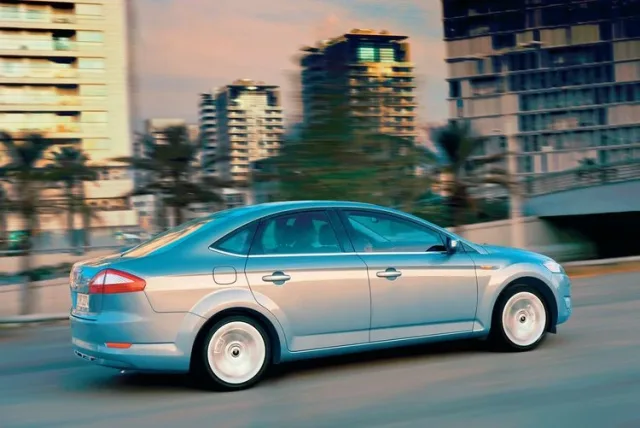
We're done with the wagon. Now the sedan, which is so loved here. This one came with a petrol turbo engine and in the expensive Ghia trim. Oh, those leather seats, the steering wheel one-third trimmed with wood, wood-polished inserts here and there... One thing is bad: all this has nothing to do with the kinetic design of the Mondeo! And it's not even about the price (a Mondeo Ghia sedan with such an engine costs $37,700) — it's surprisingly cheap, philistine kitsch. The sedan drives just as well as the hatchback, plus there's now proper visibility through the rear window, but the thrill is completely gone. And not only because of offended aesthetic feelings: in the leather seats, almost without lateral support (by the way, another 2000 dollars extra), I started being thrown from side to side, and I stopped feeling the car. No, this is not the Mondeo.
And which one is "the one"? I think "the one" Mondeo should be with the Mazda engine of 2.3 liters, with a manual gearbox (it's with this engine, as well as with the two-liter diesel, that you can order a six-speed automatic) and in the expensive but impeccably stylish Titanium version — even the name is consonant with the kinetic spirit of the car! Such a car costs $32,750 (sedan). And no need for any "gadgets," no cruise, damping, or other controls! Well, maybe pay an extra $399 for a Bluetooth-based "communicator" so as not to be distracted by the phone. And if you have about three thousand dollars left, you can take the same Titanium, but with the 220-horsepower Volvo engine. And on that, you can safely put a full stop, knowing that you have the best front-wheel-drive car in its class. Even two classes — D and E: the Mondeo can easily compete with the Toyota Camry or Nissan Teana. We'll compare soon.
And for now — a low bow to chief designer Martin Smith. No, not for the vulgar-philistine Ghia version, but for the Titanium and the brilliantly realized idea of kinetic design in all three body styles. A deep bow — to Jens Ludmann. Not for the adaptive cruise control and other marketing-electronic gadgets in the spirit of Nokia and SonyEricsson phones, but for the stunning chassis that gives that rare and therefore so valuable feeling of unity. At least with the car. And also — thanks to the seagull. For the fact that — I believe! — it remained alive and unharmed. And for the fact that it tore from me a frantic scream of fear and hope. I understood: it was catharsis. That which helps restore the shaken harmony with oneself, the world, and the people dear to me.
| Technical specifications | ||||||
| Parameters | Vehicle | |||||
| Ford Mondeo | ||||||
| Modification | 1.6 L | 2.0 L | 2.3 L | 2.5 L | 2.0 L TDCi (130 hp) | 2.0 L TDCi (140 hp) |
| Body type | sedan | sedan | sedan | sedan | sedan | sedan |
| Number of seats | 5 | 5 | 5 | 5 | 5 | 5 |
| Trunk volume, L | 493* | 493* | 493* | 493* | 493* | 493* |
| Curb weight, kg | 1360 | 1402 | 1466 | 1492 | 1503 | 1481 |
| Gross weight, kg | 2050 | 2090 | 2165 | 2185 | 2190 | 2170 |
| Engine | petrol, with distributed fuel injection | petrol, turbocharged | diesel, turbocharged | |||
| Location | front, transverse | front, transverse | front, transverse | front, transverse | front, transverse | front, transverse |
| Number and arrangement of cylinders | 4, in-line | 4, in-line | 4, in-line | 5, in-line | 4, in-line | 4, in-line |
| Number of valves | 16 | 16 | 16 | 20 | 16 | 16 |
| Displacement, cm³ | 1596 | 1999 | 2261 | 2521 | 1997 | 1997 |
| Cylinder bore/piston stroke, mm | 79.0/81.4 | 87.5/83.1 | 87.5/94.0 | 83.0/93.2 | 85.0/88.0 | 85.0/88.0 |
| Compression ratio | 11.0:1 | 10.8:1 | 10.6:1 | 9.0:1 | 17.9:1 | 17.9:1 |
| Max power, hp/kW/rpm | 110/81/6300 (125/92/6300)** | 145/107/6000 | 161/118/6500 | 220/162/5000 | 130/96/4000 | 140/103/4000 |
| Max torque, Nm/rpm | 160/4100 (160/4100)** | 185/4500 | 208/4200 | 320/1500—4800 | 320 (340)***/1750—2240 | 320 (340)***/1750—2240 |
| Drive | front-wheel | front-wheel | front-wheel | front-wheel | front-wheel | front-wheel |
| Gearbox | 5-speed manual | 6-speed automatic | 6-speed manual | 6-speed automatic | 6-speed manual | |
| Front suspension | independent, coil spring, McPherson, with stabilizer | |||||
| Rear suspension | independent, coil spring, multi-link, with stabilizer | |||||
| Front brakes | disc, ventilated | disc, ventilated | disc, ventilated | disc, ventilated | disc, ventilated | disc, ventilated |
| Front disc diameter, mm | 300 | 300 | 300 | 300 | 300 | 300 |
| Rear brakes | disc | disc | disc | disc | disc | disc |
| Rear disc diameter, mm | 302 | 302 | 302 | 302 | 302 | 302 |
| Tires | 205/55 R16 (optional 215/55 R16, 235/45 R17, 235/40 R18) | |||||
| Maximum speed, km/h | 190 (195)** | 210 | n/a**** | 245 | 200 | 210 |
| Acceleration time 0—100 km/h, s | 12.7 (12.3)** | 9.9 | n/a | 7.5 | 10.9 | 9.5 |
| Fuel consumption, L/100 km | ||||||
| urban cycle | 10.0 (10.3)** | 11.2 | n/a | 13.6 | 9.8 | 7.6 |
| extra-urban cycle | 5.6 (5.7)** | 6.0 | n/a | 6.8 | 5.6 | 4.9 |
| combined cycle | 7.2 (7.4)** | 7.9 | n/a | 9.3 | 7.1 | 5.9 |
| Fuel tank capacity, L | 70 | 70 | 70 | 70 | 70 | 70 |
| * With full-size spare wheel | ||||||
| ** Data in parentheses — for the 125 hp version | ||||||
| *** Briefly, in overboost mode | ||||||
| **** N/a — no data | ||||||