
Ford Kuga. Wonders of Kinetics

Appearance has always played a decisive role in making people want to buy a car. A car must be memorable and desirable. Guided by this principle, Ford confidently stepped into an uncharted niche for itself - compact crossovers.
How it all began
The starting point was the S-Max. More precisely, its precursor - the SAV concept, which opened a new era in the brand's design. By putting Ford of Europe's chief designer Martin Smith at the helm of the kinetic style direction, the company achieved the desired effect: the entire European Ford lineup literally breathed freshness. Galaxy, Mondeo, Focus... and even the utilitarian Ranger did not go unnoticed - it was also tidied up. The new style, or, as the 'Ford guys' themselves call it, the new design language, became common to the entire range. While most models simply underwent plastic surgery, the Kuga was created from scratch. Although, wait, not quite from scratch...
Ready-made solutions
In any refrigerator, it's useful to keep a supply of dumplings - at the right moment, you can quickly boil or fry them, and there you have a hot dinner on the table. The main thing is speed. For Ford, the role of such semi-finished products is played by the universal C-1 platform. Practical and convenient. Many models have already been produced on it, not only with the Ford emblem, but also Mazda, and even Volvo. What did you think? In the modern pace, automakers have to use ready-made solutions, especially in the budget segment, otherwise the project will drag on or become too expensive. This approach is also beneficial for the buyer: the design is time-tested, and the price is more affordable. Taking the C-1 platform as a base, the 'Ford guys' got to work.
The compact crossover market is overcrowded today, so to attract a buyer, the Kuga had to stand out. The main audience of 'urban SUVs' chooses with their eyes. They care more about external resemblance to real SUVs and loud words like 'all-wheel drive' or 'large ground clearance' than real capabilities. And for a Russian driver, the word 'jeep' is more of a status: the car is big and tall, everyone respects it and gives way. No money for a huge body-on-frame SUV? Then a crossover is your choice.

The Ford Kuga is perhaps the brightest in its class: an aggressive rear, sculpted sides, and a massive front end. It seems that it is the one that came closest to its older brothers with the 4×4 formula. Brutal but smooth, swift but not floating - this is not Japanese unisex or German restraint, this is pure kinetic design. Competitors are knocked out; they can only admit defeat. Yes, the designers did not lose face, or rather, did not sell the Kuga short.
What's inside
The Kuga can hide its kinship with the rest of the Ford Motor Co family, but only for a while. After admiring the exterior, we press 'unlock' on the key fob and open the door. Inside - the interior of the good old family man C-Max! We step back - Ford Kuga. Open the door again - C-Max. No miracle. And it all started so promisingly - here are your semi-finished products!
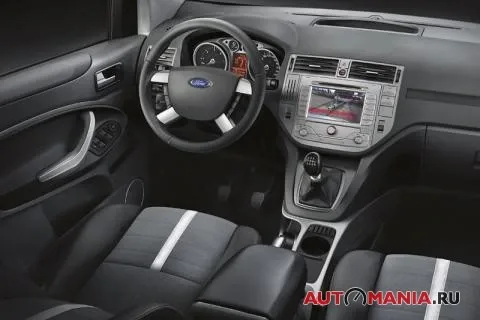
The interior is full of contradictions. It is practical, sometimes comfortable, but somehow unfinished. It seems that after the designers finished the exterior, a big boss came to them and demanded they speed up. Poor engineers hastily assembled something - and it went into production. It's better not to touch the buttons on the center console. And there's not much to look at - everything is in the spirit of inexpensive music centers, even the Sony inscription is present. But as soon as you try to change the temperature or lower the volume, your fingers start slipping on the uncomfortable knobs. The instrument panel is not bad and reads easily, but with some Asian tint. The steering wheel is very comfortable, but why were the cruise control buttons placed in the most prominent place, while the radio controls, which you use more often, are hidden? And the washer can't be turned on the first time. With a habitual movement, you pull the steering column lever toward you and are surprised to hear rustling behind you. Everything is the opposite, just like a looking glass!
At the back, there is a small but pleasant bonus: a 220V outlet. Laptop owners will appreciate it. And also at the back, under the mat, a nice hiding place is hidden (I didn't tell you that!). According to the engineers' plan, a repair kit for RunFlat tires should lie there.
The trunk of the Ford Kuga is multifunctional. Firstly, it can easily fit a week's supply of groceries from the supermarket - the volume of 360 liters allows it. If desired, you can fold the second row of seats fully or partially, but long items cannot be transported - the front passenger seat does not fold. And secondly, the heavy tailgate is an excellent exercise machine for your arms! If every morning, while the car warms up, you open and close the fifth door, you will soon have biceps.
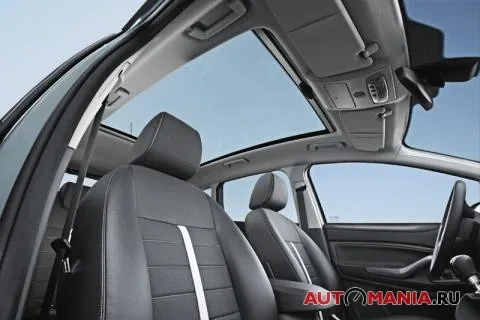
The most pleasant thing in the Ford Kuga's interior is the panoramic roof! Regular sunroofs are gradually dying out, like dinosaurs. An impractical atavism. Driving with an open sunroof at speed is uncomfortable, and why? Want some coolness? But most modern cars have climate control or at least air conditioning. And panoramic glazing is really great. A roof that is two-thirds glass creates a special atmosphere. And even if this observatory will draw out heat in frosts, you can always count the stars.
Time to go
Swedes make excellent engines. Especially good is the inline 'five' from Volvo with a volume of 2.5 liters with turbocharging. Taking advantage of family ties, Ford has long and successfully used this engine. Mondeo, Focus ST, now also Kuga. For it, the Swedish 'semi-finished product' was slightly throttled, reducing power to 200 hp, which is quite enough for the heavy crossover.
Finally seated, I try to start the beast under the hood, but instead of the ignition lock, I find only a plug. In the center of the instrument panel, a 'FordPower' button is hidden - oh, these marketers! Let's start...
Wow, what a sound! It feels like under the hood is not a 2.5-liter unit, but a full-fledged V8. You just want to quickly move the automatic transmission lever to 'Drive'. Another hit: a dynamic engine, a torque converter from Aisin, which performed excellently on heavy Mondeo - and the notorious kinetic design gains movement. The dynamics match the appearance. The first 2-liter diesel for the Ford Kuga could not do that, even though it was equipped with a 6-speed manual.
The suspension matches the powertrain. Assembled and very dense, it confidently swallows both small cracks and large potholes. But a series of road irregularities is harder. The Kuga starts jumping like a basketball, and passengers shake like plastic dogs on a taxi dashboard - you'd think their heads will fall off. Stability returns only when you release the 'gas'.
The steering is typically 'Ford-like', artificial. Even despite three sensitivity modes (standard, sport, and comfort), the steering character barely changes. But driving the Ford Kuga is still pleasant. The steering wheel is no better than competitors', but no worse - an ordinary crossover.
The 4×4 formula in the Kuga is implemented through the well-known Haldex coupling. In good weather on dry asphalt, your Kuga is an ordinary front-wheel-drive city dweller, and in a critical situation, the electromagnet 'transfers' part of the torque to the rear axle. But the Kuga can only seem like a jeep, because its all-wheel drive is strangled by electronics from all sides. ESP, ABS, Traction Control - in the city this helps, but in the forest it does a disservice. It's foolish to try to test the off-road capabilities of a crossover. Once on slippery ground, the Kuga will start spinning helplessly, and you'll think about the nearest sober tractor driver. The strict ESP quite roughly strangles the engine exactly at the moment when it seems you could get out with a slight wheelspin, and when pressing the brake, ABS turns the braking distance into a long ski track. Surprised? In vain, because the natural habitat of the Ford Kuga is the city, where it won't let you down.

Conclusions
The Ford Kuga is a car that sells an image. Its main task is to create the right impression. In the company of friends over evening beer, you can casually drop: my Kuga has all-wheel drive, the engine is borrowed from the Focus ST, and the stability control can be turned off if desired. Your interlocutors can only nod approvingly. In city traffic, this car will definitely not go unnoticed - even in a gray everyday crowd, the Kuga attracts glances. But the more interesting this car is, the more internal contradictions it has. Stylish appearance coexists with dull gray plastic on the dashboard, which looks frankly cheap. The starting price of the 'city conqueror' is 1,099,900 rubles for a two-liter diesel with a six-speed manual. If you choose a gasoline engine and an automatic, you'll have to pay 1,189,900 rubles. Is the car worth more than a million? The question is what exactly you are paying for. For the reaction of others: 'Wow, what an SUV you have!'. For the opportunity to answer with dignity: 'Yes, and under the hood is 2.5 liters, 200 horses'. For a feeling of confidence behind the wheel, because you have a jeep, albeit nominal. However, no one around guesses about this convention. The main thing is the effect produced; that's what you pay money for.
Nikita Vasilyonok
Technical specifications
| Length, mm | 4 443 | |||
| Width, mm | 1 842 | |||
| Height, mm | 1 710 | |||
| Wheelbase, mm | 2 690 | |||
| Ground clearance, mm | 188 | |||
| Curb weight, kg | 2 130 | |||
| Trunk volume (l) | 360–1 405 | |||
| Fuel type | Petrol | |||
| Engine displacement, cc | 2 523 | |||
| Turbocharging | yes | |||
| Max. Power, hp |
200/6 000 | |||
| Max. torque, Nm |
320/4 800 | |||
| Max. Speed, km/h | 205 | |||
| Acceleration time (0-100 km/h) s | 8.8 | |||
| Average consumption (l) |
10.3 | |||
| Price, RUB |
From 1 099 900 | |||
Source – AUTOMANIA.RU