
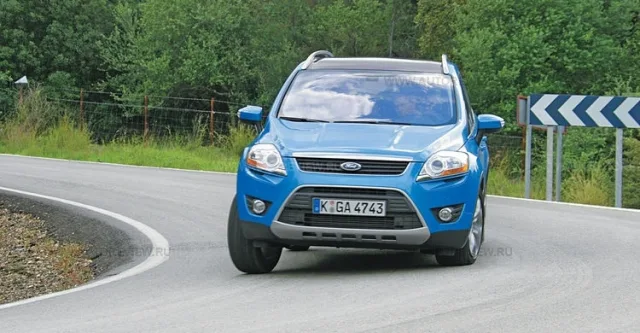
Kuga glides silently along Spanish roads — smoothly and gracefully, like a cat on soft paws. And its name suits it: it echoes Cougar, that Ford coupe. True, the word Kuga is not in dictionaries — it was invented specially, just like the car itself. After all, Ford of Europe is just beginning to master the compact crossover genre.
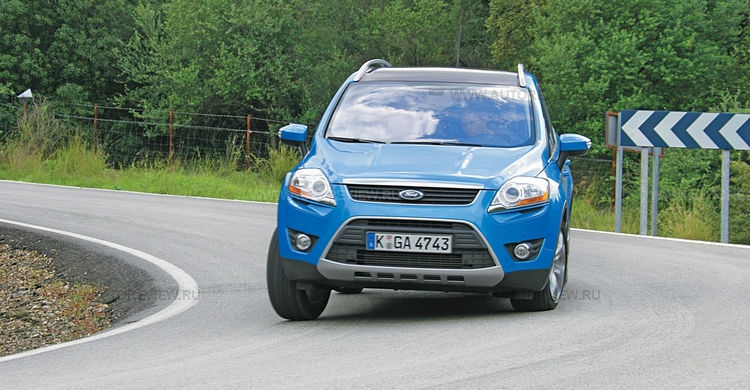
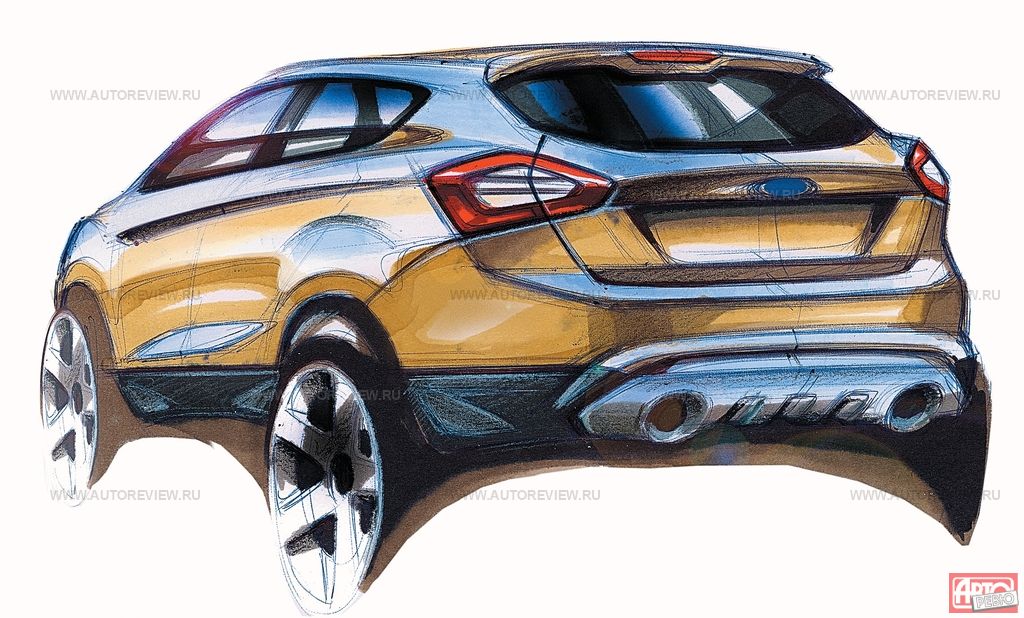 Crossover SUVs are now at the peak of popularity in Europe. Judge for yourself: the most sought-after Nissan in the Old World is not the little Micra or the practical Note, but the Qashqai! As for Ford... The attempt to sell the "American" Maverick here, essentially a rebadged Mazda Tribute, was not successful. So three years ago, Ford's people took up developing their own European crossover.
Kuga is the first Ford created under the full leadership of chief designer Martin Smith and exterior specialist Stefan Lamm, who moved from Opel in 2005.
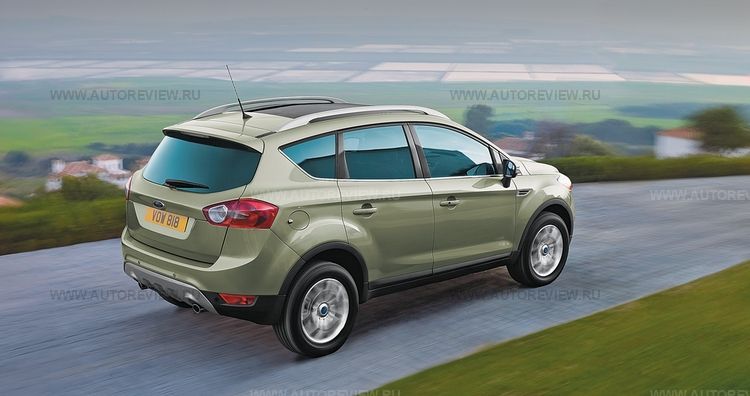
And the little cat turned out to be well-built! An expressive face with the signature Ford grin, lean flanks, a daring beltline... The only thing that seems a bit heavy is the rear with its diffuser imitation. But the fake air intakes under the headlights and on the fenders, as well as two muscular longitudinal stampings on the hood in the style of Mercedes roadsters — that's sportily lively!
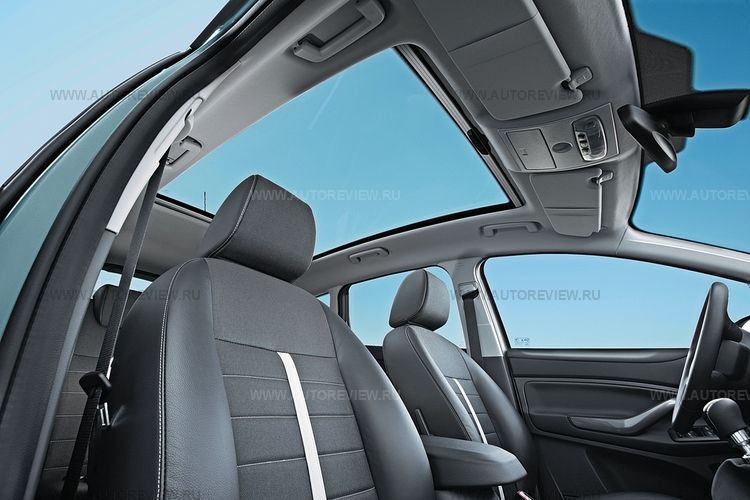
The glass roof for 24,700 rubles is available only in combination with the heated windshield, which is another 5,800 rubles
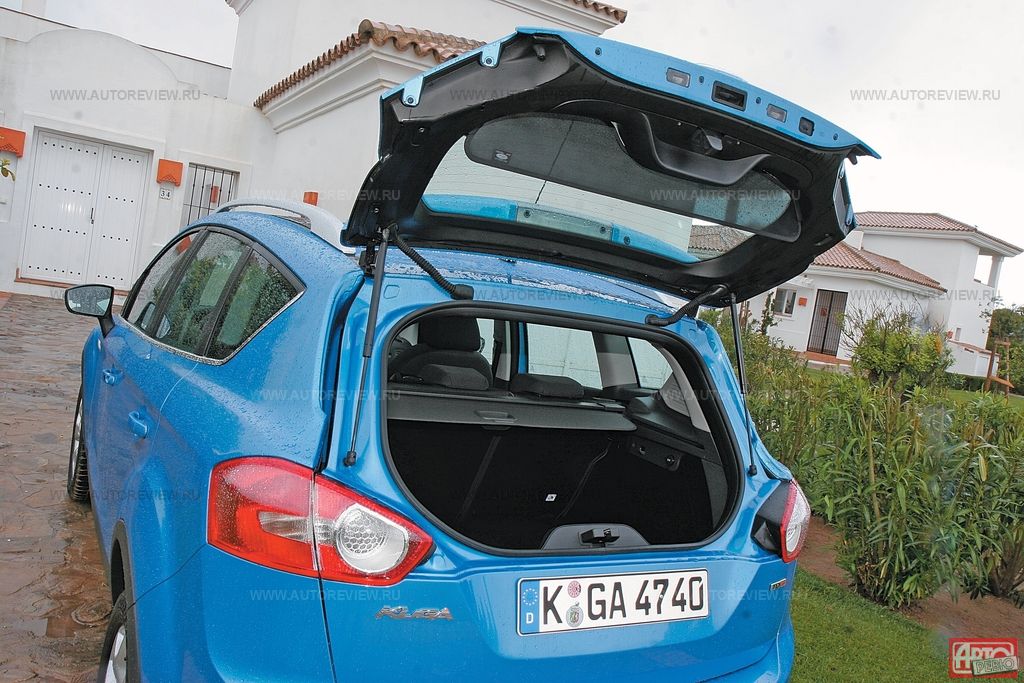
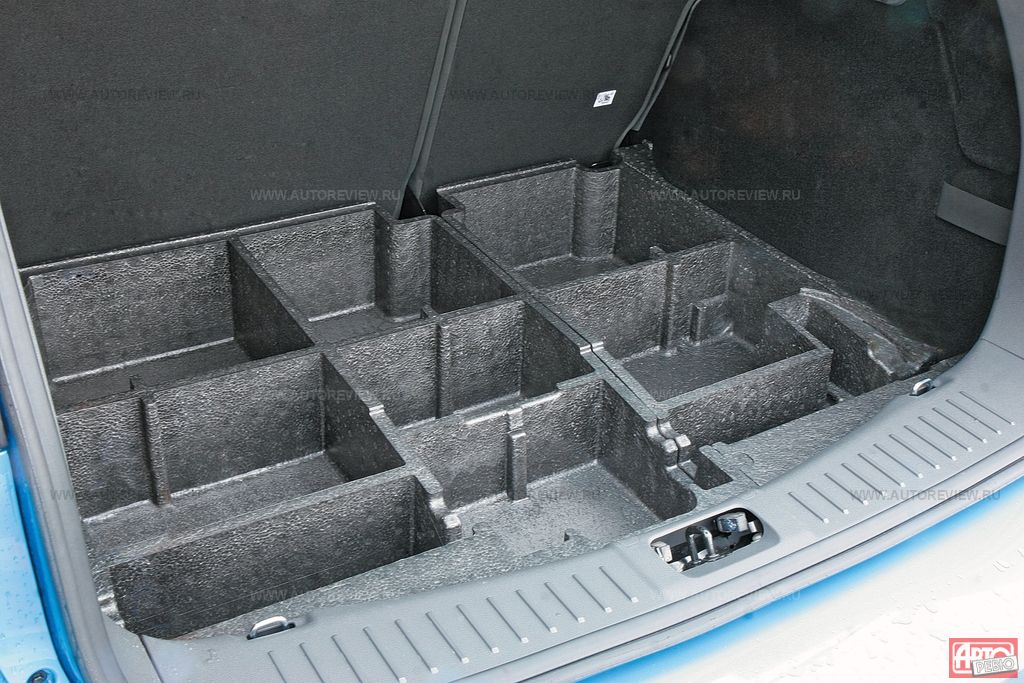
In terms of size, the Ford Kuga is close to the Volkswagen Tiguan and Toyota RAV4, but in wheelbase length it surpasses the Mitsubishi Outlander XL! So passengers should have plenty of room, right? And indeed: with my height of 176 cm, there was no less than 15 cm from my knees to the rigid folding table on the back of the front seat! It's just a pity that the rear "sofa" cannot be slid longitudinally. True, the volume of the not-so-large 360-liter trunk can still be increased by 50 liters if you take a repair kit instead of a space-saver spare. But the upper section of the fifth door opens separately — it's more convenient for loading grocery bags, especially in tight parking lots.
And behind the wheel, the C-MAX compact van is immediately recognizable. The same high seating position in comfortable seats, a "grippy" steering wheel, a soft lid on the armrest box, a Z-shaped "handbrake"... But the door trim now has a convenient recess for the elbow, and the front panel has acquired a silver shield for the entertainment center and a niche for small items. The instruments, albeit without an HMI display, have moved here from the new Mondeo.
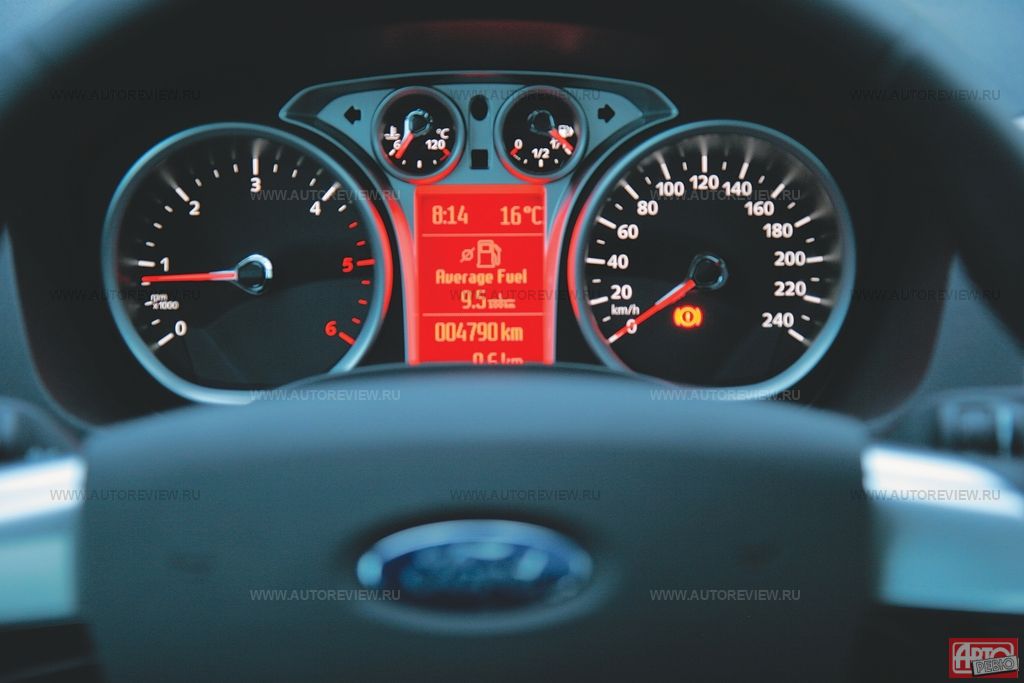 | 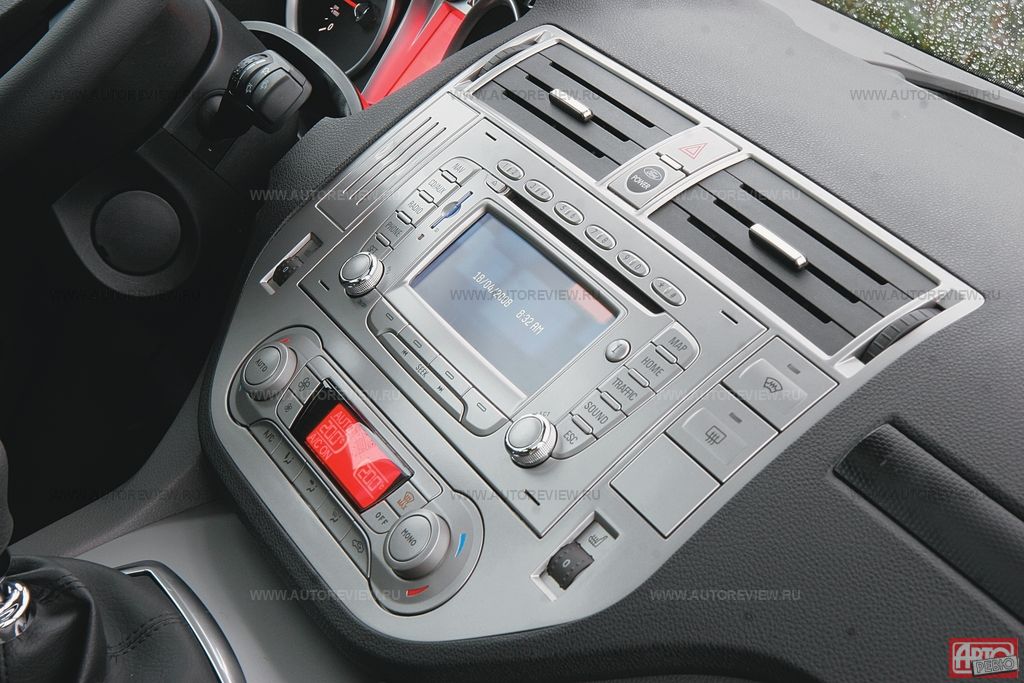 |
| The instrument needles are decorative, but the scales are easy to read | Dual-zone climate control — only for expensive versions |
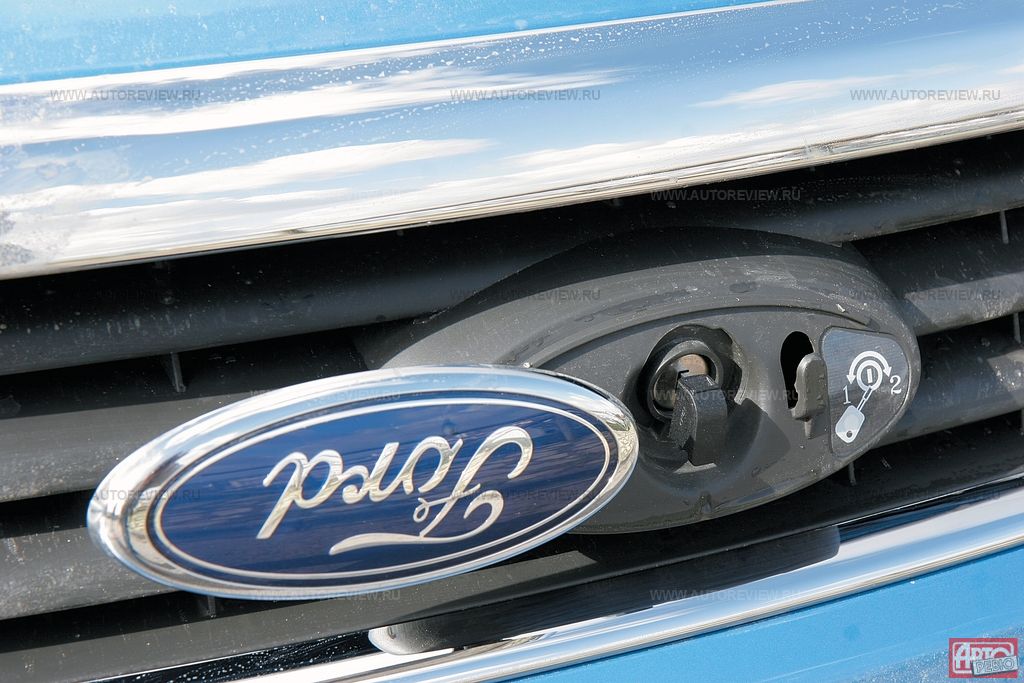 | 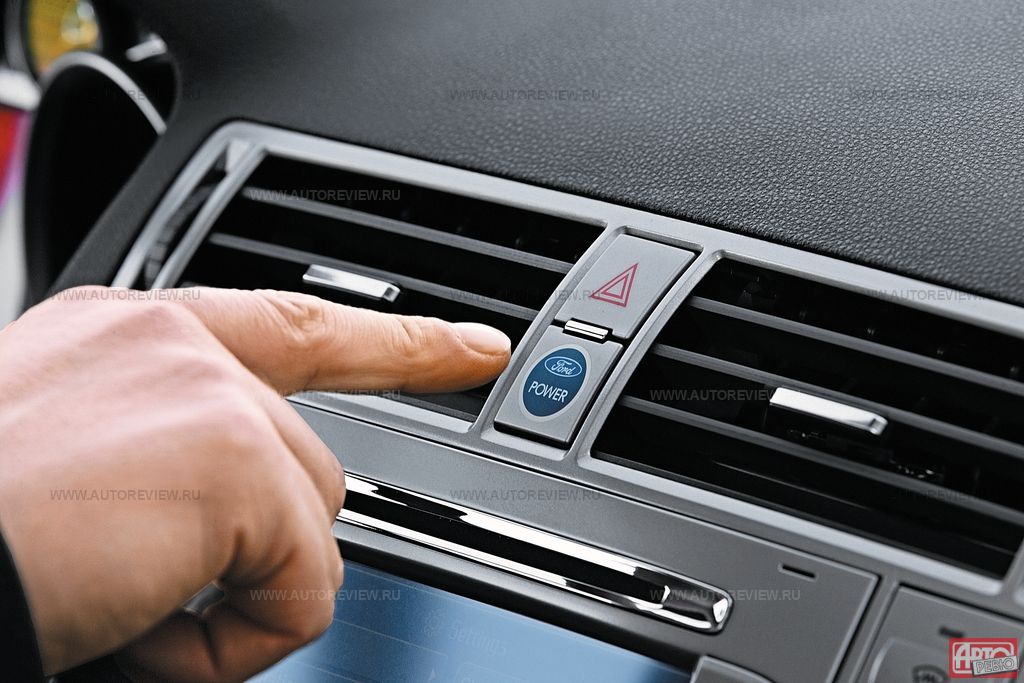 |
| Why do you need a "regular" key if the engine starts with a button? To open the hood! | |
From Jerez airport, I head along the highway into the mountains. I drive softly, smoothly... During quick lane changes, the Kuga first reluctantly, like a sleepy cat, stretches toward the adjacent lane, and then, as if waking up, sharply darts there — like at prey. It seems the rear multi-link suspension is "working" this way.
To the right is the Formula 1 track, where in 1997 Michael Schumacher tried to knock Jacques Villeneuve out in the title fight. But I, alas, am not going there. Instead, ahead is a mountain serpentine...
The Kuga is good here too: on corner entry, it slightly slides its front end, on throttle lift-off it goes into a smooth drift, the light steering wheel clearly conveys information about lateral forces, and the stability control system activates "just in time" — in response to a counter-steer. And yet, I didn't feel that pharmacist-like precision of reactions that the Volkswagen Tiguan delighted me with on the winding Hungarian roads.
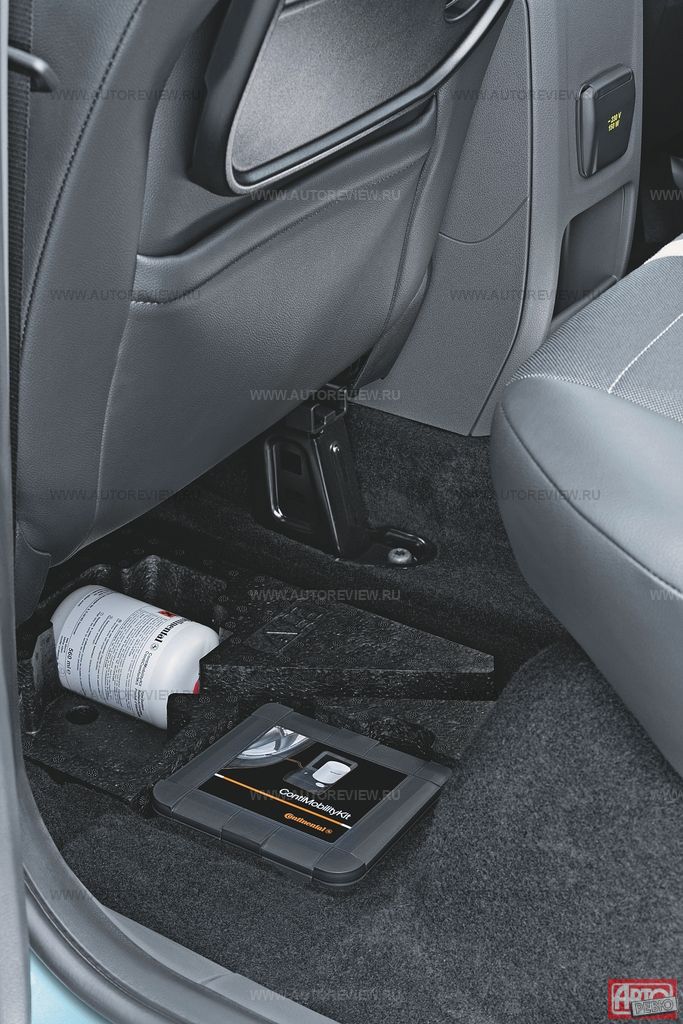 | 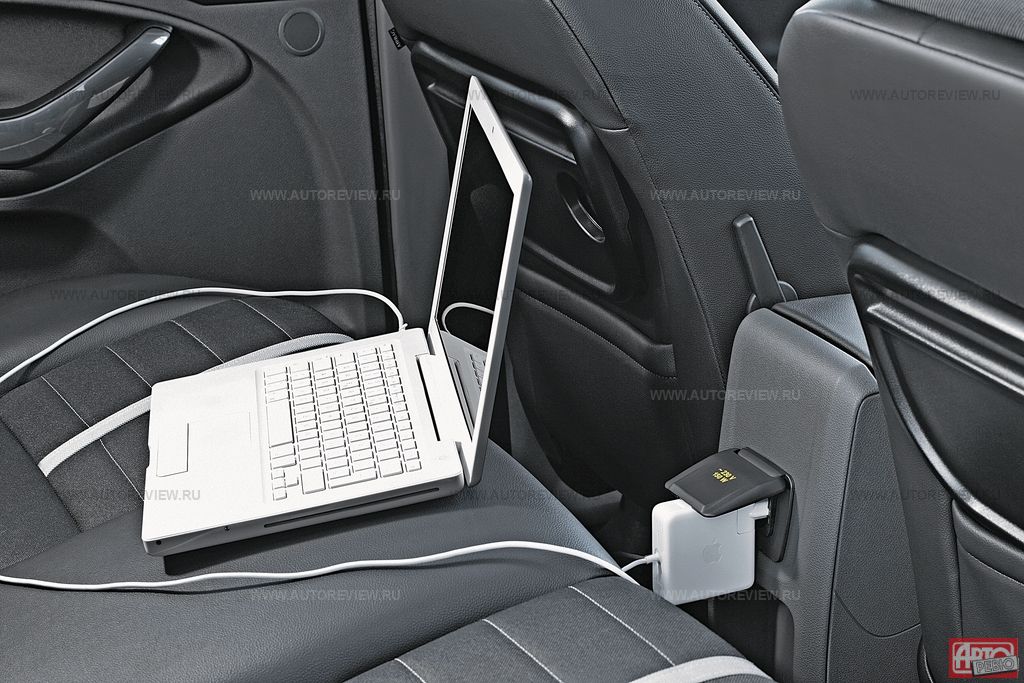 | 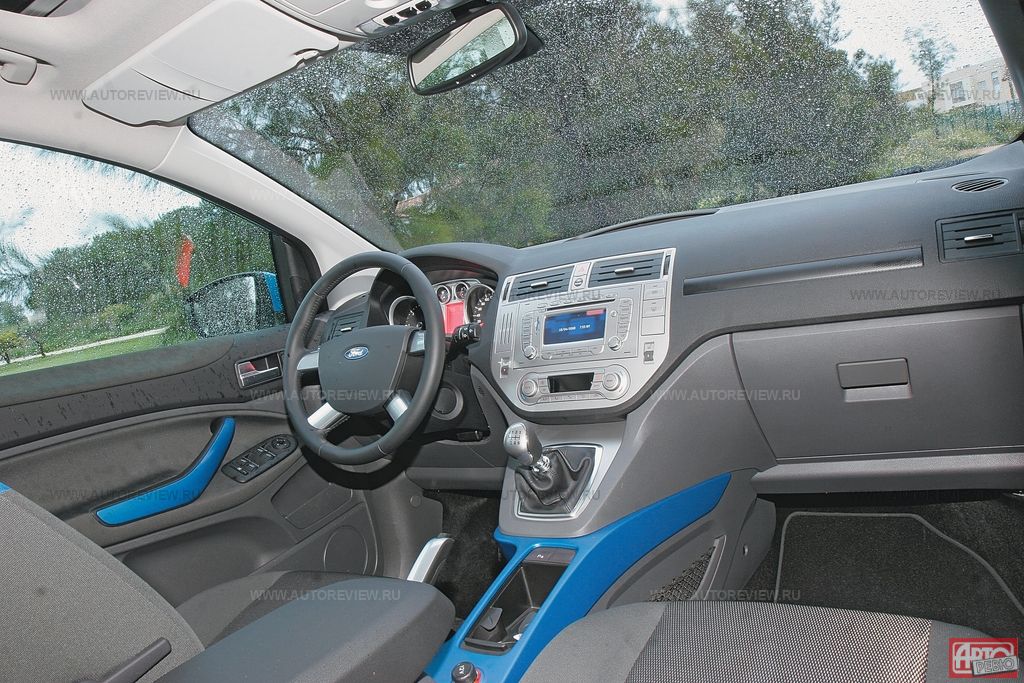 |
| Tire sealant and compressor are hidden in a niche behind the driver's seat | For an extra 3,900 rubles, the Kuga can be equipped with a 220-volt outlet at 150 watts | The interior of the Trend version with colored plastic (blue or orange) resembles a children's room: men will most likely prefer the Titanium, where the inserts are painted to look like "silver" or dark marble |
And also...
— Look what it's doing! — exclaimed my colleague from Avtosport magazine, Valery Arutin, showing the just-shot footage. I was "posing" behind the wheel in the corner, and everything that happened with the car seemed quite ordinary to me. But in the photos, you can see: the Kuga hardly rolls, and the most interesting thing is that it slightly rises, as if on an invisible jack!
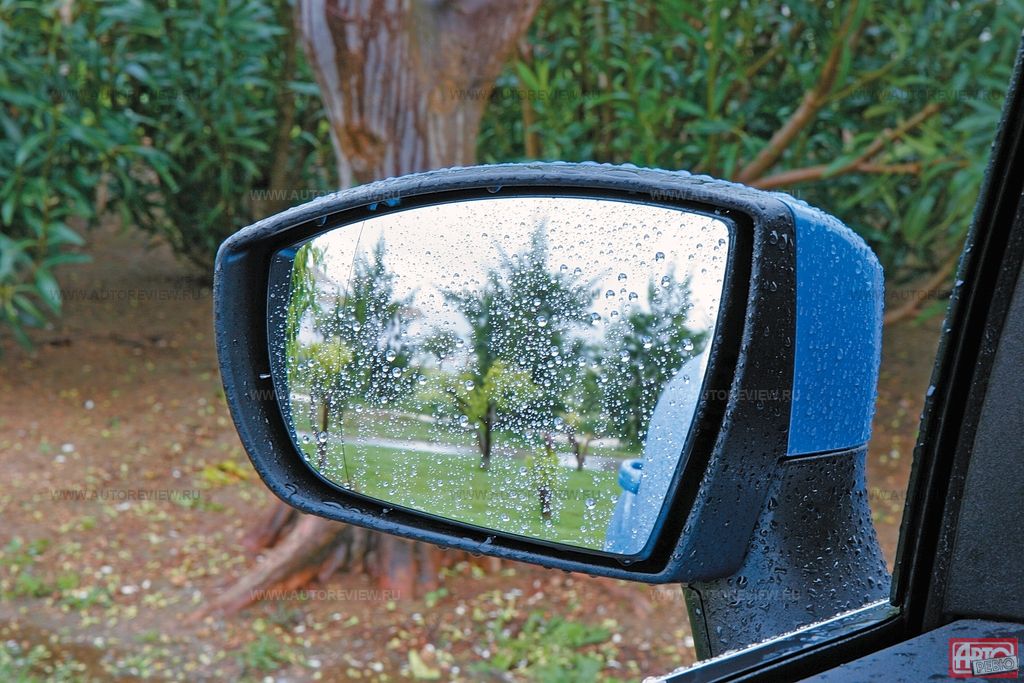 | |
| The lack of rear visibility due to thick body pillars is compensated by excellent mirrors from the S-Max, and a rear-view camera will appear later | |
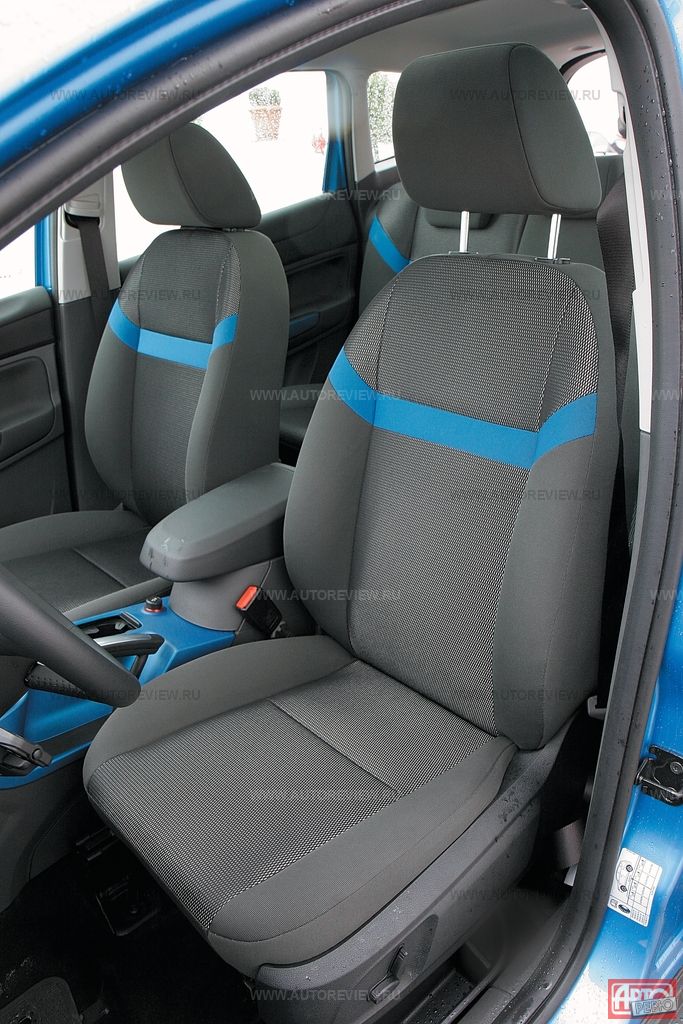 | 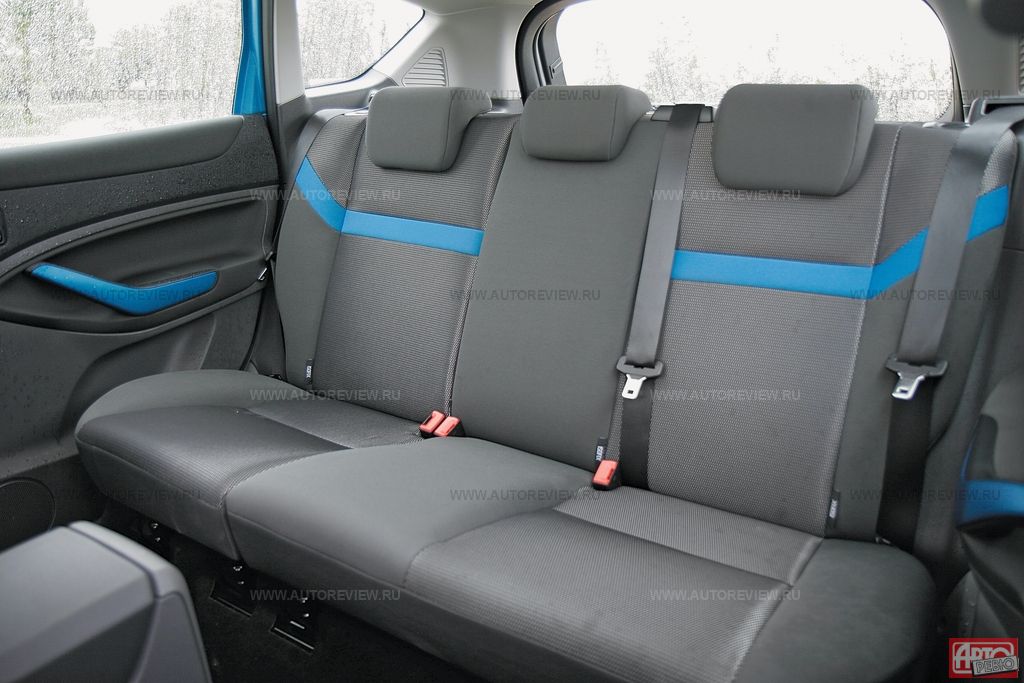 |
| The contoured seats with a well-calibrated profile are perhaps even too sporty for a comfortable crossover | Rear passengers have no reason to complain about cramped space. But you can't slide the seats forward to increase the trunk |
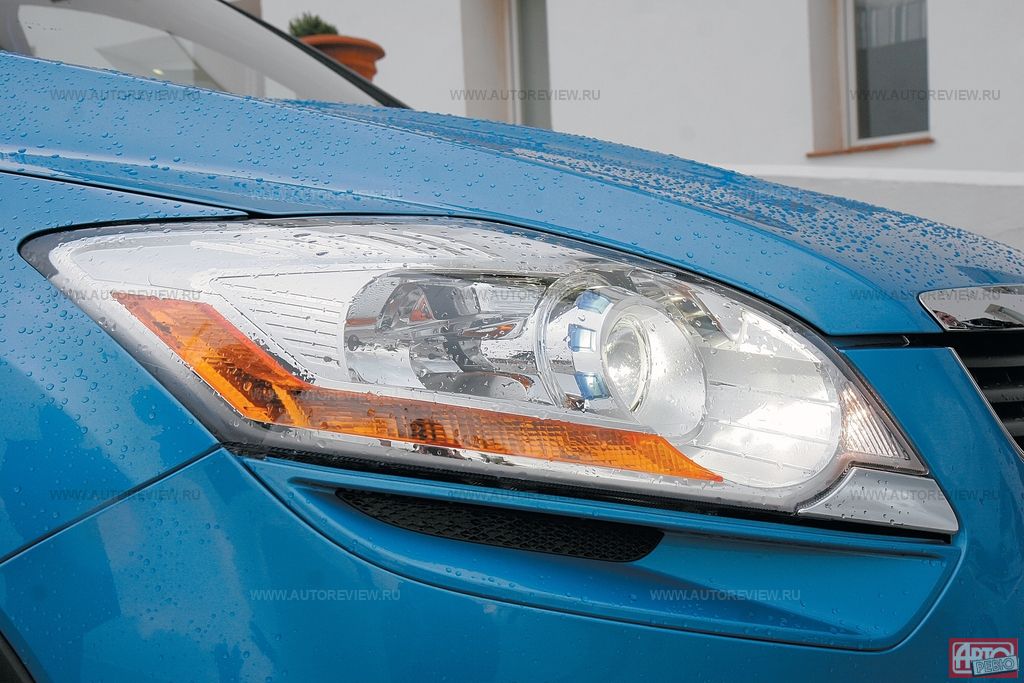 |
| The fake air intakes under the Kuga's headlights suit it, but the blue lights around the low-beam projectors — not so much |
Theoretically, along with the body lift, the risk of rollover also increases (the center of mass becomes higher, meaning the lever arm on which the "overturning" centrifugal force acts grows), as does the likelihood of the unloaded, inner wheels lifting off the ground — the rebound travel reserve decreases. But these nuances are surely leveled out by the selection of tire grip properties in the lateral direction (in limit and beyond-limit situations, the car should slide, not roll over), and ESP successfully handles the slides themselves.
But comfort has only benefited from this, since the diameter of the anti-roll bar was even reduced to prevent the car from being bothered by pitching on uneven surfaces. The hydraulic mounts of the lower front suspension arms and recalibrated shock absorbers with hydraulic rebound travel limiters also had a beneficial effect on ride smoothness.
And with noises, everything is fine too: tire hum is barely discernible, aerodynamic whistle appears only above 120 km/h, and the diesel runs no louder than gasoline engines.
The only ones I can't vouch for are those prone to motion sickness: the soft shock absorbers still allow some rocking.
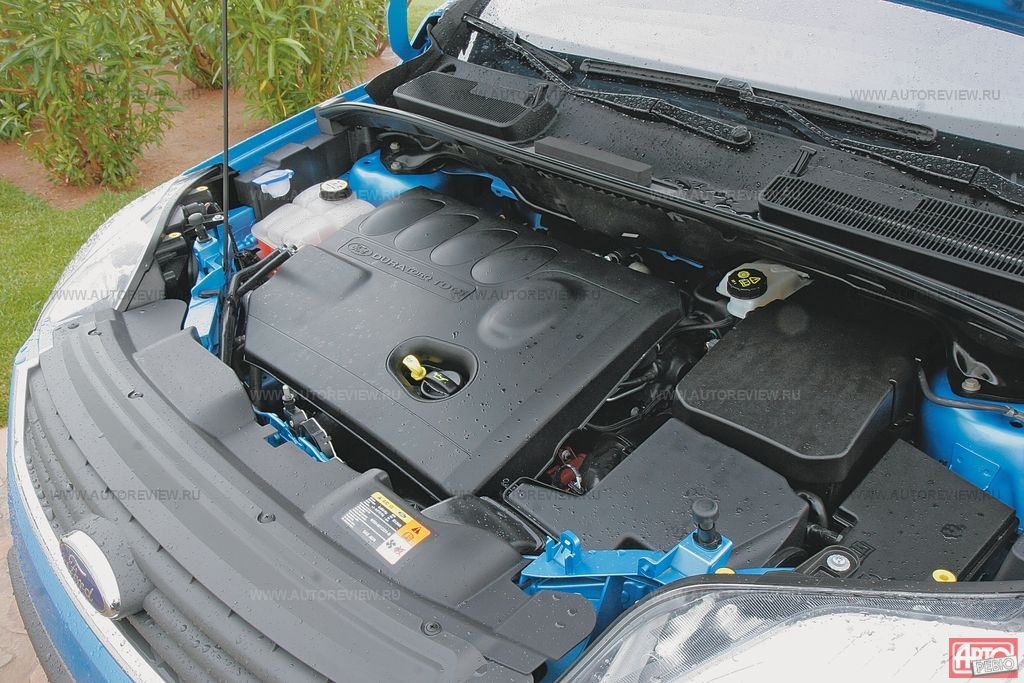
The diesel is a time-tested but still lively unit: 136 horsepower is extracted from the two-liter TDCi, which works in conjunction with the six-speed manual from the Mondeo. The engine pulls confidently from the bottom, with a strong surge felt between 1700 and 4000 rpm, and then the rev limiter kicks in at five thousand. There are no complaints about gear selection.
 |
 |
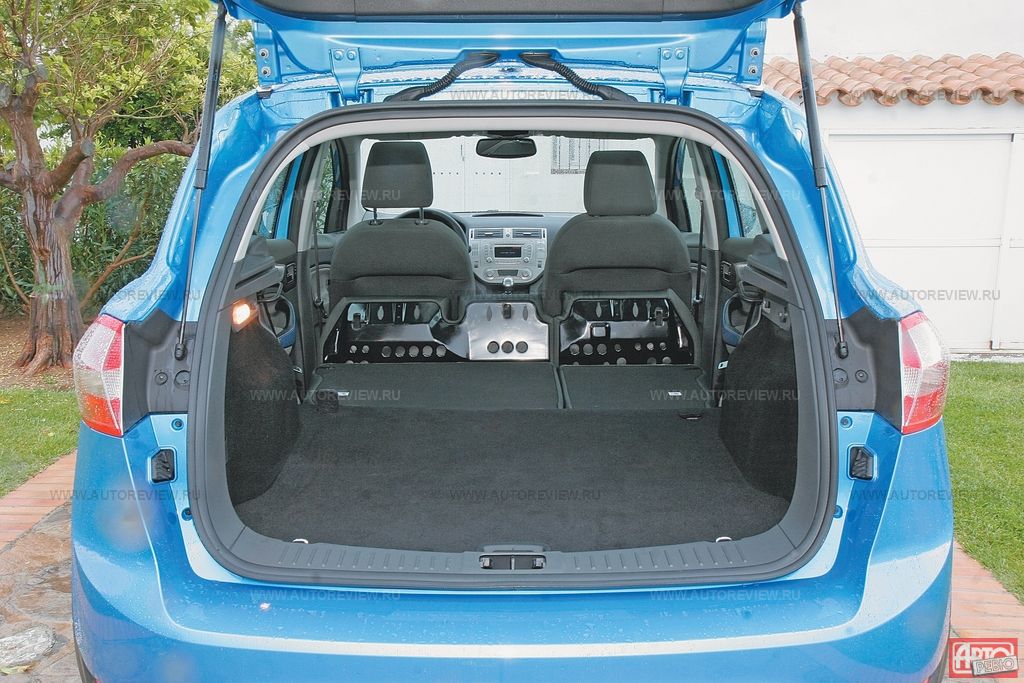 |
| So far, the Kuga is only available with the two-liter diesel producing 136 hp and a manual gearbox | The upper split section adds weight to the tailgate, but it makes loading light items more convenient | The trunk can be enlarged by folding the split rear seat, but the folded cushions prevent the front seats from being pushed back |
 |
 |
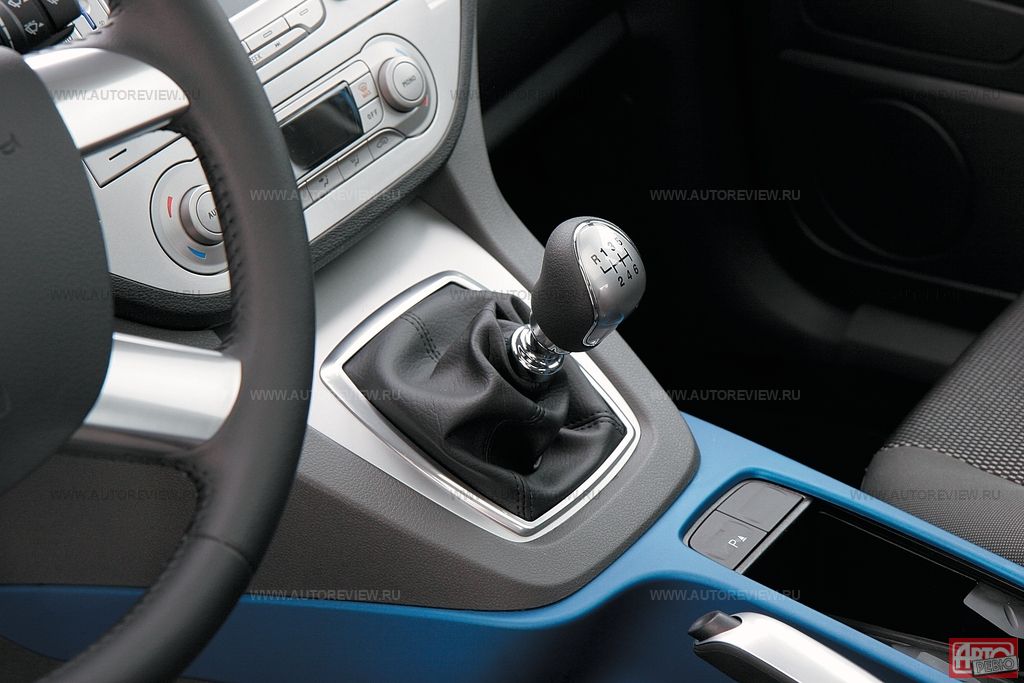 |
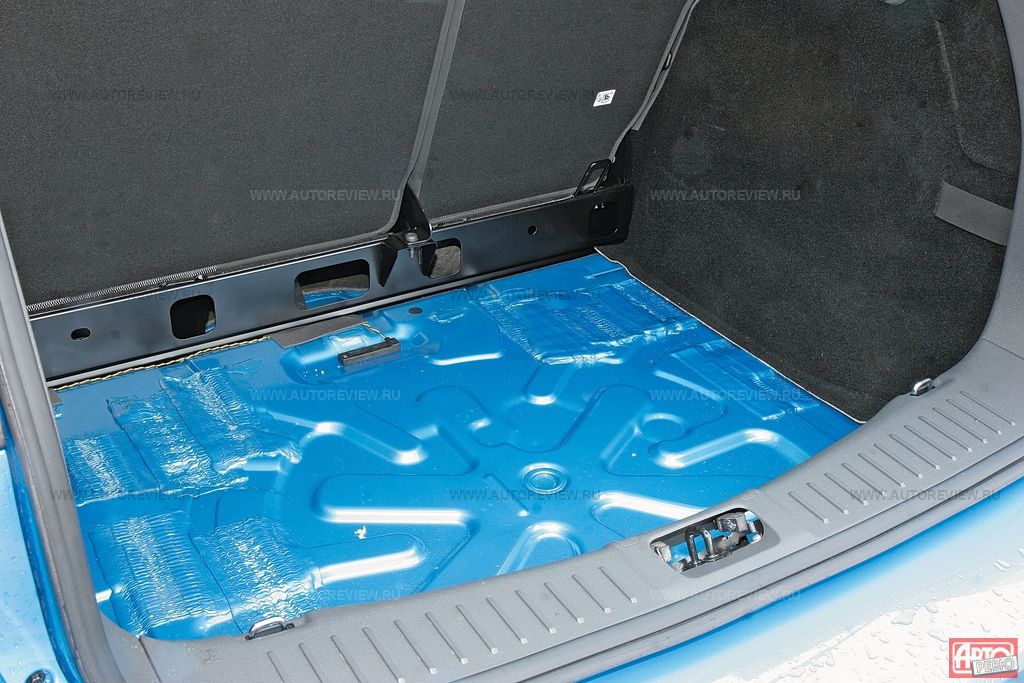
| If you don't order the space-saver spare (in Russia it costs an additional 1700 rubles), a 50-liter space is freed under the floor, which is occupied by a removable plastic organizer with many rectangular compartments for small items | The cable-operated gearshift lever in the Kuga remains as light and precise as in the C-MAX | |
However, on dirt roads, the Kuga starts to lose ground. Its geometric off-road capability is modest — ground clearance drops to 157 mm when fully loaded, and the diesel doesn't help either. If there were a low-range gear, there would be no questions, but as it is, second gear simply "wilts," and first gear lacks the torque to power through difficult sections. All that remains is to rely on all-wheel drive with the automatically engaging Haldex coupling, but even here hope is weak — it has no forced locking.
No other engines are available yet. The two-liter gasoline engine, which is in greatest demand among Russian buyers in this class, was deemed too weak by Ford for the crossover — even in front-wheel-drive form, it is 82 kg heavier than the C-MAX. The gasoline version with the five-cylinder Volvo turbo engine producing 225 hp and an automatic transmission will only appear here early next year. For now, only the diesel paired with a manual.
Why didn't Ford provide an automatic even for the diesel, knowing the demands of the Russian market? It seems they miscalculated.
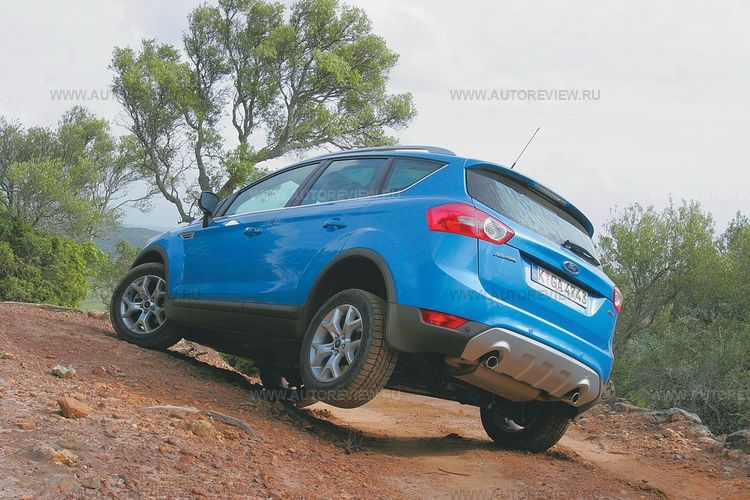
The suspension is short-travel, but the Haldex coupling quickly engages the rear axle, and the electronic imitation of inter-wheel locks "bites" the hanging wheels with the brakes, helping to move forward
However, in Russia there will be buyers for the diesel Kuga with a manual, but not many: only a thousand cars are planned to be sold out of the forty thousand that will be assembled at the German plant in Saarlouis by the end of the year. The base front-wheel-drive version is priced at 880 thousand rubles — 21 thousand cheaper than the Toyota RAV4. But, as Ford claims, the Kuga has a "100% masculine image" — in contrast to the "feminine" image of the Toyota model.
And — no body roll at all!
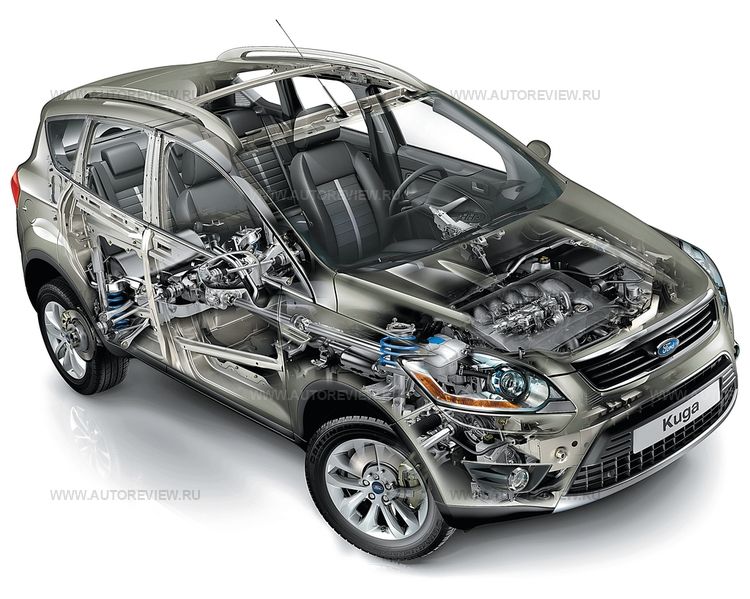
The Kuga is built on the platform of the Ford C-MAX compact MPV, but the wheelbase is stretched by 50 mm and the track is widened by 43 mm. Up front are McPherson struts, and at the rear is a multi-link setup with a reinforced subframe. The rear wheels on all-wheel-drive versions are engaged by a multi-disc Haldex coupling mounted directly on the rear differential
| Specifications | |
| Parameters | Vehicle |
| Ford Kuga | |
| Modification | 2.0 TDCi |
| Body type | 5-door wagon |
| Number of seats | 5 |
| Dimensions, mm | |
| length | 4443 |
| width | 1842 |
| height | 1677 (1710)* |
| wheelbase | 2690 |
| track front/rear | 1574—1580/1584—1590 |
| Approach angle, deg. | 21 |
| Departure angle, deg. | 25 |
| Fording depth, mm | 450 |
| Ground clearance unladen/with full load, mm | 188/157 |
| Drag coefficient Cx |
0.38 |
| Trunk volume**, l | 360/1355*** |
| Curb weight, kg | 1538 (1498)**** |
| Gross weight, kg | 2130 (2060) |
| Engine | turbo diesel |
| Location | front, transverse |
| Number and arrangement of cylinders | 4, in-line |
| Number of valves | 16 |
| Displacement, cm³ | 1997 |
| Cylinder bore/piston stroke, mm | 85.0/88.0 |
| Compression ratio | 18.3:1 |
| Max power, hp/kW/rpm | 136/100/4000 |
| Max torque, Nm/rpm | 320/2000 |
| Drive | all-wheel, with Haldex coupling in the rear axle drive (on front wheels) |
| Gearbox | 6-speed, manual |
| Front suspension | independent, coil spring, McPherson |
| Rear suspension | independent, coil spring, multi-link |
| Front brakes | disc, ventilated |
| Rear brakes | disc |
| Tires | 215/70 R16 |
| Maximum speed, km/h | 180 (182) |
| Acceleration time 0—100 km/h, s | 10.7 (10.6) |
| Fuel consumption, l/100 km | |
| urban cycle | 8.1 (8.0) |
| extra-urban cycle | 5.4 (5.3) |
| combined cycle | 6.4 (6.3) |
| CO₂ emissions, g/km | 169 (165) |
| Fuel tank capacity, l | 58 |
| Fuel | diesel Euro 4 |
| * With roof rails | |
| ** For vehicles equipped with a space-saver spare | |
| *** With rear seats folded | |
| **** Data in parentheses for front-wheel-drive version | |
With or without roll?
The roll center is a hypothetical point around which the body tilts in the transverse plane. To understand how to find it, consider a simplified example with a double-wishbone suspension. Extend the lines of the lower and upper arms, say, of the left wheel until they intersect. From this point, draw a line to the center of the contact patch of the same tire with the road. Do the same for the right wheel. The point where the last two lines (those going to the contact patches) intersect is the roll center. In static conditions, it's enough to do this for one wheel: the roll center will be at the intersection of the line from the contact patch with the vertical axis of the car. There is also the concept of the roll axis — the line connecting the roll centers of the front and rear suspensions. It's important to remember that both the roll centers and the axis itself can shift relative to the body depending on driving conditions — for example, due to loading of the left and right wheels.
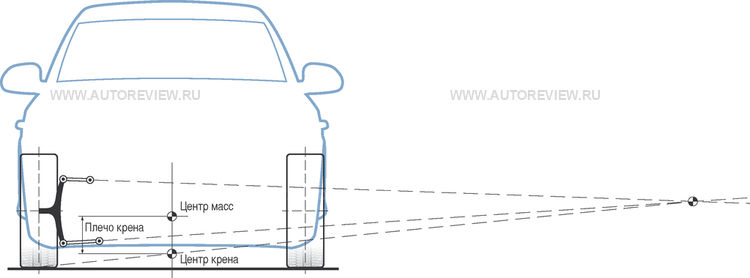
Diagram for determining the roll center (simplified example of a double-wishbone suspension)
Usually, the roll center is located lower than the vehicle's center of gravity. The higher the roll center, the smaller the lever arm on which centrifugal force acts relative to this point, and therefore the smaller the body roll angle in a turn. Theoretically, with an independent suspension, the roll center can be moved anywhere, even to coincide with the center of mass. In such a situation (if we simplistically assume that the roll centers of the front and rear axles are at the same height), the car would not lean at all in a corner. And if the roll center is raised even higher than the center of gravity, the car would behave more like a motorcycle—it would not roll but straighten up or even "tip over" outward in a turn. However, the temptation to raise the roll center harbors a host of side effects that can harm handling and stability much more than ordinary body roll.
One such unpleasant consequence is the lifting of the car in a turn. The lateral grip of the tire with the asphalt, which holds the car on the arc, transfers load to the body via the suspension arms. The higher the roll center is raised, the greater the portion of this force directed upward. In other words, the horizontal component of the force that makes the car corner decreases, while the vertical, "parasitic" component increases. Part of the tire's grip is spent not on keeping the car on the trajectory, but on tossing it upward. Additionally, when the body rises, the suspension's rebound travel reserve is reduced: if a pothole is encountered in a turn, the wheel cannot press against the road but simply hangs in the air. Moreover, with large rebound travel, the wheel alignment angles inevitably deviate from ideal, which also hurts handling and stability.
It turns out that in automotive engineering there are no solutions without compromises: you gain in one aspect, you lose in another. Therefore, the main thing is to find a balance and observe a sense of proportion. Judging by the first impressions, the engineers who created the Ford Kuga have this sense in perfect order.