
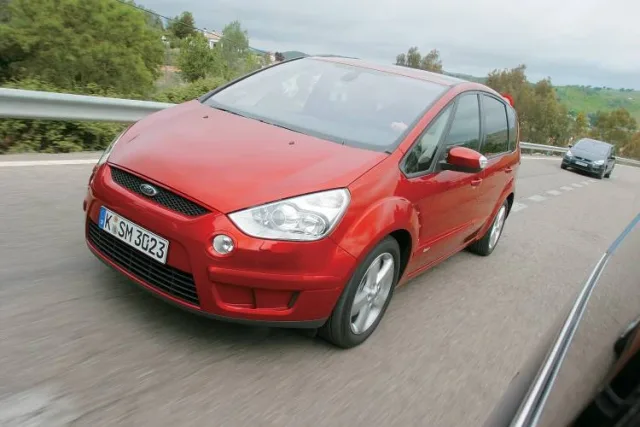
Unlike the first-generation Galaxy minivan, which Ford built together with Volkswagen (the VW Sharan, Seat Alhambra, and Ford Galaxy one-box models differed only in badges, grille design, and lights), the new Galaxy was developed independently in Cologne. And the process was so engaging that twins appeared — the seven-seat minivans Galaxy and S-MAX. As befits real twins, the cars turned out similar. But with different characters.
 |
| Chief designer of the twin minivans, Claudio Messale, envisioned the Galaxy's exterior to resemble high-speed trains and set the mood for long journeys |
Why does Ford need two almost identical minivans at once? — They are not identical at all, — Michl Koch, press attaché for technical matters, objects. — The Galaxy is a car for a true family man who lives with the concerns of his household and perceives the car merely as a means to organize a pleasant vacation. Here, the main thing is still spaciousness and comfort. But the S-MAX is a way of self-expression and a source of pleasure — both driving and aesthetic. Its owner is used to taking everything from life, believes he is always right, and dictates his lifestyle to his loved ones… Do you feel the difference?
To please such different buyers, Ford intends to get by with little blood — the twins are built on the common C1 Plus platform (“plus” to the one underlying the familiar C-MAX compact van) and are identical “up to the waist.” The whole highlight is in the roofs: they are different. The Galaxy has a high roof, which is good for cabin volume, while the S-MAX sports a curved arch-shaped roof. This is kinetic design — “design of motion,” Ford's new style. And among the twin minivans, the S-MAX most fully corresponds to it — “dynamic” glazing, a gloomy “face” with a protruding air intake lip, ventilation “gills” in the front bumper and fenders. A predator!
 |
| One of the first sketches of the S-MAX one-box |
It's only upon closer inspection that you notice the gills are fake, although if desired, you could drill holes in them yourself. But the hint of sportiness is appropriate, because under the hood of “my” S-Max is a 220-horsepower five-cylinder Volvo turbo engine, which is installed on the Focus ST!
“Family values” inevitably take a back seat. First — behind the wheel!
I sat down comfortably: the steering wheel adjusts in two directions, and the seat, moderately firm and “grippy,” adjusts via electric drives — in as many as eight. The interior is done in the same sporty spirit: instruments hidden in truncated cylinders and a sea of “aluminum” plastic that adorns the steering wheel, door panels, and completely covers the center console. Pleasant to look at — plain to the touch. Tactile pleasure comes from the soft plastic of the front panel, in the center of which a small items box is nestled — the same as in our route Gazelles. Well, fellow passengers, pass along a tenner — and off we go along the serpentines of Seville.
— This is a ready-made special stage of a rally! — exclaimed the colleague from Autosport magazine sitting on the right when we got onto a country road.
 |  |
| Readable instruments in “wells” and Russian-language menu | Light control is separate, with individual buttons for “fog lights” |
 |  |
| For the panoramic roof on the S-Max, you need to pay an extra $750, for retractable window shades — another $120 | In the S-Max interior, there is a lot of plastic “aluminum,” which in the Galaxy is partially replaced by “wood.” On the upper steering wheel spokes are convenient “phone” buttons for controlling onboard electronics, between the seats are keys for the electric “handbrake” and seat heating |
Right-left, up-down — the asphalt spiral twisted in all directions like a restless snake. If we were carrying passengers, “airplane” bags would be very useful. Usually on such “adrenaline” sections, you dream of something small, nimble, and preferably with a roll cage, and “piloting” an SUV or minivan here is hard, at least morally. But in the case of the S-Max, everything was not bad. Even good! Reactions to steering input are precise but not sharp. With the reactive action — in order: proportionally to the steering angle, the wheel unobtrusively tends to return to the “zero” position, and there it seems to “lock.” But if the “naturalness” of feedback is due to the power steering settings, then the clear “zero,” according to engineers, is the result of “geometric” suspension tuning.
Fundamentally, the suspension here is “common” for many Ford models — McPherson struts at the front and a “multi-link” at the rear. But all key elements (shock absorbers, springs, bushings) are selected anew — with a “comfort” bias for the Galaxy and a “sporty” one for the S-Max.
 |  |  |
| Michl Koch explains the operation of the active cruise control (its radar is hidden behind a plug in the fake radiator grille), which is designed to maintain a constant distance to the car ahead, and emphasizes that electronics are only a driver's assistant. In the frame is the instrument panel display, which shows the leading car (it appears at the top while driving), the follower, and the distance between them. Cruise control shows “activity” at speeds from 30 to 180 km/h and, if necessary, ensures deceleration of the car up to 0.4 g | Under the rear bumper of the S-Max is a diffuser! According to the creators, it reduces lift caused by the arched roof by 10–15 percent and helps self-clean the rear window | |
 |  | |
| Instead of a “spare tire” — a “first aid” kit | Blind “gills” — for beauty: there are no holes in them | |
The Ford S-MAX appetizingly swallows bumps and reliably traces corners — without large rolls and diagonal rocking. But as soon as you relax and slow down, the road ripple vividly reminds you of the eternal compromise between ride smoothness and handling. More speed — less shaking.
— On the North Loop of the Nürburgring, the 220-horsepower S-MAX turns out to be only slightly slower than our “hot” sedan Mondeo ST220, — proudly says Jürgen Gagstatter, one of the developers of the twins.
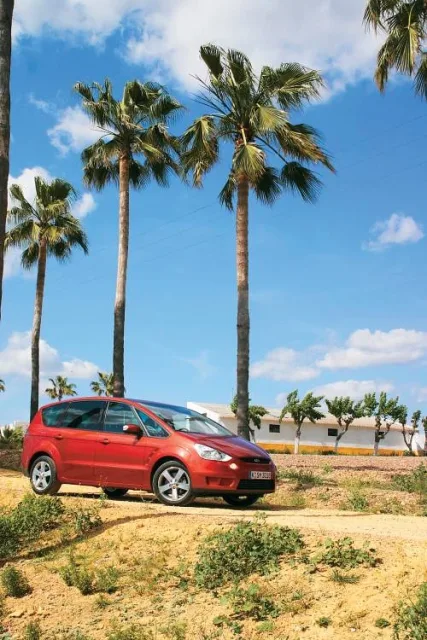
Yes, the Nürburgring. That's in fashion today. But seriously, the S-Max is, of course, far from big sport; it's also not close to amateur — after all, the hot ST heart has to pull an extra 200 kg and seven riders. But the S-MAX does physical exercise with all its heart — it can run the “hundred” on the speedometer in eight seconds.
 |  |  |
| The rear row seats fold into a flat area in parts, forming two cubic meters of free space above them | For an extra charge, the five-seat version of the S-Max can be equipped with a retractable trunk floor, making it easier to load heavy (up to 150 kg) items |
And the Galaxy?
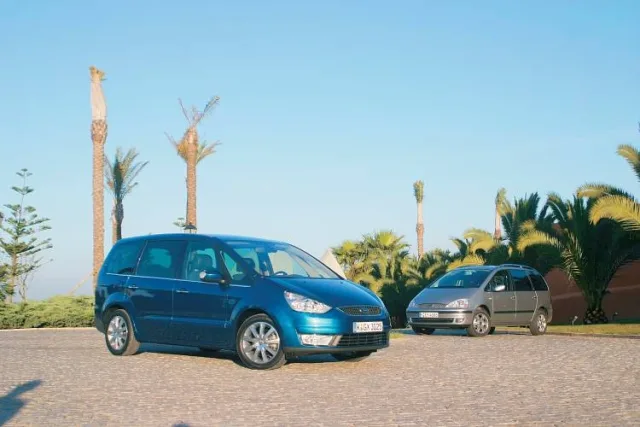
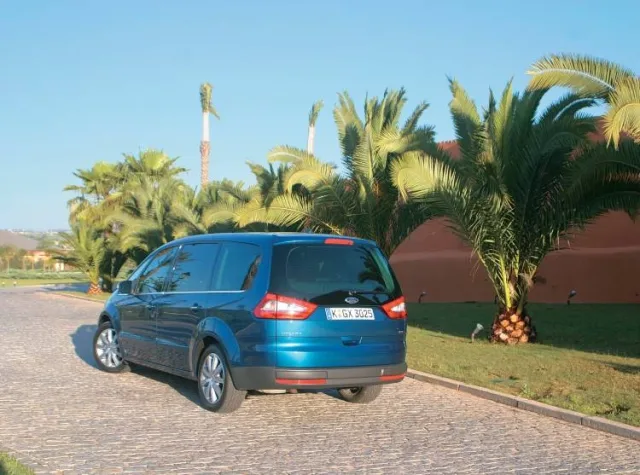
Galaxy calms you down with its very appearance — a classic minivan profile, huge glazing. Under the hood — a 140-horsepower turbodiesel. Inside — the familiar S-MAX interior, but with a shortened center console (so it's easier to pick up children from the rear row) and a ceiling that is 69 mm higher than in the S-MAX. The new Galaxy has noticeably outgrown its predecessor: it has become 180 mm longer, 45 mm wider, the seat adjustment ranges have increased, and the doors open wider. However, the removable seats that could also be turned against the direction of travel are gone — they were abandoned for ergonomic reasons.
 |  |  |
| In the Galaxy, the third row of seats is more spacious than in the S-MAX, especially in height | As in the S-MAX, the second-row seats move, fold, and recline independently of each other | Unlike the S-MAX front seats, the Galaxy seats do not have developed lateral support |
 | ||
| The overhead console can have up to five compartments | Panoramic roof and LCD screens in the headrests — for an extra charge |
— Owners of first-generation cars often complained that removing and installing seats was a real hassle, — says Gagstatter. — So we went the way of simplifying the transformation, like in the Opel Zafira. Now the seats of the two rear rows fold into a flat floor with one or two movements…
The platform turns out excellent — about a meter by two. You could say, a ready-made bed. In the S-MAX, the same folds out, but there is no such huge overhead console with five compartments totaling 20 liters — opened, put, closed, forgot.
And also in the Galaxy, from the third row, you can watch movies with "adult" comfort (a pair of LCD screens in the headrests of the front seats — for an extra charge), while the "gallery" of the S-MAX is suitable only for children. So there is still an advantage.
And, of course, the Galaxy is more pleasant on our roads: the small stuff that made the S-MAX shock absorbers drum, the "comfort" suspension of the Galaxy barely notices. But there is also a downside: in fast corners, the Galaxy noticeably rolls and starts to sway. So it's better not to rush.
You drive calmly, listen to music, scroll through menu items with the joysticks on the steering wheel — and enjoy the seat ventilation. Such an option is available in the new minivans; it moved here from the Mondeo.
In a calm rhythm, the pair of the 2.0-liter Duratorq diesel (140 hp) and the six-speed manual is quite enough, and the cabin is quiet. (Automatics for both models will appear only in a year.)
— In terms of noise insulation, we were guided by the Renault Espace, — says Gagstatter.
Therefore, the suspension subframes of both minivans are attached to the body through dense rubber "washers," the hydraulic mounts of the rear lower arms are "sliding" (they allow the wheels to shift slightly longitudinally to dampen impacts), and the wheel arches are covered with fleecy mats.
 |  |  |
| One of the creators of the twin minivans, Jurgen Gagstatter: "As for noises and vibrations, our benchmark was the Renault Espace one-box, and as for driving qualities, we are quite capable ourselves — in essence, we 'polished' the driving behavior of the previous Galaxy" | The mechanical "handbrake" — with an "aviation" handle, like on the Renault Scenic | The hoods of the new minivans open in the traditional way — from the cabin. The five-cylinder 220-horsepower turbo engine (pictured) is only for the S-MAX |
But the Ford people do not reveal all secrets: adaptive cruise control, adjustable Monroe shock absorbers (like on Volvo with the Four-C system), and the Hill-Launch Assist hill-start assistant will appear on the minivans only in September. However, I have already had a ride in an S-MAX equipped with all these systems. Nothing supernatural. Switching suspension modes (Normal, Comfort, or Sport) barely changes the character of the car; the difference is felt only by the rear passengers. The electromechanical "handbrake" is convenient, but also not new. But the "smart" cruise control…
— Remember: this is a dumb electronic radar, — Michl Koch, sitting on the right, taught me. — You are the captain, you are responsible for everything, electronics are just an assistant…
But the assistant is smart! Especially on a straight-as-an-arrow highway: by "locking onto" the car ahead, the radar helps maintain a safe distance (it is calculated as the path the car travels in one second at the current speed). The leader accelerates — the S-MAX accelerates in response. It brakes — the Ford slows down on its own. True, in sharp corners, the radar sometimes loses the target, and the car unexpectedly starts to accelerate. The simplicity of the system is to blame — it is no match for the complex systems of BMW, Mercedes, or Audi. But it also costs incomparably less — the cost is no more than $500. True, you cannot order adaptive cruise separately — only in a package with "electronic" shock absorbers and the "handbrake," for which they will ask $2700 here. For this money, you can also take other, no less pleasant options — for example, a panoramic roof, a pull-out trunk floor (it facilitates loading heavy items up to 150 kg), or a tire pressure monitoring system.
 |
| The S-MAX and Galaxy are produced in Belgium, mixed with the Mondeo |
The twin minivans are already being assembled at the Ford plant in Genk, Belgium, on the same line as the current Mondeo. In Russia, the first cars will appear in June. The "base" S-MAX with a 145-horsepower gasoline engine will cost $24,630 — $1,800 cheaper than the similarly equipped Mazda 5 2.0, and almost $6,000 less than the "base" Mitsubishi Grandis. The "base" Galaxy with the same two-liter engine will cost from $25,900 — slightly more expensive, but almost $8,000 (!) cheaper than the first-generation Galaxy, which was sold in Russia in small numbers. Across Europe, they plan to sell about 100,000 S-MAX and Galaxy per year — almost twice as much as the sales of the "lonely" first-generation Galaxy, which over eleven years sold more than half a million units.
So the race for two hares at Ford may be justified. And who knows, maybe the population of one-box "hares" will grow? And Ford M-MAX, L-MAX, XXL-MAX will appear…

On the left - Ford S-MAX, on the right - Ford Galaxy
| Model | S-MAX | Galaxy |
| Body type | minivan | minivan |
| Number of seats | 5+2 | 7 |
| Trunk volume, l | 285—2000 | 308—2325 |
| Curb weight, kg | 1547—1672 | 1530—1672 |
| Gross weight, kg | 2415—2500 | 2415—2500 |
| Ford S-MAX/Galaxy (manufacturer data) | ||||
| Engine | 2.0 | 2.5* | 1.8TDCi | 2.0TDCi |
| Type | petrol | petrol, turbocharged | turbodiesel | turbodiesel |
| Location | front, transverse | front, transverse | front, transverse | front, transverse |
| Number and arrangement of cylinders | 4, in-line | 5, in-line | 4, in-line | 4, in-line |
| Displacement, cm³ | 1999 | 2522 | 1753 | 1997 |
| Cylinder bore/piston stroke, mm | 87.5/83.1 | 83.0/93.2 | 82.6/82.0 | 85.0/88.0 |
| Compression ratio | 10.8:1 | 9.0:1 | 18.5:1 | 17.9:1 |
| Number of valves | 16 | 20 | 8 | 16 |
| Maximum power, hp/kW/rpm | 145/107/6000 | 220/162/5000 | 100/74/3850 (125/92/3850) | 130/96/4000 (140/103/4000) |
| Maximum torque, Nm/rpm | 190/4500 | 320/1500—4800 | 280/1800 (320/1750) | 320/1750 (320/1750) |
| Gearbox** | M5 | M6 | M5 | M6 |
| Gear ratios | ||||
| I | 3.8 | 3.39 | 3.8 | 3.58 |
| II | 2.14 | 2.05 | 2.05 | 1.95 |
| III | 1.48 | 1.43 | 1.26 | 1.24 |
| IV | 1.11 | 1.09 | 0.87 | 0.86 |
| V | 0.9 | 0.87 | 0.67 | 0.94 |
| VI | — | 0.7 | — | 0.79 |
| Reverse | 3.73 | 3.23 | 3.73 | 1.42 |
| Final drive | 4.07 | 4 | 3.56 | 4.06/2.96*** |
| Drive | front | front | front | front |
| Front suspension | independent, coil spring, McPherson | |||
| Rear suspension | independent, coil spring, multi-link | |||
| Front brakes | disc, ventilated | |||
| Rear brakes | disc | |||
| Tires | 215/60 R16 | 215/60 R16 | 215/60 R16 | 215/60 R16 |
| Maximum speed, km/h | 197 | 230 | 171 (187) | 188 (193) |
| Acceleration time 0—100 km/h, s | 10.9 | 7.9 | 14.3 (11.9) | 11.2 (10.5) |
| Fuel consumption, l/100 km | ||||
| urban cycle | 11 | 13.3 | 8 | 8.2 |
| extra-urban cycle | 6.4 | 7.1 | 5.3 | 5.5 |
| combined cycle | 8.1 | 9.4 | 6.3 | 6.5 |
| Fuel tank capacity, l | 70 | 70 | 70 | 70 |
| Fuel | AI-95 | AI-95—98 | diesel | diesel |
| * Only for S-MAX model | ||||
| ** M5 — manual 5-speed, M6 — manual 6-speed | ||||
| *** I—IV gears/V—VI and reverse | ||||