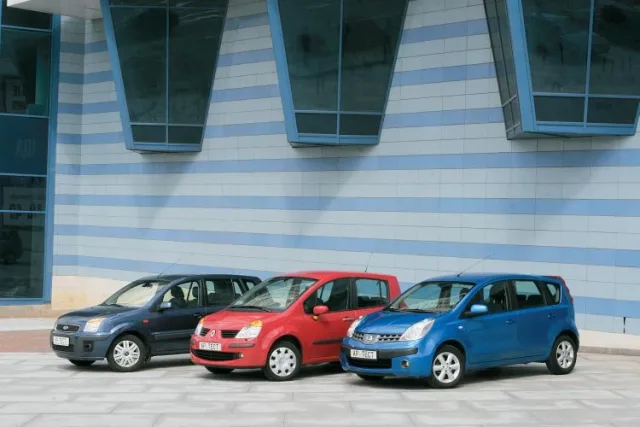
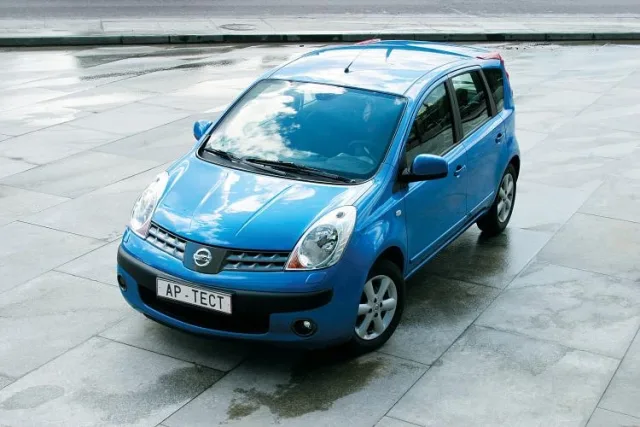
No one would have guessed that these two small cars share the same lineage. The Nissan Note and Renault Modus are built on the same platform as the Nissan Micra. What could the playful Modus and the solid Note, whose front end is styled after the Murano crossover, possibly have in common? And the Note is almost 30 centimeters longer than its brother.
Yet these two are twins in terms of technical content. And their main rival on the Ukrainian market is the modernized Ford Fusion. To find out which of the three is best, we took top versions with 1.6-liter engines and classic four-speed automatic transmissions.
The main motto of such cars is "compact outside, spacious inside." And this applies first and foremost to the Nissan. There is so much room in the back row of the Note that it brings to mind large business-class sedans. Even if the front seat is pushed all the way back, it won't touch the knees of a rear passenger — unless that passenger is a basketball player nearly two meters tall.
 |  This is how the Luxury version's interior looks. It looks decent: the plastic isn't cheap, the seats are massive and heated, and the steering wheel is covered in buttons... |  The Note has no temperature gauge — only two indicator lights: blue (cold engine) and red (overheating) |
 The Nissan automatic transmission works flawlessly |  |  |
| The double floor in the trunk is a convenient solution | ||
And where else in a car of this size can a rear passenger stretch their legs, tucking them under the front seat? Here, it's no problem! Plus a low tunnel, easy access, tables, cup holders, niches, and separate reading lights...
However, the Modus is no slouch either. Rear passengers couldn't believe their eyes: the Renault's wheelbase is 12 cm shorter, yet there's the same amount of legroom! True, this works if there are two people in the back and the transformable seat is slid back almost to the trunk door. To allow the cushion to travel 20 cm without catching the wheel arches, engineers had to make it split. The central part lifts up, the side sections slide toward the middle — and you can sit comfortably, like in a big car. Just without an armrest and other extras.
This transformable seat is called Triptic, and it's available for all Modus versions except the base Authentique. But if Triptic is set up to carry three people, legroom becomes tight: the adjustment range shrinks from 20 to 8 cm.
 |  |  |
| Climate control is from the Micra. The audio system sounds average. Above it is a shelf | A hidden compartment is tucked under the passenger seat | Surprisingly spacious in the back of the Nissan |
 |  |  |
| A good seat that suits drivers of any build. | Tables with cup holders | The glove box is cooled, and there's a shelf on the outside of the lid |
The Fusion, however, is simpler: no clever transformations, no longitudinal adjustments. And significantly less legroom. But the rear row itself is wider — three people will have more shoulder room.
What will drivers say?
The Renault Modus interior is unconventional itself. Instead of the usual instrument panel, there's a "hemisphere" with digital scales in the middle of the dashboard. Speed is read in large numbers, but the rest is "cramped" — to understand how much fuel is left or what the onboard computer shows, you have to take your eyes off the road for a long time.
 |  | |
| Renault Modus: the speedometer numbers are clearly visible, but the rest can't be read without glasses | The automatic disappointed — even with adaptive mode and manual shifting | |
 |  |  |
| The seat heating button is hidden in a blind spot to the left of the cushion | Triptic: lift the middle section, slide the side sections toward the center — the seat moves back 20 cm (left). In the normal position (right), the travel is only 8 cm | |
There's a bit of a shortage of front space, but thanks to the upright seating position and the tilted-forward steering wheel, a driver up to 185 cm tall can sit comfortably in the Renault — with plenty of headroom. However, the pedal area is cramped — moving your foot from gas to brake is awkward. And why is there so much hard plastic in the cabin? Even the leather steering wheel didn't please — the seam on the inner side of the rim is too rough.
 |  |  |
| The huge glass area makes the Modus cabin the brightest | The backrests fold separately, the cushion is one piece | |
 |  |  |
| The spare tire is hidden under the floor and secured with a cable and latch | The Renault has a large glove box and small niches in the floor | The fold-down shelf will hold a bag during braking |
The Nissan Note feels like a much more mature car. The plastic is nicer, and all buttons and switches operate more precisely. The "two-story" center console looks more interesting, and the equipment is richer — for the same money, you get climate control instead of a simple air conditioner. Plus rain and light sensors. In the Renault, the CD changer is tucked under the driver's seat, while in the Nissan it's built into the front panel. Both have cooled glove boxes, but the Nissan's is more spacious, and it also has an extra pocket on the lid. And under the passenger seat, there's a roomy hidden compartment.
The seating position in the Note is lower, almost like in a sedan. And the seat is more comfortable — the semi-circular backrest holds the body well regardless of build. There are even fold-down armrests — a nice bonus for a car with an automatic.
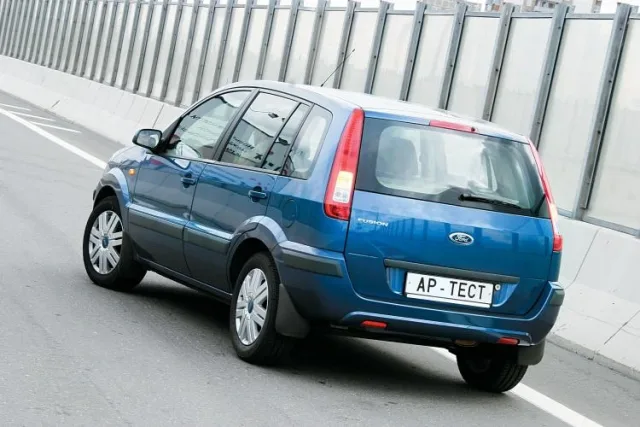
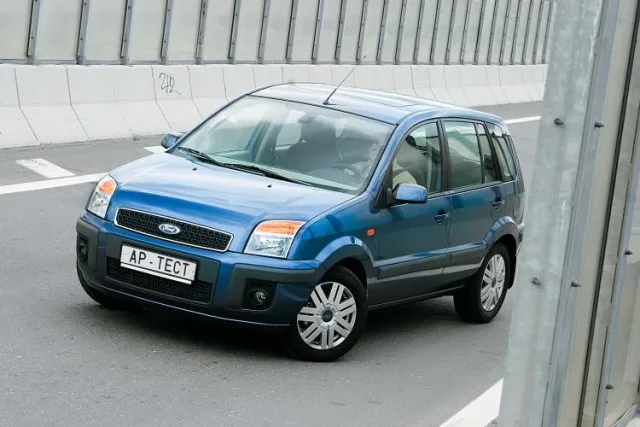
Ford Fusion, as it turned out, is not designed for large drivers. The front seats are a bit narrow — people with clothing sizes from 50 and up will find it frankly cramped. However, the seating position is high and comfortable, the ergonomics are thought out in the best Ford traditions, and the quality of trim materials is beyond reproach. It's nice that Ford took care of fully localizing the onboard computer menu into Russian, and the number of available settings here is greater than that of competitors. In the menu, for example, there are central locking options (you can choose to unlock only the driver's door or all at once), turn signal modes (one or three flashes with a brief press), and even adjustment of the horn volume!
 |  | |
| Ford Fusion: the clearest instruments. Also because the menu is in Russian | The glovebox is deep, but without cooling | An optional sunroof with manual drive is available |
 |  | |
| Climate control, CD changer, and heated windshield — for an extra charge | The seat is narrow, and the heating button has to be found by touch | The "automatic" is simple, but works well |
But for transporting the most important passengers — children — the Fusion is less prepared. Child seats can only be secured here with standard belts. Our tests (AR No. 11, 2006) showed that the Isofix system is both more convenient and significantly safer in a collision. Unfortunately, the Fusion has no Isofix brackets, while the Note has them in the rear, and the Modus (except for the base version) even allows securing an Isofix seat in the front.
We've sorted out children and adults. What about luggage?
 |  |  |
| Ford Fusion pleases with high-quality interior finishing | The rear seats do not move — there is little legroom | The spacious trunk has the lowest loading height |
The Renault is the least suitable for country trips — it has the most modest trunk volume. By sliding the rear bench forward, you can slightly increase the space, but passengers are unlikely to appreciate such savings.
The trunks of the other two cars are noticeably more spacious. The Fusion is especially convenient with its low loading height — it's easier to load heavy bags over a small threshold. The Note, in turn, pleases with a two-level floor with easily removable shelves.
Well, is it time to hit the road?
The Nissan Note is not only faster than its rivals, but also more convenient in managing traction. Its "automatic" shifts imperceptibly, smoothly, and quickly picks up when needed. And the torquey engine is great for the city.
The Ford's "automatic" also works decently, but the engine is 10 horsepower weaker and noticeably noisier. Even with moderate throttle application, the engine's howling starts to tire, and at full throttle it becomes downright annoying.
The Modus disappointed even more, despite its more powerful engine and adaptive gearbox. Acceleration feels jerky — transmission jolts are felt both on downshifts and upshifts. For example, if after active acceleration in second gear you release the throttle, the car first slows down with the engine, then there's a lurch, then a pause, and only then third gear engages. During calm driving, the gearbox shifts up too early, and with a slightly stronger throttle press, it immediately jumps down. It darts back and forth until you floor the pedal. After a couple of intense accelerations, the "automatic" adapts and works fine for a while, but not for long. In manual mode, the gearbox behaves decently, but then why have an "automatic" at all if you still have to shift yourself?
The Renault also lost in braking distance measurements. Moreover, during repeated braking, the brakes began to overheat, and the results got even worse. The Nissan's brakes also weaken from heat, but the Note's distance is shorter. The most stable in this exercise was the Fusion — its braking distance barely changed even after a series of stops. With such a car, you can confidently drive to Crimea or the Caucasus!
On a mountain road, the Fusion also pleased with its handling — it confidently enters sharp turns, holds the line steadily, and even diagonal rocking doesn't throw it off course. The only hindrance is the low sensitivity of the steering: 3.4 turns from lock to lock force you to turn the wheel more actively. That's why two out of five drivers missed the "sudden obstacle" during the emergency maneuver simulation. But the steering effort is excellent.
The Nissan is equally simple and understandable to drive, but its reactions are softer, rolls are more noticeable, and body pitching is more pronounced. However, this softness doesn't create any discomfort — moderate sensitivity, calm reactions, and a reasonably light steering wheel fully match the concept of a "family car." Moreover, the Note barely notices longitudinal ruts, while the Fusion wanders from side to side on them.
The Renault stands perfectly on smooth asphalt, holds confidently in corners, with slight rolls and high lateral acceleration. But the electric power steering ruins everything — the artificial effort breaks the connection with the road. And the stiffer suspension on bumps provokes deviations from the course. It turns out the Modus can take a corner faster than the Note, but there's zero pleasure in it. Even in normal modes, you constantly have to correct the steering, guessing the right angle.
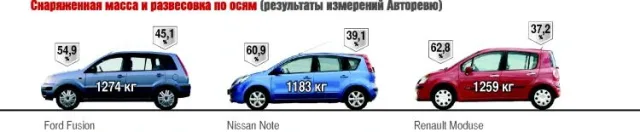
Making a small car comfortable is very difficult: a light body on a short wheelbase bounces over bumps like a ball. That's exactly how the Modus and Fusion behave, especially on minor surface defects at medium speeds. True, on the highway at 100–120 km/h, both the Renault and especially the Ford show decent suspension energy capacity. But Nissan's engineers managed to tune the springs and shock absorbers better — the Note barely notices either small or large bumps. However, with a full load, the Nissan loses ground: when there are five people in the cabin, the suspension often bottoms out on the compression bump stops.
In terms of acoustic comfort, the Ford Fusion was the worst: the engine is noisy, and after 100 km/h, wind noise in the windows adds to it. The Modus and Note are noticeably quieter. Comparing them, the Nissan's engine is louder at high revs, while the Renault's suspension is noisy on bumps.
And about visibility. Here again, the Nissan leads — thanks to its large exterior mirrors. The Ford's mirrors are small. The Modus has a large glass area — that's a plus, but the mirrors are not only small but also shifted back by the width of the quarter windows. As a result, shorter drivers have to constantly turn their heads to monitor the situation. Also, the Modus driver doesn't feel the front dimensions — the windshield is pushed far forward, and the hood is not visible. Parking in the city, especially for beginners, will be difficult.
Such compact but spacious cars are made specifically for the city. And in a couple of years, like in Paris, people in Moscow will be circling blocks looking for parking. So the Nissan Note — a simple, easy-to-drive, comfortable, and spacious car — should be appreciated not only in Europe but also here.
There are, of course, more compact classmates — for example, the Renault Modus. But besides its compactness and five-star EuroNCAP rating, the Modus has few advantages over its Nissan platform sibling.
But the most popular in this class will likely remain the Ford Fusion. Even if it's inferior to the Nissan in some ways, it's cheaper. If the Note in base trim costs $14,990, and the Modus costs $16,699, a simple Ford Fusion can be bought for $12,990. And that, as they say, is worth a lot…
The Ford Fusion 1.4 (80 hp) in the base Core trim at $12,990 is perhaps the most attractive option in the compact MPV segment. The base already includes four airbags, an anti-lock braking system, and hydraulic power steering. For an additional $1,050, you can get the "robotic" Durashift EST gearbox, which mimics the operation of an "automatic."
The Trend trim at $14,090 offers a more pleasant interior, front electric windows, and a CD receiver. If you take the same car with the 1.6-liter engine (100 hp), the price rises to $14,890. With this engine, you can order not only a manual but also a full-fledged "automatic" — such a version in Elegance trim with air conditioning costs $17,290. For climate control, a rain sensor, and other pleasant options, you'll have to pay extra.
The car comes with a 2-year or 100,000 km warranty. Credit terms: down payment from 50%, rate from 4.9% per annum for up to three years.
The Nissan Note will cost more — the starting price with the 1.4 engine (88 hp) is $14,990. However, the base Comfort version is already well equipped: a pair of airbags, ABS, electric power steering, front power windows, and heated and power-adjustable mirrors. The next step is Luxury for $17,230, which includes four airbags, air conditioning, a rain sensor, 15-inch alloy wheels, a six-disc CD player, and the FlexiBoard luggage transformation system.
The 1.6-liter modification (110 hp) can be had either with a five-speed manual (from $17,280) or a four-speed automatic (from $18,280). For these versions, the top Tekna trim is also available — climate control, 16-inch alloy wheels, and leather inserts in the interior. However, the price of such a small car with an automatic transmission reaches $20,490…
The warranty here is 3 years or 100,000 km. Credit — down payment from 0%, rate from 7.9% per annum for up to five years.
The Renault Modus turns out to be even more expensive: the initial Authentique version with a low-power 75-hp 1.2-liter engine, electric power steering, and ABS, but without air conditioning and audio, costs $16,699! There are only two airbags here, and there are no rear head restraints or Isofix child seat anchors at all.
The Modus 1.4 (100 hp) is sold only in the Expression trim (four airbags, Isofix, and the Triptic rear bench with head restraints) from $18,169. The most powerful Modus Dynamique with a 1.6-liter engine (113 hp), six airbags, and an audio system costs $19,899, and with adaptive transmission — already $20,879…
Due to inflated prices, demand for this model is minimal — about ten cars per month. Therefore, dealers are now selling off 2005 Modus models with a $2,000 discount.
Warranty — 2 years without mileage limit. Credit — down payment from 10%, rate from 7.9% per annum for up to 5 years.
Light output
To evaluate the effectiveness of the headlights, we photographed the cars at night from the same point. The photos show that the Nissan Note has the best low beam — its optics fully illuminate a person standing on the roadside 80 meters away. The Ford Fusion illuminates the roadside slightly weaker, while the Modus disappointed with the dimmest headlights — they only light up the pedestrian's legs. The high beam of the Ford and Nissan raises no complaints: a smooth, bright beam illuminates the road and a person at a distance of 160 meters. The Renault's high beam is weaker and, for some reason, shifted to the right — a pedestrian on the road is less distinguishable.
During the shooting, only the driver was in the cars, and the headlight levelers were in the zero position.
| Ford Fusion | Nissan Note | Renault Modus |
| Low beam. Pedestrian standing on the roadside 65 m from the car | ||
| Low beam. Pedestrian standing on the roadside 80 m from the car | ||
 | ||
| High beam. Pedestrian standing in the middle of the road 160 m from the car | ||
Moose test
The maneuver simulating an avoidance of an unexpected obstacle was performed in two stages. First, several drivers, after getting accustomed to each car's behavior in normal mode, tried to complete the lane change on the first attempt at a speed far from the maximum. Then an expert took the wheel and gradually increased the speed, approaching the limits of the car's capabilities.
In terms of maximum speed, all three hatchbacks turned out to be comparable: the Ford and Nissan hit the limit due to insufficiently informative steering, while the Modus, when returning to its lane, went beyond the markings because of weakly gripping tires. The Nissan Note proved to be the most understandable and predictable — all drivers did not knock down a single cone on the first attempt. The Fusion and Modus performed worse: the maneuver succeeded for only three out of five. The Ford let down because when the steering wheel was turned quickly, sensitivity decreased, and drivers did not turn the wheel enough, hitting the imaginary moose. And the Modus in extreme situations was let down by the electric power steering: the steering wheel "sagged," not allowing precise angle selection.

Maximum speed during the moose test, km/h
Car - Speed
Ford Fusion - 73.8
Nissan Note - 73.3
Renault Modus - 73.6
Moose test on the first attempt at 65 km/h*
Car - Maneuver completed by
Ford Fusion - 3 drivers
Nissan Note - 5 drivers
Renault Modus - 3 drivers
* Five drivers participated in the tests
 |  |  |
| During a sharp maneuver, the Fusion shows low sensitivity to steering wheel turns | The Note is the most understandable and easy-to-drive car | The Modus's handling is spoiled by artificial steering feel |
Ford Fusion 1.6, Nissan Note 1.6, Renault Modus 1.6 (manufacturer data)
| Car | Ford Fusion | Nissan Note | Renault Modus |
| Body type | 5-door wagon | ||
| Number of seats | 5 | ||
| Trunk volume, l | 337/1175* | 280/1131* | 198/620* |
| Curb weight, kg | 1170 | 1131 | 1160 |
| Gross weight, kg | 1630 | 1580 | 1650 |
| Engine | petrol, with distributed fuel injection | ||
| Location | front, transverse | ||
| Number and arrangement of cylinders | 4, in-line | ||
| Displacement, cm3 | 1596 | 1598 | 1598 |
| Compression ratio | 11.0:1 | 10.7:1 | 10.0:1 |
| Number of valves | 16 | 16 | 16 |
| Maximum power, hp/kW/rpm | 100/74/6000 | 110/81/6000 | 113/82/6000 |
| Maximum torque, Nm/rpm | 146/4000 | 153/4400 | 151/4250 |
| Gearbox | automatic, 4-speed | ||
| Gear ratios | |||
| I | 2.88 | 2.86 | 2.72 |
| II | 1.57 | 1.56 | 1.5 |
| III | 1 | 1 | 1.32 |
| IV | 0.7 | 0.7 | 1.03 |
| reverse | 2.3 | 2.31 | 2.46 |
| final drive | 4.28 | 4.07 | 3.65 |
| Drive | front-wheel drive | ||
| Front suspension | independent, coil spring, McPherson | ||
| Rear suspension | semi-independent, coil spring | ||
| Front brakes | disc, ventilated | ||
| Rear brakes | drum | disc | disc |
| Tires | 195/60 R15 | 185/65 R15 | 175/65 R15 |
| Maximum speed, km/h | 176 | 174 | 184 |
| Acceleration time 0-100 km/h, s | 13.1 | 11.7 | 12.3 |
| Fuel consumption, l/100 km | |||
| urban cycle | 10.3 | 9.3 | 10.4 |
| extra-urban cycle | 6.1 | 5.8 | 5.9 |
| combined cycle | 7.6 | 7 | 7.5 |
| Fuel tank capacity, l | 45 | 46 | 49 |
| Fuel | AI-95 | AI-95 | AI-95 |
| * With rear seats folded | |||
| Make | Ford Fusion | Nissan Note | Renault Modus |
| Base version price, $ | 12990 | 14990 | 16699 |
| Base version engine | 1.4 | 1.4 | 1.2 |
| 1.6 engine | O | O | O |
| Front airbags | + | + | + |
| Front side airbags | + | + | + |
| Inflatable curtains | – | – | O |
| ABS | + | + | + |
| Power steering | + | + | + |
| Automatic transmission | O | O | O* |
| Height-adjustable steering column | + | + | + |
| Height-adjustable driver's seat | + | O | O |
| Leather steering wheel | + | – | + |
| Multifunction steering wheel | – | O | – |
| Heated front seats | O | + | + |
| Heated windshield | O | – | – |
| Air conditioning | O | O | O |
| Climate control | O | O | – |
| Remote central locking | O | O | + |
| Immobilizer | + | + | + |
| Power-folding mirrors | O | O | – |
| Power and heated exterior mirrors | O | + | O |
| Front power windows | O | + | O |
| Rear power windows | – | O | – |
| Light sensor | O | O | – |
| Rain sensor | O | O | – |
| Trip computer | O | O | + |
| Split-folding rear seat | + | + | + |
| CD audio system | O | O | O |
| CD changer | O | O | O |
| Fog lights | + | O | + |
| Full-size spare wheel | + | – | + |
| Metal engine protection | – | – | + |
| Alloy wheels | O | O | – |
| Metallic paint | O | + | – |
| Manual sunroof | O | – | – |
| Remote trunk release | + | – | – |
| Remote fuel filler flap release | – | + | – |
| Keyless engine start | – | O | – |
| Folding tables in front seat backs | – | O | – |
| Price of tested car, $ | 20185 | 20490 | 20879 |
| * Manual gear selection mode | |||
| (+) Included in base version | |||
| (–) Not available in base version | |||
| (O) Options installed on cars tested | |||
Speedometer accuracy
| Speedometer reading, km/h | 40 | 60 | 80 | 100 | 120 | 140 | 160 |
| True speed, km/h | |||||||
| Ford Fusion | 38 | 58 | 77 | 97 | 116 | 136 | 155 |
| Nissan Note | 39 | 59 | 78 | 97 | 117 | 135 | 154 |
| Renault Modus | 39 | 59 | 78 | 97 | 117 | 136 | 156 |
Autoreview expert ratings
| Parameter | Max score | Ford Fusion | Nissan Note | Renault Modus |
| Design | 160 | 125 | 130 | 125 |
| Exterior | 80 | 60 | 65 | 65 |
| Interior | 80 | 65 | 65 | 60 |
| Ergonomics | 160 | 125 | 135 | 125 |
| Driver's workplace | 80 | 60 | 65 | 60 |
| Visibility | 80 | 65 | 70 | 65 |
| Dynamics | 260 | 220 | 225 | 190 |
| Acceleration dynamics | 80 | 65 | 70 | 55 |
| Braking dynamics | 100 | 90 | 85 | 75 |
| Handling | 80 | 65 | 70 | 60 |
| Ride comfort | 210 | 155 | 170 | 155 |
| Ride smoothness and vibration protection | 80 | 55 | 65 | 55 |
| Acoustic comfort | 70 | 50 | 55 | 55 |
| Climate | 60 | 50 | 50 | 45 |
| Cabin comfort | 210 | 165 | 170 | 155 |
| Passenger seats | 70 | 55 | 65 | 55 |
| Trunk | 70 | 55 | 55 | 45 |
| Cabin transformation | 70 | 55 | 50 | 55 |
| Total score | 1000 | 790 | 830 | 750 |
Some Autoreview measurement results
| Car | Ford Fusion | Nissan Note | Renault Modus |
| Maximum speed, km/h | 167.1/171.7* | 167.4/176.2* | 175.2 |
| Acceleration time, s | |||
| 0-50 km/h | 3.8 | 3.8 | 4.8 |
| 0-100 km/h | 12.7 | 12 | 12.8 |
| 0-150 km/h | 36.1 | 33.3 | 35.5 |
| over 400 m | 18.6 | 18.4 | 19.1 |
| over 1000 m | 34.6 | 34.2 | 35 |
| 60-100 km/h (D) | 7.8 | 7.4 | 7.9 |
| 80-120 km/h (D) | 11.2 | 10 | 10.8 |
| Coast-down, m | |||
| from 50 km/h | 611 | 644 | 611 |
| 130-80 km/h | 889 | 906 | 889 |
| 160-80 km/h | 1321 | 1336 | 1321 |
| Braking distance | |||
| from 100 km/h, m | 41.5 | 42.2 | 45.9 |
| Deceleration, m/s² | 9.3 | 9.1 | 8.4 |
| * In IV/III gear | |||
Acceleration graphs
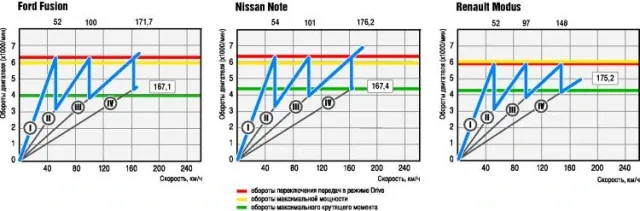
Measurement results