
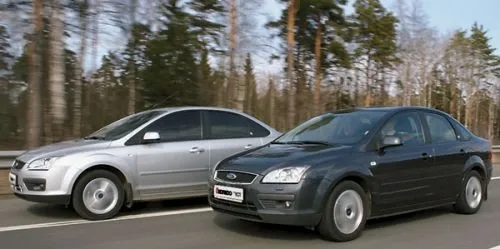
What to prefer: a Ford Focus with a 1.6-liter engine producing a hundred horsepower, or a unit of the same displacement but boosted to 115 "horses"? Perhaps today this question troubles many.

2005 Ford Focus 1.6
© Photo: 5 Koleso
Perhaps no other model on the Russian market currently stirs the minds of so many drivers — both those already behind the wheel and those just looking. Of course, we are talking about the second-generation Ford Focus. This is a car around which debates do not subside, to which internet resources are dedicated, and which many consider the benchmark of value for money. That is why the Focus has become a kind of reference point when choosing any other car. In dealerships, you often hear: "Is this car larger or more compact than the Focus?", "How much more expensive is it than the Focus?" In short, this model is always on everyone's lips.
And those who have already chosen the Focus II are troubled by questions of a different kind. Which trim to take? Which powertrain suits better? If with equipment everything is more or less clear — xenon, rain sensors, or parking sensors from more expensive versions can be installed later — then replacing the engine with another is much more troublesome. It is especially difficult to decide when it comes to engines of the same displacement but with different output. That is why we arranged a comparative test of the Focus 1.6 with 100-horsepower and 115-horsepower engines. Let us clarify right away: the equipment of the cars did not interest us this time; all attention was only on driving qualities.
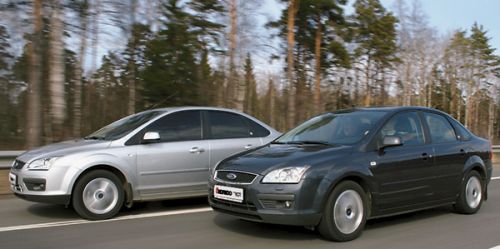
2005 Ford Focus 1.6
© Photo: 5 Koleso
First, let us figure out what the difference is between these units. The displacement of both is the same — 1596 cubic centimeters. Each has four valves per cylinder, and both are equipped with electronic throttle control. The difference lies in the design of the cylinder head. The 115 hp version has a system of dual independent variable valve timing, thanks to which the engine responds more lively to the driver's actions. It is also important that at high revs it produces more torque: peak 155 Nm is available at 4150 rpm, while the regular 16-valve has a maximum of 150 Nm at 4000 rpm.
2005 Ford Focus 1.6
© Photo: 5 Koleso
And how are these technical calculations felt in practice? We did not feel a fundamental difference in the character of the cars, although a couple of nuances in favor of the more powerful variant were still found. Although the torque peak of such an engine is reached at higher revs, starting off on it turned out to be a bit easier. The engine also needed to be revved slightly, but in elasticity it clearly won. And, as both subjective sensations and subsequent comparison of characteristics showed, the Focus with 115 "horses" turned out to be more spirited. Not by much, but the difference was felt. And on overtaking, it picked up more eagerly — sometimes you did not even have to engage fourth gear instead of fifth. The hundred-horsepower unit in such situations required more careful handling. In terms of fuel consumption, both engines are approximately the same: 9 liters in the city and 6 on the highway. True, many noticed that the more powerful engine runs noisier. However, there is nothing to be surprised about: it has noticeably more mechanisms than the regular one.
If we talk about money, then in identical trims the 115-horsepower version will cost the buyer $400 more. Agree, the difference is small. Whether this money is worth the increase of 15 horsepower and how it will affect taxes — it is up to you to decide.
© 5 Koleso