
Ford Fiesta. A holiday that is always with you…
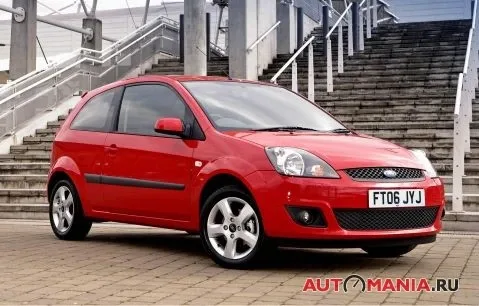
Despite the fact that the model has already celebrated a solid anniversary for itself, it still looks fresh and quite up to par. For its thirtieth anniversary, it received a minor cosmetic update: the bumpers and the shape of the front headlights were slightly changed. This is just a slight nod to the brand's current "kinetic" philosophy. The designers were satisfied with the result of such "plastic surgery": the style remained impeccable, and the look became noticeably friendlier — the car simply radiates positivity and well-being.
And we are talking about Ford's most popular model in Europe — the Fiesta. The car is nimble, agile, capable of parking in a couple of square meters, and at the same time very economical. In the conditions of a modern metropolis, such a car simply has no equal. This has long been understood in both Europe and Asia. It's time for our motorists to part with the stereotype that a compact car is exclusively a woman's car.
Take a look inside the Fiesta: the interior is stuffed in a far from feminine way. Even before the restyling, it was not simple — take, for example, the instrument panel with many liquid crystal displays. Now they have been joined by a monitor with a Russian interface (like on the Focus), and more modern equipment has appeared on the center console, for example, a climate control system borrowed from the Mondeo. The cockpit itself has also changed beyond recognition: new shapes, materials with a pleasant texture and pliability. Now even the interior color can be matched to the body color — the solution is not new, but it looks stunning!
It's just a pity that the old ergonomic shortcomings were left unattended. There are few of them, but they can spoil the impression. For example, the steering column of the hatchback is still adjustable only for height. The seat profile is also not ideal: the cushion is a bit short, the backrest is a bit stiff, although the lateral support is well developed, and the range of adjustments is decent. The rear row, which is formally designed for three, cannot be called comfortable in reality — only a child will be fine there. The trunk is also not notable for its volume; it will only be enough for supermarket bags. Something larger will require folding the rear seats. However, the same complaints can be made against any other classmate of the Ford.
After analyzing the "comforts," let's move on to the main thing — the drive. In the range of engines for the Russian market, the Fiesta peacefully coexists with three petrol engines with a volume of 1.3, 1.4, and 1.6 liters, producing 70, 80, and 100 hp, respectively. Following the tradition established in the class, the most modest unit is combined only with a 5-speed manual. For more powerful versions, an alternative is offered: the 1.6-liter engine can be ordered with a 4-speed automatic, and for the 1.4-liter engine, a proprietary robotic gearbox Durashift EST is provided. The latter option, in my opinion, is the most interesting. The 1.4-liter engine itself is not bad: it is lively, loves revs, easily accelerates the car (though it makes quite a bit of noise), but remains economical and obedient. However, it is in pair with the "robot" that it becomes the most attractive in the entire lineup and is best suited for driving on congested Moscow highways. Depending on the situation, the driver can choose between manual and automatic modes. The latter will clearly help in creeping traffic jams and dense congestion. You can also drive in a dynamic flow on it, but then you will have to get a little used to the somewhat non-standard algorithm of the gearbox.
That, in fact, is where the peculiarities end. In everything else, the Fiesta behaves like a typical representative of its class: stability is excellent, brakes are effective, handling is top-notch, as is the level of comfort.
Now about prices. The minimum cost of the hatchback today is $12,090 — this is the base version Ambiente with a 1.3-liter engine and manual transmission. The 1.4-liter engine is available in the Comfort trim, which is $700 more expensive, and the robotic gearbox will add another $1,000 to the price. The top version Ghia with a 100-horsepower 1.6-liter engine will cost at least $15,290, which is quite modest. True, it is worth remembering the traditionally rich list of additional equipment, which usually significantly affects the final price tag.
Technical specifications
Length (mm) 3918
Width (mm) 1685
Height (mm) 1464
Wheelbase (mm) 2486
Weight (kg) 1102
Trunk (l) 284/947
Engine displacement (cm3) 1388
Max power (hp) 80 at 5700 rpm
Max torque (Nm) 124 at 3500 rpm
Max speed (km/h) 166
Acceleration (s) 13.2
Average fuel consumption (l) 6.2
Price ($) from 12,790
Yuri Goryachev
Source – www.automania.ru