
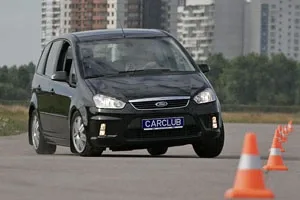
 The C-MAX is slightly inferior to its rivals in comfort, but it certainly doesn't lack sportiness.Comments
 The Ford S-MAX made a lot of noise in its time on the market – a minivan that looks like an athlete and is equipped with a 2.5-liter turbo engine became an undisputed sales hit in its class. It is bought for taxis, for families, and some even consider it as a replacement for the Ford Mondeo. In Europe, the situation is similar: there, the S-MAX was named Car of the Year 2007.
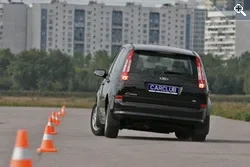 Against the backdrop of such a successful older brother, the compact van C-MAX remained in the shadows. To remedy this, the younger model underwent a facelift. The main task was to translate the New Edge style into the new direction of Kinetic design, in which the S-MAX and the fresh Mondeo have already been made. Recently, the Focus was also updated in the same vein.
For a detailed introduction to the updated C-MAX, we took for a test the version with the most powerful 2.0-liter engine in the range with 145 horsepower, a manual gearbox, and the rich Ghia trim.
I'll say right away: in terms of design after the facelift, the C-MAX, of course, does not reach the charismatic S-MAX, but the step forward is obvious. The vertical fog lights and large air intake added aggression and swiftness to the exterior. The only thing missing is the fake deflectors on the front fenders, like the older brother's – it would be absolutely perfect.
But the interior, alas, did not impress. Solid gray plastic – for a European compact van, this is a mandatory program, but nothing more. The instrument panel reads perfectly, but also without a zest. And the "wood-look" inserts on the dashboard and door handles look alien. Aluminum or light plastic would look much more logical here – such a finish is available in the Titanium version. The Ghia equipment also surprised: for 671,000 rubles, you only get a regular air conditioner, and you'll have to pay extra for climate control.
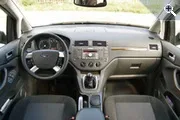

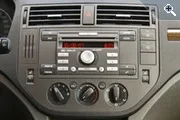
But the ergonomics of the cabin, despite the simple trim, are perfectly calibrated. The hand itself finds the gear lever, and its short and precise strokes are already a Ford calling card. The pedals are also informative. At first, the seating position after a passenger car seems elevated, but you get used to it quickly, and there is no discomfort either in the city or on the highway.
Rear passengers have the best life, especially if there are two of them. The middle seat can be folded into the trunk, and the side seats can be moved back by 10 cm. However, even in standard form, the cabin is so spacious that you can sit cross-legged, like in a limousine. The trunk volume with this layout will, of course, decrease, but it will still remain decent. If you need to transport something large, the rear row can not only be folded but completely removed from the car – then you get 1620 liters, which is comparable to large station wagons, given that the C-MAX is only 4333 mm long. There is also another feature, like in the Renault Scenic: small hiding places are hidden under the feet of rear passengers – a real "smuggler's dream." They are hidden under the mats, and not everyone will be able to find them.
Enough inspecting the cabin – it's time to start the engine. At low revs, you expect more pressure from two liters, but after 3000 rpm the engine comes alive and pulls smoothly all the way to 6500. If you keep the tachometer needle in this zone, the compact van drives very briskly and won't let you get bored. On the highway, you can calmly hold around 180 km/h, but you need to remember: the tall body cuts through the air poorly, and fuel consumption at such speeds exceeds 15 liters per hundred. For comparison, a regular Ford Focus at the same speed fits into 10-12 liters.
The character of the engine is perfectly complemented by the handling. The chassis from the Focus, tenacious and composed, has hardly suffered from the upward-shifted center of gravity. The steering wheel is filled with pleasant effort, gives full control, and the slightest movement of the wheel immediately changes the trajectory – precisely and adequately. On the C-MAX, it is equally interesting to fly through a series of corners outside the city at speeds over a hundred, and to frolic in city traffic on narrow streets.
The cornering behavior of the C-MAX is almost neutral, so the driver can easily play on the edge of understeer and oversteer. And it's good that even in the top version there is no stability control system – no "electronic collars" interfere with control. For those who doubt their skills, there is ESP along with a traction control system. The sound insulation was a separate pleasant surprise: the engine is audible in the cabin only after 3000 rpm, and even at the red zone, the sound does not press on the ears. You can talk without strain even at 150 km/h.
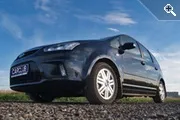
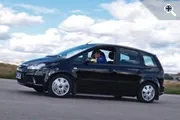
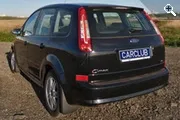
But the steering wheel seemed not the most successful to me – for such a chassis, a more compact three-spoke wheel is called for. An acquaintance also complained about the rough seam of the leather trim, which rubs the fingers. For a family car, this is not respectable. Moreover, outside the city in ruts, you have to hold the steering wheel firmly – wide tires make the car noticeably wander.
In terms of comfort, the C-MAX is slightly inferior to competitors, but this is a conscious price for innate sportiness. The driver is constantly aware of road joints, although the suspension handles large potholes quite smoothly.
On dirt roads, problems begin: suspension travel is small, wheels sometimes lose contact with the road, and the body receives hard impacts. The C-MAX also behaves not in the best way when braking: even smooth deceleration causes noticeable nose dives, and the driver and passengers are forced to brace against the belts. So you must buckle up in this compact van. Ford engineers failed to completely overcome the pitching of the tall body. At the same time, the brakes themselves are very responsive: a little over-press – and the car is already stopped.
At first glance, a sporty character is completely unnecessary for a family car. Remember the trendsetter – the Renault Scenic. Even though the Renault factory team is the current Formula 1 champion, the compact van both externally and in road behavior radiates absolute calm. Try taking corners with tire squeal in such a car – passersby will twirl a finger at their temple: you bought a family car, so it's time to calm down and ease off the gas.
I don't argue, a measured style has the right to exist. I myself often drive slowly, especially when my daughter is sleeping in the back. But that doesn't mean my car shouldn't be able to go fast when needed. Therefore, the Ford Focus C-MAX fits perfectly into my coordinate system. If only it had a more interesting interior – and it would be an ideal sports-family car, like the older brother Ford S-MAX with the 2.5-liter turbo engine. It's not for nothing that the C-MAX advertisement says: "Life is movement."
Test: Leonid Pavlov