
When it comes to compact vans, cold calculation usually takes over, and emotions take a back seat. But the Citroen C4 Picasso can make you doubt that. Such cars are gaining popularity in Russia — sales jumped by 70% last year. We decided to compare three representatives of this class: the Citroen C4 Picasso with a two-liter engine and robotic transmission, the Volkswagen Touran with a 1.4 TSI turbo engine and DSG gearbox, and the Ford C-MAX 2.0 with a classic automatic.
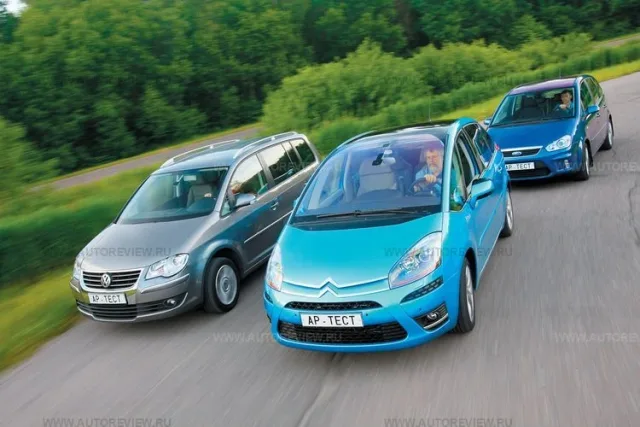
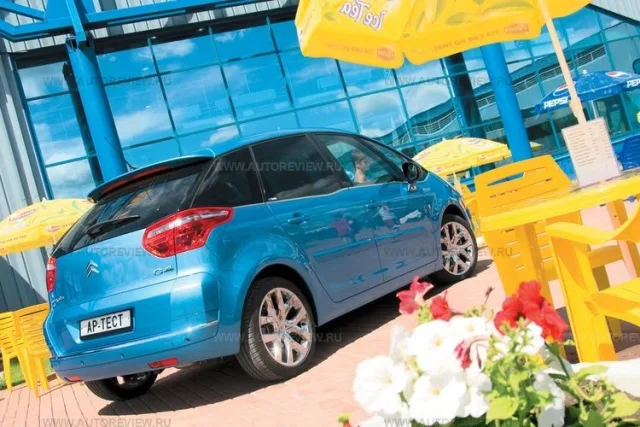
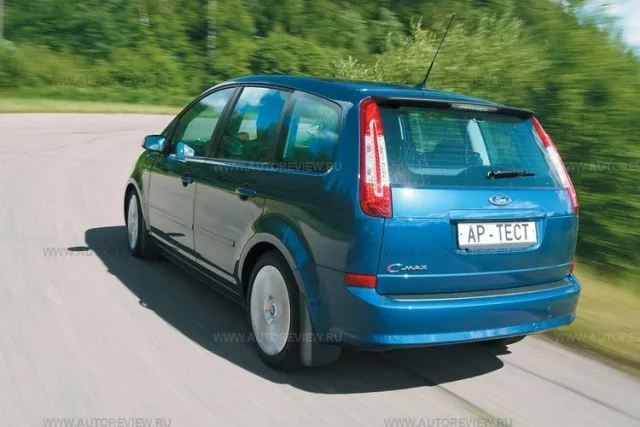
The new C4 Picasso looks like a true work of art. The body resembles a Faberge Easter egg: an elegant beltline like the equator, diamond headlights, and ruby taillights. And inside, you enter a different world where conventional ideas about cabin layout stop working!
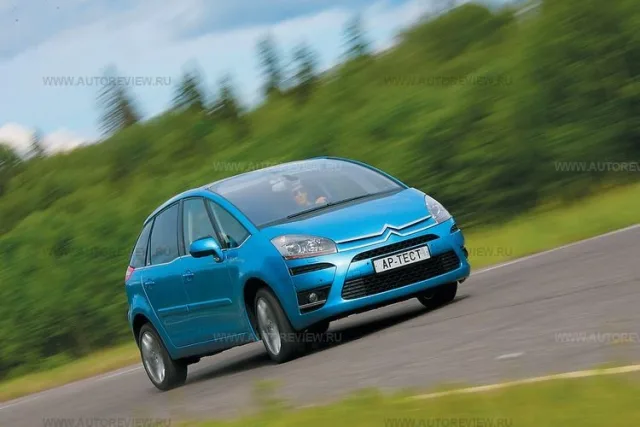
The C4 Picasso has neutral understeer, but body roll is too pronounced
The steering wheel has a fixed hub with convenient buttons scattered on it, the instruments are moved to the center of the dashboard, and the stereo is hidden under a lid — so as not to spoil the stylish interior with its appearance... The dual-zone climate control is truly divided: the driver controls the main unit to the left of the steering wheel, while the front passenger only adjusts the temperature in their zone. Even the buttons for electric seat adjustment are located unusually — on the inner side of the seat cushion.
And what is that thin lever sticking out on the steering column? It turns out to be the selector for the robotic gearbox!
The picture is topped off by a glass roof and a huge panoramic windshield. You slide back the sun visors, which turn out to be a curtain, and above your head opens a sky that takes your breath away.
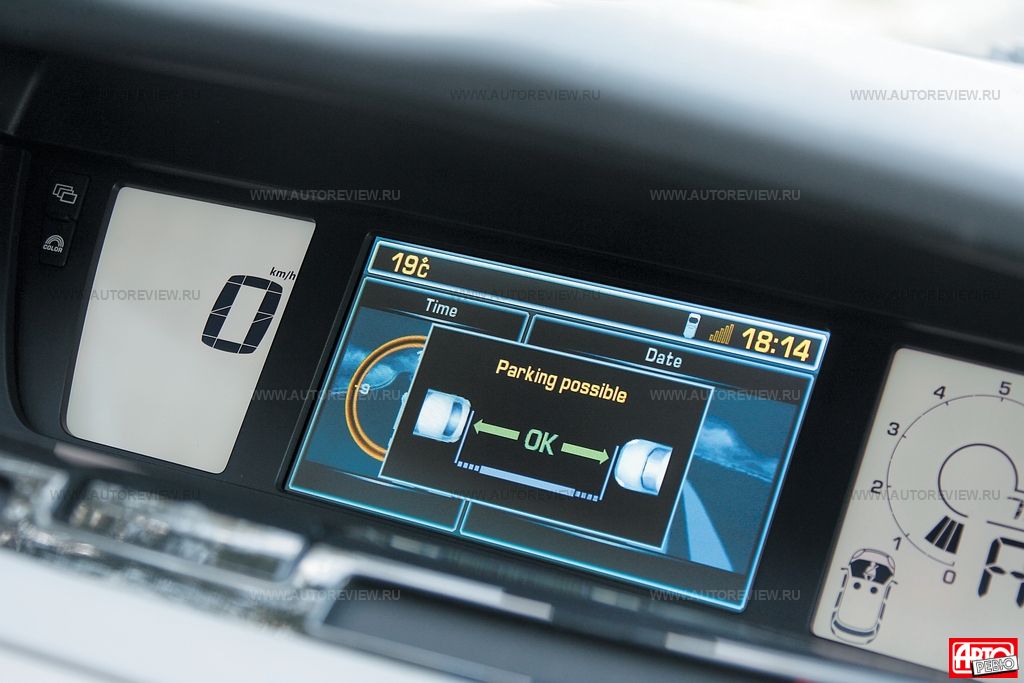 | 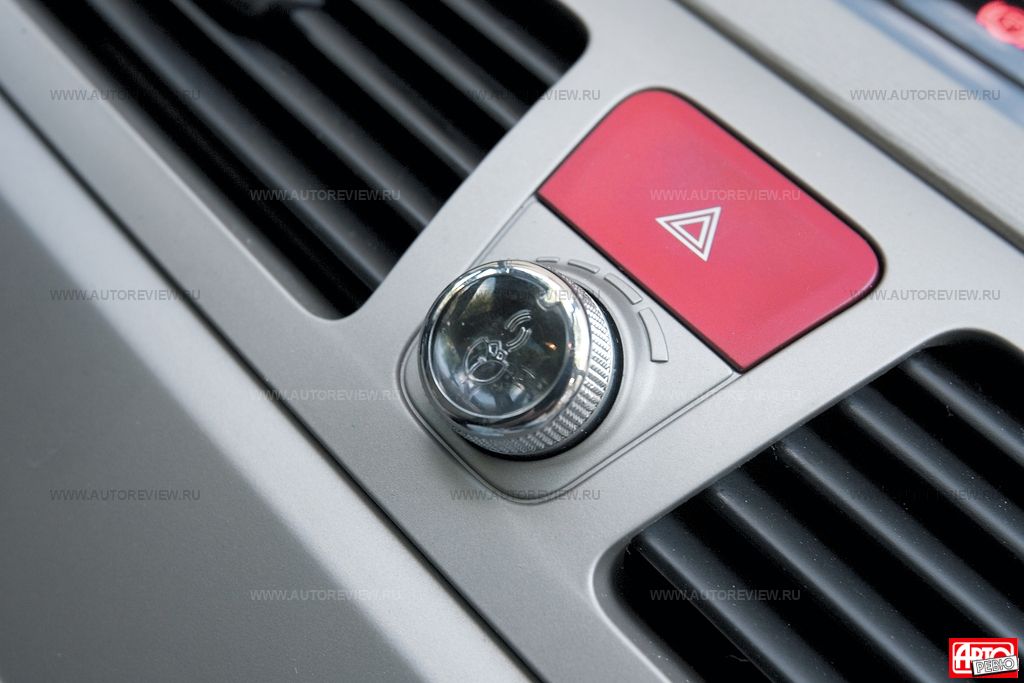 | 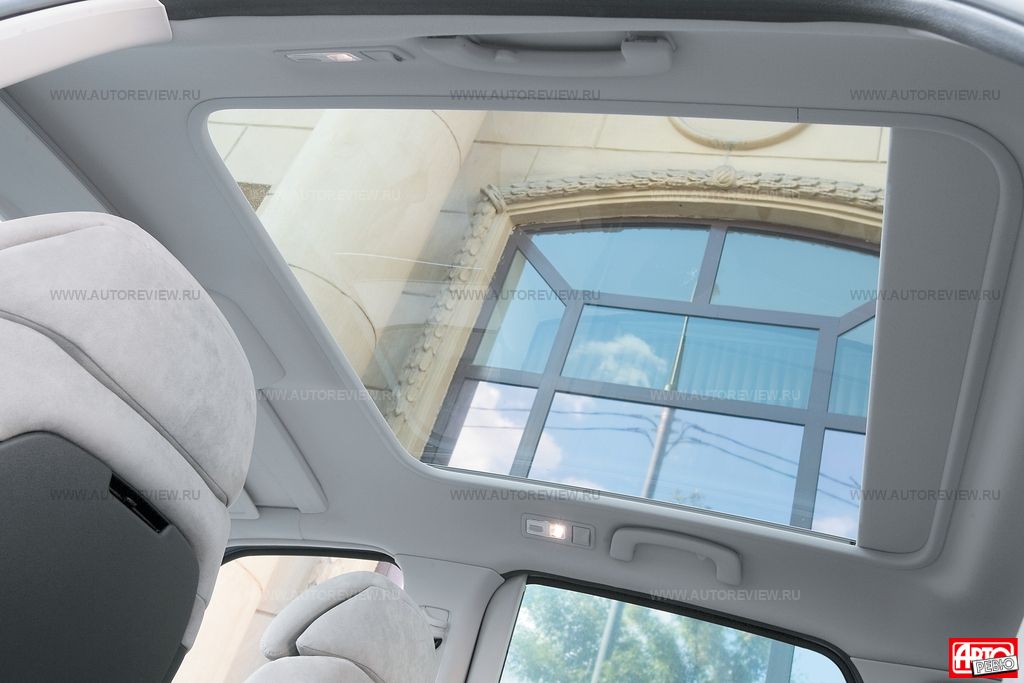 |
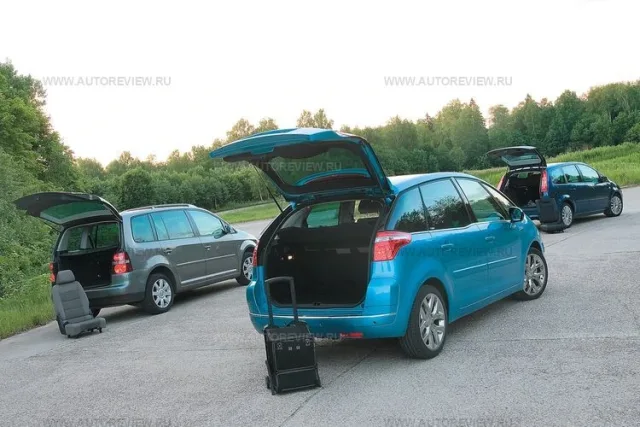
| Parking allowed! The Citroen can itself determine the necessary gap between cars | The French car — with a built-in air freshener | Sunny circle, sky around — this is the glass roof |
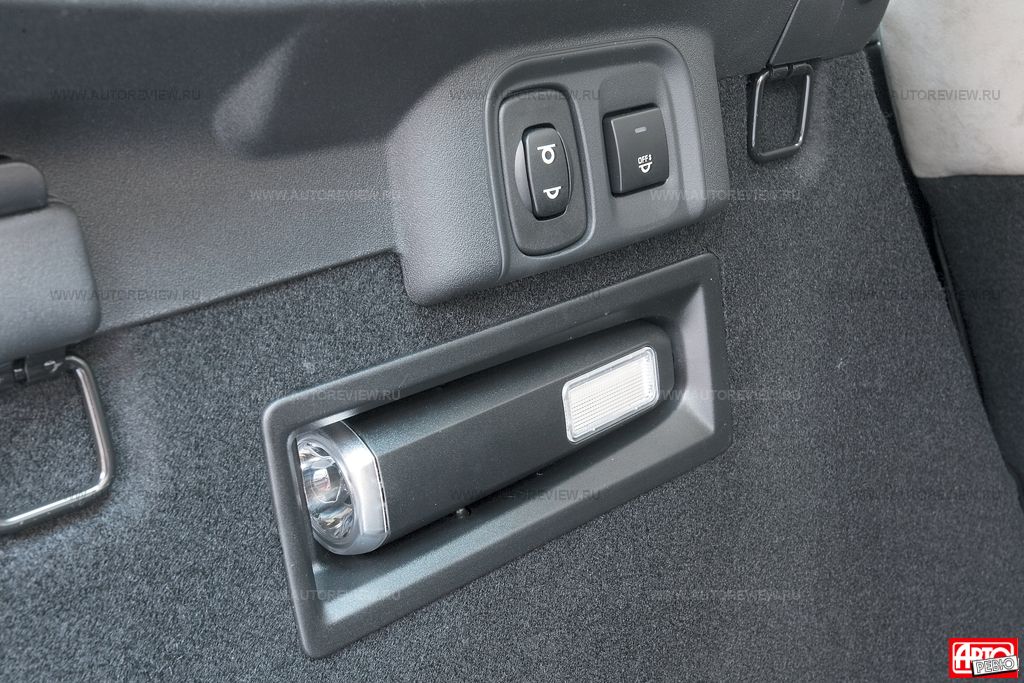 | 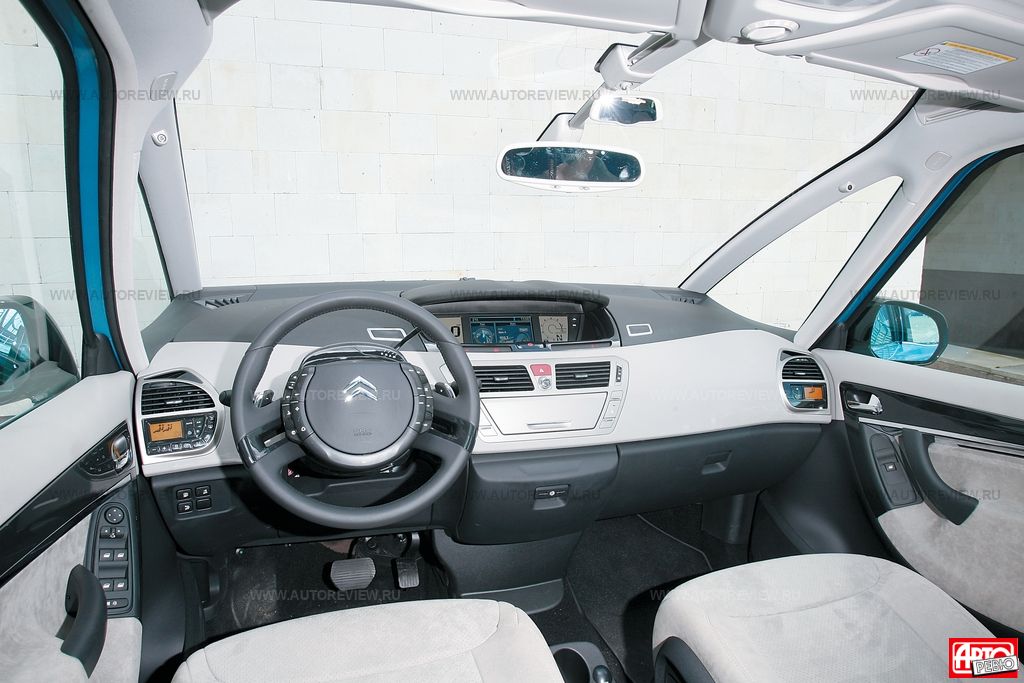 | 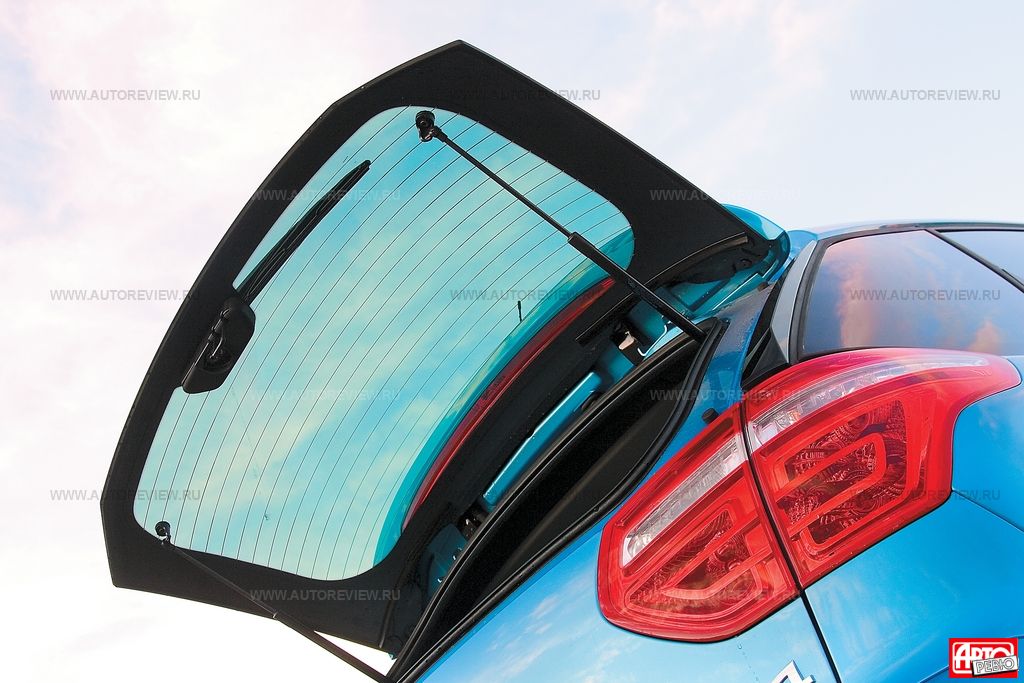 |
| The Picasso has a flashlight in the trunk | Original, stylish, and bright | The glass on the fifth door of the C4 Picasso can be opened separately |
Of course, there are some drawbacks. The speedometer hides behind the steering wheel rim, and the buttons and small screen of the "left-side" climate control unit are also hidden from the driver. But everywhere there are many compartments for small items. Just on the front panel with a large "refrigerator" in the center, there are four of them. And sitting behind the wheel is comfortable: the flat, small steering wheel immediately fits in your hands and adjusts for height and reach, and the seats with widely spaced side bolsters and soft Alcantara upholstery are simply luxurious.
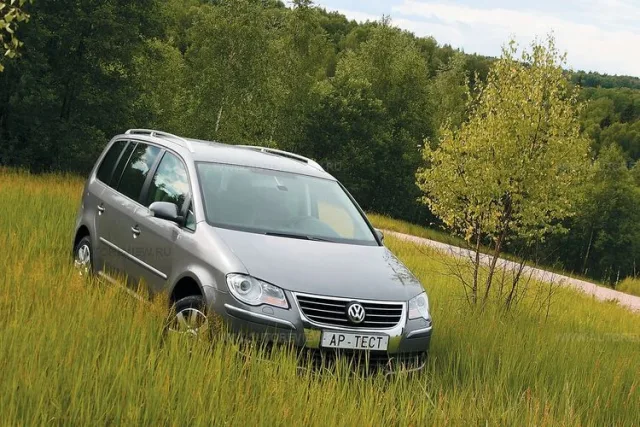
The Volkswagen Touran is a completely different story. This one is a traditionalist and rationalist to the core of its mechanical bones. A gloomy face like a Passat, a chest-like profile. And the interior? It wasn't drawn — it was drafted. But everything is precise, everything in its place. Grippy fabric bucket seats, a small "sporty" steering wheel — everything adjusts in wide ranges. Familiar Volkswagen dials, a high-mounted and therefore extremely convenient climate control unit... Ordnung über alles — order above all!
| Citroen C4 Picasso | Ford C-MAX | Volkswagen Touran |
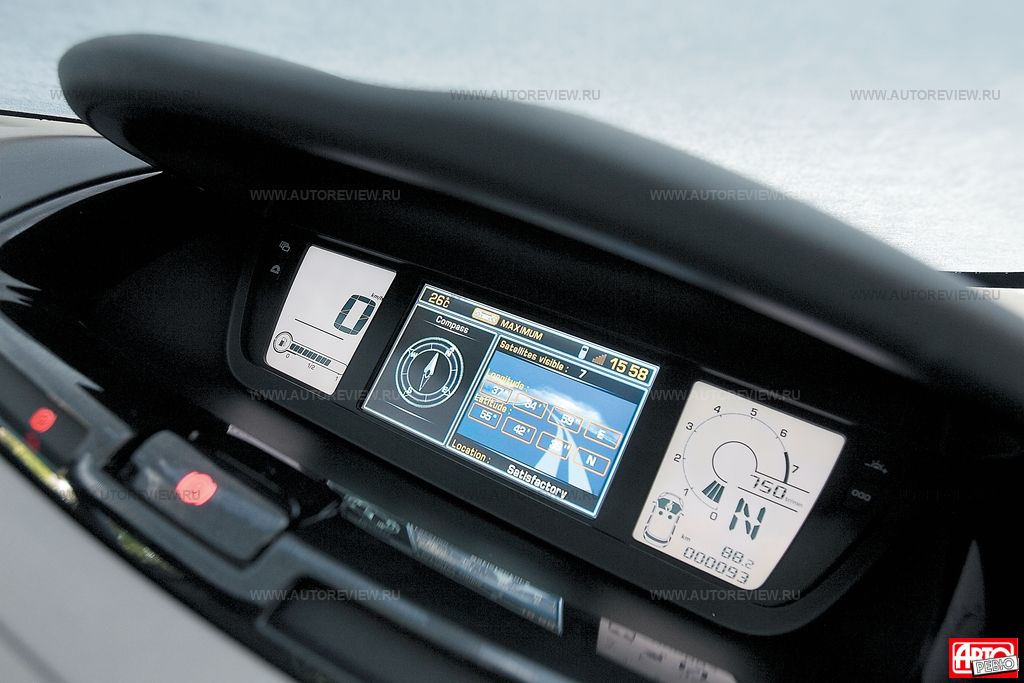 | 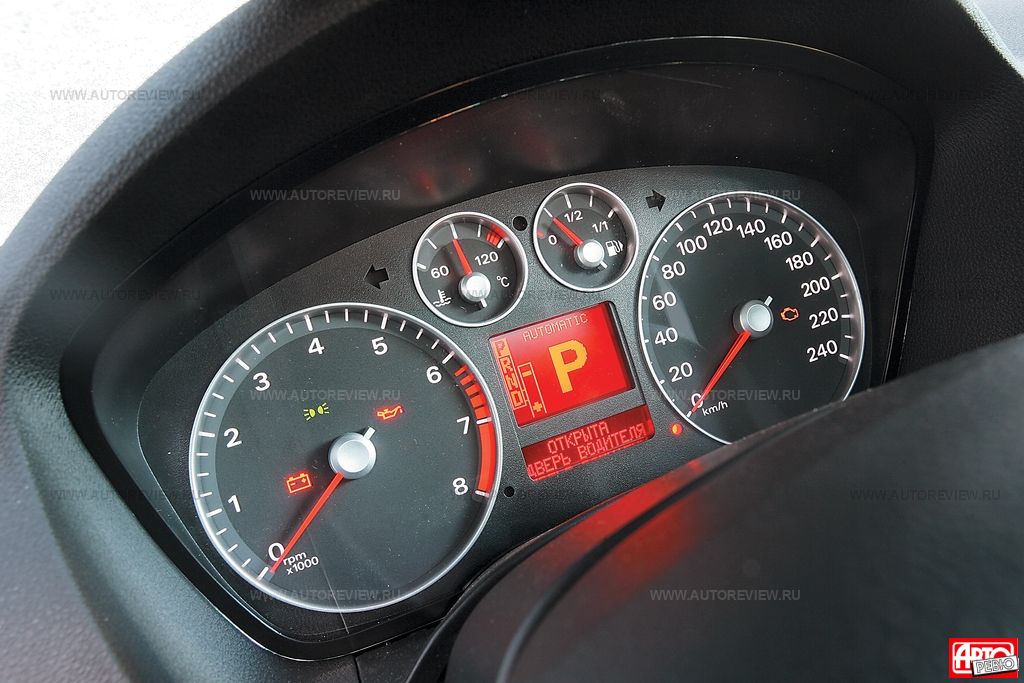 | 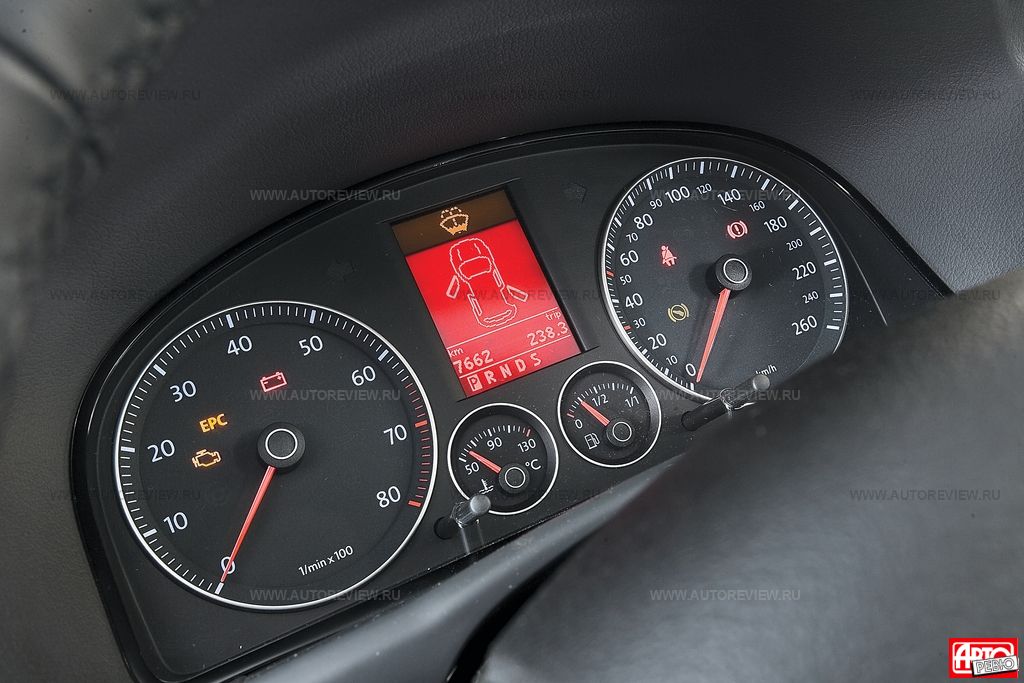 |
| The analog instruments of the Ford and Volkswagen are perfectly readable, but you have to squint at the "digital" speedometer and tachometer scattered at the edges of the Citroen | ||
The updated Ford C-MAX is a kind of compromise, a golden mean. It's not boring: new slanting headlights with daytime running light brows and "vertical" fog lights suit it. But there's no hint of French design extremism here either. Inside, there are smooth contours and appropriate metallic inserts. The only complaints might be glare from the stereo and simple-looking instruments. But they are highly informative. Even the position of the automatic selector is displayed as a large symbol in the center of the instrument panel, with hints for manual mode.
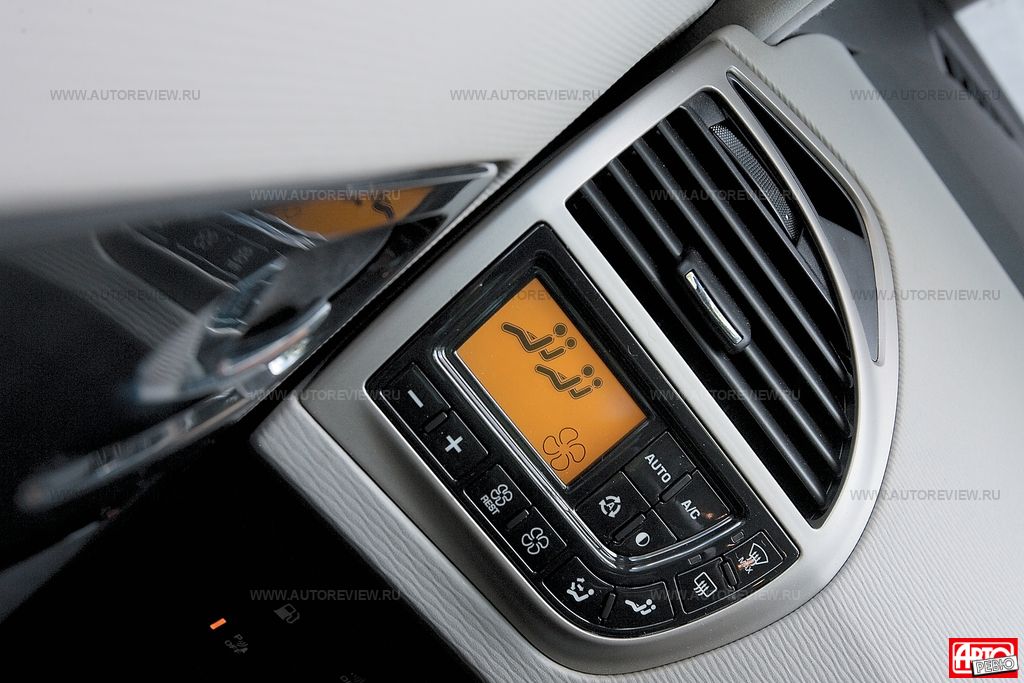 | 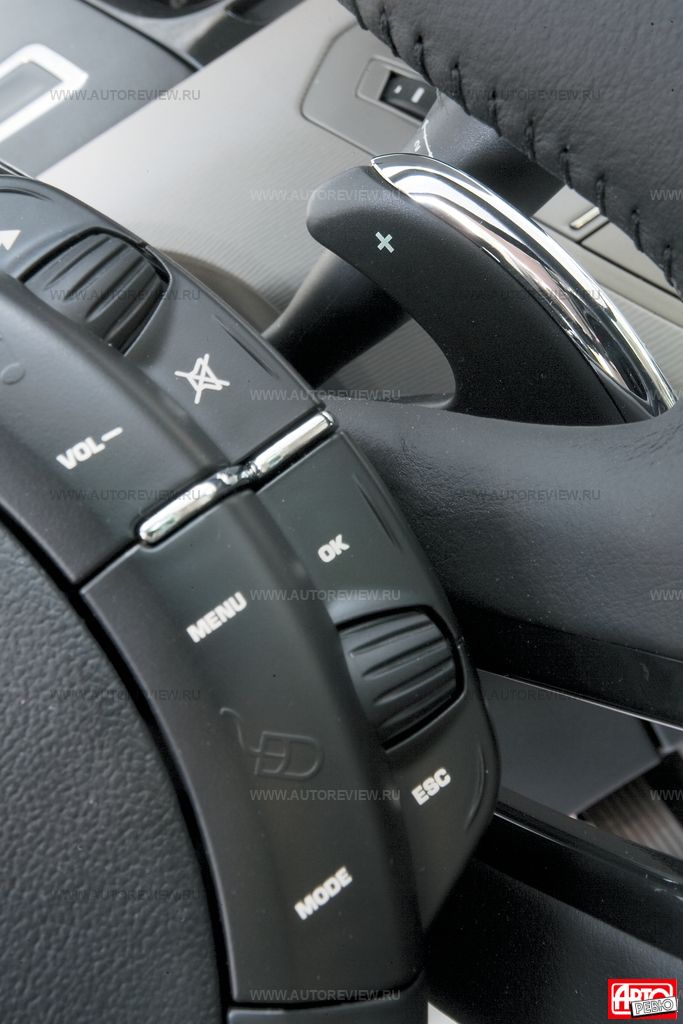 |
| The central climate control panel is to the left of the driver | Using the paddle shifters, the array of buttons, and "dials" on the steering wheel hub is convenient |
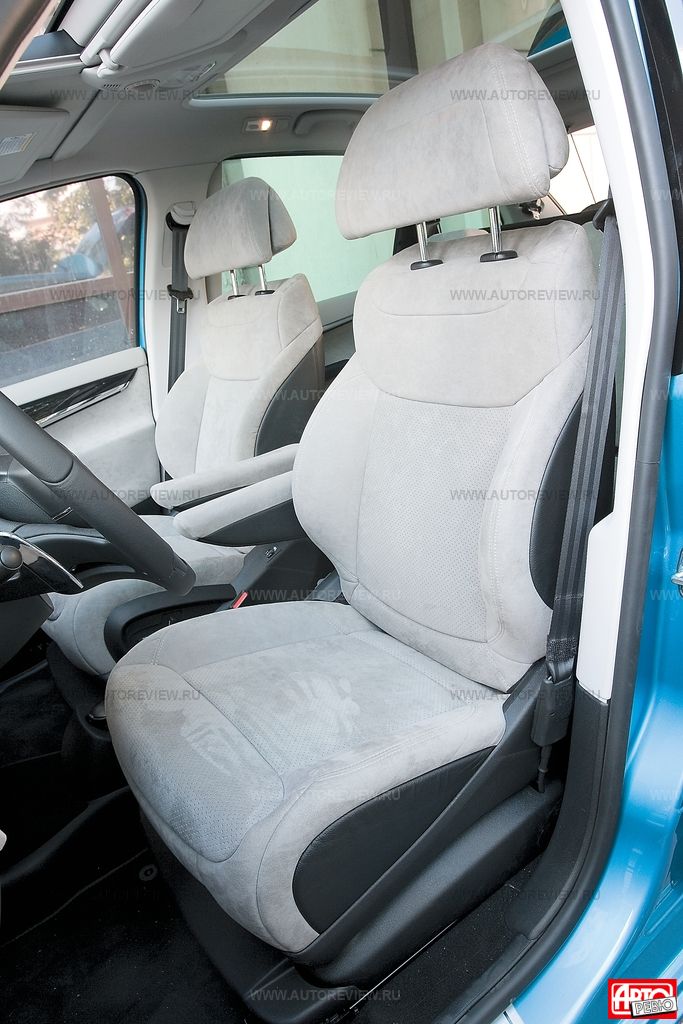 | 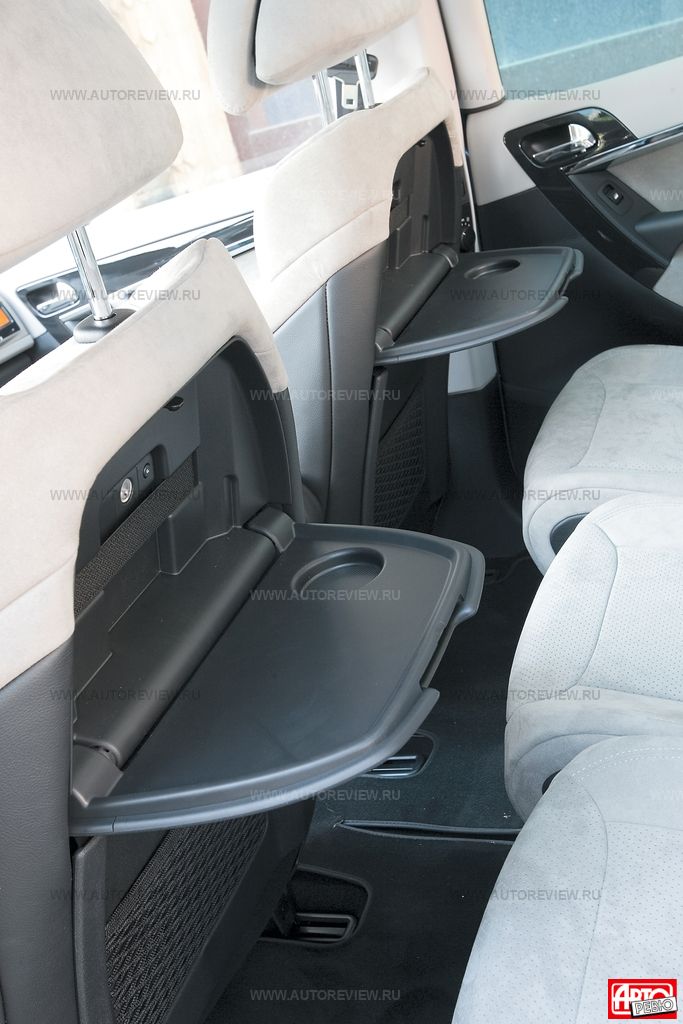 |
| The soft Citroen seats put a lot of pressure on the spine of a stooped person | In the back, there are fold-down tables like on airplanes |
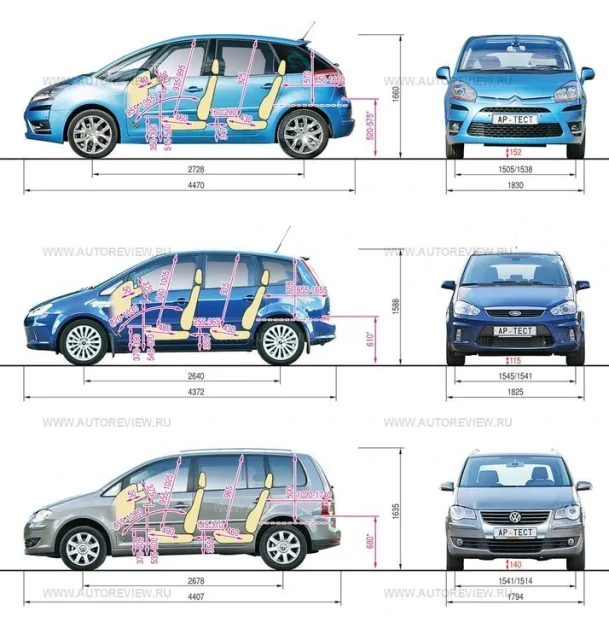
But for rear passengers, the Ford is not as comfortable as the Citroen. In the Citroen, it's truly spacious! Not only is there no central tunnel and the ability to sit comfortably three abreast in the back, but the middle passenger can also stretch their legs freely — there's no console between the front seats either! Additionally, there's a climate control panel — rear passengers can adjust the airflow intensity. It's a pity that the rear seats only fold down — they can't be removed from the cabin.
The Touran and C-MAX are a bit tighter. When getting in, your knees hit the fold-down tables, and the middle passenger has to deal with the console and central tunnel. But in both cars, you can remove the middle of the three separate rear seats and end up with a four-seat cabin. In the Ford, by sliding the seats with armrests back diagonally, you get truly royal comfort for two. It's a pity it's not convenient to do — all the latches and locks work with difficulty. Not like the Volkswagen — everything works smoothly there. The best transformer! But even here, there's a fly in the ointment: the rear seats don't have armrests, so the four-seat configuration is a thing in itself. You sit like on a chair in the middle of an empty room.
Need to transport a refrigerator or throw in twenty bags from the supermarket? The Citroen is good here. The trunk is spacious, and the loading height is the best of the three. Additionally, the glass of the fifth door opens separately, there's a branded thermal picnic basket, a flashlight, and many other useful little things. The French love not only family shopping but also trips to nature!
The Touran's trunk is neat with a spacious underfloor — pedants will be delighted. And the Ford loses to its rivals both in trunk volume and trim quality. However, it's not bad either.
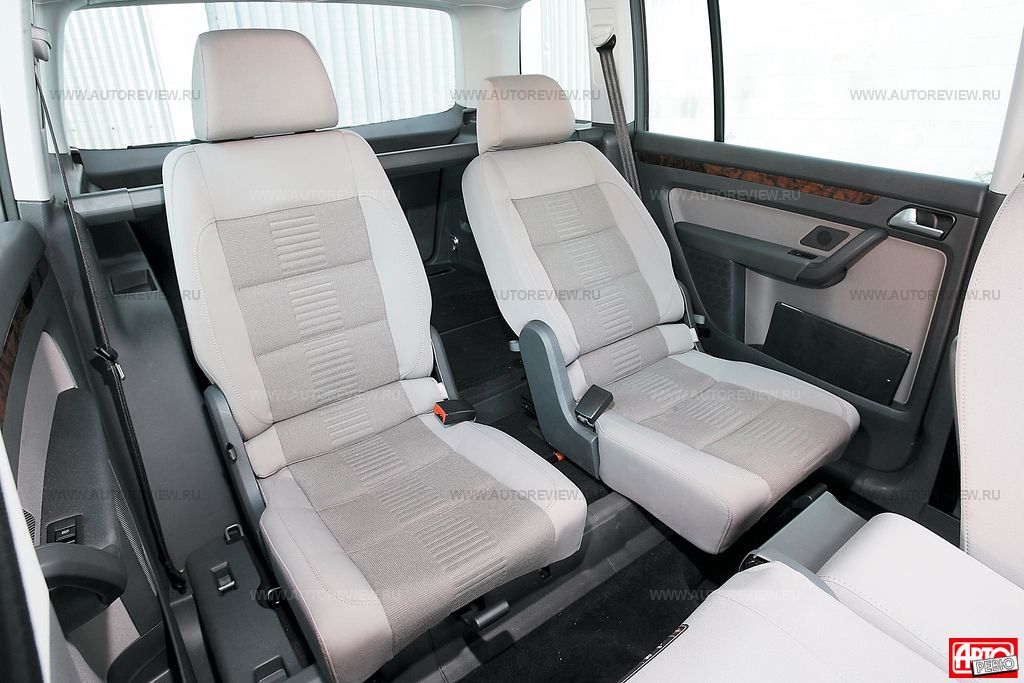 | 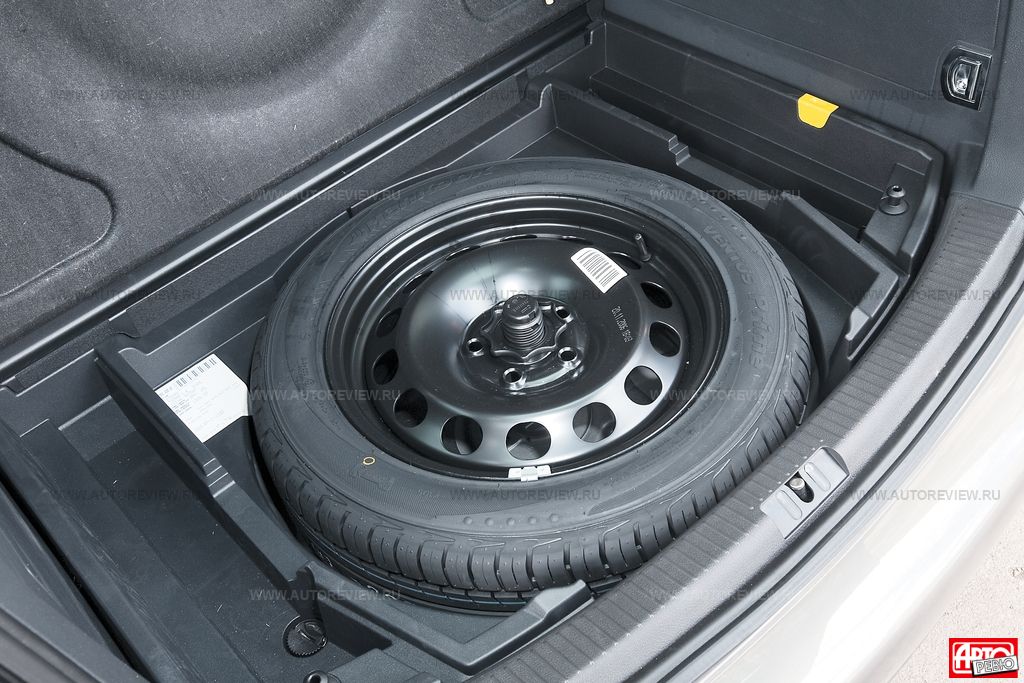 | 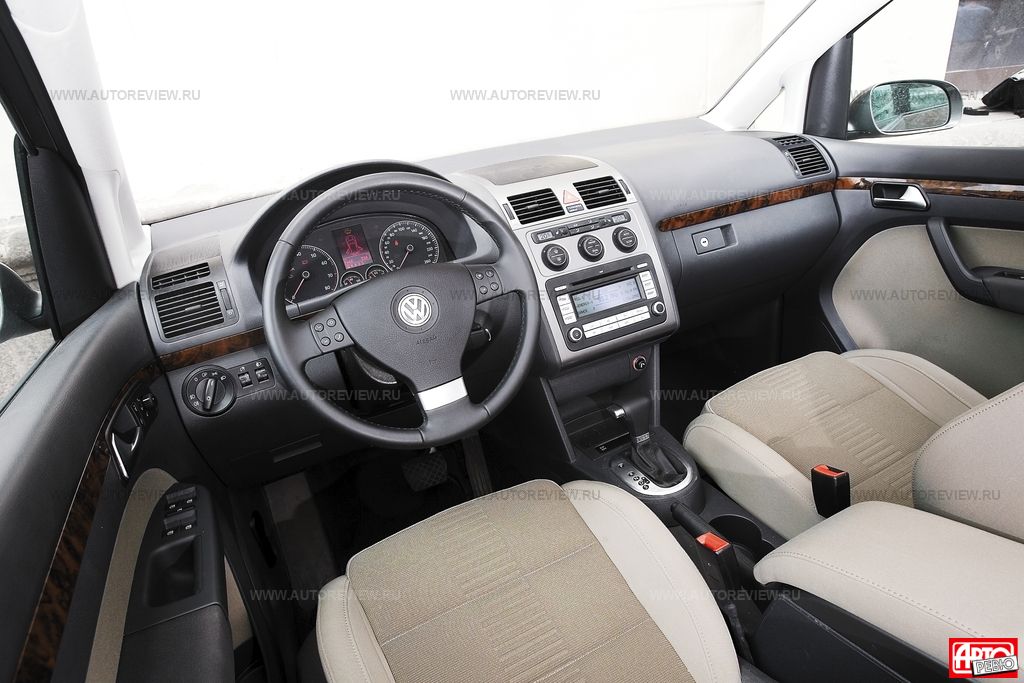 |
| Two rear seats in the spacious Touran are like two chairs in the middle of an empty room: uncomfortable | The Touran and C4 Picasso have full-size spares, while the C-MAX (pictured) gets a space-saver for an extra $50 | Volkswagen Touran — the quintessence of German pedantry and neatness |
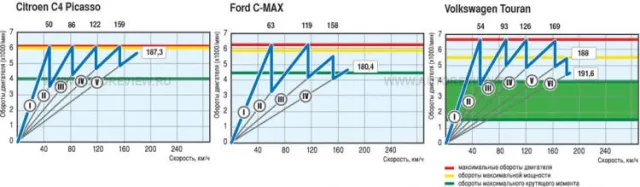
Ford turned out to be exactly the car that fits the definition of "solid." Even though it yields to Volkswagen and Citroen in acceleration dynamics, and its second gear is overly stretched, the classic four-speed automatic works flawlessly. Yes, a fully loaded C-MAX is reluctant to tackle hills, and energetic drivers may find it phlegmatic, but in a calm rhythm it is simple and convenient: the car is literally tied to the accelerator pedal. And is anything else needed for a family car?
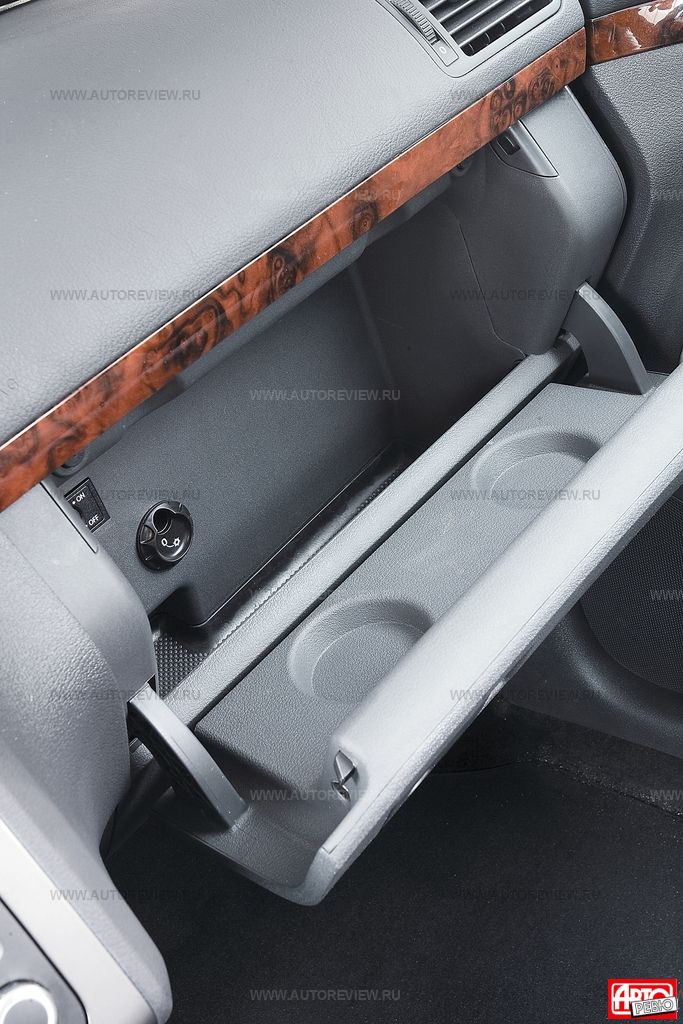 | 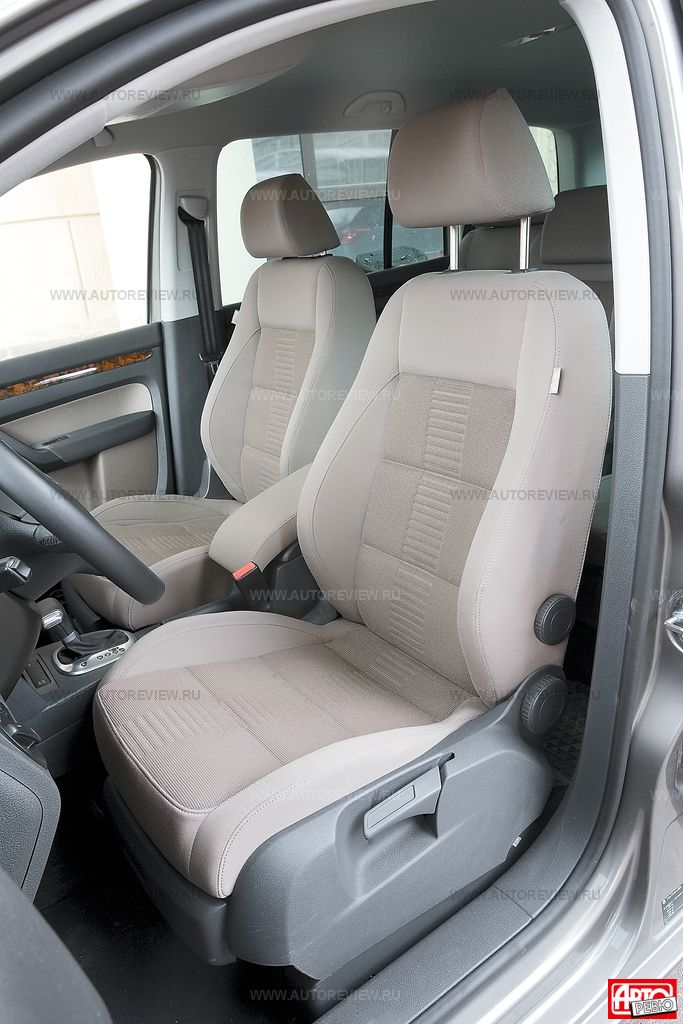 | |
| On the ceiling of the Touran — a glasses case and two compartments for A5 books | The glove box is not deep, but tall | Volkswagen seats have an excellent profile and strong lateral support |
Volkswagen, however, presents a surprise: where does this modest burgher get so much fire? The secret is in a unique engine — an inline four-cylinder 1.4 TSI with twin charging. The mechanical supercharger provides thrust from the very bottom, then the turbo takes over, and two-liter rivals are left far behind! And what a voice this unit has — rich, with growling notes… True, the notorious robotic DSG gearbox with two clutches sometimes annoys with illogical shifts and noticeable pauses in Drive mode. But switch the selector to Sport, and all complaints disappear.
Citroen, in terms of feel, does not yield to Volkswagen in dynamics. But the whole picture is spoiled by the "robot" based on a manual, which stumbles on every gear. If you press the gas very smoothly, the jerks are almost imperceptible, and the pauses are small. But in city traffic jams, its thoughtfulness when engaging first gear becomes frankly infuriating. And when you move to more active driving — it's a real disaster. Delays, jolts... Only the paddle shifters and manual mode save the day.
| Citroen C4 Picasso | Ford C-MAX | Volkswagen Touran |
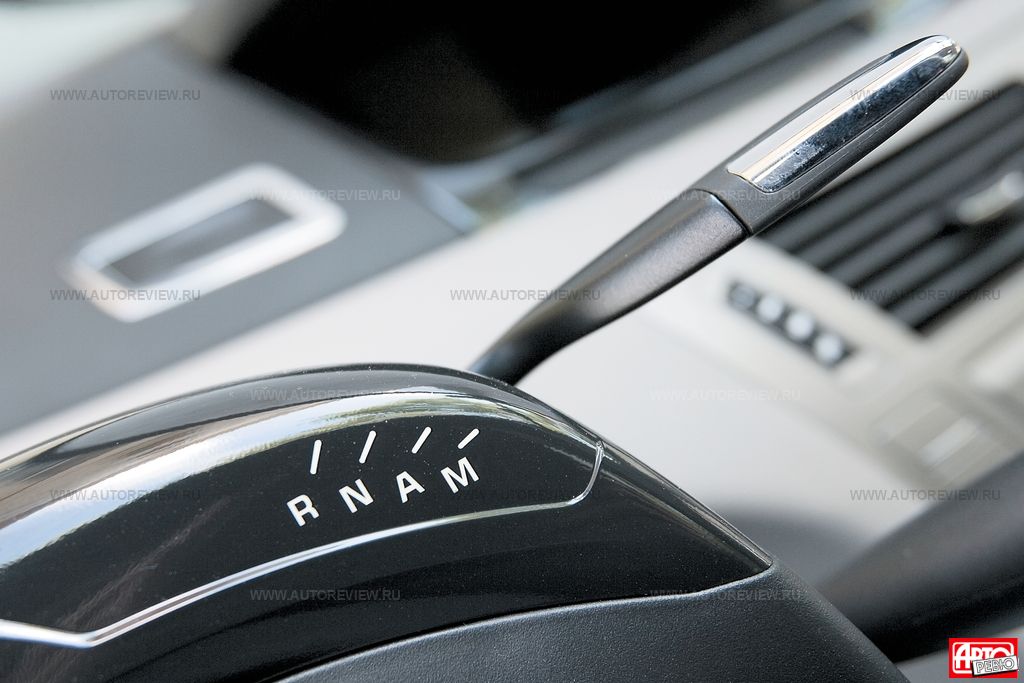 | 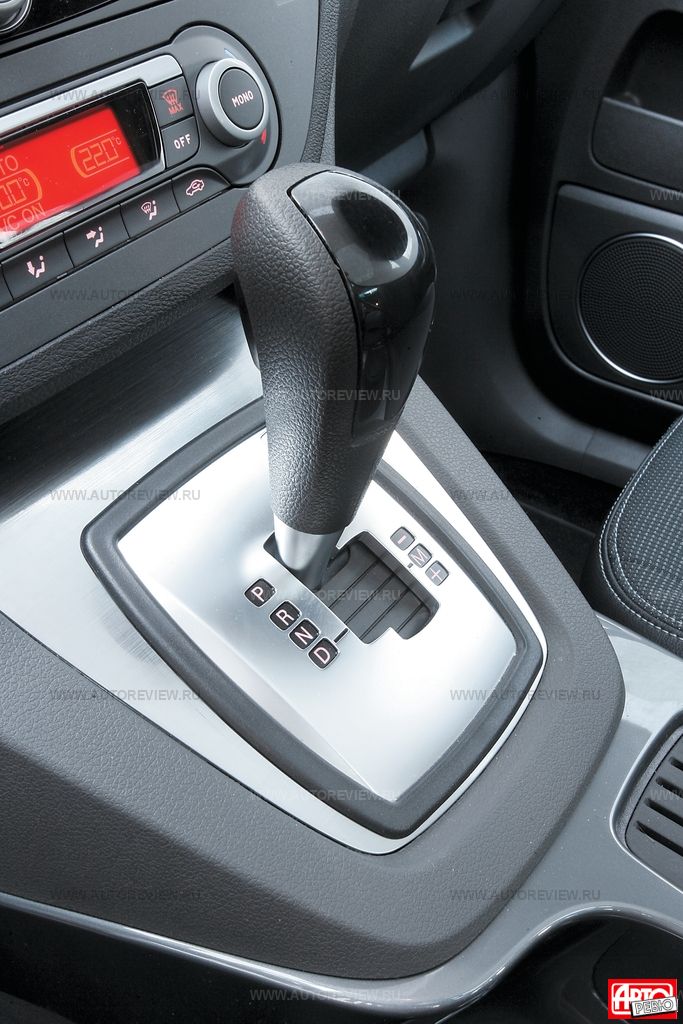 | 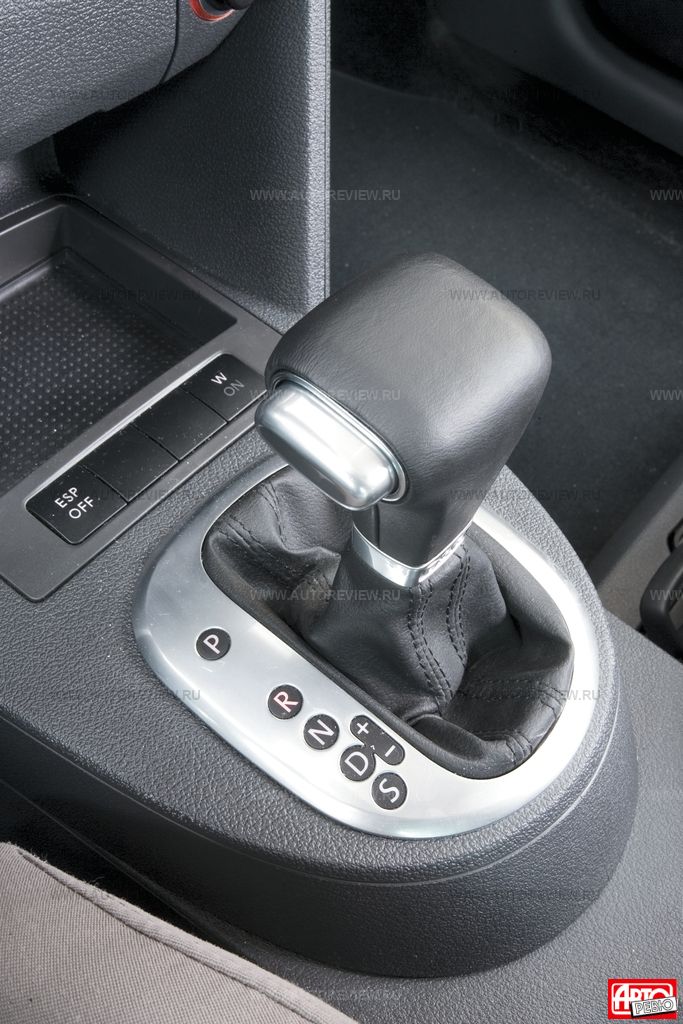 |
| The Citroen's "robot" is only good for leisurely driving, the praised Volkswagen DSG also lags in Drive mode, and the Ford's automatic shifts most predictably | ||
To assess dynamics, we conducted a separate test for the compact vans: fully loaded cars had to climb a calibrated hill, where we recorded the speed at the top. No miracle happened: the Touran showed 94 km/h, the C4 Picasso — 86 km/h, and the C-MAX could only accelerate to 80 km/h. But if you trust the onboard computers, the most spirited Volkswagen turned out to be the most voracious: its average consumption was 13.4 l/100 km. For the Ford over the same route, it came out to 12.0 l/100 km. But Citroen became the triumph of efficiency — only 10.8 l/100 km according to the electronics.
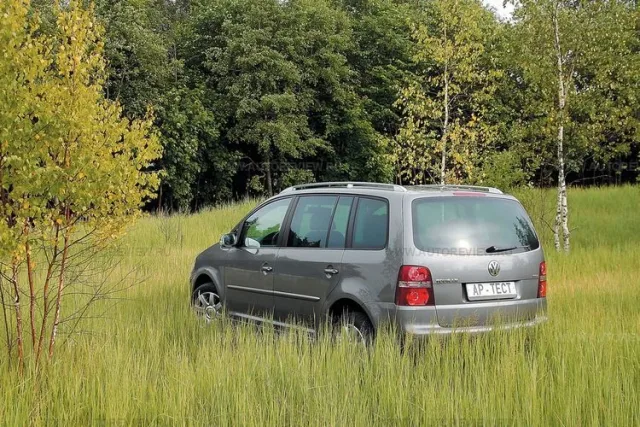
At the same time, the Picasso also proved to be the safest in emergency braking: on the asphalt of the dynamometric road at the Dmitrov test site, it stopped from 150 km/h in just 92.7 m. It's a pity that in normal modes the pedal is too "soft" — unlike the Ford, where the brakes are tuned exemplarily. Still, in terms of braking distance, the C-MAX yielded three meters to the Citroen. And the Volkswagen with its "cottony" and overly sensitive pedal — as much as seven meters! Maybe it's the Hankook tires?
But these Korean tires did not prevent the Volkswagen from showing the best result in the "moose test" — 78.6 km/h. What a chassis! On a straight line, the Touran stands as if glued, but just turn the wheel — and it's already in the next lane. During such maneuvers, the stability control even sometimes intervenes! Rich steering effort, instant responses, almost neutral handling… And if you turn off ESP, you can take a corner in a spectacular drift, like in rally: at the limit, the Volkswagen prefers rear-end slide.
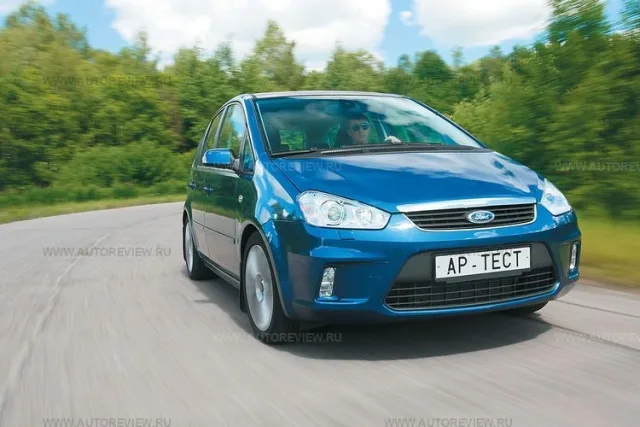
Ford C-MAX is reliable in corners and moderately spirited
But how it shakes here! Even when the car is fully loaded, the Touran is merciless to passengers. Impacts from potholes, constant engine hum in the cabin — especially in the gearbox's sport mode… And at speeds from 140 km/h, aerodynamic whistle is added to all this, which drowns out all other noises.
Ford engineers clearly found a more successful compromise. The C-MAX holds a straight line no worse than the Touran, but changes lanes softer and calmer. Even though it doesn't enter a corner as sharply and first slightly understeers, then the car fully obeys the driver. Slides build up smoothly and are easily controlled — all thanks to the transparent and natural steering effort. Rolls are moderate, and stability control activates only to correct a slide.
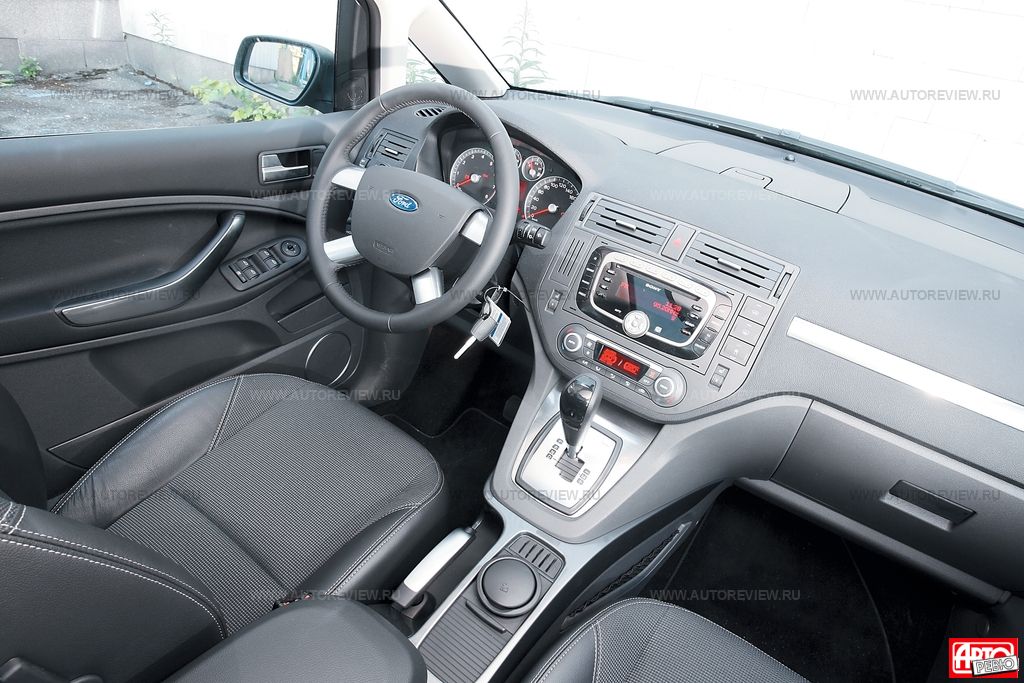 | 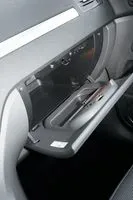 | 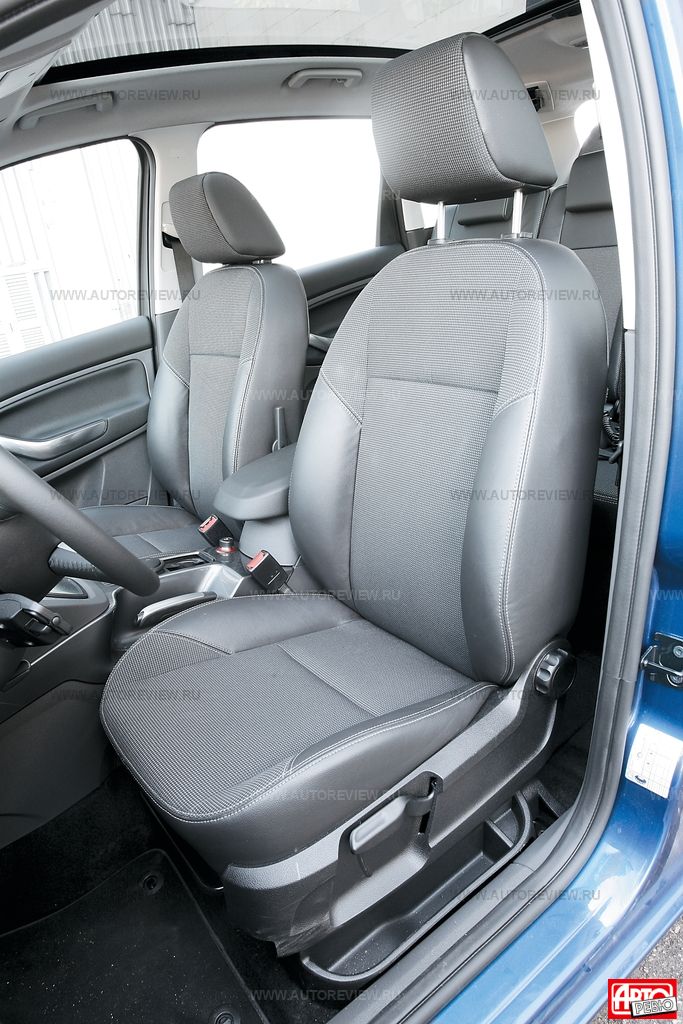 |
| Ford's interior in the Titanium version is a model of refined tech style | The Ford has a deep "stash" | The extra charge for sports seats is $790, and they are worth it |
Moreover, the C-MAX is the leader in ride comfort: it smooths out any irregularities superbly, regardless of load. It's only a pity that the cabin is a bit noisy: the tire hum on rough asphalt is especially annoying.
And what about Citroen?
At high speed, it is also good: it confidently holds a straight line, instantly reacts to steering wheel turns. Responses are fast, smooth, and predictable, and the steering effort, though not entirely natural, is quite informative. In sharp corners — almost neutral handling. Moreover, even under acceleration, the Citroen does not tend to straighten the arc, but tenaciously follows it, slightly screwing inward. Oversteer? It will be gently suppressed by the stability control, which cannot be disabled above 50 km/h. But if you need to sharply avoid an obstacle, it will be difficult or even impossible: with rapid steering, the wheel locks up solidly!
| Citroen C4 Picasso | Ford C-MAX | Volkswagen Touran |
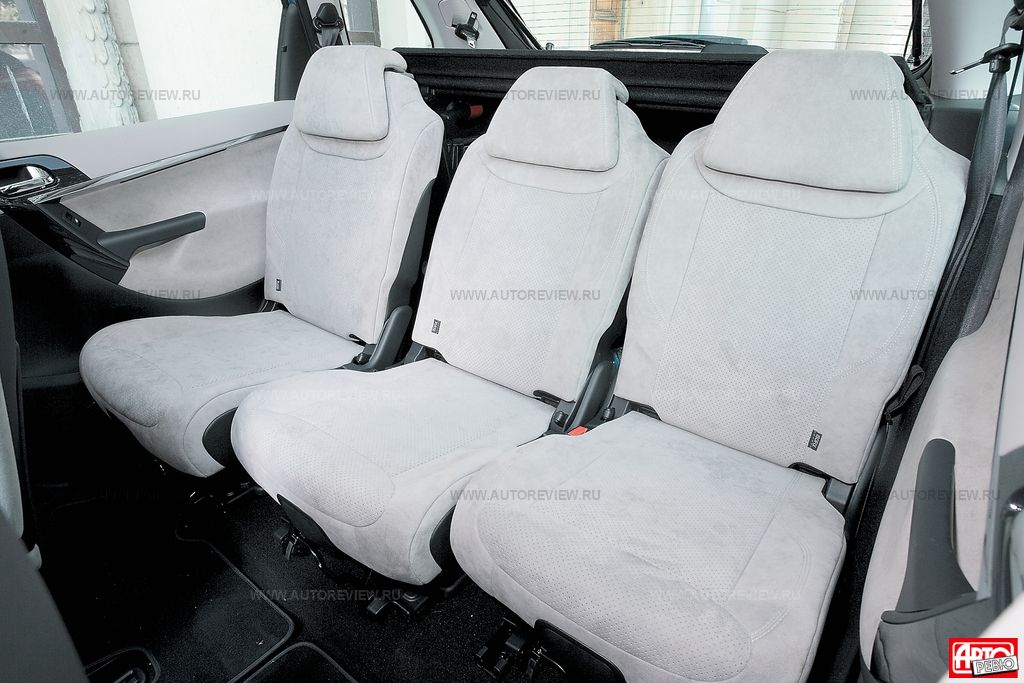 | 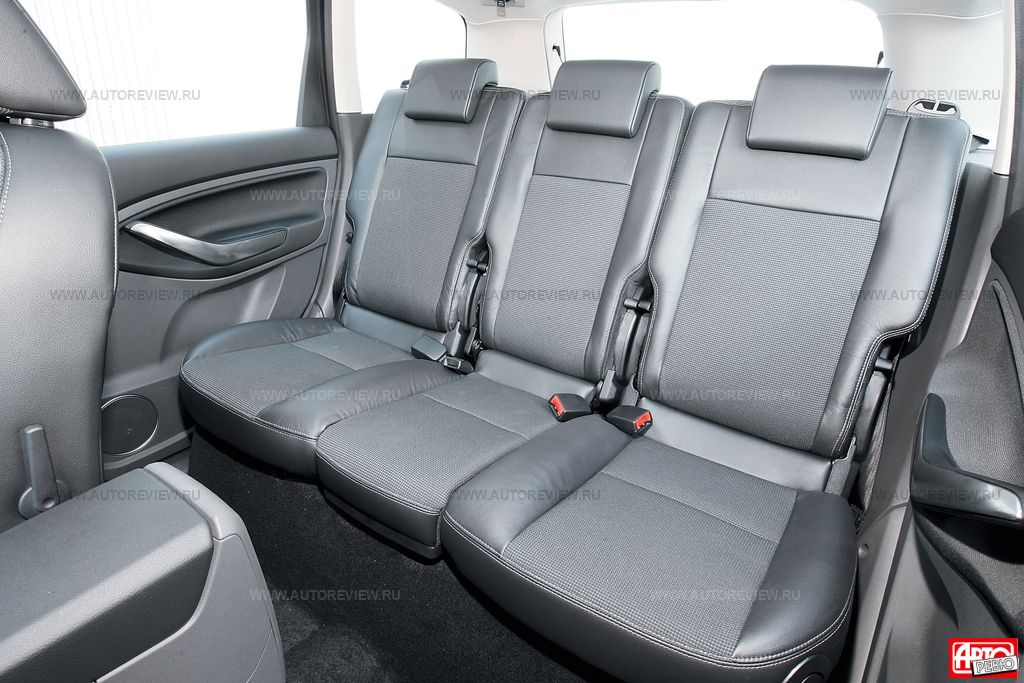 | 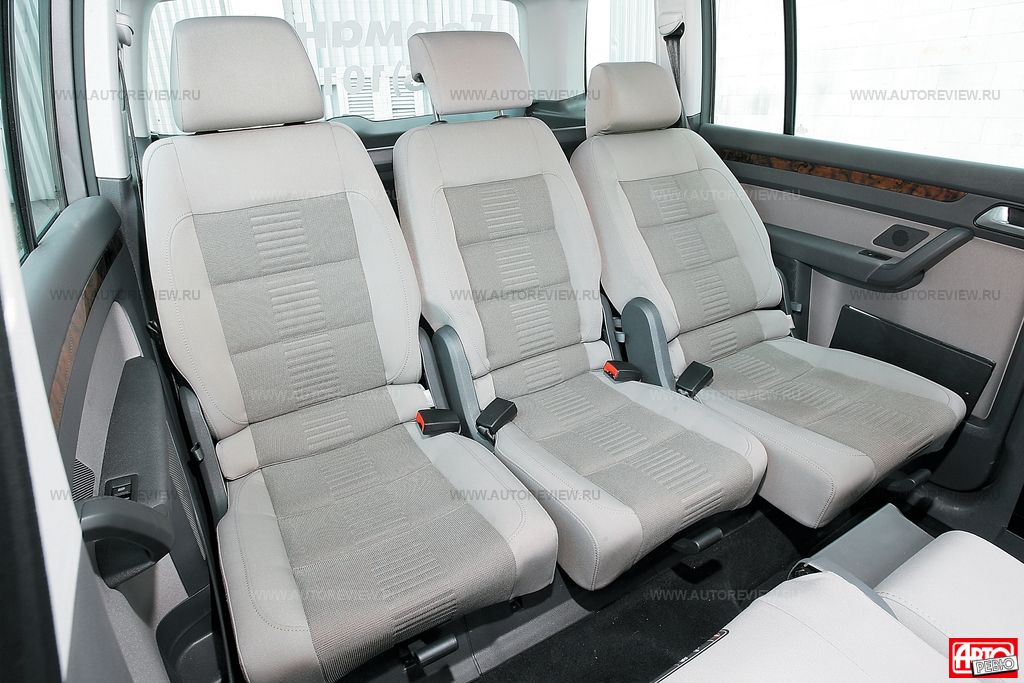 |
| In the rear seats, all cars are quite spacious, but the Citroen has the most room | ||
Moreover, the Picasso has somewhat large rolls, and on corners, diagonal rocking is noticeable, causing the car to deviate from its course. When hitting hard bumps, the steering wheel literally tears out of your hands. All road small stuff transmits vibration to the body, and on large bumps the suspension bottoms out — it lacks energy intensity. And those prone to motion sickness should avoid the Citroen altogether: it will definitely make you sick. The only consolation is that the cabin is very quiet.
So what to choose?
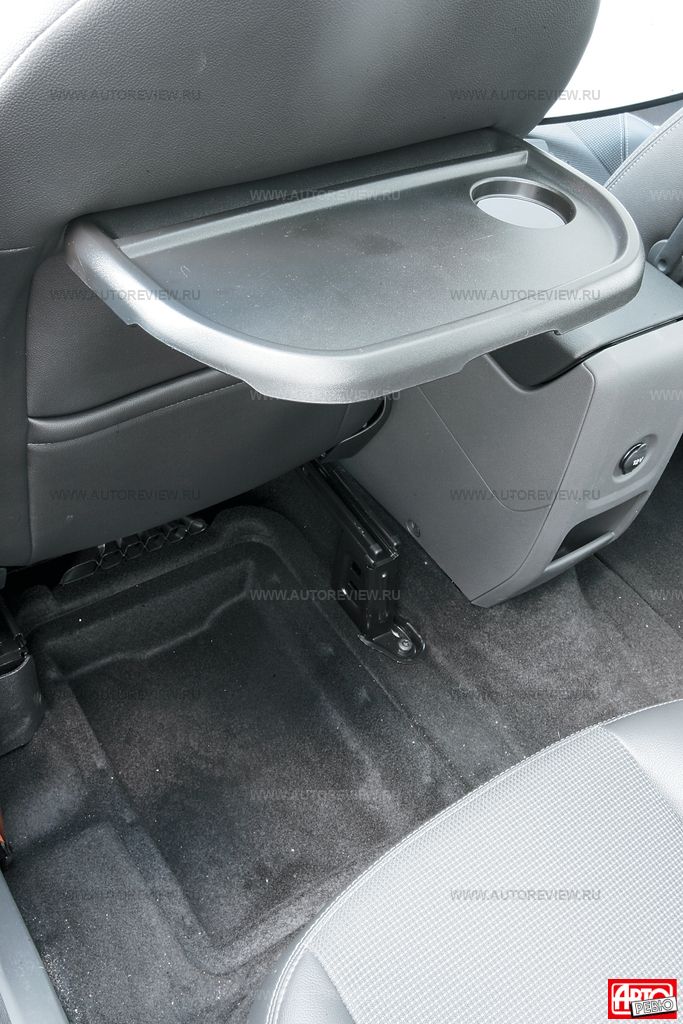 | 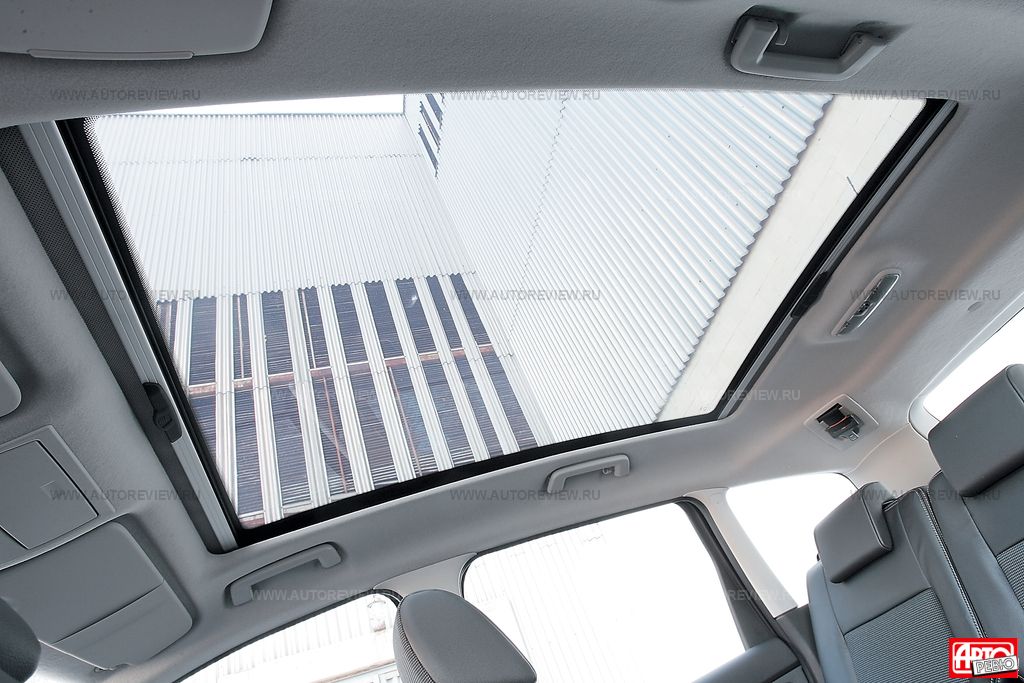 | 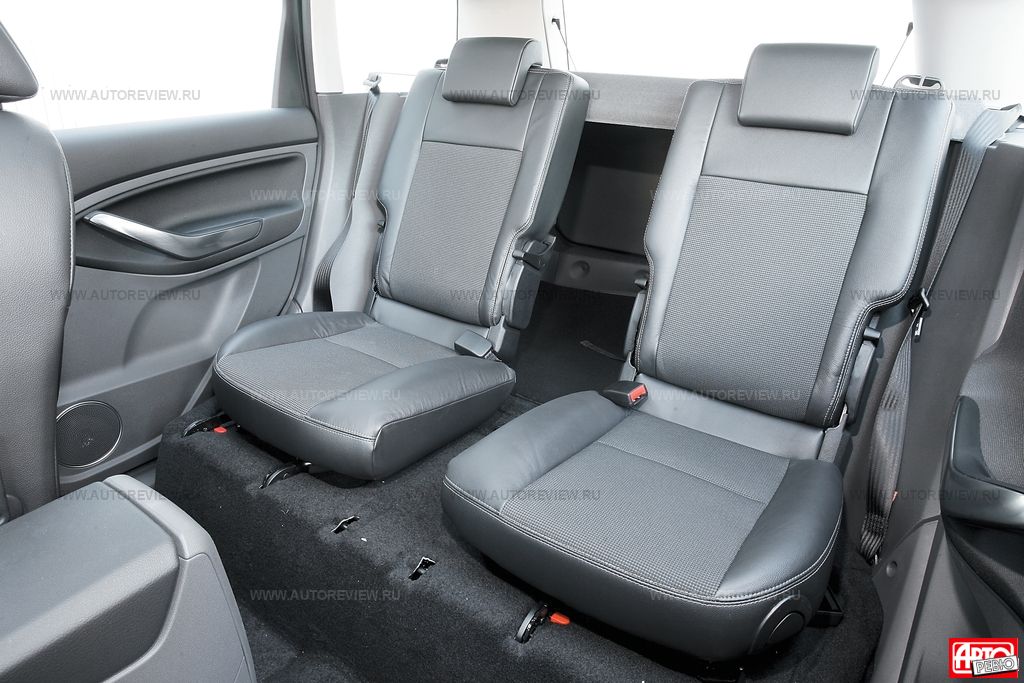 |
| The table in the Ford folds down, interfering with the passenger's knees | Glass roof on the C-MAX — for $740 | For two in the back row of the Ford — royal comfort |
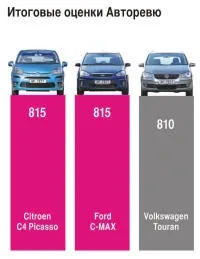
The score tally almost equalized all three — the difference between them does not exceed five points! Each car is good in its own way, each is practical… But their characters are still different.
Three characters: Citroen C4 Picasso, Ford C-MAX, and Volkswagen Touran
Volkswagen Touran is Germany itself: strict, pedantic, and thought out to the smallest detail. It turned out to be the most spirited to drive among the trio, although it looks a bit boring on the outside. Its price tag matches the quality — for this money, you could get a more versatile Passat. But here, unlike Germany, ride comfort is more important than driving excitement, especially when it comes to a family car. Touran sales are sluggish: only 507 cars were sold in the first half of the year.
Citroen C4 Picasso is France in its purest form. Here, beauty and comfort are valued: it is the most striking, the most spacious, and the quietest in this comparison. If you forgive it the ergonomic flaws, the jerky "robot" transmission, and the need to take motion sickness pills before every trip, then the Picasso is a decent option. True, it's expensive: the starting price is $26,830, and the test vehicle cost as much as $48,000!
| Citroen C4 Picasso | Ford C-MAX | Volkswagen Touran |
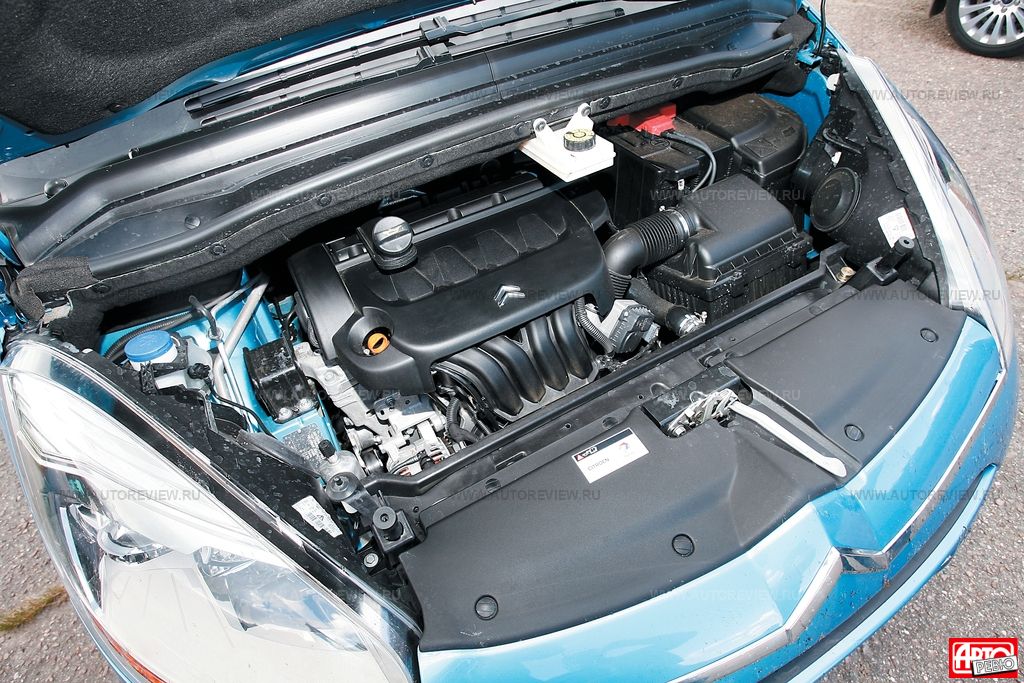 | 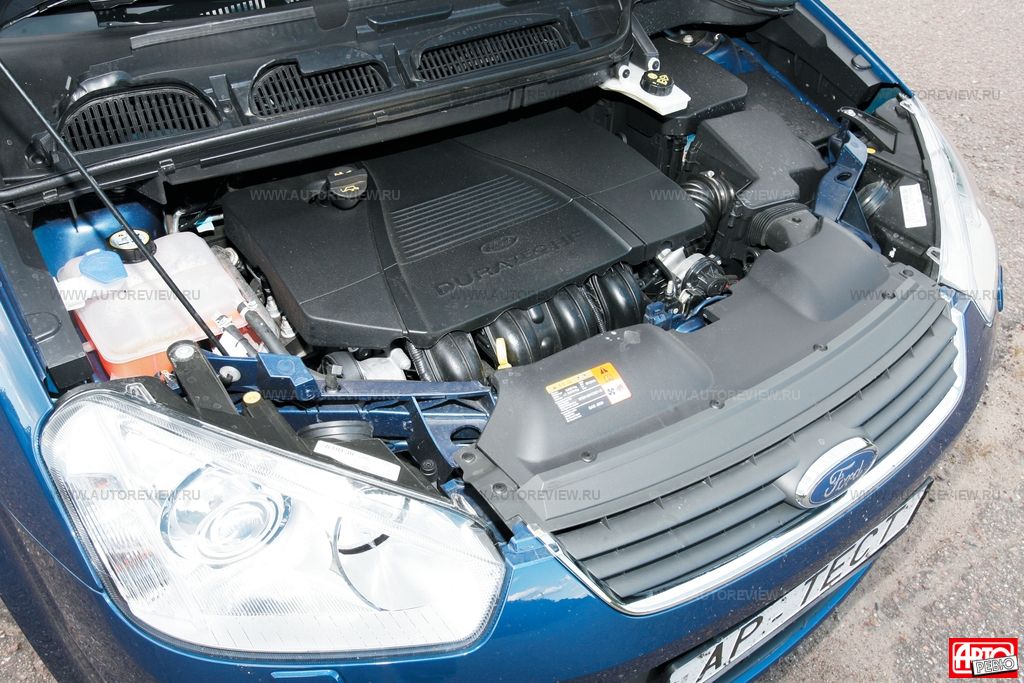 | 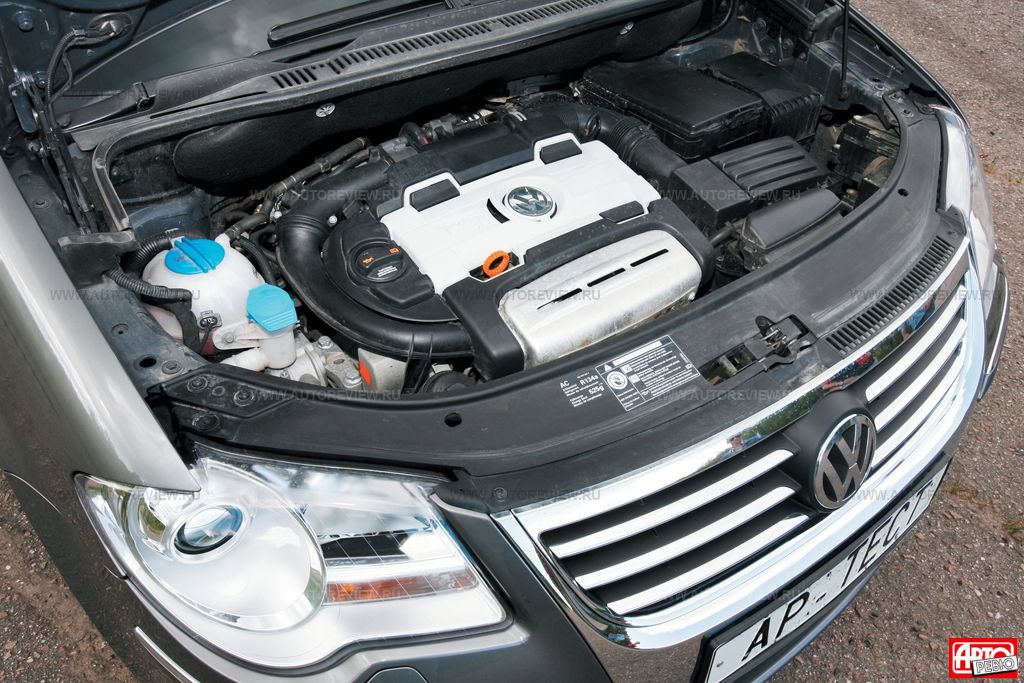 |
| Ford — 145 hp, Citroen — 143 hp, Volkswagen — 140 hp. Power does not match the feel and measurements: the fastest is the Touran, followed by the C4 Picasso, and only then the C-MAX | ||
Ford C-MAX is a true cosmopolitan. It successfully combines drive with comfort, style with practicality. And its price is the most democratic, even despite the price increase after the facelift. It's no coincidence that the C-MAX was the leader among compact vans on golf platforms until the last six months: in 2007, it was only overtaken by the Opel Zafira — 3,421 cars versus 2,951.
What Autoreview readers think
Before the test, we asked visitors of www.autoreview.ru which car from this trio they would choose. The votes were distributed as follows:
Ford C-MAX — 38.64%
Volkswagen Touran — 37.18%
Citroen C4 Picasso — 24.18%
A total of 7,677 people voted.
| Autoreview expert ratings | ||||
| Parameter | Max score | Vehicles | ||
| Citroen C4 Picasso | Ford C-MAX | Volkswagen Touran | ||
| Design | 160 | 140 | 130 | 125 |
| Exterior | 80 | 70 | 65 | 60 |
| Interior | 80 | 70 | 65 | 65 |
| Ergonomics | 160 | 130 | 140 | 135 |
| Driver's seat | 80 | 60 | 75 | 70 |
| Visibility | 80 | 70 | 65 | 65 |
| Dynamics | 260 | 205 | 220 | 220 |
| Acceleration | 80 | 55 | 60 | 65 |
| Brakes | 100 | 90 | 90 | 85 |
| Handling | 80 | 60 | 70 | 70 |
| Ride comfort | 210 | 165 | 160 | 155 |
| Ride smoothness | 80 | 55 | 65 | 60 |
| Acoustic comfort | 70 | 60 | 50 | 50 |
| Climate control | 60 | 50 | 45 | 45 |
| Interior comfort | 210 | 175 | 165 | 175 |
| Passenger seats | 70 | 60 | 55 | 55 |
| Trunk | 70 | 60 | 55 | 60 |
| Interior transformation | 70 | 55 | 55 | 60 |
| Total | 1000 | 815 | 815 | 810 |
The "moose test"
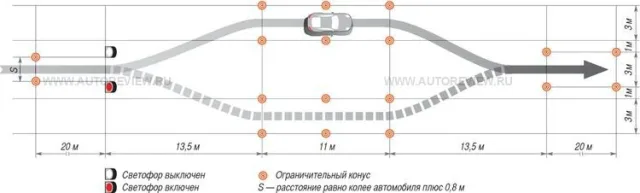
We simulate a sharp obstacle avoidance maneuver in two stages. First, four drivers already familiar with the cars attempt to avoid the "moose" at 65 km/h on the first try — the direction of the maneuver is indicated by a traffic light. Then an expert in a series of runs seeks the maximum speed.
The results of the "traffic light" runs were disappointing: only 25% of successful attempts across all three cars. But they behaved differently.
The Volkswagen surprised: in normal driving, it responds keenly to the steering wheel, but in an emergency situation, the response turned out to be sluggish. Nevertheless, it was the Touran that showed the best result — 78.6 km/h. The ESP works exemplarily here: it reduces speed, suppresses the skid in its infancy, and immediately releases the brakes. But the steering wheel got in the way: first resistance, then a dip — this was confusing.
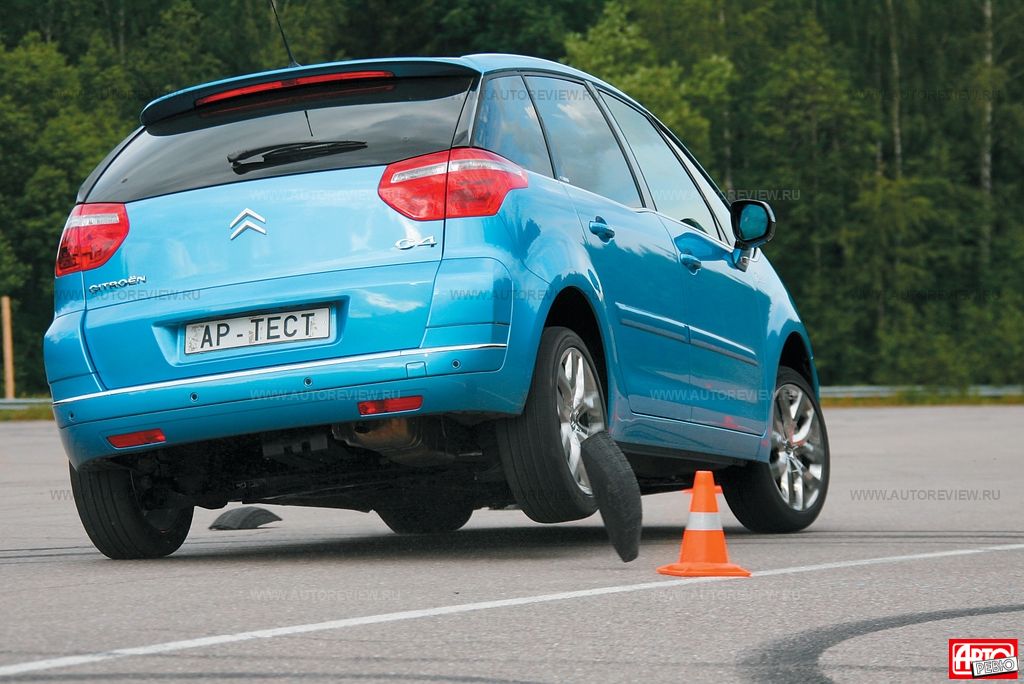 | 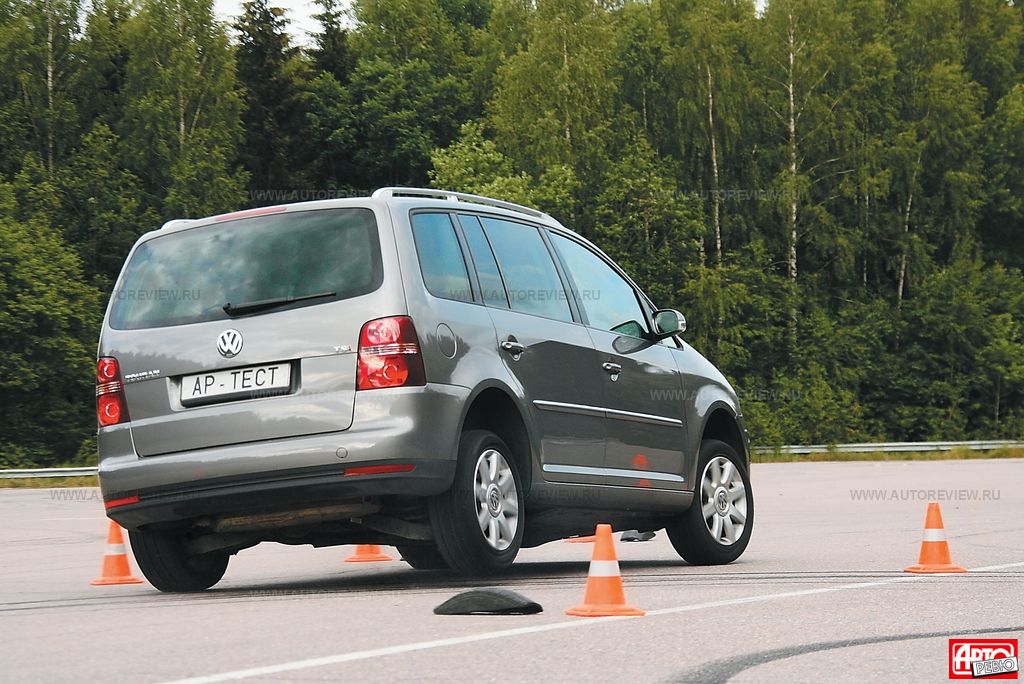 | 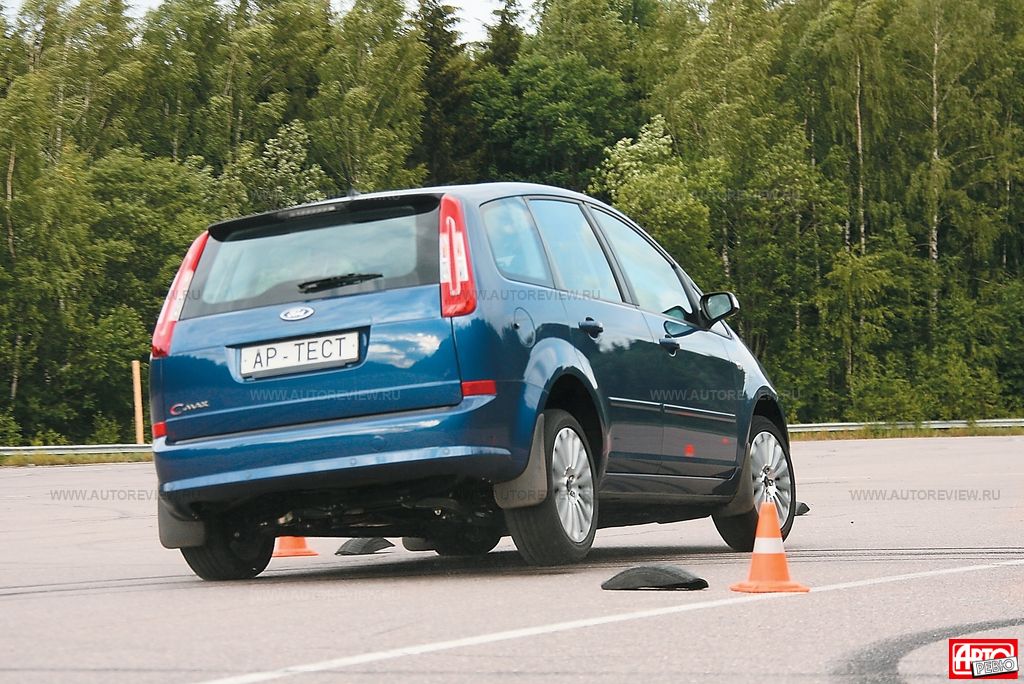 |
| The Citroen noticeably lifts its rear wheel in the "moose test" — the short rebound travel and large body rolls take their toll | The Volkswagen can boast the most "intelligent" stability control system | The Ford is obedient, but ESP intervenes with a delay |
The C-MAX is friendly and understandable even in a stressful situation. But drivers had a poor sense of the car's dimensions: after knocking down a cone, many were sure they had passed cleanly. The expert could not accelerate above 77.4 km/h due to progressive understeer, a step in the steering wheel, and late ESP activation.
The Citroen also did not let drivers feel the dimensions, and the steering wheel with a noticeable step caused complaints. For the expert, this step became insurmountable: 75.5 km/h required enormous physical effort. With such a power steering setting, neither the good chassis nor the precise ESP will help in an emergency.
| "Moose test" on the first attempt at 65 km/h | |
| Vehicle | Maneuver completed by |
| Citroen C4 Picasso | 1 out of 4 drivers |
| Ford C-MAX | 1 out of 4 drivers |
| Volkswagen Touran | 1 out of 4 drivers |
| Maximum speed in the "moose test", km/h | |
| Vehicle | Speed |
| Citroen C4 Picasso | 75.5 |
| Ford C-MAX | 77.4 |
| Volkswagen Touran | 78.6 |
| Technical specifications | |||
| Parameters | Vehicles | ||
| Citroen C4 Picasso | Ford C-MAX | Volkswagen Touran | |
| Body type | 5-door compact van | 5-door compact van | 5-door compact van |
| Number of seats | 5 | 5 | 5 |
| Trunk volume, l | 500—1734 | 473—1633 | 695—1989 |
| Curb weight, kg | 1560 | 1435 | 1500 |
| Gross weight, kg | 2040 | 1930 | 2170 |
| Engine | petrol, with multi-point fuel injection | petrol, with multi-point fuel injection | petrol, with direct injection, mechanical supercharger and turbocharger |
| Location | front, transverse | front, transverse | front, transverse |
| Number and arrangement of cylinders | 4, in-line | 4, in-line | 4, in-line |
| Displacement, cm³ | 1997 | 1999 | 1390 |
| Cylinder bore/piston stroke, mm | 85.0/88.0 | 87.5/83.1 | 76.5/75.6 |
| Compression ratio | 10.8:1 | 10.8:1 | 10.0:1 |
| Number of valves | 16 | 16 | 16 |
| Max power, hp/kW/rpm | 143/103/6000 | 145/107/6000 | 140/103/5600 |
| Max torque, Nm/rpm | 200/4000 | 185/4500 | 220/1500—4000 |
| Gearbox | manual, automated, 6-speed | automatic, 4-speed | manual, automatic, 6-speed |
| Gear ratios | |||
| I | 3.54 | 2.81 | 3.46 |
| II | 2.04 | 1.49 | 2.15 |
| III | 1.43 | 1.00 | 1.46 |
| IV | 1.10 | 0.72 | 1.08 |
| V | 0.88 | — | 1.09 |
| VI | 0.75 | — | 0.92 |
| reverse | 3.31 | 2.64 | 3.99 |
| final drive | 4.18 | 4.20 | 4.12 |
| Drive | front | front | front |
| Front suspension | independent, spring, McPherson | independent, spring, McPherson | independent, spring, McPherson |
| Rear suspension | semi-independent, pneumatic | independent, spring, multi-link | independent, spring, multi-link |
| Front brakes | disc, ventilated | disc, ventilated | disc, ventilated |
| Rear brakes | disc | disc | disc |
| Tires | 215/55 R16 | 205/55 R16 | 195/65 R15 |
| Maximum speed, km/h | 195 | 192 | 198 |
| Acceleration time 0—100 km/h, s | 11.3 | 11.2 | 9.7 |
| Fuel consumption, l/100 km | |||
| urban cycle | 11.1 | 11.3 | 10.2 |
| extra-urban cycle | 6.2 | 6.2 | 6.1 |
| combined cycle | 8.0 | 8.1 | 7.5 |
| Fuel tank capacity, l | 60 | 55 | 60 |
| Fuel | petrol AI-95 | petrol AI-95 | petrol AI-95 |
Light output
| Citroen C4 Picasso | Ford C-MAX | Volkswagen Touran |
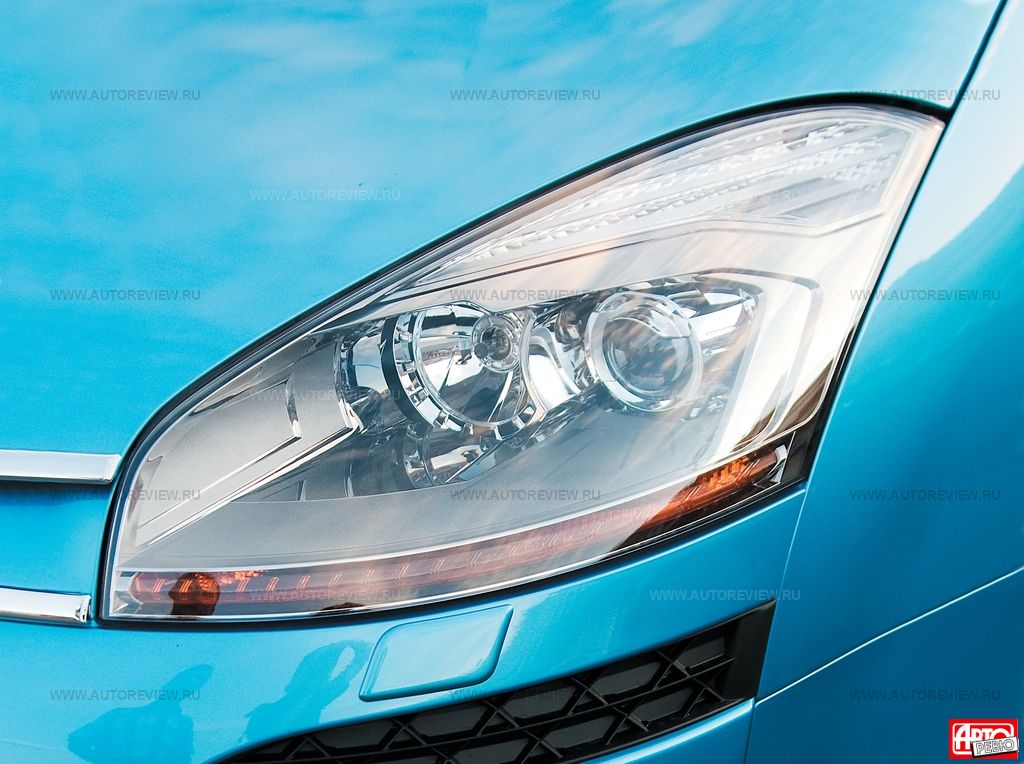 | 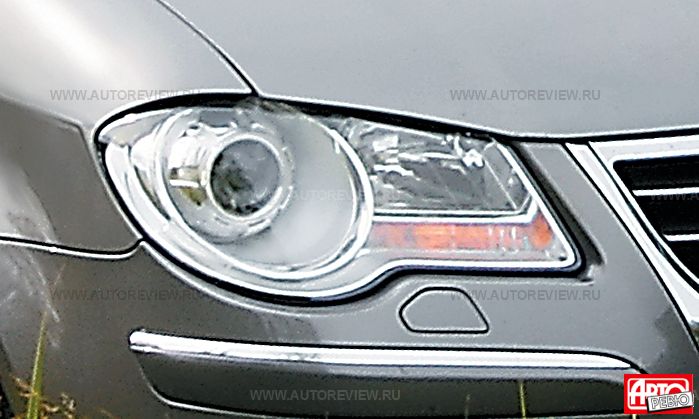 |
The effectiveness of the headlights is convenient to evaluate from night shots. Judging by the photos, the best low beam is from Ford: the xenon optics reaches a person standing on the roadside 80 meters away, and the figure is fully illuminated. The Citroen's low beam is also xenon, but it is noticeably weaker, although the pedestrian is still clearly visible. But the halogen headlights of the Volkswagen clearly disappoint — they only pick out the legs of a person from the darkness. The high beam of all three cars is decent (a pedestrian at 160 meters is visible), but the xenon in the C4 Picasso and C-MAX works noticeably brighter.
At the time of shooting, only the driver was in the cars, and the headlight levelers were in the zero position.
| Ford C-MAX | Citroen C4 Picasso | Volkswagen Touran |
| Low beam. A pedestrian is on the roadside 80 m from the car | ||
| High beam. A pedestrian stands in the center of the road 160 m from the car | ||
Family safety
In terms of safety, the base Ford C-MAX in our trio looks the poorest: the equipment includes only ABS, four airbags, and seatbelt pretensioners. Side curtain airbags, which added two points to the European version of the C-MAX under the EuroNCAP methodology, Isofix mounts, and the stability control system — all these are options. Meanwhile, the Touran and C4 Picasso already have curtains, Isofix, and ESP in the base, and the French car additionally has a driver's knee airbag.
Under the EuroNCAP methodology, crash tests were only conducted on the pre-facelift Ford and Volkswagen, as well as the seven-seat Citroen Grand C4 Picasso.
The C-MAX has passive safety at a high level: the body proved to be strong, the restraint systems worked clearly, but due to the injury-prone front panel, experts deducted penalty points. The result is four stars. The Isofix mounts provided good protection for children — four stars. Pedestrians are moderately protected.
The Touran in a frontal impact provides the same level of protection as the Ford — also a penalty for the front panel. The Volkswagen survived side impacts slightly better, receiving the maximum score. In total — five stars. Both child dummies were not injured in the frontal impact, but the loads on the neck and chest were serious. Pedestrian protection is good — three stars out of four.
The Citroen Grand C4 Picasso also earned the maximum five stars. However, it still received one penalty point — for the potentially dangerous front panel, and even the driver's knee airbag did not save it. With child protection, not everything is smooth: in a frontal impact, the head of a one-and-a-half-year-old "child" touched the back of the driver's seat. Therefore, only three stars out of five. Pedestrians are moderately protected.
| Ford C-MAX | ★★★★☆ | |
| Overall rating | 31 points | 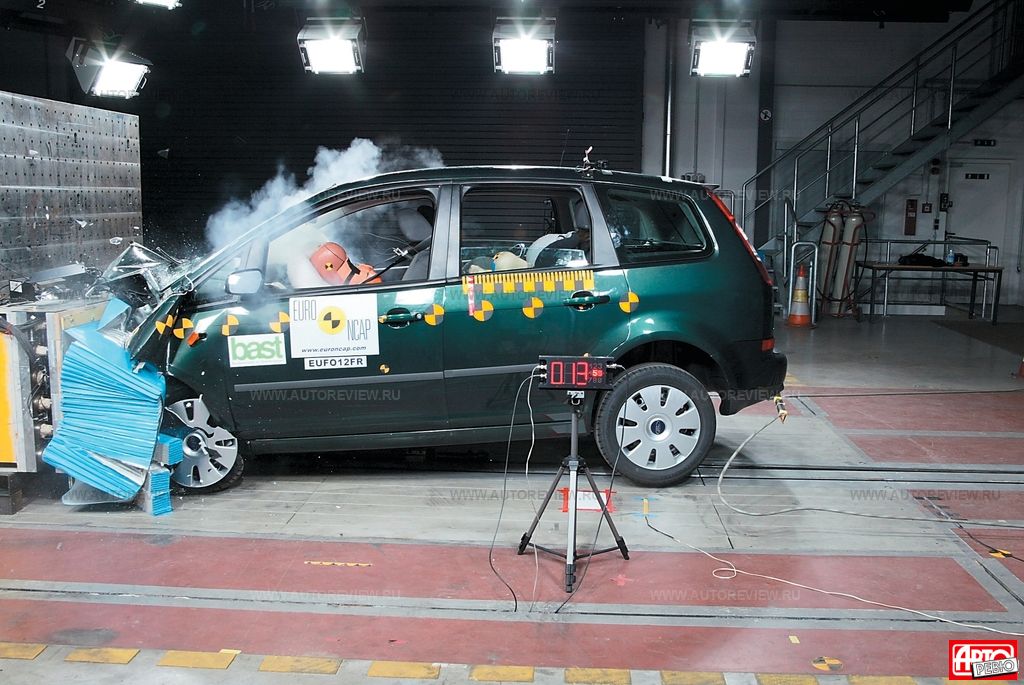 |
| Frontal crash test | 13 points | |
| Side crash tests | 17 points | |
| SBR* | 1 point | |
| Child passenger protection | 38 points | |
| Pedestrian protection | 14 points | |
| Curb weight | 1420 kg | |
| Volkswagen Touran | ★★★★★ | |
| Overall rating | 33 points | 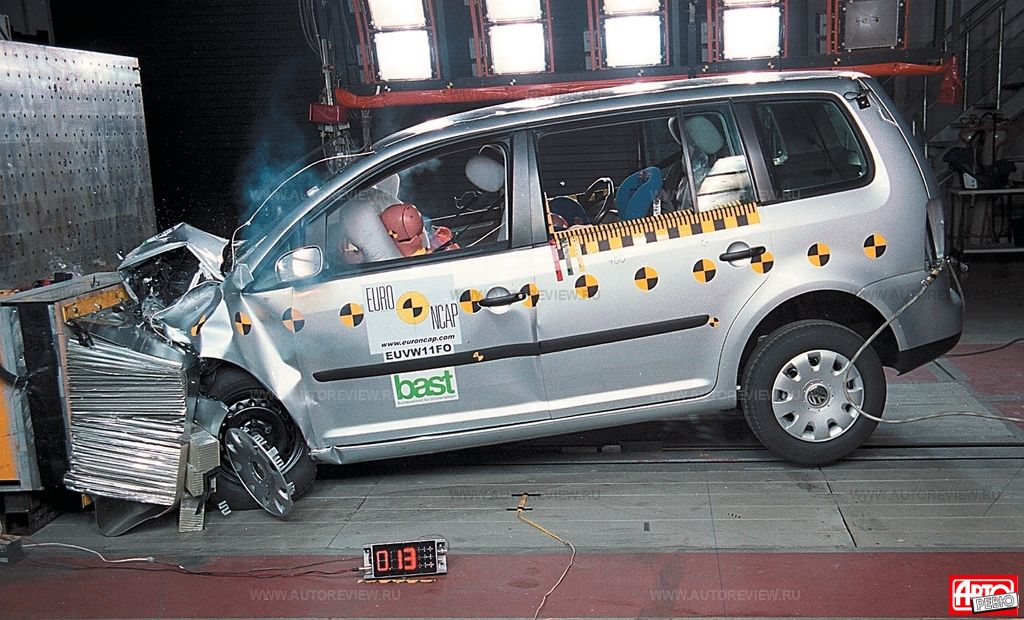 |
| Frontal crash test | 13 points | |
| Side crash tests | 18 points | |
| SBR | 2 points | |
| Child passenger protection | n/a** | |
| Pedestrian protection | 19 points | |
| Curb weight | 1460 kg | |
| Citroen Grand C4 Picasso | ★★★★★ | |
| Overall rating | 35 points | 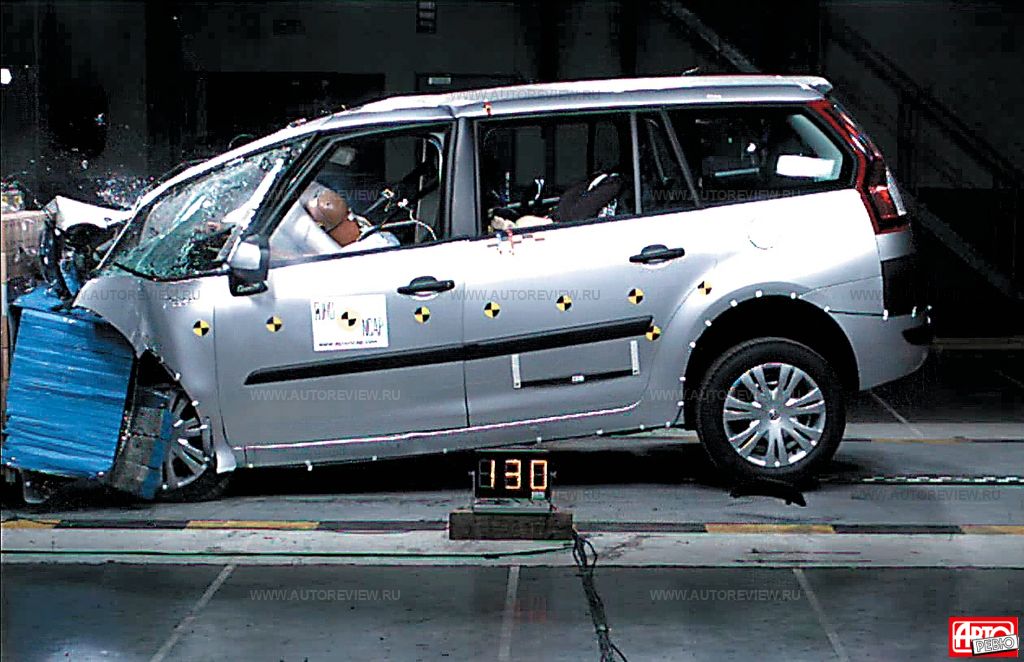 |
| Frontal crash test | 15 points | |
| Side crash tests | 18 points | |
| SBR | 2 points | |
| Child passenger protection | 34 points | |
| Pedestrian protection | 16 points | |
| Curb weight | 1539 kg | |
| * SBR — seatbelt reminder system | ||
| ** N/a — no data | ||

Visibility
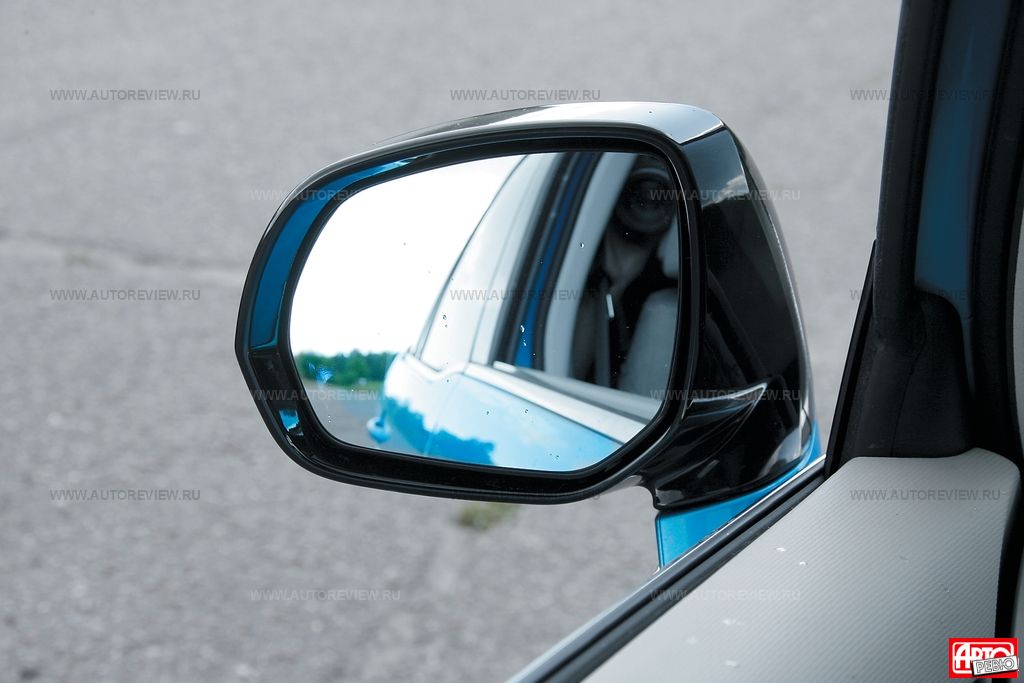
The Ford has the widest view among the test participants — 278.5 degrees, and the mirrors are pleasing with the absence of distortion. However, the triangular windows at the front pillars, which do not open, hinder the forward view. The Touran has a slightly more modest total viewing angle — 271.5 degrees, but the interior mirror here is the best of all. However, the exterior mirrors are located somewhat low, and the wipers leave a large uncleaned zone.
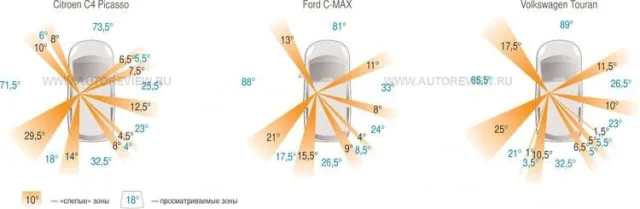
As for the Citroen, its strong point is the large mirrors and big triangular windows. But on the highway, the view through the interior mirror disappoints: very little is visible in the rear window opening, which reduces the total viewing angle to 259.5 degrees. And in rainy weather, the largest area of uncleaned zones on the windshield in our trio adds problems.
| Car | Total viewing angle, deg. | Total angle of "blind" zones, deg. |
| Citroen C4 Picasso | 259.5 | 100.5 |
| Ford C-Max | 278.5 | 81.5 |
| Volkswagen Touran | 271.5 | 88.5 |
| Citroen C4 Picasso | Ford C-MAX | Volkswagen Touran |
 |
| Speedometer reading accuracy | ||||||||
| Vehicles | Speedometer readings, km/h | |||||||
| 40 | 60 | 80 | 100 | 120 | 140 | 160 | 180 | |
| True speed, km/h | ||||||||
| Citroen C4 Picasso | 37 | 57 | 77 | 97 | 117 | 137 | 157 | 177 |
| Ford C-MAX | 36 | 56 | 76 | 96 | 115 | 135 | 154 | 174 |
| Volkswagen Touran | 37 | 55 | 75 | 94 | 112 | 131 | 150 | 170 |
| Some measurement results from Autoreview | ||||
| Parameters | Vehicles | |||
| Citroen C4 Picasso | Ford C-MAX | Volkswagen Touran | ||
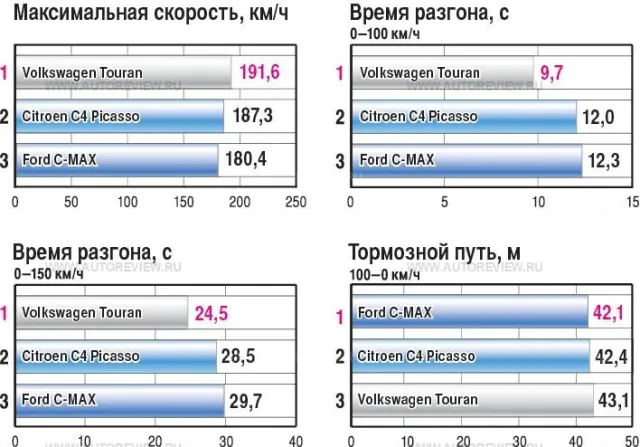
| Maximum speed, km/h | 187.3 | 180.4 | 191.6 | |
| Acceleration time, s | 0-50 km/h | 3.6 | 4.5 | 3.9 |
| 0-100 km/h | 12.0 | 12.3 | 9.7 | |
| 0-150 km/h | 28.5 | 29.7 | 24.5 | |
| over 400 m | 18.1 | 18.4 | 17.4 | |
| over 1000 m | 33.1 | 33.7 | 31.9 | |
| 60-100 km/h (III) | 7.5 | — | — | |
| 60-100 km/h (IV) | 11.2 | — | — | |
| 80-120 km/h (V) | 16.7 | — | — | |
| 80-120 km/h (VI) | 22.6 | — | — | |
| 60-100 km/h (D) | 7.6 | 7.5 | 6.0 | |
| 80-120 km/h (D) | 9.2 | 9.6 | 7.6 | |
| Coast-down, m | from 50 km/h | 634 | 721 | 710 |
| 130-80 km/h | 1055 | 1091 | 1049 | |
| 160-80 km/h | 1563 | 1615 | 1550 | |
| Braking from 100 km/h | distance, m | 42.4 | 42.1 | 43.1 |
| deceleration, m/s² | 9.1 | 9.2 | 8.9 | |
| Braking from 150 km/h | distance, m | 92.7 | 95.9 | 99.7 |
| deceleration, m/s² | 9.4 | 9.0 | 8.7 | |
| Equipment of the vehicles tested | |||
| Equipment | Vehicles | ||
| Citroen C4 Picasso | Ford C-MAX | Volkswagen Touran | |
| Base version price, RUB/$* | 766500/29820 | 656000/25525 | 740290/28805 |
| Front airbags | + | + | + |
| Front side airbags | + | + | + |
| Driver's knee airbag | + | – | – |
| Inflatable curtains | + | – | + |
| ABS | + | + | + |
| Traction control system | + | O | + |
| Dynamic stability control system | + | O | + |
| Adjustable rear air suspension | O | – | – |
| Power steering | + | + | + |
| Automatic transmission | +** | O | O*** |
| Transmission shift paddles on steering wheel | + | – | – |
| Multifunction steering wheel | + | –**** | O |
| Adjustable steering column (height and reach) | + | + | + |
| Leather-wrapped steering wheel | O | + | O |
| Heated windshield | – | O | – |
| Power-adjustable front seats | O | – | – |
| Driver's seat memory | O | – | – |
| Heated front seats | + | O | O |
| Auto-dimming rearview mirror | O | + | – |
| Built-in phone | O | O | – |
| Central locking (remote) | O | + | + |
| Anti-theft alarm | O | – | O |
| Cooled compartment | + | – | + |
| Dual-zone climate control | + | O | O |
| Power-adjustable and heated exterior mirrors | + | + | + |
| Power-folding exterior mirrors | O | – | – |
| Front power windows | + | + | + |
| Rear power windows | O | + | O |
| Split-folding rear seatbacks | + | + | + |
| Adjustable rear seats | + | + | + |
| CD audio system | O | + | + |
| CD changer | O | – | + |
| Light sensor | O | + | O |
| Rain sensor | O | + | O |
| Trip computer | + | + | + |
| Cruise control | + | – | + |
| Panoramic roof | O | + | – |
| Front parking sensors | O | – | – |
| Rear parking sensors | O | O | – |
| Parking assist system | O | – | – |
| Rear head restraints | + | + | + |
| Alcantara upholstery | O | – | – |
| Combined seat upholstery (leather, fabric) | – | O | – |
| Wood interior trim | – | – | O |
| Remote fuel filler flap lock | + | – | + |
| Xenon low-beam headlights | O | O | – |
| Fog lights | + | + | O |
| Headlight washers | + | O | O |
| Rear sunshade | O | – | – |
| Side sunshades | O | – | – |
| Removable Modubox (insulated) | O | – | – |
| Alloy wheels | O | O | O |
| Full-size spare wheel | –***** | – | O |
| Metal engine protection | – | – | – |
| Metallic paint | O | O | O |
| Price of tested vehicle, RUB/$* | 1236000/48100 | 828900/32255 | 911600/35470 |
| * At exchange rate $1=25.7 RUB | |||
| ** Robotic manual | |||
| *** DSG | |||
| **** On steering column | |||
| ***** Repair kit (full-size spare wheel in base version) | |||
| (+) Included in base version | |||
| (–) Not available in base version | |||
| (O) Options installed on tested vehicles | |||
What's the price?
The cost question: three compact MPVs, three approaches
Let's start with price lists, as for many this is the main criterion. The Ford C-MAX is the most affordable here: the base version 1.6 (100 hp) with four airbags, ABS, power-adjustable mirrors, and front power windows is priced from 510,000 rubles ($19,844)*. However, for this money you won't even get air conditioning. It, along with the trip computer, heated mirrors, and CD player, only appears in the Trend trim, which comes with the 1.8 engine (125 hp) and costs 590,000 rubles ($22,957). The two-liter version (145 hp) in the same trim will cost 656,000 rubles ($25,525) if you choose the automatic. Ford offers a huge number of options, but some seemingly small things require extra payment: even a space-saver spare costs $50. In our test, we had a C-MAX 2.0 AT Titanium: full electric package, dual-zone climate control, fog lights, alloy wheels, light and rain sensors. Plus we added sports seats ($790), glass roof ($740), bi-xenon headlights ($1,080), stability control ($595), and parking sensors ($300). The total came to 828,900 rubles ($32,255). The most expensive C-MAX is the diesel: 2.0 TDCi Trend (136 hp) costs 699,000 rubles ($27,200). A custom-ordered car will have to wait four months.
Ford's warranty is 2 years or 100,000 km. The dealer network has 134 points in 85 Russian cities.
Volkswagen Touran in the base trim looks more generous: six airbags, stability control, air conditioning, CD/mp3 stereo and heated mirrors. But the price is also higher: Touran 1.6 (102 hp) costs 664,600 rubles ($25,860) — $3,600 more than an equivalently equipped Ford. In the rich Highline version, you can order a third row of seats ($860), power sunroof ($950), navigation ($870) or a luxury package with leather interior, heated front seats and bi-xenon ($2,530). The 1.4 TSI (140 hp) engine with twin turbocharging, which completely replaced the naturally aspirated 2.0 FSI, raises the price to 740,290 rubles ($28,805). Our test Touran 1.4 TSI Highline (dual-zone climate, full power package, alloy wheels) with DSG "robot" (surcharge 56,540 rubles, or $2,200) reached 911,600 rubles ($35,470). The top version with TSI boosted to 170 hp and DSG is 933,940 rubles ($36,340). There are also diesel options: from 772,030 rubles ($30,040) for the base 1.9 TDI (105 hp) to 881 thousand rubles ($34,280) for the Highline 2.0 TDI (140 hp). Order wait time is up to four months.
Warranty is 2 years without mileage limit. Volkswagen dealers: 54 in 35 cities.
Citroen C4 Picasso is the most expensive of the trio. The 1.8 Base version (127 hp) costs 689,500 rubles ($26,830*), and it has neither air conditioning nor audio system. But it does have seven airbags, stability control, cruise control, fog lights and heated mirrors. For climate control, CD player, rear electric windows and light and rain sensors in the Confort version, you need to pay an extra 75,250 rubles ($2,930). The two-liter C4 Picasso (143 hp) with a six-speed robotic gearbox starts from 766,500 rubles ($29,820) for the base with air conditioning. We tested the C4 Picasso 2.0 Exclusive for 908,250 rubles ($35,340): rear parking sensors, alloy wheels and rear air suspension that maintains constant ground clearance and "squats" for easy loading. The full set of options (glass roof, dual-zone parking sensors, insulated trolley in the trunk, etc.) inflated the price to 1 million 236 thousand rubles ($48,100)! There is also an Exclusive version with a four-speed "automatic" — 936,250 rubles ($36,430). Order wait time is the same four months.
Warranty is 2 years without mileage limit. Citroen has 43 dealers in 22 Russian cities.
* At the exchange rate of $1=25.7 rubles.
| Cost of scheduled maintenance with consumables and parts, rub. | ||||
| Scheduled maintenance | Vehicles | |||
| Citroen C4 Picasso | Ford C-MAX | Volkswagen Touran* | ||
| Cost per standard hour | 1208 | 1290 | 1568 | |
| Mileage, km | 15000 | 4200 | — | 4800 |
| 20000 | — | 4200 | — | |
| 30000 | 4200 | — | 10500 | |
| 40000 | — | 7290 | — | |
| 45000 | 7700 | — | 4800 | |
| 60000 | 5190 | 4200 | 15000 | |
| 75000 | 4200 | — | 4800 | |
| 80000 | — | 25340 | — | |
| 90000 | 16500 | — | 10500 | |
| Total | 41990 | 41030 | 50400 | |
| * Prices are nominated in euros and converted at the CBR exchange rate on 17.09.2007 | ||||
| Approximate prices for original parts at Moscow dealers, rub. | |||
| Parts | Vehicles | ||
| Citroen C4 Picasso | Ford C-MAX | Volkswagen Touran* | |
| Oil filter | 442 | 338 | 728 |
| Fuel filter | 364 | — | 1534 |
| Air filter | 624 | 546 | 1170 |
| Cabin filter | 806 | 806 | 598 |
| Spark plug | 338 | 338 | 780 |
| Front brake pads | 2184 | 3146 | 5356 |
| Rear brake pads | 2028 | 3146 | 3042 |
| Front shock absorber | 2028 | 4238 | 5694 |
| Rear shock absorber | 2470 | 4056 | 4784 |
| Front headlight | 20930 | 16562 | 10634 |
| Rear light | 2000 | 11648 | 3094 |
| Front fender | 9048 | 6292 | 5330 |
| Front bumper | 14066 | 13442 | 8164 |
| Hood | 13260 | 12272 | 10348 |
| Windshield | 18408 | 16198 | 8684 |
| * Prices are nominated in euros and converted at the CBR exchange rate on 17.09.2007 | |||
What else?
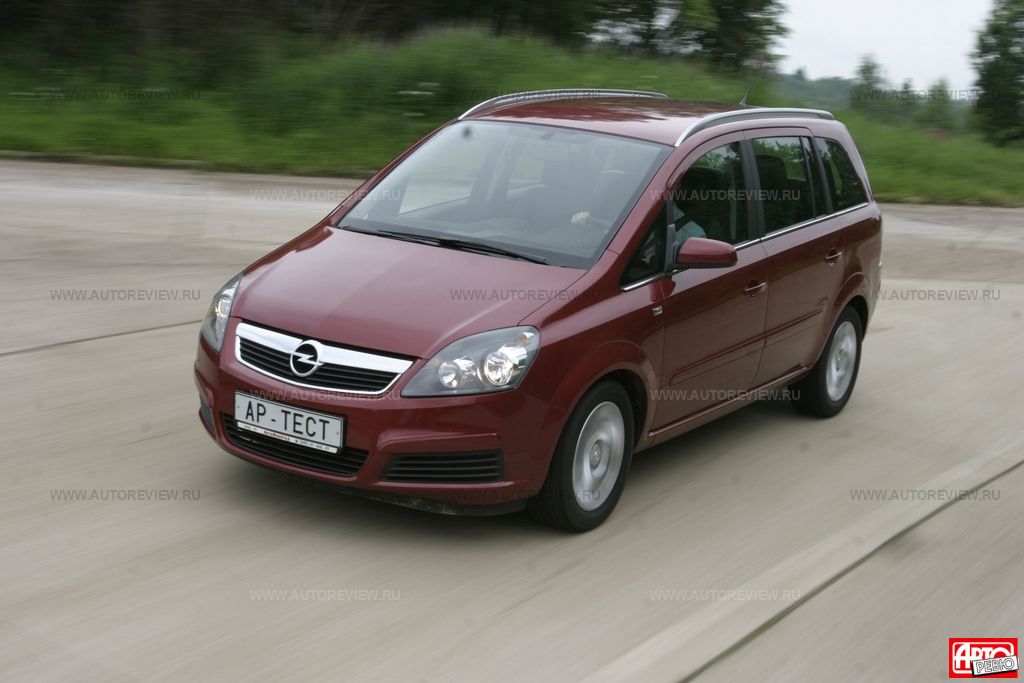
If you need a compact MPV with a powerful engine and automatic transmission, take a look at the seven-seat Opel Zafira. The version with the 1.8 engine (140 hp) and robotic Easytronic gearbox starts from 619 thousand rubles ($24,090)*, and the Zafira 2.2 (150 hp) with a full "automatic" is 819 thousand rubles ($31,870). The Zafira is good for its combination of smooth ride, confident handling and a comfortable cabin. More details in AR No. 19, 2005 and AR No. 18, 2006.
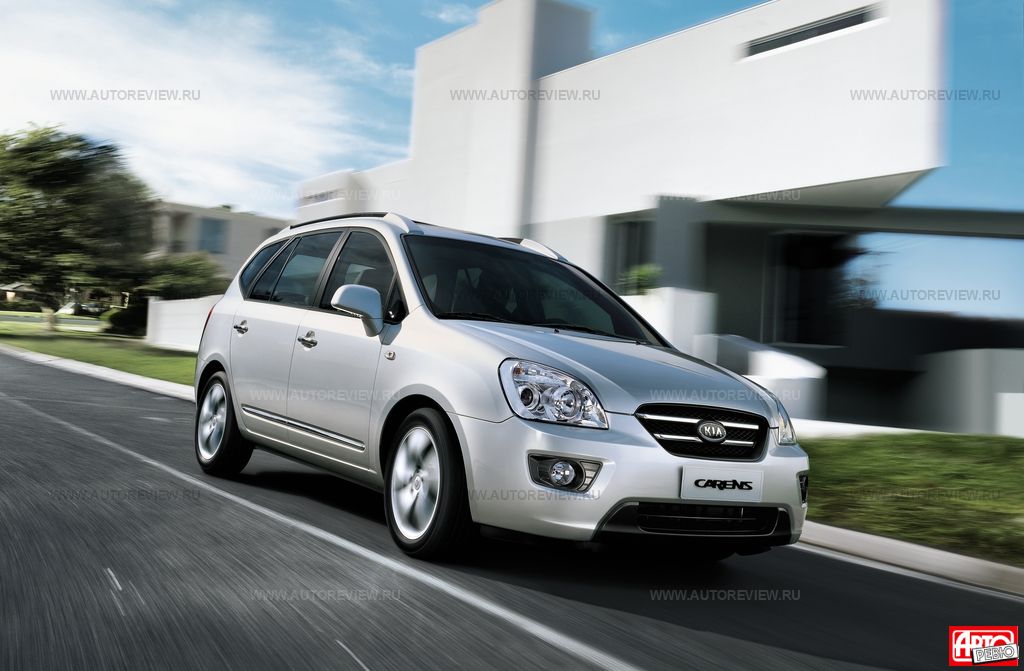
Kia Carens of the second generation, which our experts have not yet tested, is equipped with a two-liter engine producing 145 hp. The five-seat version with "automatic" costs from 723 thousand rubles ($28,130), the seven-seat version is 14 thousand rubles ($540) more expensive.
Toyota Corolla Verso recently underwent a light restyling — the front end slightly changed. The engine remains the same — 1.8 L (129 hp), and instead of the "automatic" there is now a robotic MMT gearbox, which we did not like. Such a Corolla Verso costs 736 thousand rubles ($28,640). Details in AR No. 19, 2005.
| Opel Zafira | Kia Carens | Toyota Corolla Verso |
 |  | |
| Renault Scenic | Seat Altea | Mercedes-Benz B200 |
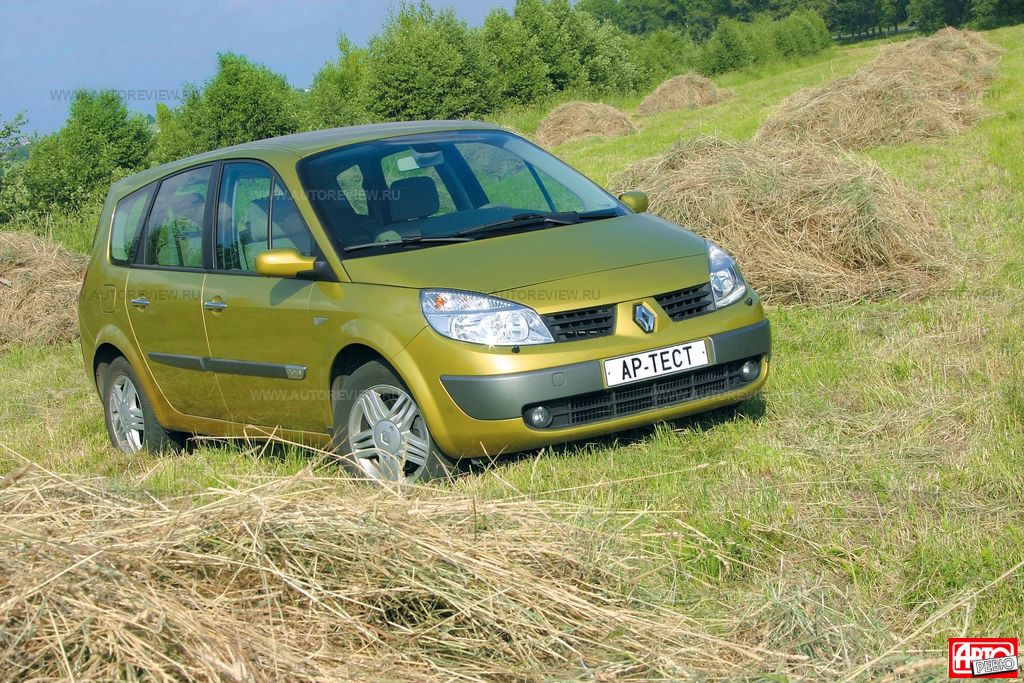 |  |
The updated Renault Scenic with a 2.0 engine (136 hp) and automatic gearbox costs 784,950 rubles ($30,540), and the extended seven-seat Grand Scenic is 824,700 rubles ($32,090). Pre-restyling versions pleased with a very comfortable suspension, but disappointed with ambiguous handling and a slow "automatic" (see AR No. 18, 2004 and AR No. 18, 2006).
Seat Altea is a newcomer to the Russian market. The five-seat compact MPV is built on the Golf platform, but its design is very different from the Touran. Prices for the Altea with a 2.0 FSI engine (150 hp) and "automatic" start from $33,900.
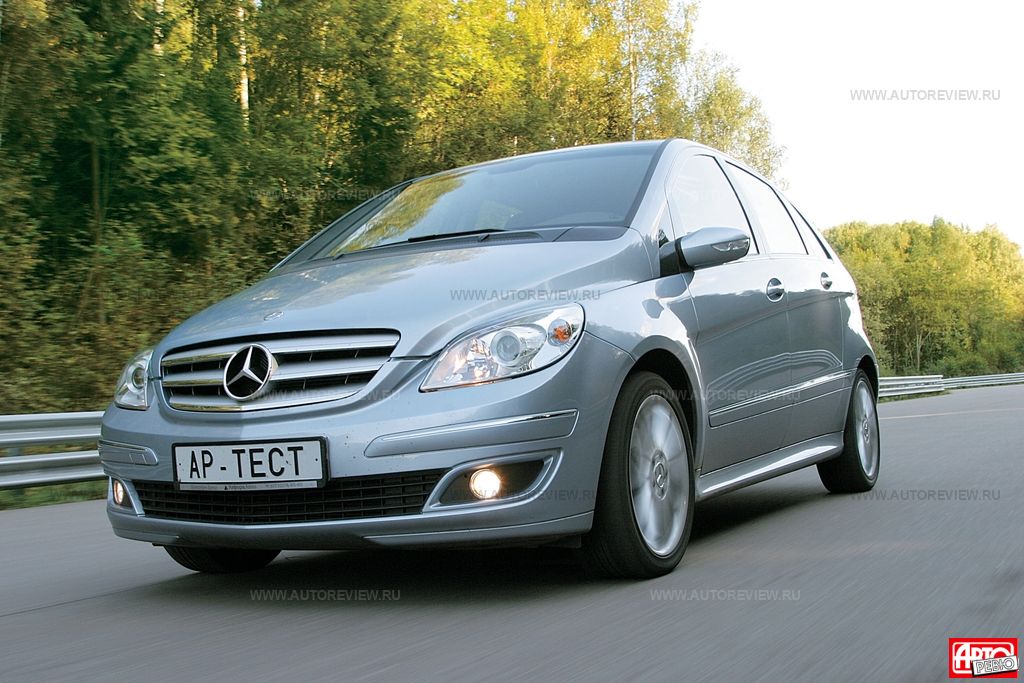
Mercedes-Benz B-Class is the most expensive alternative. The B200 modification with a two-liter engine producing 136 hp and Autotronic CVT costs from 1,011,500 rubles ($39,360). The "German" handles without excitement, but reliably, however, the ride smoothness is far from exemplary. Details in AR No. 19, 2005.
* In parentheses are approximate prices in US dollars at the exchange rate of $1=25.7 rubles.