
FIAT Panda. The Little Bear
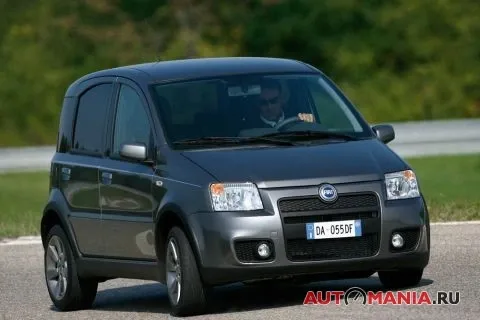
The model was first shown in Geneva in 2003, and at that time it bore the name Gingo. But Renault raised objections due to its similarity to their Twingo, so the car went into production under a different, long-familiar name to Europeans — Panda, which was the name of its predecessor, produced from 1980 to 2003. However, the new model has practically nothing in common with it.
On our market, the Panda appeared almost immediately after its premiere, but in the first couple of years, like the entire brand as a whole, it remained in the shadows. Nevertheless, given the long-standing love of local drivers for Italian cars, the prospects look quite promising.
In terms of its actual dimensions, the Panda is comparable to the Daewoo Matiz, which is well known here. But visually it seems larger and, perhaps, more modern than the "Korean": a tall body with fashionable longitudinal ribs, which makes the proportions resemble more of a microvan than a subcompact hatchback, massive almost square headlights, a large glass area, and unusual windows in the rear pillars. On the outside, the "little bear" is definitely a success.
It is clear that luxurious trim cannot be expected from such a car, and the materials confirm this. But the Italians managed to make the interior attractive through original solutions. The first thing that catches your eye when opening the door is the seats. Not the dashboard, not the gear lever on the center console, not the round rotating knobs of the heater and air conditioner, but the seats themselves. More precisely, the fabric upholstery in the body color, covered with large bumps. It is so cheerful that at the very least it pleases the eye, and at most it lifts your mood.
At first, it seems that the base trim of the Panda is quite poor, but this is a deceptive impression. Even in the initial Dynamic version, there are already front power windows, central locking, an immobilizer, an onboard computer, the proprietary two-mode electric power steering Dualdrive, a driver's airbag, ABS with EBD, and the "Follow me home" function, which illuminates the path home. In more expensive versions, air conditioning, a passenger airbag, roof rails, and a storage box under the front passenger seat may appear.
You sit behind the wheel quite comfortably, although the seating position is high, almost like in a jeep, which is unusual for this class — it takes time to get used to. The seats, both driver's and passenger's, are adjusted manually: the backrest angle and longitudinal position change. Even in the standard version, despite the modest range of longitudinal movement, a person of almost any build can sit behind the wheel. However, the steering wheel adjusts only in height — that's a minus. The pedals are positioned so closely that wide shoes will be uncomfortable.
The Panda is, of course, designed for four people. On the rear bench, you can seat three if desired, but then you'll have to forget about comfort. And if the driver's seat is moved all the way back, only a small child will fit normally behind it.
The Fiat's trunk also doesn't impress with its volume, but what else can you expect from a hatchback that was created to carry a couple of bags from the store. For larger items, you'll have to fold the rear seat back — it splits in a 50:50 ratio, although this option is not available in the base version.
Currently, all Pandas supplied to us are equipped with a single 1.2-liter engine. It works in conjunction with either a five-speed manual or a robotic Dualogic gearbox. For the version with the manual, they ask at least 340,000 rubles (about $13,000), and for the automatic — already 405,000 rubles (approximately $15,500).
The economical and quite peppy engine is perfect for a car weighing 860 kilograms — its 60 "horses" are quite sufficient. The engine pulls confidently from low revs and provides acceptable dynamics for the city: acceleration to 100 km/h takes 14 seconds. But as soon as the tachometer needle goes past 3,000 rpm, it noticeably loses steam, so you have to shift frequently to maintain the pace. Fortunately, the gear lever is located on the raised part of the center console, right under your hand. By the way, we should thank the Italian engineers: even at maximum revs, the engine is almost inaudible in the cabin, but the silence is broken by aerodynamic noises — the weak sound insulation of the wheel arches takes its toll. And at speeds above 120 km/h, the antenna on the roof starts to hum.
The car handles well, but it's better not to provoke sharp maneuvers — due to the high center of gravity, it's easy to roll over. The "Italian" is clearly designed for calm driving on congested city streets. The steering wheel is already too light, almost "empty," and with the "City" mode activated, it becomes completely weightless — it seems that the front wheels are not touching the asphalt. Perhaps this button on the center console should only be pressed when parking.
The suspension also left mixed impressions. On smooth surfaces, the car holds the road confidently and swallows small bumps well. But noticeable body rolls force you to slow down before corners. Moreover, the car absolutely cannot stand bad roads: as soon as you hit a broken section, it starts to "buck" — the short wheelbase takes its toll. Although, perhaps this says more about the condition of our roads than about the shortcomings of Italian engineering.
Currently, official Fiat dealers offer the Panda in three fixed versions: Dynamic, Dynamic+, and Climbing. The first two differ mainly in the set of options and the type of transmission, while the third is already an all-wheel-drive version of the hatchback. It has increased overall dimensions and wheelbase, added an off-road styling package, and the options include a center differential lock. With such equipment, the Panda promises to become even more exciting to drive, but the price may scare off — 515,000 rubles or $19,700. For an A-class hatchback, that's already a bit much, don't you think?
Technical specifications:
Dimensions: Length (mm) 3358 Width (mm) 1578 Height (mm) 1540 Wheelbase (mm) 2299 Weight (kg) 860 Trunk volume (l) 206/860 Engine displacement (cm3) 1242 Max. power (hp) 60 at 5000 rpm Max. torque (Nm) 102 at 2500 rpm Max. speed (km/h) 155 Acceleration 0-100 km/h (s) 14 Avg. fuel consumption (l/100km) 5.6 Price (rub.) 340,000-515,000
Alexey Vorontsov
Source – www.automania.ru