
Oleg RASTEGAEV, author's photo
To Turkey, to Istanbul? But there's a crisis there! The Constitutional Court annulled the results of the presidential vote, people took to the streets in protests, clashes
with police... And right in Istanbul, the premiere of the new Fiat Linea is scheduled for May 2! Moreover, we are to stay in the very heart of the city. In "Autoreview" we're used to this: we witnessed both Russian "revolutions" of the late last century almost in the thick of events, yet managed not to miss a single issue. But what were the organizers of this presentation thinking?
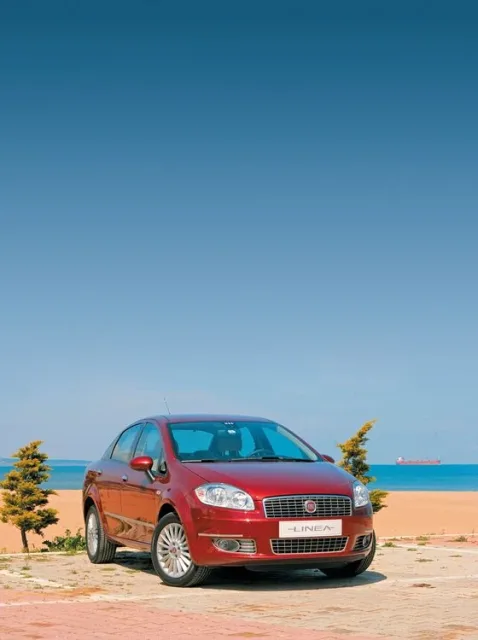
And here's what's curious. In three days in Istanbul, I only saw demonstrations on TV, and there were no more police on the streets than traffic cops in Moscow. Even disappointing. So the organizers didn't cancel the program: a test drive around the city and its surroundings, a spectacular show on an island in the middle of the Bosphorus, and fireworks at the end. Everything went as planned. There it is, a sign of globalization: crisis or no crisis, the premiere of a "world" car is more important!
And no wonder: the Fiat Linea will not only go on sale on almost all continents but will also be assembled at five plants — in Turkey, Brazil, India, China, and, which is especially relevant for us, in Russia. At the enterprise in Naberezhnye Chelny, where the "Oka" was once made, installation of a new line for producing Fiat Linea sedans is now being completed. First, they will install components on ready-made bodies from Turkey, and then welding and painting shops will appear. So at the beginning of next year, another "worldwide" Fiat will come to Russia. The first, Albea — the successor to the Fiat Paleo hatchback — is already coming off the line in Chelny, and now it's the turn of a golf-class car: the Linea will compete with the Ford Focus, Mitsubishi Lancer, and Toyota Corolla.
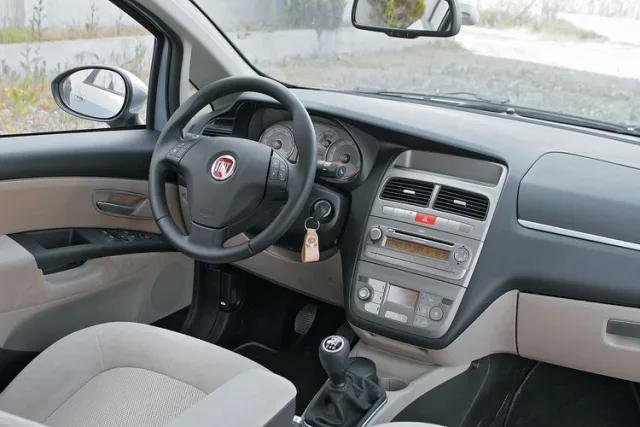
The nice interior is trimmed with hard plastic. Climate control is included in the top Emotion trim
The Italians, as usual, emphasize design. The Linea's appearance hints at features of the Grande Punto hatchback from the Guigiaro Design studio — the cute front end of the sedan is adorned with a "two-tier" radiator grille and almond-shaped headlights. True, the Linea inherited not only the looks from the Grande Punto but also the platform, although the car itself has been stretched to an impressive 4.56 m. The result is almost the longest sedan in its class. But also one of the narrowest. Truly — Linea, "line."
At the same time, the Linea doesn't "squeeze" in the shoulders — at least when there are four people in the cabin. But the extra "longitudinal" centimeters came in handy — they allowed significantly expanding the adjustment ranges of the front seats. With my height of 190 cm, I moved forward two clicks from the rearmost position! I sat "behind myself" — and again it's spacious: there's a gap between my knees and the back of the driver's seat. True, the joy was spoiled by the low ceiling, which I hit my head on — the roof will cause inconvenience to anyone taller than 180 cm.
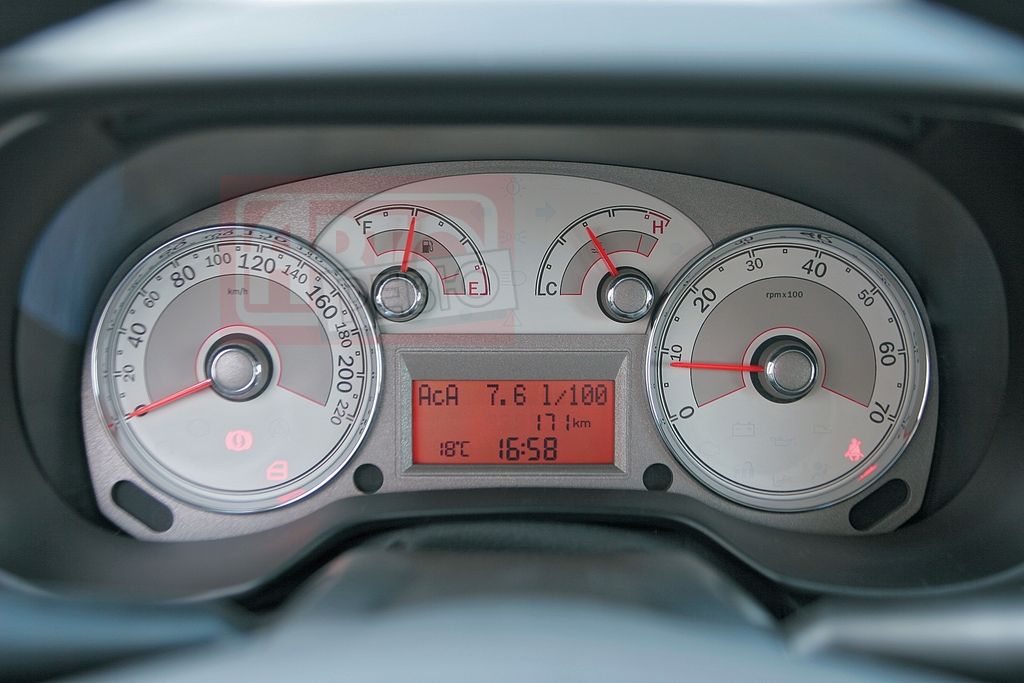 | 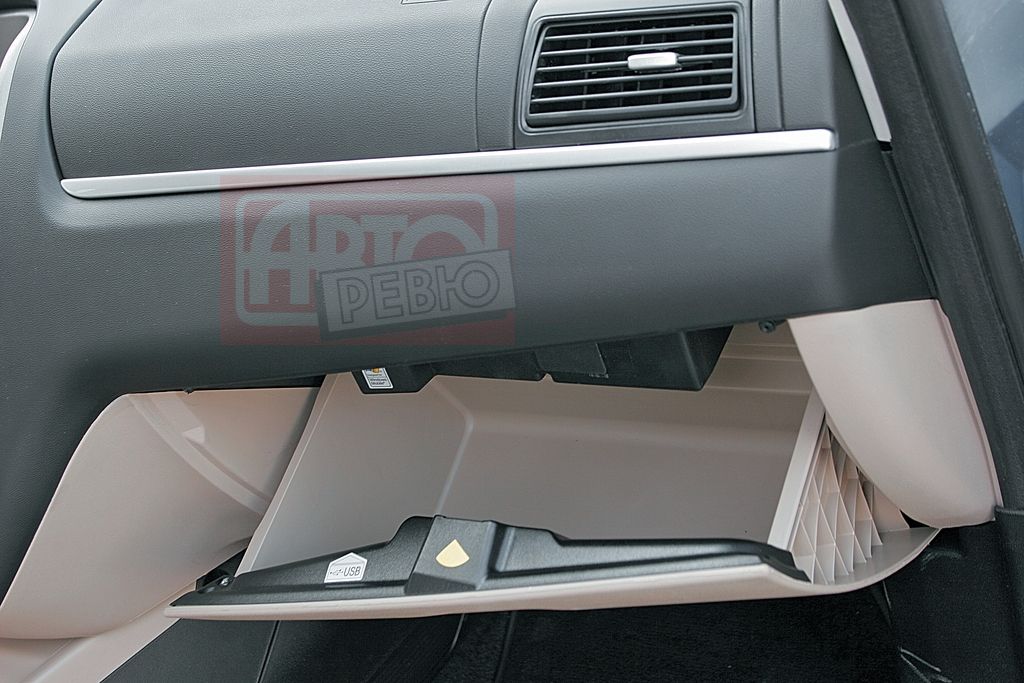 | 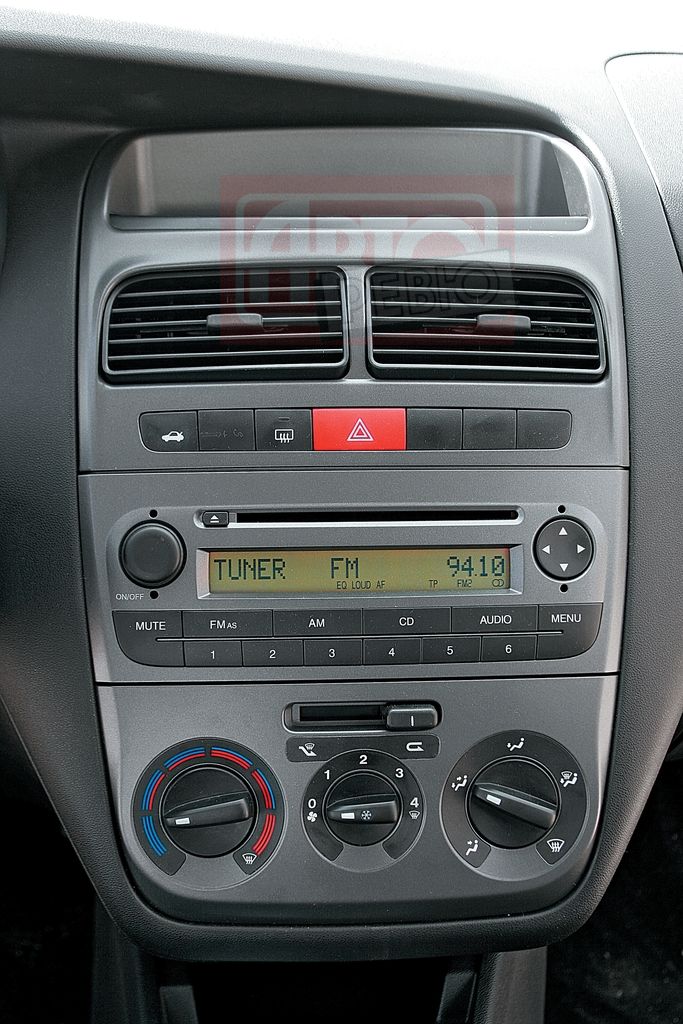 |
| The instrument design shows nostalgia for the sixties | The "glove box" is small, but it houses a processor where you can upload music via a USB port | For simple versions, "rotary" climate control is offered |
The interior pleases the eye: pleasant shapes, a "bourgeois" combination of dark top and light bottom in the trim of the front panel and doors, "vintage" instruments. On the "worktop" of the central console are large buttons for controlling the stereo and climate control. And in the "glove box" — an optional USB port for uploading music in mp3, wav, or wma formats. You can't immediately tell that the car was intended as a "budget" one for "third world" countries (for Western Europe, there's another golf-class model, the new Bravo hatchback (see AR No. 7, 2007). True, the soft-looking plastic turned out to be hard. The seat with pleasant "plush" upholstery is spoiled by its shape — the backrest doesn't hold at all in corners, and on the "vintage" speedometer dial, the font is too small. In general, ergonomics are far from ideal. And how does it drive?
To be honest, at first, I wasn't up to the car. Okay, I'm used to taxi drivers suddenly darting to the curb (by the way, most of them drive little Fiat Albea sedans), but for buses to steer to stops the same way, right from the third lane... In Moscow, they already drive better. More politely, more cautiously. But here — no one will let you in! Traffic jams worse than Moscow's. And only after crossing the one-and-a-half-kilometer Atatürk Bridge to the Asian shore of the Bosphorus did I breathe more freely. Even though there are fewer attractions here, there are also fewer cars.
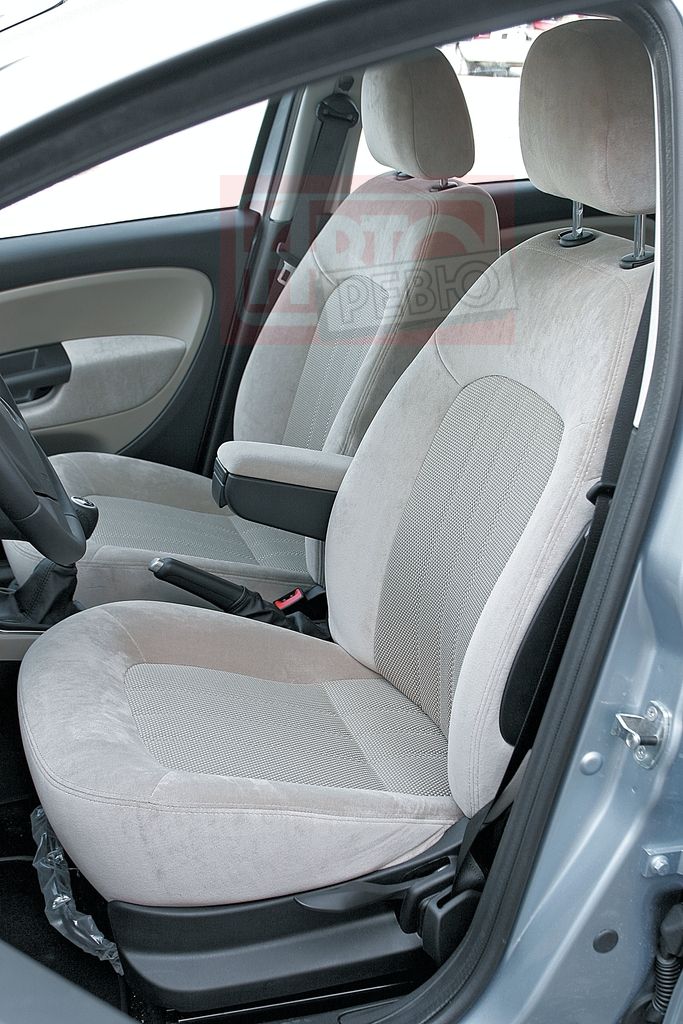 | 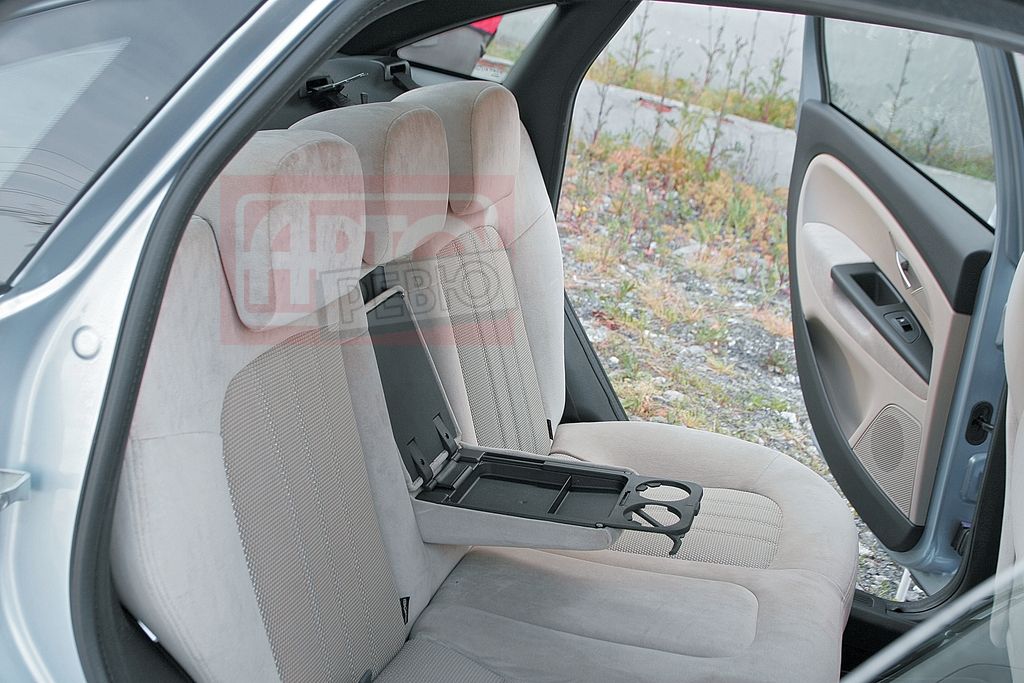 |
| The velour seat doesn't hold well in corners | There's plenty of legroom in the back, there's a fold-down armrest, but tall passengers will complain about the low ceiling |
| The window shade is a nice addition on a hot day | An air vent is also provided for rear passengers |
To start, I took a car with a T-Jet badge on the radiator grille. This means there's a 120-horsepower 1.4 Turbo engine under the hood. A decent little engine — quiet, without a pronounced turbo lag. Smooth start, confident acceleration up to the limit of 6400 rpm, when the limiter gently kicks in. By feel, the engine is very similar to a good naturally aspirated 1.6-liter or even 1.8-liter unit. The engine is good, but the drive of the five-speed gearbox is not so good: the "stiff" mechanism requires considerable effort with each shift, and selectivity also leaves much to be desired.
Brakes are fine: the adequate build-up of pedal force allows precise calculation of deceleration. ABS, judging by the frequency of activation, is not the latest generation, but it's included in the standard equipment list of all versions except the base Active. But for the "hill-hold" Hill Holder system, you'll have to pay extra. A pleasant option, especially for novice drivers: on an incline, after releasing the brake pedal, the electronics hold the car in place for a couple more seconds, helping to start on a hill.
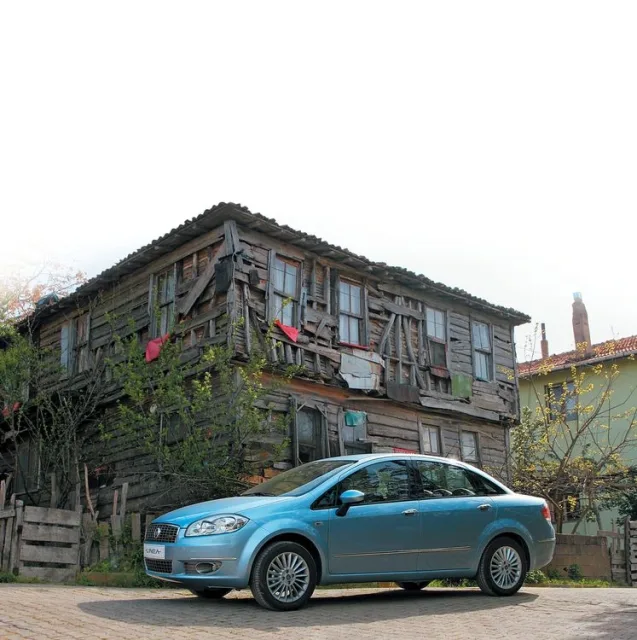
In terms of handling, there are no revelations — average sensitivity, average steering effort, and average feedback. By the way, the Italians abandoned the fashionable electric power steering in favor of the traditional hydraulic one. Steering effort is low, which makes life easier in the city, and the level of feedback is quite sufficient for controlling the car on the highway. And if you go faster? Boring. The Linea stands confidently in corners, barely wanders on bumps, but the level of ultimate lateral acceleration is low, and body rolls reduce the precision of reactions on narrow Turkish roads. In response to lifting off the throttle, the rear wheels readily break into a slide. The oversteer isn't dangerous, but correcting it already requires some skill. However, those who lack it can order the stability control system — for an extra charge.
And here's the broken asphalt, here are the "native" patches.
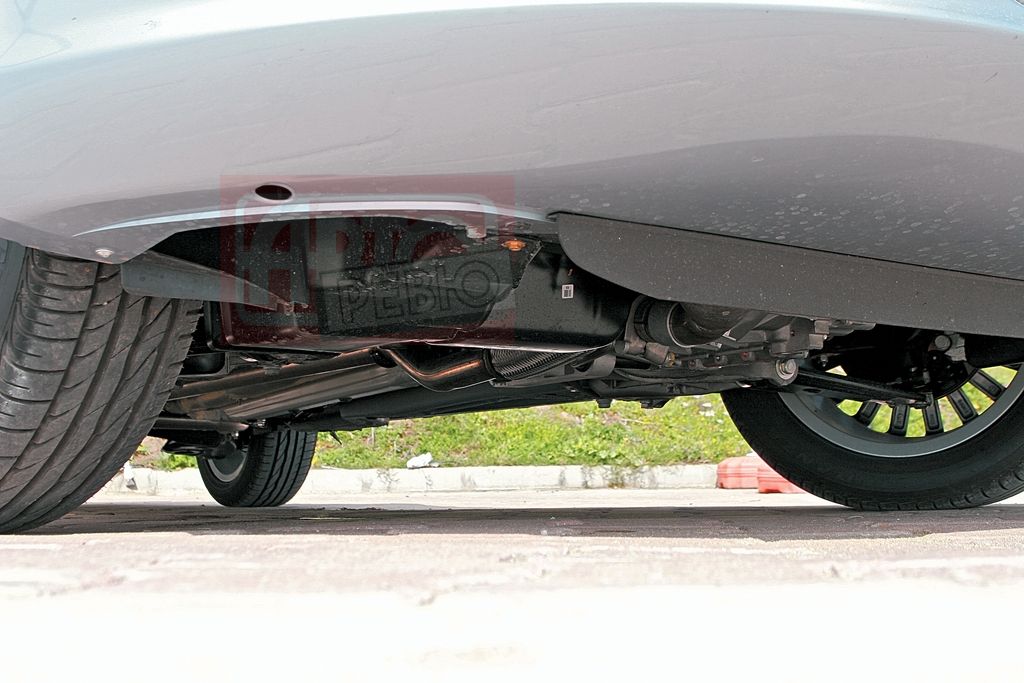 | 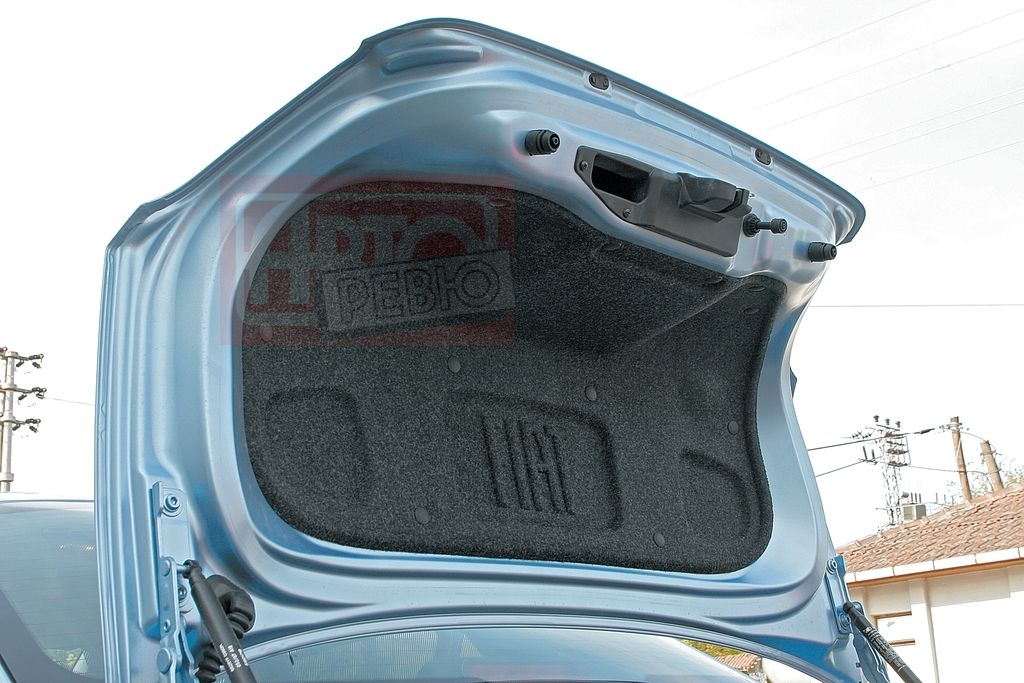 |
| Ground clearance is about 160 mm — and no engine protection | The lid has a handle, but it's inconvenient to use |
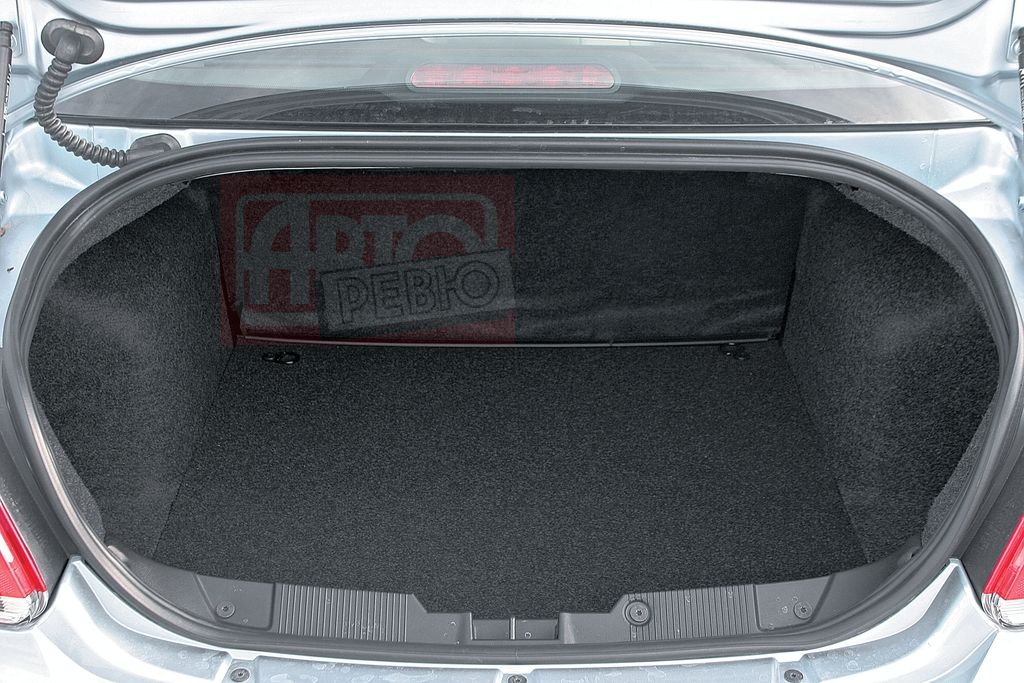 | 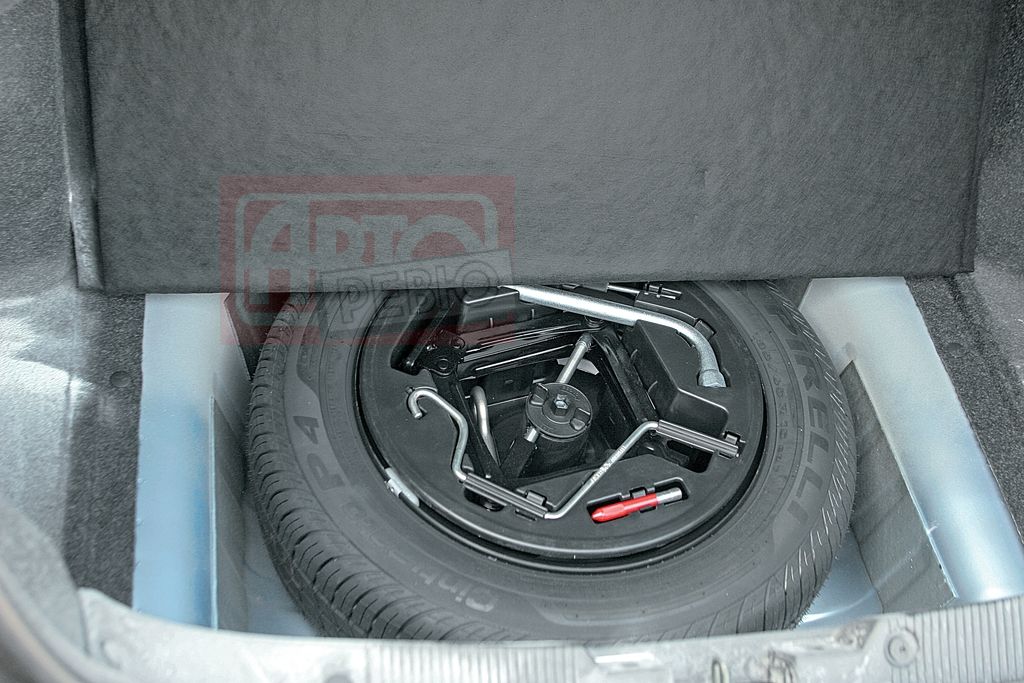 |
| The trunk is decent — only niches and pockets are missing. Under the mat is a full-size spare | |
— Slow down! — the navigator shouts. Bang, bang… It turned out to be a speed bump, without a single warning sign. Just like in our country. However, the Fiat's suspension handles bumps well up to 100 km/h. If you go faster, on a broken and wavy road the body starts to rock, and the shock absorbers will increasingly hit the bump stops. The suspension's reserve of strength is not that great. In addition, the car with a ground clearance of about 160 mm lacks engine protection, and at the lowest point, right under the engine, the exhaust system runs. It's easy to damage it — just hit a deep rut, also tearing off the rubber aerodynamic apron that constantly catches on the asphalt on those very speed bumps. One can only hope that versions assembled in Russia will have metal protection for the engine compartment.
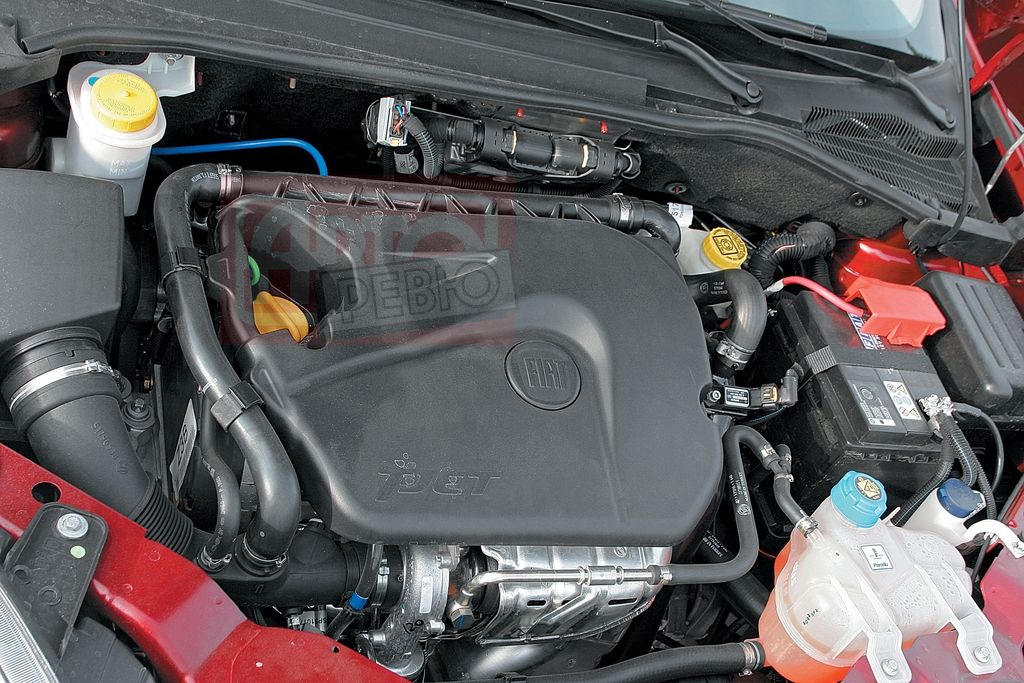 |
| The 120-horsepower 1.4 T-Jet turbo engine is good, except for the price… |
If we compare the Fiat with its classmates hypothetically, in terms of ride smoothness it will, I think, be somewhere between the soft and long-travel Renault Megane, adapted to our roads, and the stiffer second-generation Focus. But acoustic comfort is in perfect order: the Fiat Linea with the 1.4 turbo engine is a very quiet car. Even when the tachometer shows 5000 rpm, you can talk calmly in the cabin without raising your voice. But when production starts in Naberezhnye Chelny, the noise picture may change: for the Russian version of the Linea, they are currently looking for the "right" engine. The naturally aspirated 1.4 (77 hp) is clearly too weak. The 1.4 Turbo engine is good in every way except one — its cost. The diesel is also expensive, and the quality of our fuel leaves much to be desired. I, by the way, took a ride in the diesel version and was not particularly impressed. A narrow operating range, a deep turbo lag — up to 2000 rpm the 90-horsepower 1.3 MultiJet turbo diesel barely pulls. Most likely, for Russia they will choose a 1.6-liter engine, and it is quite possible that it will be of Chinese production — from those that are planned to be installed on cars assembled in China.
However, this is far from the only headache that the company "Severstalavto" will have to solve. And the main one is quality, which, as is known, Fiat cars are not famous for. This was confirmed by the "presentation" cars. On one of them, there was a failure in the engine management system — and the Linea flatly refused to start. On my copy, the electronics worked without complaints, but the handle for opening the left rear door stuck, and the gear shift lever cover constantly popped out of place. Little things? But it is precisely they that spoil the impression of a seemingly good car.
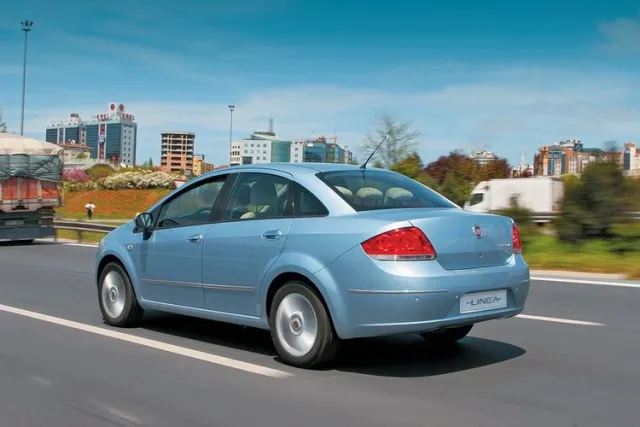
The questions of price and basic equipment of "Russian" cars remain open. But you should hardly expect gifts. Judge for yourself: in Romania, the Fiat Linea with a naturally aspirated 1.4-liter engine in the base trim costs 12,555 euros, which is about $17,000. It is unlikely that the Russian version with a 1.6-liter engine, even if Chinese, will be cheaper. But we still hope.
| Specifications | |||
| Parameters | Vehicle | ||
| Fiat Linea | |||
| Modification | 1.4 | 1.4 T-Jet | 1.3 MultiJet |
| Body type | sedan | sedan | sedan |
| Number of seats | 5 | 5 | 5 |
| Dimensions, mm | |||
| length | 4560 | 4560 | 4560 |
| width | 1946* | 1946* | 1946* |
| height | 1494 | 1494 | 1494 |
| wheelbase | 2603 | 2603 | 2603 |
| track front/rear | 1467/1483 | 1467/1483 | 1467/1483 |
| Trunk volume, l | 500 | 500 | 500 |
| Curb weight, kg | 1160 | 1180 | 1185 |
| Engine | petrol, with distributed fuel injection | petrol, with distributed fuel injection and turbocharging | diesel, with turbocharging |
| Location | front, transverse | front, transverse | front, transverse |
| Number and arrangement of cylinders | 4, in-line | 4, in-line | 4, in-line |
| Displacement, cm³ | 1368 | 1368 | 1248 |
| Cylinder bore/piston stroke, mm | 72.0/84.0 | 72.0/84.0 | 69.6/82.0 |
| Compression ratio | 11.1:1 | 9.8:1 | 17.6:1 |
| Number of valves | 8 | 16 | 16 |
| Max. power, hp/kW/rpm | 77/57/6000 | 120/88/5000 | 90/66/4000 |
| Max. torque, Nm/rpm | 115/3000 | 206/2500 | 200/1750 |
| Gearbox | manual, 5-speed | ||
| Drive | front-wheel | front-wheel | front-wheel |
| Front suspension | independent, coil spring, McPherson | ||
| Rear suspension | semi-independent, coil spring | ||
| Front brakes | disc, ventilated | ||
| Rear brakes | drum | disc | drum |
| Tires | 185/65 R15 | 185/65 R15 | 185/65 R15 |
| Maximum speed, km/h | 165 | 200 | 170 |
| Acceleration time 0—100 km/h, s | 14.6 | 9.0 | 13.8 |
| Fuel consumption, l/100 km | |||
| urban cycle | 8.2 | n.a.** | 6.5 |
| extra-urban cycle | 5.1 | n.a. | 4.0 |
| combined cycle | 6.3 | n.a. | 4.9 |
| Fuel tank capacity, l | 45 | 45 | 45 |
| Fuel | AI-95 | AI-95 | diesel |
| * Including exterior mirrors | |||
| ** N.a. — not available | |||