FIAT Grande Punto
Powertrain — 1.4 8V
Top speed (km/h) — 165
Acceleration
0 to 100 km/h — 13.2 sec.
Fuel consumption (l/100 km):
city — 7.7
highway — 5.2
combined — 6.1
Fuel tank capacity (l) — 45
Wheelbase — 2510 mm
Track width front/rear — 1473 / 1466 mm
Body length — 4030 mm
Width — 1687 mm
Height — 1490 mm
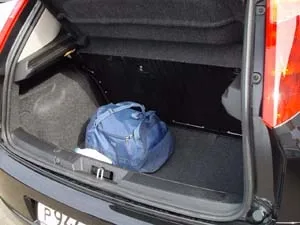
Trunk volume (l) min / max (with rear seats folded) — 275 / 1030
Curb weight — 1025 kg
The history of the Italian concern FIAT began in 1899, when a group of investors, among whom Giovanni Agnelli stood out, founded the company. The headquarters was located in Turin.
The brand earned its reputation as an extraordinary manufacturer back in 1911, when the S61 model with a 10.5-liter engine won the Grand Prix in France. The very next year, Agnelli launched mass production of cars under the F.I.A.T. brand. He was one of the first to realize: every automaker must have its own style, developed by a stylist artist.
Expansion abroad began early — in 1909, a plant in Poughkeepsie opened in the USA. The approach reflected Agnelli's strategy to strengthen control over production. Its result was the Lingotto project — the largest automotive complex in Europe, which began operating in 1922. Its philosophy was to create a mass-market car, not a car for the elite.
After World War I, FIAT became the leader of the Italian automotive industry. By the early 1920s, it had become the country's largest company. However, the strikes of 1919–1920, led by communists Antonio Gramsci and Palmiro Togliatti, virtually destroyed production. Agnelli returned to leadership only after Mussolini came to power. In 1927, the IFI holding appeared, managing FIAT, where the Agnelli family still dominates.
In 1936, the world saw the "Topolino" (FIAT-500) — a two-seater car with a 569 cc engine, the smallest in the world among production cars. From 1936 to 1955, 519 thousand units were sold. Different versions of this model were supposed to stir interest in motorization in Italy.
In 1966, FIAT signed an agreement with the USSR to build the Volga Automobile Plant (VAZ) in Stavropol-on-Volga, which the authorities renamed Tolyatti — in honor of the man who nearly ruined the company in the 1920s.
A turning point came in 1983, when the famous Uno debuted — a car with many innovations in electronics, materials, and engine design.
In 1980, the compact FIAT Panda was shown in Geneva. Over 20 years of production, 60 modifications appeared. In 1986, the FIAT group acquired Alfa Romeo, strengthening its position in the global market and soon presenting the Alfa 164.
The five-door hatchback Tipo debuted in January 1988, the four-door sedan Tempra in February 1990, and the Tempra Station Wagon and Marengo van in May of the same year. In October 1995, they were replaced by the Bravo/Brava and Marea families.
Punto/Sporting — a front-wheel-drive car of the especially small class (3- and 5-door hatchback). The most popular model in its class, with 17 base versions (including a convertible). The most powerful is the GT. Debut — autumn 1993, new generation — July 1999.
In the summer of 2000, the "luxury" version Barchetta Riviera was shown in Turin. In October of the same year, the passenger-cargo Doblo was presented in Paris — in both passenger and cargo versions (Doblo Cargo).
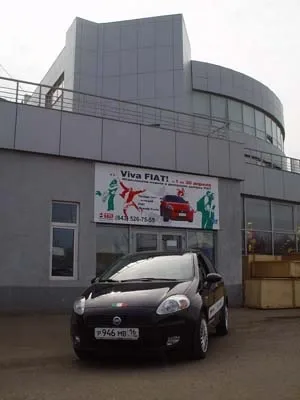
As for the Grande Punto, in 2005 this one of the few truly popular models of the brand became a "grande." The debut took place at the 61st Frankfurt Motor Show.
The new model was supposed to return Punto to its former glory. The stylish and spacious Grande Punto significantly outgrew its predecessor in dimensions (4030x1690x1490 mm) — a serious claim to move into a higher class. The Italians offered two body options: a 3-door and a 5-door hatchback. The model is built on the common compact FIAT-GM platform, with features including an independent double-wishbone rear suspension (front — classic McPherson struts).
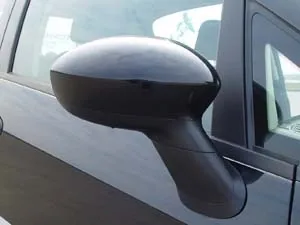
The body is an example of Italian style. Sloping lines and their smooth transitions give the car a unique appearance.
Inside, everything is more prosaic, but there are pluses. The car has become more spacious than its predecessor. The 275-liter trunk can be quickly increased to 1030 liters by folding the rear seats.
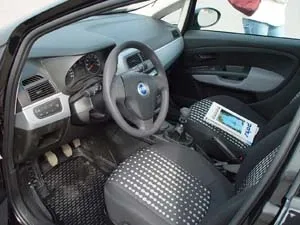
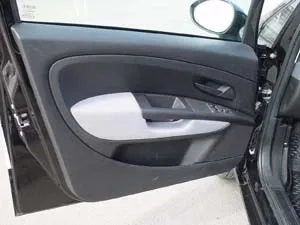
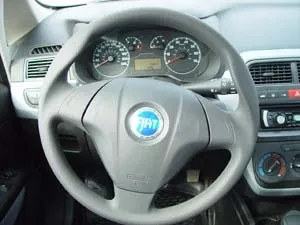
The interior is modest but tastefully done. Clear lines of the front panel with a highlighted "driver zone," two-tone seat upholstery. The driver's seat has a full set of adjustments, and the steering wheel adjusts for height and reach.
Experts rated the model's safety highly. Possible injuries to the head, chest, and limbs are minor. For child protection during transport — 35 points (72%), three stars out of five. Pedestrian safety — 19 points (53%), three stars out of four.
At the time of the test, the company was working on a new modification of the Grande Punto, which was supposed to go on sale in the summer of 2007. The car was planned to be equipped with a new 1.4-liter turbo engine in two versions — 120 or 150 hp.
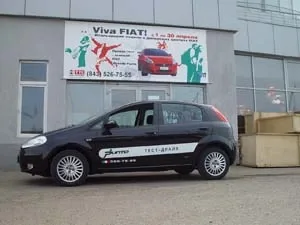
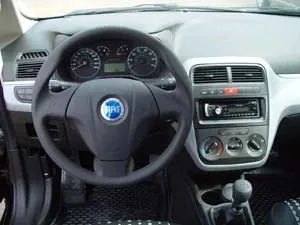
Grand Punto — the ideal car for the city.
Alfred. Recently, brands like Alfa Romeo (part of FIAT) and Seat left the Russian market, slamming the door. And now FIAT, like a boomerang, has returned, making a splash. What do you know about FIAT? Most will say: weak suspension, they don't handle our roads well. But here the suspension is identical to the new Opel Corsa — the result of a recent partnership with GM. We've already tested the Corsa, and if the settings are the same, then it's already worth buying for that.
Vadim. The chassis deserves only an excellent rating. Insensitivity to potholes and bumps, smooth passage over rails, and at the same time excellent handling. Separately about the brakes: very stiff, the slightest press — and the car stops dead. That's a plus, brakes should be "fierce," especially since you quickly get used to dosing the force. By the way, such brakes will break the common habit of taking corners with the pedal pressed.
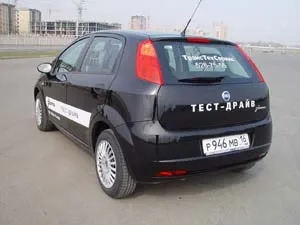
Alfred. And the looks? Italy! The hand of the brilliant Giugiaro created an image resembling Maserati and Aston Martin at the same time. Common features are in the shape of the headlights and radiator grille. The car is very beautiful, and FIAT has never had others: every car is a "Car of the Year" title in Europe.
Vadim. Indeed, a beautiful car. Swift, flashy looks — you can buy it for that alone. Inside, the ribbed seat cushion impressed me: unusual and very comfortable. The plastic of the dashboard doesn't shine with quality (that's normal for this price), but everything is assembled solidly, no complaints. Only the reflection of plastic on the windshield was annoying, though the area is small and hardly interfered with visibility. Among the pluses — the armrest between the front seats. Note: its length is adjustable, easily adapting to the driver. Among the minuses — the stiffness of the steering column switches: in foreign cars, everything should work smoothly.
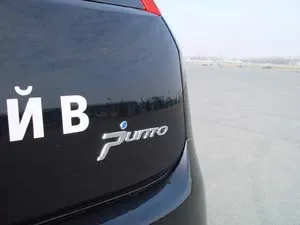
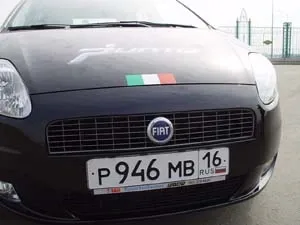
Alfred. When you get behind the wheel of this car, you immediately find yourself in an atmosphere of elegant forms and impeccable taste. There's something like refined chic that doesn't catch the eye but is felt in every detail. From the very first seconds of movement, you notice that the steering wheel is too light — even overly so. It's all about the parking assistant: it automatically turns off when speed exceeds 50 km/h (I might be off on the exact number), and only then does the wheel fill with the usual effort. The suspension works just magnificently — the same story as with the Corsa, but with Italian flair, that is, with sharper handling. In essence, all previous Fiat cars were famous for excellent driving manners: they confidently hold the arc in corners, easily change lanes in traffic. Our subject is no exception to this tradition.
By the way, fans of the cult game "Need for Speed: Most Wanted" remember that in the game, the Punto is a very obedient and lively little car, convenient for starting a career. And that's not without reason. The only thing to nitpick is the high-positioned pedals and the lack of torque from the 1.4 engine. The controls are raised so that when pressing, you have to lift your leg high, which is a bit tiring. And the engine is clearly weak for such a chassis, which deserves more. Although I wouldn't pay extra for a larger engine — these 1.4s are enough, it's just that sometimes you want to push harder. Special thanks for the protection against accidental reverse gear engagement — done in a reliable Opel-like manner. As for the gearbox, clutch, and brakes — there's nothing to say, everything works as it should, nothing to complain about. You definitely won't get bored behind the wheel of this car — it involuntarily infects you with its positive attitude.
Vadim. Now, more about the engine. This is a classic 1.4 8V with 77 hp and 115 Nm, available already at 3000 rpm. To understand whether this is good or not, let's compare it with the Opel Corsa 1.2 16V (80 hp) — after all, both models are on the same platform and almost identical in characteristics. The Fiat's trump card is torque, which peaks earlier, at 3000 rpm, while the Opel's only at 4000 rpm. The result is pleasant: at low revs, the Punto pulls noticeably more confidently. What does this give in practice? In city traffic, you don't need to panic-watch the tachometer needle — the car almost always responds adequately to the gas. This is especially appreciated by women, who often forget to shift down in time. Here's a simple example: the Grande Punto calmly and without jerks drives in fifth gear at 40 km/h and accelerates normally. But the Corsa in the same fifth requires at least 50 km/h, and at around 1000 rpm it immediately asks to shift down if the speed drops a bit.
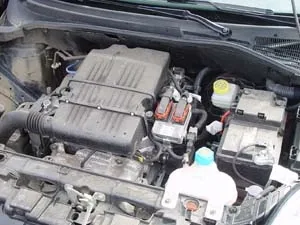
But after three thousand revs, the picture changes: to achieve sharp acceleration on the 1.4 8V, you'll have to either shift down or use the tricky technique of "press-release-press." While on the 1.2 16V at the same 3000 rpm, it's simpler — just floor it, and that's it, because 16 valves work more efficiently on both intake and exhaust. Let's sum up. For calm city driving, without extra aggression, it's better to take the 1.4 8V — it allows you to drive without constant shifting and, thanks to low revs, saves fuel. It seems to me that such an engine suits either inexperienced drivers (it's ideal for women) or, on the contrary, seasoned ones who have already had their fill of speed. There's another nuance, though I don't know how relevant it is now: million-mile engines are always 8V, while the lifespan of 16-valve ones is noticeably more modest.
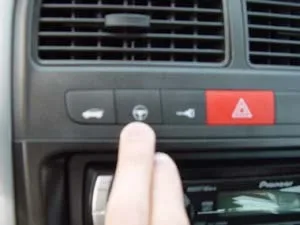
The car is beautiful, cozy inside, and drives great. Only the price let it down: the Grande Punto will find it hard to compete in the B-class. Take, for example, the same-platform Corsa D — with similar equipment, it's cheaper by at least 30 thousand rubles. And other competitors have even more affordable options.
Alfred. This time, I took my wife on the test drive. She recently got her license and didn't dare to get behind the wheel in the company of three "serious" men, but she happily rode as a passenger. We're just looking for a car for her for the future, so — this Punto instantly closed the search question. It put a bold FULL STOP. The only thing is, she'd prefer the version with a robot, not a manual. And what? It's a perfectly worthy choice: it's handsome, with an Opel "gait," Fiat-style original, and handles excellently.