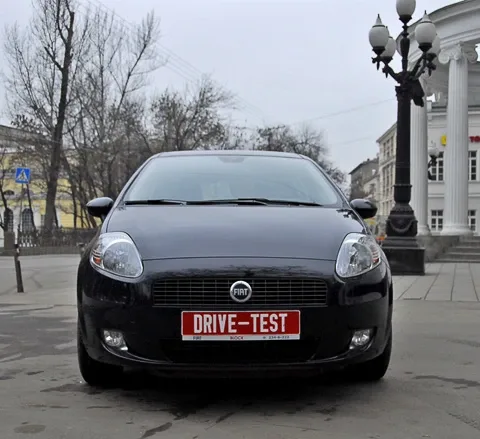
Here I am at a traffic light, bored. Next to me stops some imported small car with a '1.6' badge on the trunk — the kind usually bought on credit with a minimal down payment. Seems unremarkable. 'Well,' I rub my hands, 'now we'll show them.' But when the light turns green, I floor the gas, drop the clutch, and my Grande Punto with wheelspin... no, it doesn't fly forward. First it just spins, then it accelerates leisurely. Slightly faster than the general flow. And so it goes at almost every intersection. Honestly, I don't even understand why I decided to race this time. After all, the Grande Punto shares only its Maserati-inspired front end with a sports car. Otherwise, it's a perfectly ordinary compact car with no hint of a driver-focused character. Five doors, an unremarkable engine paired with an equally ordinary five-speed manual. Moreover, by all logic, it should be 'anti-driver'! You sit behind the wheel, and there's no talk of any connection with the car. Just a solid city car. So what could provoke the driver? Let's try to figure it out. I've already expressed my opinion on the looks — they're good and really do look very dynamic. From the outside, the Grande Punto seems like a much 'hotter' hatchback than it actually is. Inside, while stylish, it's not at all racy — just a neat and attractive cabin. The seats and dashboard feature cute light-blue inserts. You won't find soft plastics here, but what's installed looks quite quality. And assembly is top-notch — gaps are even, and nothing rattles on the move except for junk in the trunk. However, there are questions about ergonomics and visibility. The small leather steering wheel with its contours beckons you to grab it. But after a bit of driving, you realize the thumb grips are more for looks than comfort — they look striking, but holding them isn't very comfortable. The gearshift lever sits high and too close to the driver, and the triangular front pillars significantly block visibility in corners. The armrest between the front seats is a real 'masterpiece' on its own. When lowered, it's comfortable for your right hand... but then shifting gears becomes nearly impossible! So, if you take the Grande Punto and don't want to pay an extra 40,000 rubles (or about $1,500) for the automated manual, it's better to raise the armrest and forget about it. The heated front seat buttons also surprised me. It's not just that you have to find them under that armrest. Their indicator is amusing — when heating is on, the button doesn't light up, and when off, it does. But overall — and this is the main thing — the interior pleases. Plus, the adjustment ranges are good, and the steering wheel adjusts for both height and reach. So getting comfortable is no problem. However, those who want to drive fast (like me) will be disappointed by the front seats lacking side support. Apart from the described flaws, everything else is done quite decently. The instruments are easy to read, and all the necessary and unnecessary buttons are at hand. But so far, nothing provocative about the car is visible. Until you start the engine... The car drives well, but with its own quirks. Well, because the chassis is tuned quite nicely. And the quirks are in the control settings. The steering is light and completely uncommunicative, the clutch has a long travel and is, again, uncommunicative: you have to guess when it finally engages. And the brake pedal is light — you guessed it! — also uncommunicative. I pressed it slightly, and the car behind almost rear-ended me. Braking smoothly is very hard! When you try to stop gently, it's somewhat okay, but if you need to slow down even a bit more intensely, you have to handle the pedal with extreme care. After struggling a bit, I decided: since smooth isn't working, we'll drive aggressively! Such settings are even a bit insulting, because the car handles well. The suspension is fairly stiff and doesn't allow much body roll or pitching in corners. It's energy-intensive and 'collected,' but it shakes unpleasantly on small bumps. Though as speed increases, the car gradually stops noticing road imperfections. And the faster you go, the less they bother you. Got the hint! But if you're going to drive the Grande Punto fast, it's better in the city than on the highway. It's not even about the relatively short wheelbase — despite it, the car holds a straight line confidently and doesn't stress at high speeds. But the engine clearly isn't enough. In the city, it's better, but to drive really fast, you have to not only rev the engine to the limiter and yank the gear lever actively. You need to squeeze into every gap, gesticulate wildly, and shout at other drivers. After all, the 'unprecedented power' touted in Fiat Grande Punto brochures actually means 13.2 seconds to 100 km/h. No, not uphill and not on ice! However, this 'unprecedented power' is generally sufficient, though the engine's suffocation by Euro-4 norms plays a nasty trick — due to lazy throttle responses, downshifting with rev-matching isn't quick or convenient. Fortunately, the gear ratios are optimally chosen. And I don't even know why, but despite all its laziness, the engine, it seems, begs to be revved once more. I won't say there's much pleasure in fast driving in the Grande Punto. Rather, it's a struggle against the car's character. I keep revving the engine, listening to its 'tasteless' howl, and rejoice that I made this car go briskly, and that in traffic it's no worse than others. In this mode, the car indeed becomes quite dynamic — it accelerates confidently and stays ahead of the flow. And there's no place or need to speed in the city. But after a couple of days, I got used to it. Got used to the silly brake pedal, the light steering, and the unresponsive little engine. And I realized that driving this car calmly is a pleasure. For its class, the Punto is quite comfortable and quiet. In its amorphous seat, you can lounge any way you like and lazily turn the feather-light wheel. In traffic jams, light pedals keep your legs from tiring. You just sit and drive. You can listen to music. Though the stereo sounds mediocre, at least it plays MP3s. Passengers like it too — they all settled in as they wanted, and there's even some room for luggage. Little touches please: buttons scattered generously on the steering wheel, a convenient info display, and the ability to customize many car functions. The dual-zone climate control is also good, which isn't yet common in cars of this class. In short, once you get used to the Grande Punto, it becomes a car that, as they say, doesn't stress you out. And if you ever want to never 'step out of character,' the Grande Punto has an interesting speed limiter function. You set the 'ceiling' yourself, and when you cross it, the car starts yelling — like, no need to race here, better save fuel! However, in any driving mode, the engine won't consume much, which is also pleasing. So, I'll turn off that limiter, I guess. After all, I 'own' a Fiat, and Fiat owns Ferrari. Well, pedal to the metal!
This car isn't one you get into and drive right away. The Fiat Grande Punto is a characteristic Italian with a tricky temperament that takes time to get used to. But if you find common ground with it, it can give you plenty of pleasure. True, for our test car, dealers ask over $19,000, and calling that sum democratic is hard. And if you want the 16-valve engine version, you'll have to pay even more. I'm afraid that for many buyers, the price will be the main disappointment, against which even the vague steering and overly responsive brake will fade into the background. But the fact that this car makes you want to squeeze everything out of it... What can you do — Italian roots make themselves known.
Specifications
Characteristics 522000 RUB ($19890)
Dimensions and weight
Wheelbase (mm) 2510
Track front / rear (mm) 1473 / 1466
Length (mm) 4030
Width (mm) 1687
Height (mm) 1490
Trunk volume (l) min / max (with rear seats folded) 275 / 1030
Curb weight (kg) 1040
Trailer weight — with brakes / without brakes (kg) 400 / 1000
Engine and transmission
Number of cylinders, arrangement 4, in-line
Bore x stroke (mm) 72.0?84.0
Engine displacement (cm3) 1368
Emission standard Euro 4
Compression ratio 11.0: 1
Maximum power, kW (hp) at rpm 57 (77) 6000
Maximum torque, N*m (kg*m) at rpm 115 (11.7) 3000
Valve train 1 camshaft in cylinder head (SOHC)
Fuel system multi-point injection
Drive front
Gearbox, number of gears manual, 5-speed
Chassis
Steering type rack and pinion with electric power steering Dualdrive™
Turning radius (m) 10
Brakes with ABS
Front (mm) 257 (disc)
Rear (mm) 228 (drum)
Suspension
Front independent, MacPherson
Rear semi-independent, torsion beam
Performance characteristics
Maximum speed (km/h) 165
Acceleration time (s) from 0 to 100 km/h 13.2
Urban fuel consumption (l/100 km) 7.7
Extra-urban fuel consumption (l/100 km) 5.2
Combined fuel consumption (l/100 km) 6.1
Fuel tank capacity (l) 45
CO2 emissions (g/km) 145
Equipment of the tested car
  • Standard equipment
    • “Follow me home” device
    • Immobilizer (Fiat CODE)
    • Electrically adjustable and heated rear-view mirrors
    • Heated front seats
    • Front electric windows
    • Central locking
    • On-board computer
    • Rear seat folding in 40/60 ratio
    • Height-adjustable driver's seat
    • Steering wheel adjustable for height and reach
    • Dualdrive electric power steering
    • Full-size spare wheel
    • ABS
    • EBD
    • Driver's airbag
    • Front passenger's airbag
    • Fog lights integrated into the bumper
  • Additional equipment
    • Dual-zone climate control system
    • Audio system with CD player supporting MP3
    • Audio system controls on the steering wheel
    • Leather trim on steering wheel and gear shift lever
    • Rear electric windows
    • Rear spoiler painted in body color
    • 15’’ alloy wheels, tires 175/65 R15

The test car was provided by
OJSC “Severstal-avto”.
Behind the scenes
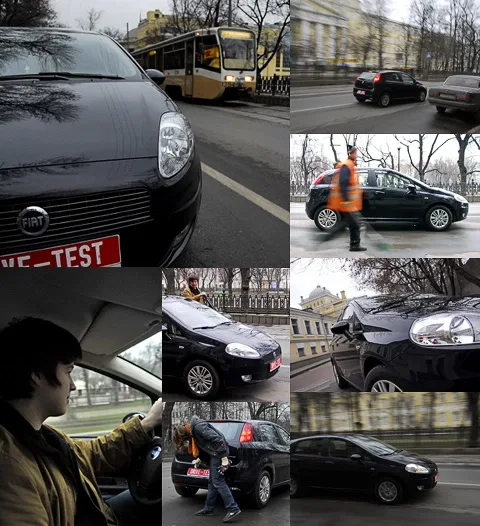
test-drive-11.jpg