
You want a "spirited" hatchback, but the family reminds you of the dacha, trips to relatives, and transporting houseplants. In the end, the choice falls on a practical and affordable van — for example, the Peugeot Partner or Fiat Doblo.
Now the Skoda Roomster has been added to them. Presenting the new model to journalists, the Czechs showed a sketch — a house with an airplane cockpit attached. Like, passengers in the Roomster will feel at home, and the driver will feel like a pilot.
Is that possible?
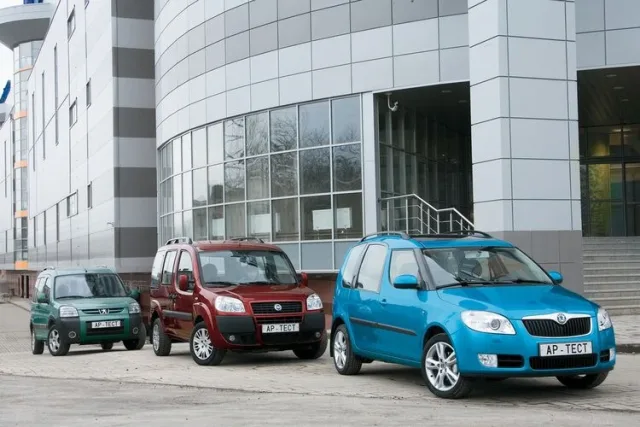
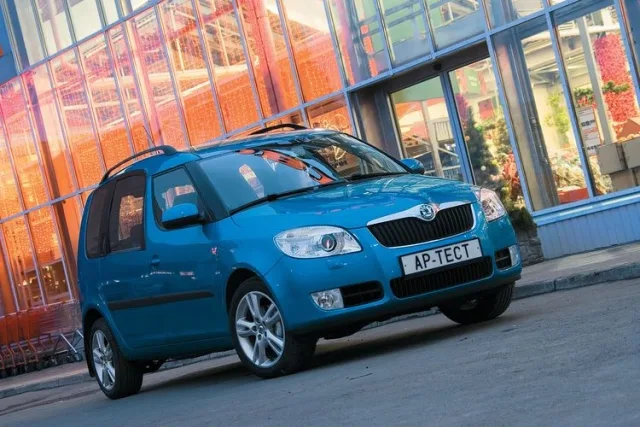
The Roomster looks attractive. The "aviation" instrument panel, hidden rear door handles — like on an Alfa Romeo, C-shaped taillights at the rear... You can immediately see that the car consists of two different parts: for passengers and for the driver. Interestingly, the "platform" of the Czech compact van is also assembled: the front part of the floor, running gear, steering, and engines are from the Fabia, while the rear part of the floor with the semi-independent suspension is from the first-generation Octavia. Therefore, the rear track of the Roomster is wider than the front.
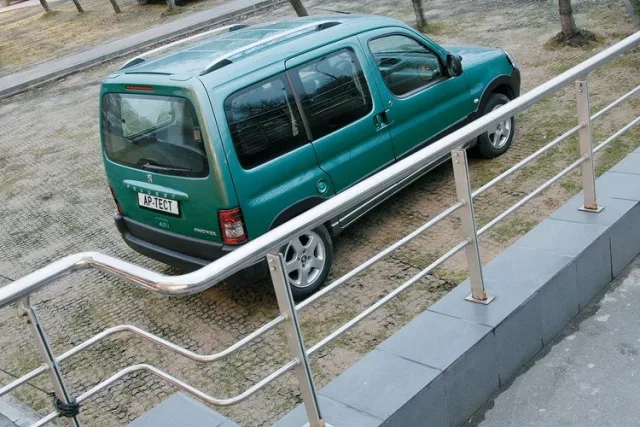
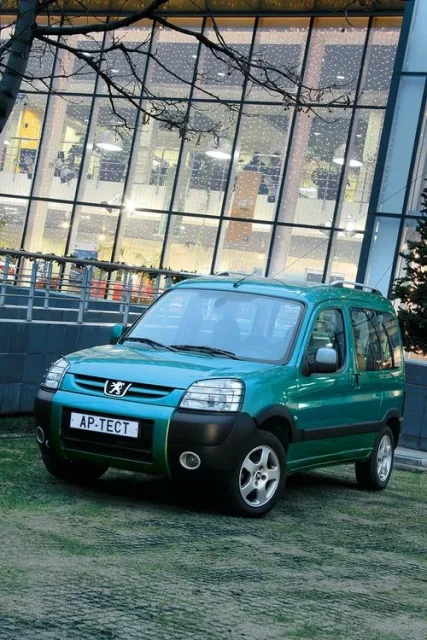
The Peugeot Partner looks calm and ordinary. Loading and unloading, meetings and send-offs... However, for a car that is already more than ten years old, the Partner holds up briskly. Stylish "glasses" on the headlights, a determined "chin" on the front bumper. And this despite the fact that four years have already passed since the last restyling...
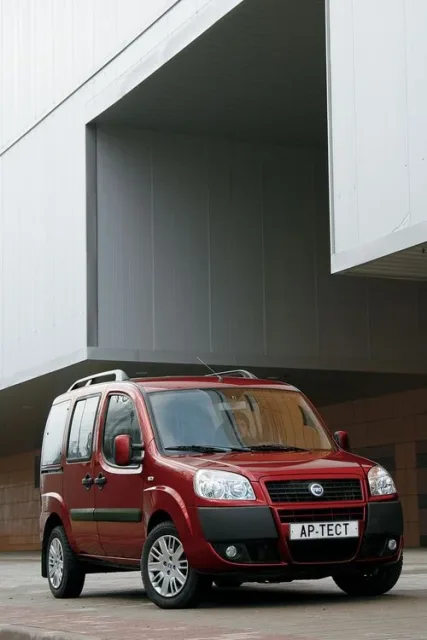
The Fiat Doblo is also not a newcomer. The update did it good: the gloomy "face" expression with dissatisfied "two-story" headlights disappeared. Does the Doblo defeat evil? But the whimsical curve of the front pillars and the stampings on the fenders still make the Fiat clumsy — the little van seems surprised at itself.
 | 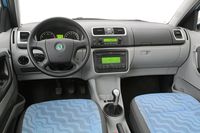 |
| The Roomster's instruments are the epitome of conciseness | The Skoda's interior is solid, though a bit plain |
The Doblo's cabin also has surprises — just the ornate front panel with its protrusions, recesses, and the superstructure for the stereo is something! On the right side of the panel there are two shelves, but because of this, the "glove box" will only fit a vehicle registration certificate. The seating position is high but uncomfortable: the seat is poorly profiled, with an awkward rise at the rear of the cushion and a "lumbar" hollow in the backrest. The backrest, by the way, adjusts in steps. Given that the steering column can only move vertically, and the pedal assembly is noticeably shifted to the right, it's not easy for the driver to find a comfortable position. The gear lever is located on a protrusion of the center console — that's convenient. But the long throws, considerable effort on the lever, and low shift precision are disappointing. And when engaging "opposite" gears, the lever noticeably moves vertically.
Visibility is also not great: the massive front pillars get in the way, and the vertically elongated exterior mirrors could be wider. In the interior mirror, the rear headrests and the massive joint of the rear barn doors loom. However, the glass of the rear "doors" is heated. And the larger one also has a wiper.
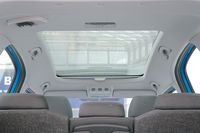 | 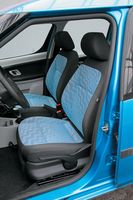 | 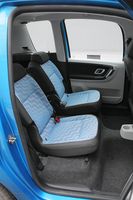 |
| Panoramic roof — optional for $610 | Comfortable seats — with height adjustment | After removing the middle section from the cabin, the outer "slices" of the rear seat can be moved closer together: romantic, but inconvenient |
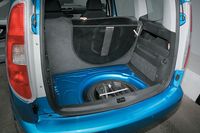 | 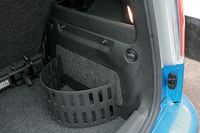 | |
| At the rear — a basket for small items, under the floor — a full-size spare wheel and tools. In other cars, the spare wheel is attached to the trunk floor from the outside | ||
Behind the wheel of the Partner, it's more comfortable to sit. True, as in the Doblo, the amorphous seat here has only two main adjustments, and the steering wheel only moves vertically. But it's easier to get settled — the backrest angle adjusts smoothly, and the seating geometry is fine. The downsides are the lack of lumbar support adjustment, the loose gear selection mechanism, and the low-placed, not very convenient "microclimate" controls. However, the elegant front pillars, large exterior mirrors, and recessed rear headrests improve visibility. The glass of the liftgate is with a wiper and heating. The only inconvenience is the windshield washer — it turns on and off with a delay.
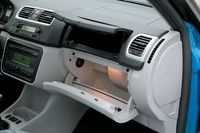 | |
| There are two glove boxes, the lower one is cooled | In the trunk — a 12-volt outlet and folding hooks |
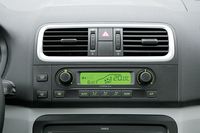 | |
| The gear lever throws are a bit long, but the selectivity is top-notch | Climate control — plus $230 over the air conditioner |
We move to the Roomster — and... It seems the Skoda is indeed "from a different opera": from a passenger car, not a heel-and-cargo-passenger one! The driver's seat is the best of all three, with large ranges of longitudinal and vertical adjustments. The steering column moves in two directions, and the steering wheel is the most comfortable. Shifting gears is pleasant: the effort is low, and the precision is excellent.
Not to mention the Volkswagen-quality trim materials and the most impressive list of additional equipment. Here you have climate control, inflatable "curtains," traction control, a panoramic roof... Moreover, in the car with "climate," all system readings are displayed on the central liquid crystal display.
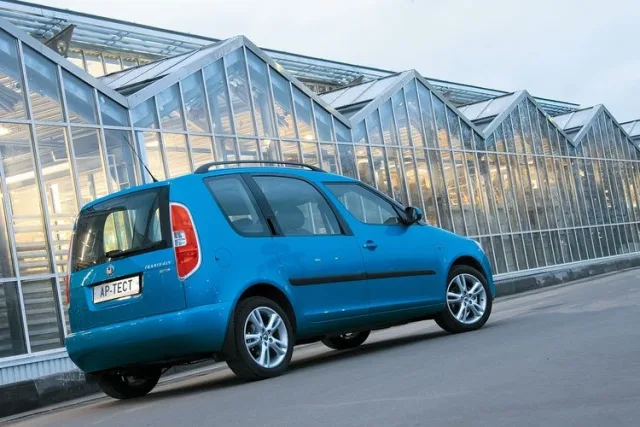
The side glazing reveals the "two-room" ideology of the Roomster
True, there is no shelf above the heads of the front occupants, as in the other two "heel" vans, in the Skoda. But there are two glove boxes, both spacious, and one of them is even cooled. And visibility is good, although behind the wheel of the Roomster it's harder to feel the front dimensions.
So, the driver is best off in the Skoda. And what about the wife and mother-in-law, if they are seated in the back?
In the back, all three cars are quite spacious, but... In the Doblo with its bare metal of the inner panels and Spartan bench, it's uncomfortable. For two in the back, it's best to settle in the Roomster — the seat here can be moved, folded, and tilted in parts. For example, the central section of the rear bench can be turned into a table with armrests — the most comfortable option for travel.
But for three in the "house," there's not enough space — the Peugeot Partner is wider. Moreover, both cars have heat supply to the feet of rear passengers: in the Partner — through deflectors at the end of the "beard" of the center console, and in the Roomster — with full-fledged air ducts.
| Fiat Doblo | Peugeot Partner | Skoda Roomster |
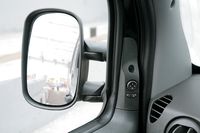 | 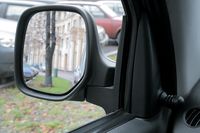 | 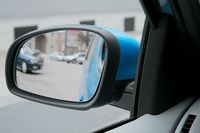 |
| The best mirrors are on the Peugeot; the Fiat's could be wider, and the Skoda is only slightly inferior to the Partner | ||
But the Doblo has the most spacious trunk. With a large square opening, with the lowest loading height... But, if you need to transport something bulky, like a mattress, the transformation mechanism of the Fiat's cabin will make you sweat. The parts of the rear seat here are not removable, but fold in a strictly defined sequence — first the small "slice," then the large one. Moreover, you have to reach from the cabin into the trunk for the floor lever of the folding mechanism. Removing and installing the trunk shelf is also a problem.
The Peugeot cabin is somewhat easier to convert: the rear seats are not removed, but their sections fold in any order — and a single hand movement is enough for this. As with competitors, to carry long items in the Partner, you can fold the front seat backrest, having first moved it forward and removed the headrest. However, in terms of cargo volume, the Peugeot loses to the Fiat by 100 to 200 liters — depending on how the seats are folded.
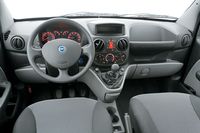 | 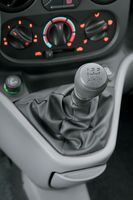 |
| The Doblo's front panel looks unfriendly — like the face of a transformer robot | The gearshift lever works with a vague feel |
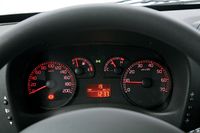 | 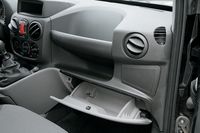 |
| The instruments are easy to read, but look dull | A couple of shelves and a glovebox that holds nothing |
The Roomster is even more modest in this regard: its trunk is the smallest. Plus a high sill and a rounded opening... But it transforms brilliantly! Each of the three parts of the rear bench can be moved, folded, and removed individually — and this can be done both from the cabin and from the trunk side.
But in motion, the Roomster…
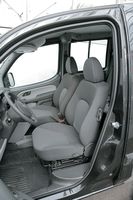 | 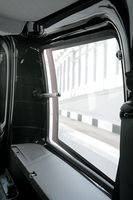 | 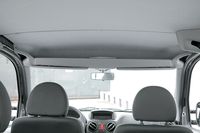 |
| Uncomfortable behind the wheel: the seat is poorly profiled, and the pedals are shifted to the right | The rear windows of the Doblo, like the Peugeot's, can be opened slightly | Above the heads of the front passengers in the Doblo, as in the Partner, there is a shelf |
No, it hasn't become faster — if only because "our" Skoda and Fiat had 1.4-liter engines (86 hp and 77 hp respectively), while the Peugeot we got only with a 1.6-liter engine (108 hp). Therefore, the Partner 1.6 accelerates more briskly, despite some lack of torque at low revs and "long" gears. But this does not give it a overwhelming advantage: the "illogical" clutch pedal and a somewhat stiff throttle noticeably complicate starting off, and you also need to get used to this.
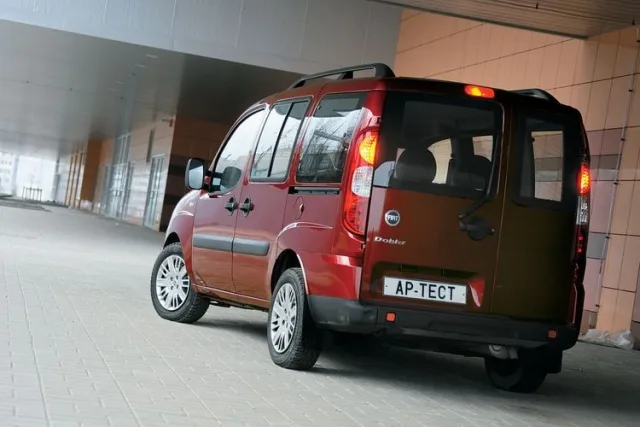
The left passenger door is a feature of the top Comfort version
The Fiat has no problems with pulling away — the pedal efforts are well chosen. And the lack of power is largely compensated by "short" gears: in second gear, the engine hits the limiter already at 80 km/h, in third — barely reaches 115 km/h. In terms of elasticity, the Doblo, of course, yields to the more powerful Partner and starts pulling confidently from higher revs (about 2500 rpm versus the "Partner's" 2000 rpm).
| Fiat Doblo | Peugeot Partner | Skoda Roomster |
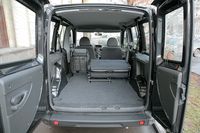 | 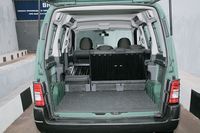 | 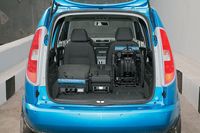 |
| The Doblo has the largest trunk, and the Roomster has the smallest. But in terms of transformation convenience, it's the opposite: in the Fiat, the seat folds only sequentially, while in the Skoda, all three sections slide, fold, and even remove separately. The Peugeot is a middle-of-the-roader in this regard | ||
And what about the Roomster? It is clearly more agile than the Doblo and only slightly slower than the Partner 1.6! The "short" gears logically pick up torque one after another: second — 77 km/h, third — 118 km/h. Well-calibrated pedal efforts, a light surge after 3500 rpm... The only inconvenience is the Volkswagen-style long-travel clutch pedal, but you can adapt to it by simply not pressing it all the way to the floor.
The brakes are good on all cars, but each in its own way. In the Peugeot, you have to press the pedal too hard. In the Fiat, on the contrary, it's easy to overdo the effort — the Doblo constantly noses over. And the Skoda pleased with the most adequate brakes: as you press, so you slow down. True, the free play of the pedal here is chosen somewhat stiffly. Moreover, when the ABS activates in the Roomster, the least vibration is transmitted to the pedal, while in the Partner, the most.
And finally, the most interesting part — handling.
Interesting? For boring "vans" designed to carry wives, mothers-in-law, children, and "pictures-baskets-cardboard boxes"?
Of course, for such cars, the main thing is control reliability. And the Peugeot Partner is an excellent example of this philosophy. The Partner does have a "sense of the car," despite the "long" steering wheel (3.25 turns from lock to lock) and the viscous effort that appears when quickly turning the wheel. And the reactions — both in calm driving and in slides — are stable and predictable.
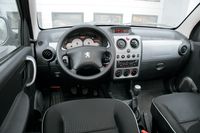 | 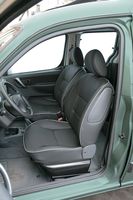 | |
| The Peugeot's front panel is simple and tidy | The soft seat lacks lumbar support | The gear selection mechanism is not notable for precision |
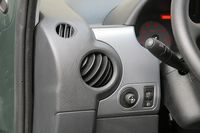 | 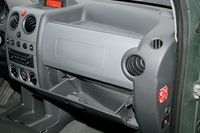 | |
| In daylight, the silver instruments are readable well, but at night, the red backlight interferes with perception | The joystick to the left of the steering wheel is the electric adjustment of the right exterior mirror | The Partner's glovebox is small |
But you can't say that about the Fiat Doblo. It's the complete opposite of the Partner! There is no such concept as feedback "through the steering wheel" here: there is effort when turning the wheel, but it is background, constant, and therefore not related to the steering angle. And the Fiat's reactions? The van begins to execute a maneuver with a noticeable delay and, squatting on the outer rear wheel, actively turns further into the corner. Even in a calm rhythm, it's impossible to drive through interchange loops on the Doblo without corrective steering — and the stronger the roll, the more noticeable the "oversteer." Dangerous handling!
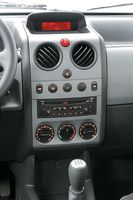 | The downsides of the center console are the low-mounted climate control knobs and the intricate fan operation algorithm: four speeds in recirculation mode! |
Well, and the flying house, that is, the Roomster? It really flies! Though very low — like that crocodile from the anecdote about the warrant officer.
Quick reactions to steering wheel turns, excellent feedback, minimal rolls — and a motor that growls in a racing manner. When lifting off the throttle in a corner, the Roomster slides off the trajectory with all four wheels and allows you to quell all understeer-oversteer in one touch. The most precise and reliable handling! The only annoying nuances are the step in effort that appears when quickly turning the wheel and the barely perceptible increase in reaction during lane changes at high speed.
But this had to be paid for with ride smoothness: the Roomster's suspension meticulously collects all the road "small stuff," harshly transmits all joints and cracks into the cabin, and makes the car follow the road profile. Hard bumps with short waves are also perceived unpleasantly.
But it won't make you motion sick…
| Fiat Doblo | Peugeot Partner | Skoda Roomster |
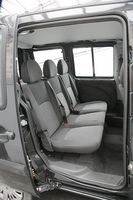 | 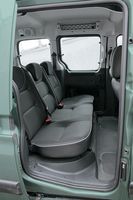 | 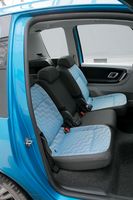 |
| It's more comfortable for two to sit on the second row of the Roomster, especially with the central backrest folded down. And for three, the Partner is more spacious. The Spartan seats of the Doblo are not conducive to travel | ||
The most comfortable in terms of ride smoothness turned out to be the Partner. It barely reacts to wave-like bumps, joints, and minor surface defects, while impacts from serious potholes reach the cabin noticeably muffled. The Doblo is inferior in this component—its more pronounced reaction to large bumps and short waves of asphalt takes its toll. In terms of noise levels, Fiat and Peugeot are roughly comparable, although the sources of discomfort differ: in the Doblo, road noise and the intrusive hum of the engine at high revs are bothersome, while in the Partner, resonant sounds in the cabin and echoes from trim elements are noticeable. The Roomster, as expected, with its passenger-car architecture, turns out to be quieter, but the advantage is small—the engine's operation is pleasant to the ear, but on a long trip its monotony begins to tire.
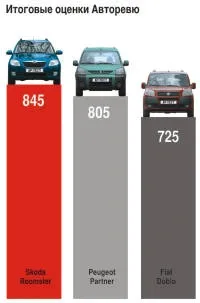
So what's the verdict?
The Doblo does not receive our approval. It is the least balanced car in this trio: spacious but inconvenient in terms of seat transformation, decent ride smoothness, yet absolutely vague handling. It is not suitable for home use and family needs. Perhaps only for small business could it be considered, although its price is not attractive either.
The Peugeot Partner with the 1.4 engine, priced from $16,630, falls into the same price range as the Fiat. But the cabin of the French car is better thought out, and handling is an order of magnitude higher. Notably, eleven years after the start of production, the Partner/Berlingo pair is not planned to be taken off the assembly line. It's a pity only that over such a long period, neither an automatic transmission nor climate control has appeared for them.
But the Skoda Roomster offers both—of course, for an extra charge. And overall, the Roomster turns out to be the most expensive purchase of the three. But at the same time, it is also the most desirable. After all, it is not just a very "family" car, but also a truly "driver's" one. A rare combination!
Under Impact
Of the three test participants, only two cars have undergone independent crash tests—the Skoda Roomster compact van has not yet been tested by EuroNCAP experts.
The pre-restyling Citroen Berlingo, which is a twin of the Peugeot Partner, showed a decent result in 2005 according to the EuroNCAP methodology—four stars out of five possible. However, the driver dummy hit its chest against the steering column, and the "passenger" hit its knees against the front panel, which was deemed "potentially dangerous." In a side impact, the driver's chest also suffered serious loads, even despite the presence of side airbags in the test car. The protection of child passengers is assessed as generally good, but in a side collision, a three-year-old "child" experiences increased loads. The Berlingo protects pedestrians poorly—the front of the body is too rigid.
The Fiat Doblo, despite appearing in 2000, showed a weaker result. The body of the pre-restyling version turned out to be insufficiently strong: in a frontal impact, the roof and floor deformed significantly, and cracks appeared in the leg area of front passengers. The chest and knees of the dummies experienced high overloads, and in a side collision, sensors recorded critical loads on the spine and abdominal cavity of the "driver" (in the version without side airbags). The Doblo handles child protection well, although in a frontal impact, the chest of a one-and-a-half-year-old "toddler" is overloaded. Towards pedestrians, the pre-restyling Doblo was ruthless.
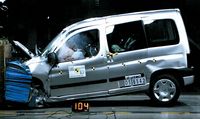 | Citroen Berlingo | ★★★★☆ |
| Overall rating | 26 points | |
| Frontal crash test | 10 (63%) | |
| Side crash tests | 15 (83%) | |
| SBR* | 1 | |
| Child passenger protection | 27 (55%) | |
| Pedestrian protection | 10 (28%) | |
| Curb weight | 1251 kg |
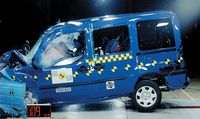 | Fiat Doblo | ★★★☆☆ |
| Overall rating | 23 points | |
| Frontal crash test | 10 (63%) | |
| Side crash tests | 13 (72%) | |
| SBR* | — | |
| Child passenger protection | 34 (69%) | |
| Pedestrian protection | 1 (3%) | |
| Curb weight | 1400 kg | |
| * SBR — presence of seatbelt reminder system | ||
What Costs What?
Prices for the Fiat Doblo in the passenger version Panorama start from $16,350 for the Base trim, which includes a driver's airbag, ABS, electric windows, onboard computer, fog lights, and one passenger sliding door. The Classic version at $17,490, which participated in the test, adds air conditioning and heated electric mirrors to the base equipment. The Comfort trim ($18,520) comes with a left sliding door, roof rails, passenger airbag, and heated driver's seat. Cargo vans Doblo in the Cargo version are offered from $13,940. Under the hood is an eight-valve "four" with a volume of 1.4 L
(77 hp), working in tandem with a five-speed manual gearbox. Sales of the Doblo start in the near future; for now, dealers are accepting orders with a three-month waiting period.
Warranty—2 years without mileage limit. The Fiat dealer network includes 21 points in 13 Russian cities.
Peugeot Partner costs more than the Fiat—the base version XR (1.4 L, 75 hp) is priced at $16,630. At the same time, the equipment is more modest—a driver's airbag and heated front seats. There is one passenger door in the "base," and at the rear—twin rear doors. The XT trim ($17,930) differs with a power package, heated mirrors, and the twin rear door gives way to a liftgate. A similarly equipped Partner with a 1.6 engine (109 hp) and a left sliding door costs $20,570. The top version Country ($21,310) is supplemented with fog lights and an engine sump guard. For everything else, as on the test car at $24,390, you will have to pay separately. For example, ABS costs $770, air conditioning—$1,090, CD player—$550, front passenger airbag—$290, and side airbags—$560. The delivery time for an ordered car is three months. Peugeot Partner cargo vans in the VU version start from $14,360.
Warranty—2 years without mileage limit. Peugeot is represented by 33 dealers in 19 Russian cities.
Skoda Roomster will interest with its price only in the initial version with a weak three-cylinder 1.2 engine (64 hp) and a driver's airbag—from $15,490. With the 1.4 engine (86 hp), the Roomster is available for at least $16,790, and the "base" already includes ABS. In the Style trim ($17,990), the Roomster 1.4 is equipped with two airbags, a power package, heated front seats and mirrors. The version with a 1.6 gasoline engine (105 hp) and a "manual" costs $18,690, and for an "automatic" you will have to pay an extra $1,300. A turbodiesel Roomster is also available—1.4 TDI (69 hp) for $19,390 or 1.9 TDI (105 hp) for $23,590. The Sport and Comfort modifications, which have air conditioners and alloy wheels, start from $19,290 for the 1.4 version and from $19,990 for the compact van with a 1.6 engine. The most expensive modification is the Roomster 1.9 TDI ($24,890). The list of options is impressive: climate control—$230, side airbags—$180, stability control—$350, CD player—$290, panoramic roof—$610. "Our" Roomster 1.4 will cost $25,500. Orders for the Roomster will begin to be accepted in January, with a delivery time of two months. A cargo version is also provided—the Skoda Praktik, but it will appear no earlier than spring.
Warranty—2 years without mileage limit. Skoda has 44 dealers in 27 Russian cities.
Autoreview Readers' Forecast
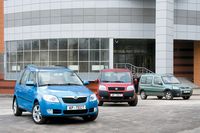
Before conducting this test, we asked visitors to the website www.autoreview.ru the question: "Which car from the participants of the next Autoreview test would you prefer?"
The votes were distributed as follows:
Skoda Roomster 65.22%
Peugeot Partner 23.62%
Fiat Doblo 11.16%
4,332 people took part in the survey
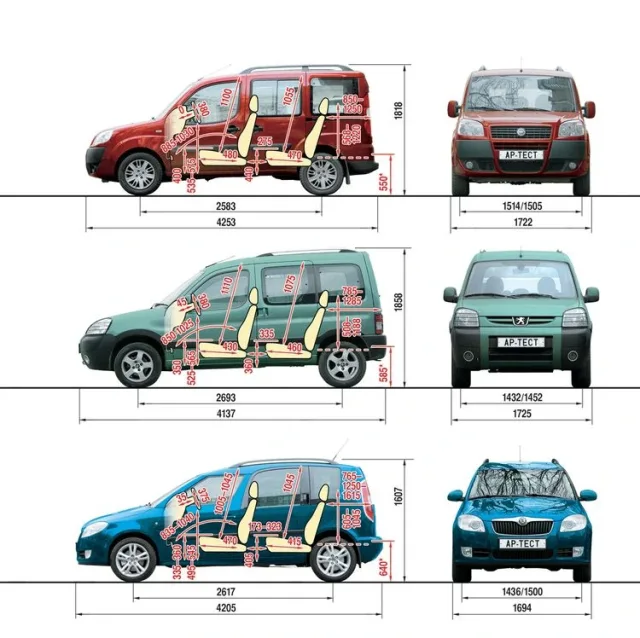
Black indicates manufacturer data, red—results of Autoreview measurements
* Loading height