
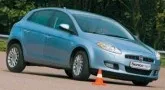
A handsome Fiat Bravo hatchback hit the Russian market in spring, having had its world premiere a year earlier in Geneva. Only the most powerful versions are brought to us — both with turbocharged 1.4-liter engines producing 120 or 150 horsepower.
The initial euphoria over the new model has subsided, so now it can be assessed soberly. We decided to compare the emotions from the design with the dry figures we will obtain at the Dmitrov test track, testing the most powerful 150-horsepower version.
I will start with what catches the eye — the exterior. The car looks very attractive. The smooth body lines form a cohesive, harmonious image that has room for both leisurely southern charm and the temperament of a true Italian. Replacing the Stilo, the Bravo continues the traditions of the Italian school of automotive design, having finally said goodbye to the angular forms of its predecessor. The company logo has also been updated.
However, the striking exterior does not quite match the interior, which seems overly calm. Do not think I am criticizing the cabin — everything here is done well: materials are pleasant, panels are impeccably fitted, seats have good lateral support, and the driver's ergonomics are commendable. Yet inside, there is clearly a lack of that Italian spark. Although, I am sure there will be those who will appreciate such a combination of flashy looks and restrained interior.
Inside, the Bravo is quite spacious: front width is 1480 mm, rear is 1475 mm. Four adult passengers will fit with relative comfort, but three in the back will be cramped. The trunk volume, according to the manufacturer, is a solid 400 liters.
The curb weight of the car is 1397 kg, and the maximum permissible weight is 1785 kg. That means with an empty car, you can put about one kilogram of cargo in the trunk for each liter of volume. The equipment includes seven airbags, including a knee airbag for the driver. This is largely why the Bravo earned the maximum score in Euro NCAP crash tests. But passengers are protected not only by airbags — the driver is assisted by ABS, ESP with hill-start assist, and the ASR system.
I start the engine and begin testing. I immediately note that the engine runs very quietly, or rather, the sound insulation impresses. This is undoubtedly pleasant. And the Bravo owner will find it even more pleasant while driving. The hatchback's suspension is not stiff, but it cannot be called soft either — it is a successful compromise between comfort and handling. Up front is a classic McPherson, at the rear is a semi-independent torsion beam.
Now about the main thing — the 1.4-liter T-Jet engine with 150 horsepower. Acceleration to 100 km/h takes 8.9 seconds, which is very good for such a modest displacement. The top speed is 212 km/h, also a worthy figure. In the city, such an engine consumes no more than 9.3 liters per 100 km, and on the highway only 5.8 liters. So on a long trip, for example from Moscow to St. Petersburg, you can forget about refueling altogether.
At the test track, the car showed its best side, as confirmed by the dry figures. It completed the ISO standard lane change at 123.8 km/h without load and 121.8 km/h with full load. Slight body rolls and deviation from the trajectory appeared. But in the slalom with frequent lane changes, you have to contend with excessive sluggishness — rolls increase, and the rear axle starts to noticeably drift. As a result, the figures were 62.2 km/h in curb condition and 61.6 km/h when loaded.
The "moose test" was not a problem for the Bravo. The car confidently avoided the unexpected obstacle, maintaining the set trajectory until the end of the maneuver. However, the engine's ability to confidently pick up on a high gear from low revs leaves much to be desired.
The brakes were tested with a series of ten emergency stops from 100 km/h. Despite this number of attempts, the Fiat remained stable, stopping consistently in the same 39 meters. An excellent, confident result.
In Russia, the Bravo is offered in three trim levels — Dynamic, Emotion, and Sport. The main difference is the engines, both 1.4 liters: 120 or 150 horsepower. Transmissions are manual or automatic. The price starts from 655,000 rubles. The top Sport version with the 150-horsepower engine and a set of sport accessories — pedal and gearshift lever covers, sill plates, spoiler, leather interior elements — will cost 720,000 rubles. Instead of 16-inch wheels, these are already 17-inch.
A wolf in sheep's clothing
Nowadays, more and more cars are equipped with small engines of 1.2 or 1.4 liters. Buyers like them for their fuel efficiency. But at the same time, everyone wants their car to also have decent dynamics, especially acceleration. Therefore, manufacturers are increasingly creating powerful small-displacement cars. Fiat has gone the route of installing a turbocharger; such engines are designated by the abbreviation T-Jet. The Bravo has two such units with a volume of 1.4 liters: 120 and 150 horsepower. The junior one accelerates the car to 100 km/h in 9.6 seconds, the senior one in 8.5. The top speed for the 120-hp version is 197 km/h, for the more powerful one it is 15 km/h higher. Fuel consumption is pleasing: the 150-horsepower version consumes 9.3 liters in the city and only 5.8 on the highway. So the future belongs to small-displacement turbo engines — with decent dynamics, they remain economical, and that is important.
Our assessment
Track tests have shown that the Fiat Bravo has good dynamic characteristics. The turbocharged engine revs easily and delivers all its power. The suspension is comfortable, which causes slight rolls, but this tuning is ideal for daily driving. The brakes demonstrate stable results.