
Remember the old documentary "Chariots of the Gods"? In the mid-seventies, it broke through the Iron Curtain and drew huge crowds. Who are we? Where do we come from? Were there aliens on Earth? Cave paintings, stone-marked "runways," Mayan structures... Now, looking out the window of a turboprop Saab at the snow-covered mountains and lakes of Swedish Lapland, I thought those filmmakers should have worked here too. What are those huge circles on the frozen lakes? Why those wide, polished-to-a-shine ice strips? An airfield? But why is there not a soul around? And why, after a minute of flight, is the picture almost the same? Markings for starships? And only when the plane descends to land at the tiny airport of the town of Arjeplog can you notice something else. A car races around in a circle, followed by a long trail of snow dust. And another car drove and drove — and suddenly spun like a top on the ice strip. This is the Mecca of winter testing. And in a sense, it's indeed an anomalous zone for the Arctic: here, they hibernate in summer, and work and earnings come in winter. Testers from almost all European companies gather here. I also raised my own trail of snow — behind the wheel of the newest five-door hatchback, the Fiat Bravo. But as for spinning like a top, even though I swung the car this way and that, it wouldn't spin: the stability control system simply cannot be turned off! A trend, however...
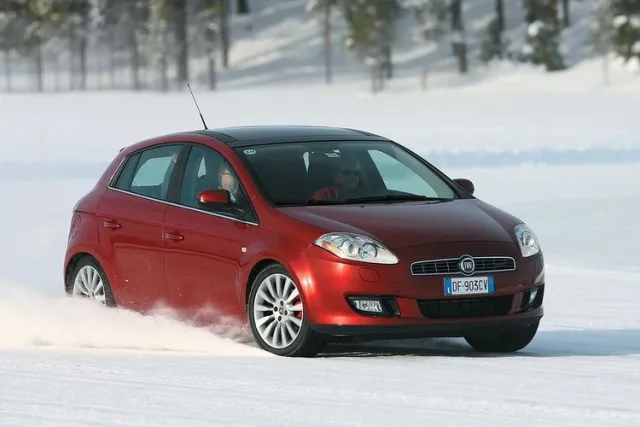
Then we decided to "check in" at the Arctic Circle — it runs about a hundred kilometers from the Colmis proving ground, where Fiat conducts "cold" tests. Ahead, one of the Fiat engineers drove a Doblo, and behind him, I followed in the Bravo. I see... As soon as I talked to them about handling, the "nitpicking test" began. We know these tricks! During such checks, our Divakov has driven more than one car into a ditch and even flipped one on its roof! No, not himself: he drove in his usual rhythm, and behind him — one of the young upstarts. In my time, both I, and Golovanov, and Rastegaev have flown off... The surface is snow, ice, and occasional patches of bare asphalt. Speed limits here and there: 70, 50... And me? What an idiotic speedometer the Bravo has! Not only are the numbers barely distinguishable, but the most used part of the scale is covered by the left palm! But I figured out that the scale is marked like a protractor, degree by degree, degree per kilometer. If the needle points down — that's zero, a state of rest. When it rises to a horizontal position — that's 90, whether degrees or kilometers per hour, and when it's at the zenith — that's 180, respectively. And mine is slightly to the right, at about 200 degrees... Okay, I think, my salary just hit my credit card — it should be enough, maybe even for a fine for exceeding the limit fourfold. And what if it's prison? After all, here in Sweden, you can't talk your way out...
 |
 |
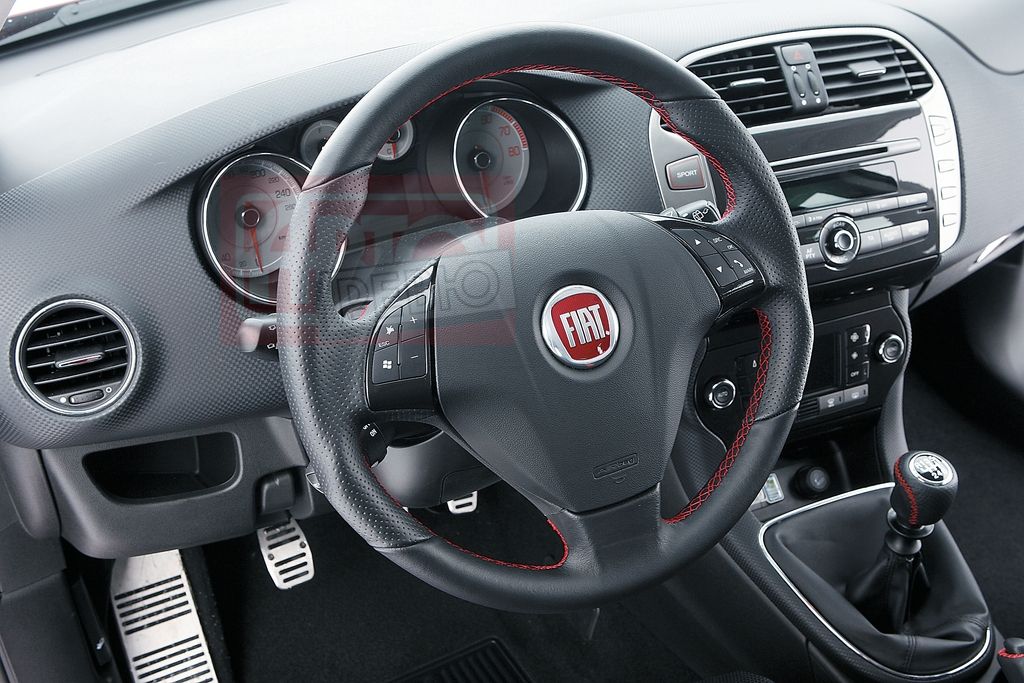
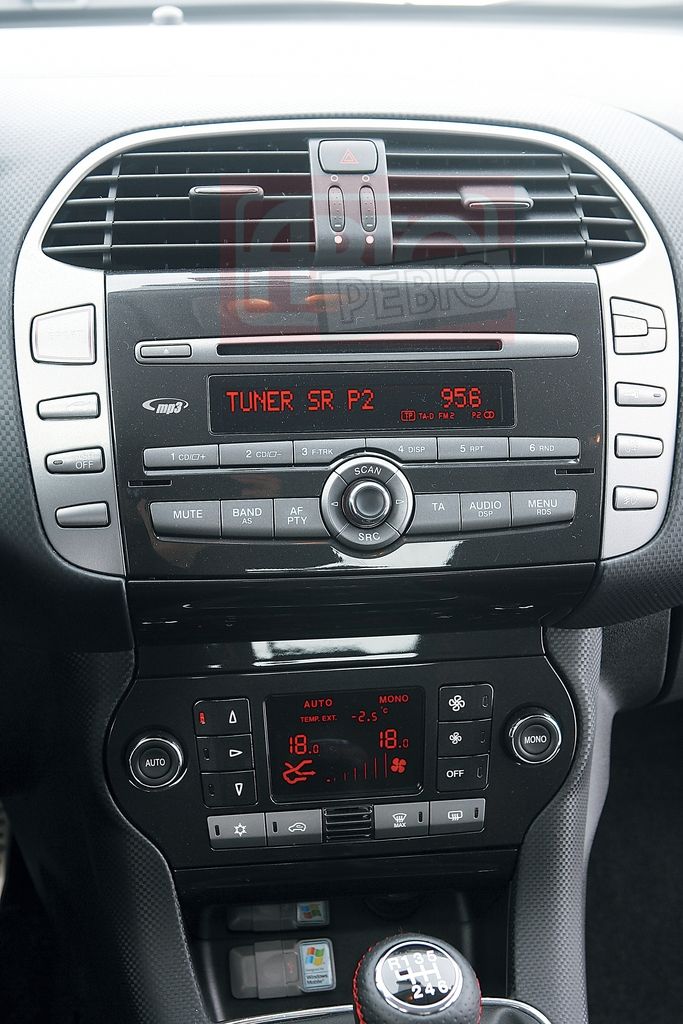
| The variety of materials and textures did not make the interior eclectic. There's a hint of "Alfa" influence here: the instruments are recessed into pods, the center console is slightly turned toward the driver, and the pedals and footrest have metal trim. Note the new "nostalgic" emblem adorning the steering wheel |
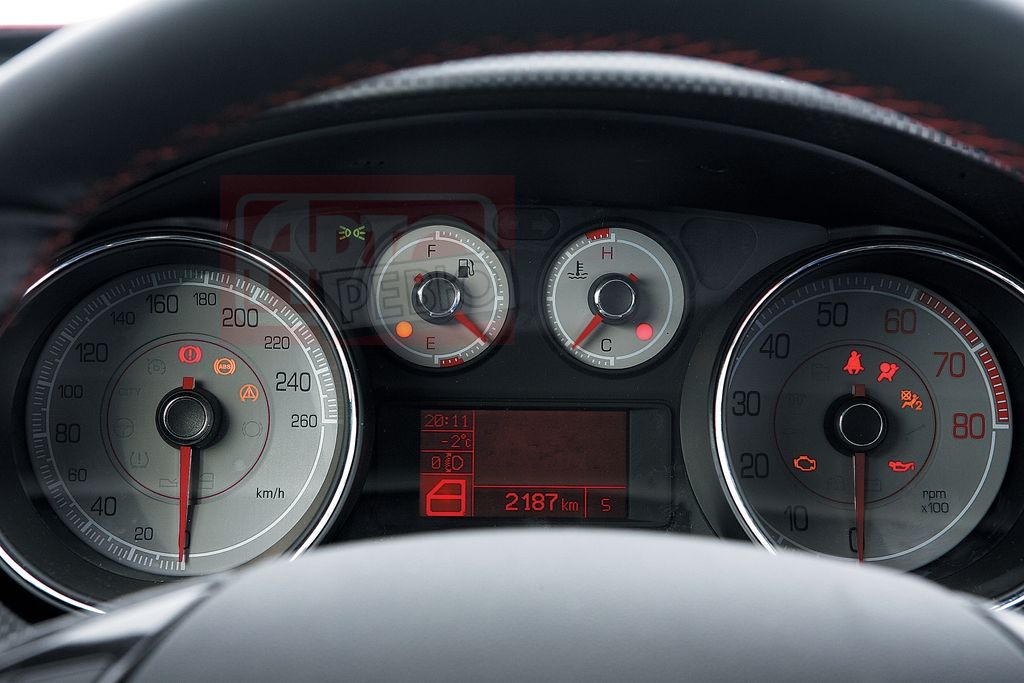
Everything would be fine if part of the speedometer and tachometer scales weren't covered by the palms resting on the steering wheel. Fortunately, the speedometer is calibrated like a protractor, so speed can be judged by the angle of the needle |
The wipers barely kept up with wiping away the slush flying from under the Doblo, and at the moment of another "clearing," I realized that prison was not the worst outcome. The road went right, and not just right, but onto a narrow bridge over a ravine. On the oncoming lane — a truck. The tires on the Bravo, though grippy, are without studs. What a blessing that behind the wheel of the Doblo was not just a pro, but a pro with broad views! Of course, he was also scared, but he didn't forget about me: so that I wouldn't rear-end him, he didn't brake sharply and, leaving me room to maneuver, put the car into a slide — it crossed the bridge like a spacer between its railing and the truck, touching neither! As for me, I was saved by the Almighty and the stability control system. The non-disengageable one. I myself was not ready for such a turn of events.
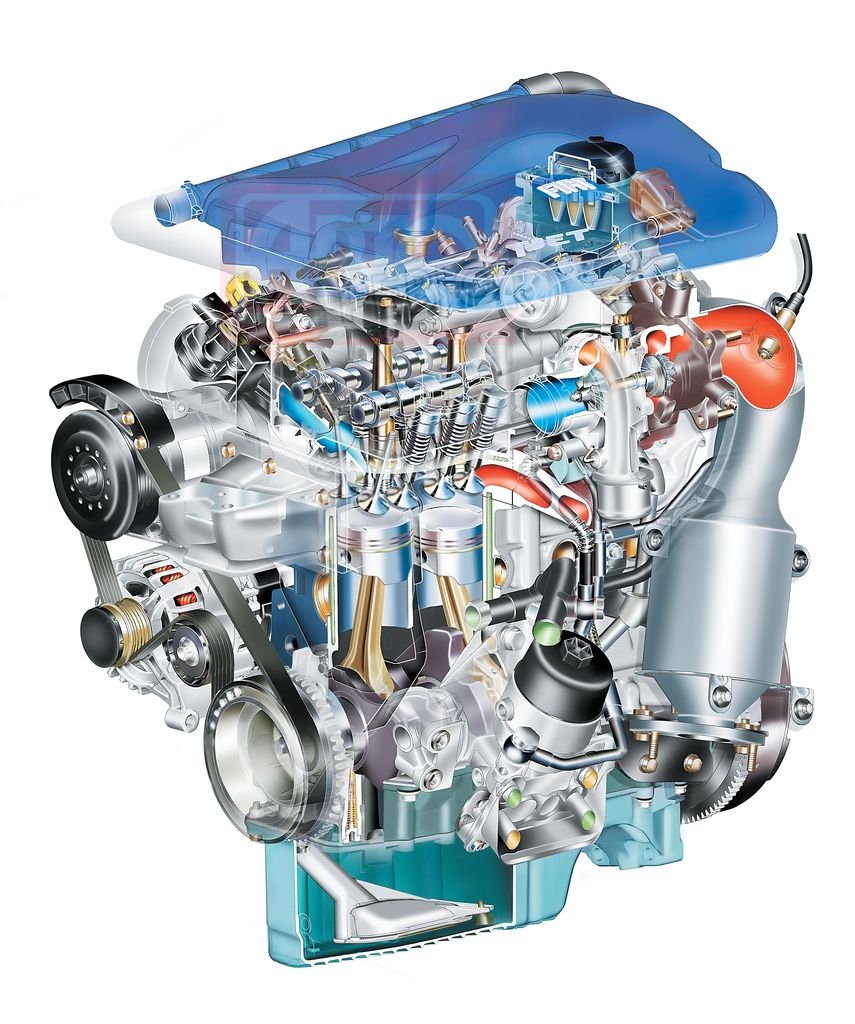 |
The little turbo engine from the T-jet series turned out to be exceptionally lively and flexible. I didn't doubt for a second that it really develops 150 hp: in sixth gear, the engine pulled the car from 40 km/h! |
The Doblo driver didn't stop, didn't ask what was what, and didn't pat me on the shoulder. The needle of the "blind" speedometer again went to the right of vertical and dropped only when we stopped near a huge sign — the Arctic Circle.
This was the Fiat Bravo with the latest 150-hp turbo engine with a displacement of just 1.4 liters. By the way, another trend: small turbocharged engines are becoming increasingly popular — they are powerful, economical, but most importantly, they help reduce harmful emissions. Moreover, no other gasoline engines of different displacement are provided for the Bravo at all. Besides "mine," there is one more, less powerful 120-hp engine and a 90-hp naturally aspirated one. There are also two diesels: both turbo, both 1.9 liters, but one is an 8-valve (120 hp), and the other has four valves per cylinder (150 hp). But only 150-hp gasoline cars were brought to Lapland: all other engines had already been presented a couple of months earlier during the "global" presentation of the new model. And no journalist had yet driven the Bravo with the 150-hp turbo engine.
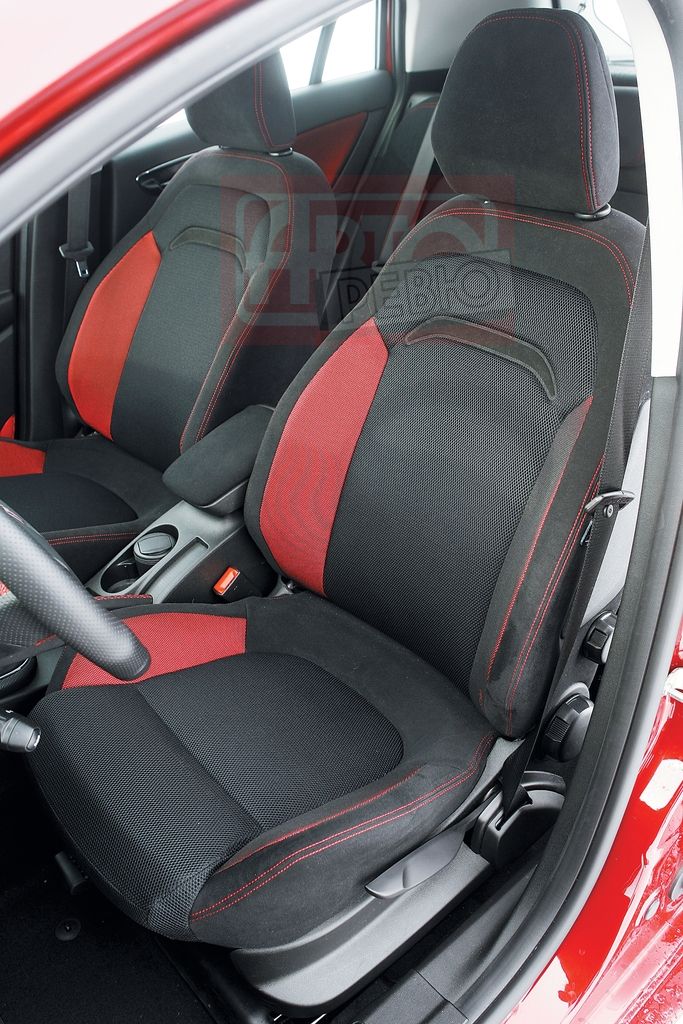
I liked this Bravo. Then, when we were returning from the Arctic Circle to the proving ground and the Super Gran Turismo style switched to a more or less "commuter" mode (the needle no longer went to the right of vertical), I caught myself doing something strange. Almost every minute, I would take my left, or more often right, hand off the steering wheel — and touch, feel different elements of the interior. On the one hand, it's a common thing — to understand where the soft "molded" plastic is, where the hard one, where the "rubberized" one, how the climate control knobs feel... But I repeated the procedure about a hundred times! I wanted to! And it's not at all that the Bravo is the first car in whose interior I've encountered such an abundance of different-textured materials. In some incomprehensible way, they all coexist, organically complementing each other: even if it's eclecticism, it's very talented. And after all, you want to touch everything beautiful, right? So I touched. Spring exacerbation? Schizophrenia? Possibly, but...
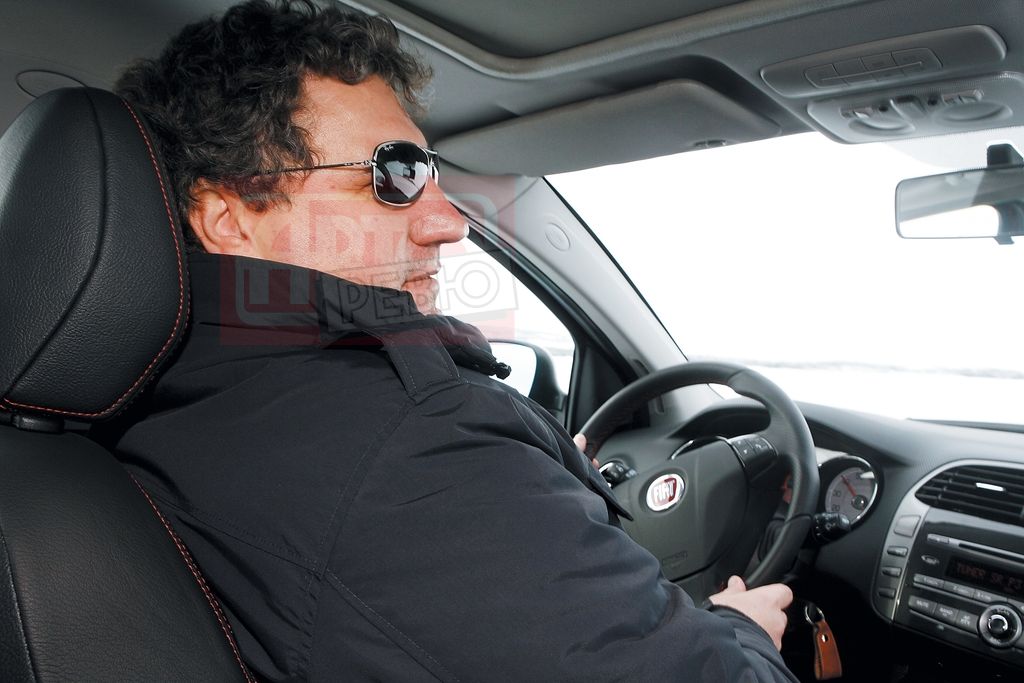
In the evening, I shared my innermost thoughts with Fabio Mingrino, the chief engineer for C-segment cars. And this heavyset man with a broad face suddenly beamed with a kind smile: "Same story with me — I'm always touching this car. And it doesn't go away!" Of course, spring exacerbation could be his too, especially since we're the same age. But he started touching the Bravo long before spring!
We also talked about why the Bravo is built on the same platform as its predecessor, the Fiat Stilo, not with the now-fashionable "multi-link" but with a torsion beam in the rear suspension.
 |
 |
 |
| Fabio Mingrino, chief engineer for C-segment cars, has worked at Fiat for about 20 years and believes that now is a good time for professionals: "We have regained faith in ourselves" |
So many different materials, so many different textures! And all — tasteful and fitting | |
— Do you think we didn't have enough money to develop a multi-link suspension? We didn't need to spend a single euro on it! We've had multi-link suspensions for a long time, and choosing one from that arsenal that suits the Bravo was as easy as pie! For example, from the Lancia Libra sedan. Everything is tested, refined! Maybe we'd have to select different bushings, springs, shock absorbers. But those are trifles! The question is — why? In the modes in which the Bravo will be used, even with the most powerful engine, even in a sport version with reduced ground clearance, stiffer springs and shock absorbers, a multi-link suspension compared to a torsion beam has no real advantages! Unless, of course, you're constantly racing or rallying. But if we had an all-wheel-drive version, then it would be a different matter: to install the final drive and route the shafts to the rear wheels, a multi-link suspension would be needed.
I didn't ask this question by chance — memories of the Stilo are still fresh in my mind. And that car was a real nightmare. What annoyed me most was the electric power steering, which felt absolutely weightless: there was no feedback at all, and it seemed as if the Stilo's nervous system was seriously hooked on something forbidden.
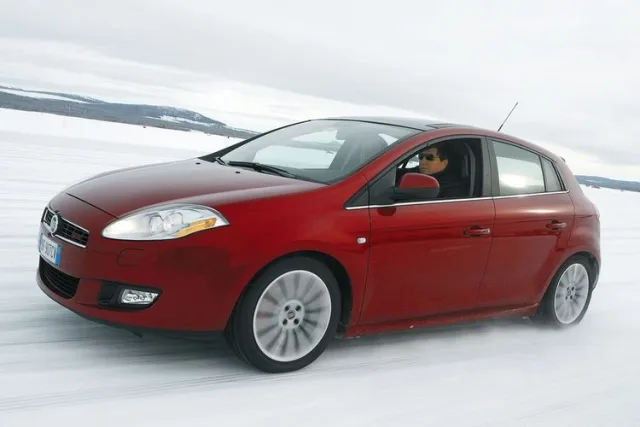
On an icy circle 100 meters in diameter, Fabio Mingrino demonstrates a system that should appear on the Bravo by the end of the year: in the event of a skid, the steering effort drops, as if hinting in which direction and at what angle to turn the wheel for correction. Something similar is already used on the Toyota RAV4 crossover
— It's not just about the power steering settings, — Mingrino explains. — Although the Stilo was the first in the golf class with electric power steering, we already knew how to tune it properly back then. The real difficulties were deeper. The company was in turmoil: one day we were told to do it like the Germans, the next — to add Italian character, the day after — to change course altogether. Engineers were rushing about, their spirits sank. We began to lose faith that Fiat was a global giant with the best engineers that could set trends. I know this story from the inside. It was a hard time. But perhaps the crisis was exactly what we needed to believe in ourselves again. Like in life. And I'm being completely honest: we created the Bravo with love. I think you've already felt that.
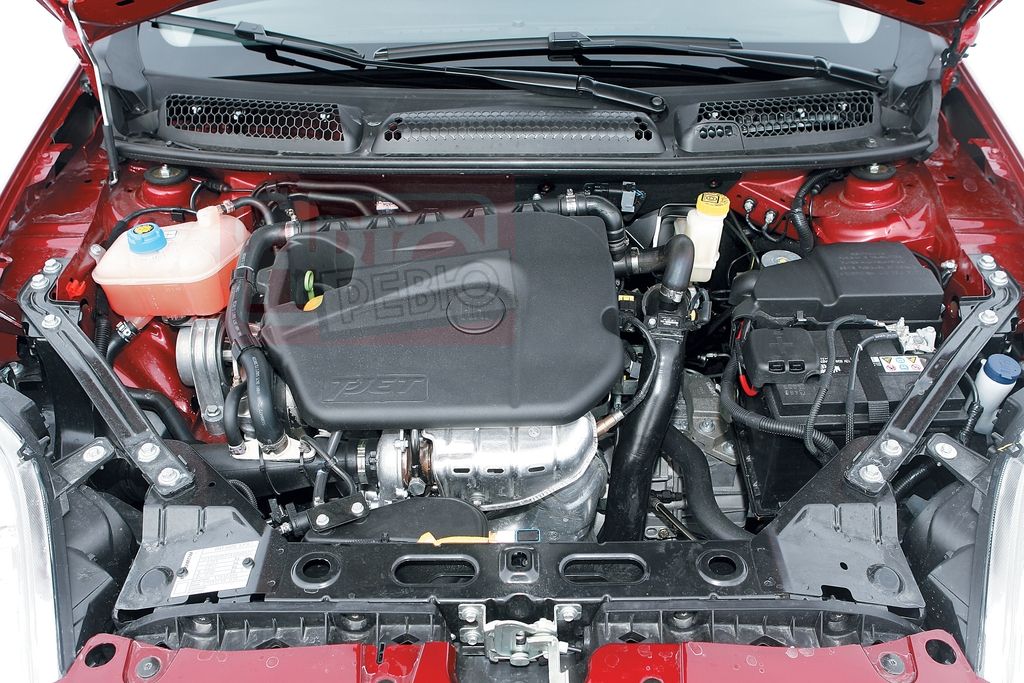 |
| The new T-Jet turbo engine is magnificent. Just 1.4 liters, yet it delivers 150 hp. |
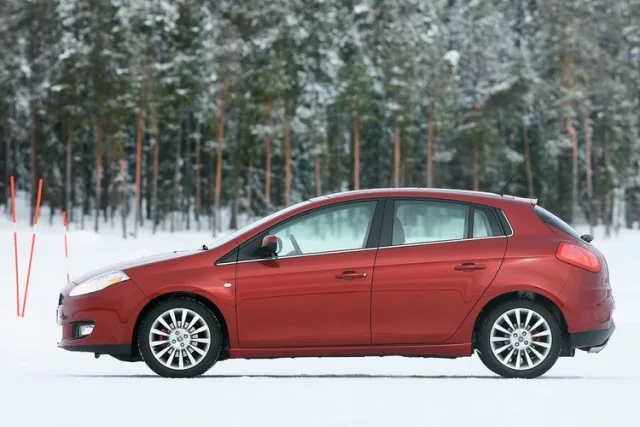
The car turned out beautiful. Without flashiness, without chasing futurism, without the desire to impress. It's simply beautiful — Italian-style lively and emotional. And you immediately want to touch it.
The exterior was designed by Fiat's own studio, and that's logical: the mood was already set by Giugiaro's Grande Punto, all that remained was to transfer it to a car a class higher without destroying the magic. The result is excellent — brothers, but not twins. And the Bravo, in my opinion, is even more attractive and soulful.
The interior also pleases: beautiful, spacious, cozy. The Italians claim that the Bravo is the only one in the C-class where a passenger 184 cm tall can comfortably sit behind a driver of the "90th percentile" (183 cm). I'm exactly that height. I checked — I believe it. And the trunk remains 400 liters. But here's the funny thing: I get out of the car to open the fifth door and can't find either a button or a handle. My palm in the gap — nothing. I try pressing the dark red emblem, sliding it — no luck. Feeling like a complete idiot (and looking around to see if anyone's watching), I search for a hidden mechanism, like that zero in the name of the Peugeot 607. No result. It turns out the trunk opens either with a lever in the cabin or with the key fob. Just like that, like normal people — no way. Oh, those Italians… I opened it with the key fob. The volume is indeed large, but the threshold is a bit high — loading is inconvenient.
The Bravo's driving qualities are at a "decent" level. Exactly that. There's no signature Golf-like composure and elasticity here, but there's also no trace of the Stilo's sloppiness. The steering pleased me, responses are soft but precise. On bumps in a tight corner, the car doesn't wander — maybe you really can live without a multi-link rear suspension? The brakes also impressed me — deceleration is dosed flawlessly. But the main discovery is the engine. I gave it a brutal test: 40 km/h, sixth gear, the tachometer shows about a thousand, and I floor the pedal. And it pulls! It pulls without rattling, without knocking — it just goes! Where does this little engine get so much torque? The displacement is only 1.4 liters, and at such revs the turbo barely works. And at the top end — it's perfectly fine. If only the throttle response were a bit quicker — you couldn't wish for a better unit for such a car.
But the Italians' fondness for electronics rather worries me. It's somehow un-Italian. On one hand, everything is great: Bluetooth (they call this communication system ambiguously — Blue&Me), USB port for mp3, navigation, a display with tons of information before your eyes. But there are also oddities. I gladly buy Italian shoes, suits, glasses. I'm even ready for an Italian car. But a camera or a TV — I'm not sure. Why, when I press the washer button, does fluid spray but the wipers stay silent? Why is the indication of the power steering modes (there are two — weightless "city" and reactive Sport) so vague? And why is there an intrusive fuel consumption ladder on the central display when I can't even properly read the speedometer? Better to…
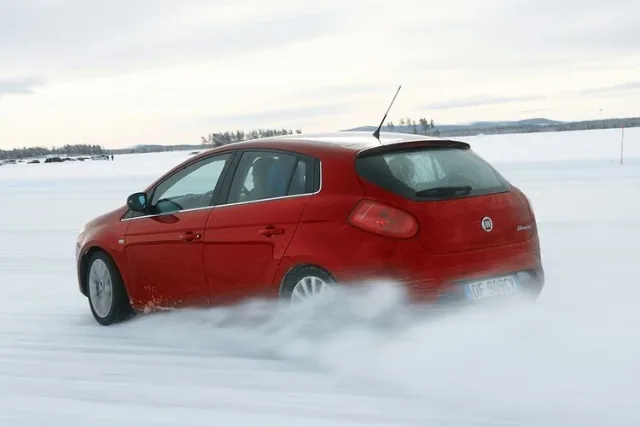
The stability control system cannot be turned off. But you can disable the traction control "subsystem" — and then you get the ability to control the trajectory not only with your hands but also with the throttle. Which I happily did on the icy circle
I told Mingrino that this display should show the speed — like on the Porsche 911. There, the analog speedometer is also blocked by the left hand, but the digital one works so well that you forget about the needle instantly.
— What, a digital speedometer on a Porsche? — Mingrino paused for a second. — It's been a while since I drove one, and engineers sometimes need that. Listen, that's a great idea. And the implementation costs pennies — almost everything is already there, we just need to refine the software…
I felt extremely pleased. And if the Bravo really gets a digital speedometer — and if it works properly (Fabio, just tell your electronics guys to use Porsche as the benchmark, not Renault or Citroen with their jerky digits!) — I'll tell this story to everyone. I really wanted the Bravo to become even better. You see, it makes you fall in love with it. Because it itself is a child of love. Mingrino didn't lie.
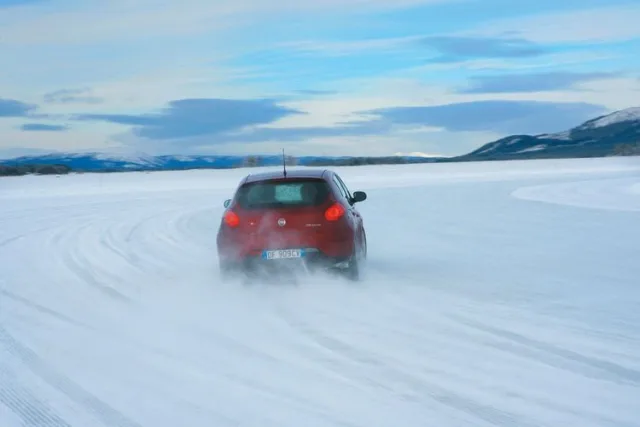
By the way, developing the Bravo took a record short time — just 18 months from idea to production. That's exactly twice as long as… Spring exacerbation?
P.S. In Russia, the Fiat Bravo will appear no earlier than autumn. Prices have not been announced yet. But if the marketers at Severstal again, as with the Grande Punto, don't jack them up to the skies, the Bravo has a chance. A good chance — just like the Bravo itself.
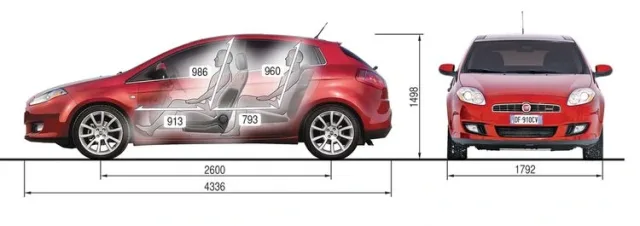
| Passport data* | |||
| Parameters | Vehicle | ||
| Fiat Bravo | |||
| Modification | 1.4 16V | 1.9 8V MultiJet | 1.9 16V MultiJet |
| Body type | 5-door hatchback | 5-door hatchback | 5-door hatchback |
| Number of seats | 5 | 5 | 5 |
| Length, mm | 4336 | 4336 | 4336 |
| Width, mm | 1792 | 1792 | 1792 |
| Height, mm | 1498 | 1498 | 1498 |
| Wheelbase, mm | 2600 | 2600 | 2600 |
| Track front/rear, mm | 1538/1532 | 1538/1532 | 1538/1532 |
| Trunk volume, l | 400—1175** | 400—1175** | 400—1175** |
| Curb weight, kg | 1205 | 1320 | 1360 |
| Engine | petrol, with distributed injection | diesel, turbocharged | diesel, turbocharged |
| Location | front, transverse | front, transverse | front, transverse |
| Number and arrangement of cylinders | 4, in-line | 4, in-line | 4, in-line |
| Displacement, cm³ | 1368 | 1910 | 1910 |
| Cylinder bore/piston stroke, mm | 72.0/84.0 | 82.0/90.4 | 82.0/90.4 |
| Compression ratio | 11.0:1 | 18.0:1 | 17.5:1 |
| Number of valves | 16 | 8 | 16 |
| Max power, hp/kW/rpm | 90/66/5500 | 120/88/4000 | 150/110/4000 |
| Max torque, Nm/rpm | 128/4500 | 255/2000 | 305/2000 |
| Gearbox | manual, 6-speed | manual, 5-speed | manual, 6-speed |
| Drive | front | front | front |
| Front suspension | independent, coil spring, McPherson | independent, coil spring, McPherson | independent, coil spring, McPherson |
| Rear suspension | semi-independent, coil spring | semi-independent, coil spring | semi-independent, coil spring |
| Front brakes | disc, ventilated | disc, ventilated | disc, ventilated |
| Rear brakes | disc | disc | disc |
| Tires | 195/65 R15 | 195/65 R15 | 205/55 R16 |
| Maximum speed, km/h | 179 | 194 | 209 |
| Acceleration time 0—100 km/h, s | 12.5 | 10.5 | 9.0 |
| Fuel consumption, l/100 km | |||
| urban cycle | 8.7 | 6.1 | 7.6 |
| extra-urban cycle | 5.6 | 4.3 | 4.5 |
| combined cycle | 6.7 | 5.3 | 5.6 |
| Fuel tank capacity, l | 58 | 58 | 58 |
| Fuel | petrol AI-95 | diesel | diesel |
| * Exact data on cars with T-Jet petrol engines is not yet available (measurements are currently being taken) and will be known in summer | |||
| ** With rear seats folded | |||
Safety
Even in the base trim, the Fiat Bravo has a pair of front and a pair of side airbags, as well as ABS with four channels. However, curtain airbags and electronic stability control are only offered in more equipped versions. In addition, a driver's knee airbag and rear seatbelts with pretensioners are available for an extra charge.
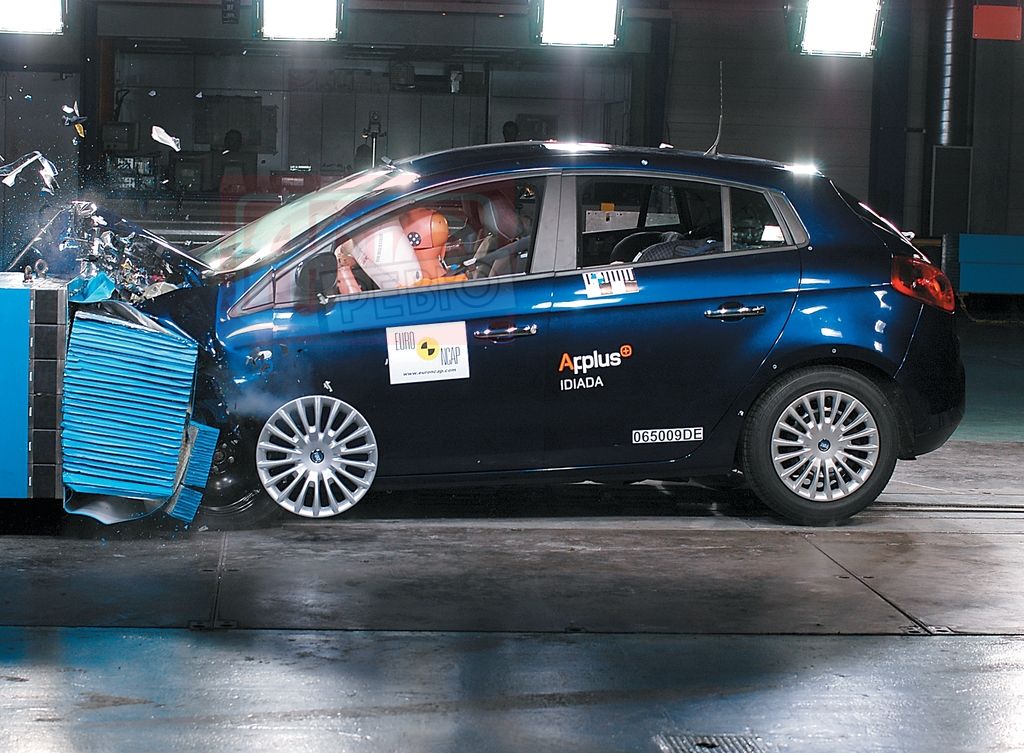 |
During refinement, specialists conducted 150 virtual and 60 real crash tests, and this bore fruit. According to the EuroNCAP methodology, the car received the maximum five stars for front passenger safety, but three points were deducted due to the steering column and ignition lock, which were deemed potentially injurious. With side impacts, the Bravo performed excellently — earning all points here. Protection of child passengers turned out to be weaker: dummies aged one and a half and three years, placed in Britax-Romer Duo Plus Isofix seats on the rear bench, received too high chest loads upon impact, and the "older" one also recorded an excess vertical load on the chest. The result is three stars out of five.
As for pedestrians, the car earned two stars out of four possible.
| Fiat Bravo* | ★★★★★ |
| Overall rating | 33 |
| Frontal crash test | 13 (81%) |
| Side crash tests | 18 (100%) |
| SBR** | 2 |
| Child passenger protection | 36 (73%) |
| Pedestrian protection | 16 (44%) |
| Curb weight | 1300 kg |
| * Tests were conducted according to EuroNCAP rules | |
| ** Seatbelt reminder | |
Local news
 Late in the evening, testers from Germany, Italy, and England were hanging out in the bar of a polar hotel. On the unlit parking lot in front of the hotel, I spotted camouflaged and not-so-camouflaged BMW M3s, some Jaguar, a Porsche 911 covered in sensors and bristling with GPS antennas, a Cadillac wagon, a Bentley convertible…
The main language of corporate communication is English, and I join a conversation between two Germans from BMW sipping beer:
— Guys, how are things with fines here? Surely not all the speeding to the test site and back goes unpunished?
They laugh:
— They understand that compared to the revenue to the local budget from our work, fines are peanuts. And if they start tightening the screws, testers will go to Finland. There are also frosts and test sites there. Here, read this.
I open the local weekly newspaper. It looks like it's photocopied, but the name is loud — The Arjeplog/Arvidsjaur Times, one for two towns. And the news in its presentation reminded me of the wonderful column "Roads Without Borders" by Andrei Khrisanfov:
"About a hundred kilometers from Arjeplog, an accident occurred involving two test drivers. It is said that one of the cars was a prototype, and it will go into mass production in a year. Both drivers were taken to the hospital, and soon their colleagues came for them and took them to the hotel."
 "In Arjeplog, a policeman stopped a prototype, suspecting its driver was drunk. But, as the analysis showed, the tester was almost sober: the blood contained only a minor amount of alcohol. Since there is an opinion that visiting testers get behind the wheel drunk more often than locals, the policeman recommended the driver to refrain from drinking alcohol before driving in the future."
"The other day, in one of the pubs in the town of Arvidsjaur, a drunk German tester quarreled with a local resident and then got into a fight. A security guard tried to calm him down, but the tester punched the guard in the eye. Despite the tester's fierce resistance, the guard managed to handcuff the offender. Then the tester tried to run away. Later, the police found him. Somehow (probably not without the help of mechanics who also came for testing), the handcuffs had already been removed. The police took the offender's passport so that he would not leave Sweden until the incident was resolved."
I read, laugh, and the testers laugh too:
— Did you notice that they never mentioned any names, any companies, or any car models? They understand: it's better not to quarrel with us. If we leave, the publication will be shut down — there will be nothing to write about!