
Fiat Albea. Back to the Future
The Russian budget car market is experiencing a real boom — demand for inexpensive cars is pushing both foreign and domestic companies to release more and more new models. Chinese manufacturers are especially active: over the past year and a half, they have brought about two dozen small cars to the country — suffice it to recall Chery A21, Amulet, Lifan Breez, Hafei Brio, Princip, or Symbo. Western brands are also not lagging behind their Eastern competitors. Sales of Renault Logan, Hyundai Accent, Nissan Almera Classic, and Kia Spectra are limited solely by factory production capacities. True, calling most of these models new is a stretch: the same Amulet was originally a Seat Toledo, and Kia Spectra and Accent in their familiar form are assembled only in Russia. Almera Classic looks even more archaic — its production started back in 2002, and the car was created for the Asian market and bore the name Samsung SM3. All these cars can be criticized equally: outdated looks from the mid-90s, old platforms and engines removed from main production. But they also share a common advantage — very attractive prices.
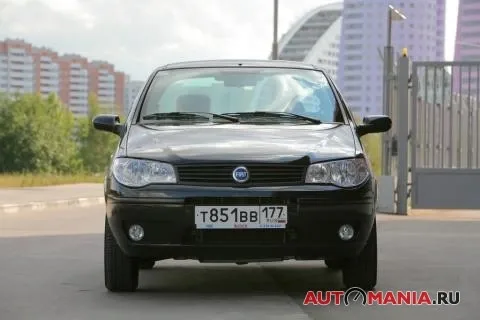
However, as it turned out, even these models are not enough for the actively growing Russian market, and the expansion of "retro cars" continues to gain momentum. Recently, Fiat Albea joined this list, and it will be the focus of this article.
Where did Fiat Albea come from in Russia? At the beginning of the article, we mentioned domestic manufacturers alongside foreign ones for a reason. The fact is that the "Severstal-Auto" group, which is the official distributor of Fiat, not only started selling the model but also established its production. In essence, this car replaced the "Oka" — the only Russian microcar — on the assembly line in Naberezhnye Chelny. The reasons for this replacement are obvious: the "Oka" is hopelessly outdated technically, and only memories remain of its former popularity. Moreover, it does not even meet the most lenient safety and environmental standards in the country. And finally, the ubiquitous Chinese models are breathing down its neck, attracting buyers not only with affordable prices but also with the presence of ABS and airbags. In general, the marketers at "Severstal" decided not to overcomplicate things and allocated the capacity to produce a more promising budget model — the Albea sedan.
The progenitor of this car is the already forgotten, but sometimes seen on European and Russian roads, Fiat Palio. In its time, it was considered a decent car, but that was fifteen years ago. And although Giugiaro, the founder of ItalDesign, had a hand in transforming the Palio into the Albea, today the Albea, like most of its budget counterparts, cannot boast of technical or design novelty. Nevertheless, if you put the Albea next to the Renault Logan, you cannot help but notice that the "Italian" looks at least no worse. And you don't even want to remember the clumsy Hyundai Accent.
However, let's leave the debates about appearance — buyers of cheap cars are usually least interested in the exterior.
The same can be said about the interior, with the only difference being that car enthusiasts still have certain requirements for the cabin of a future purchase. Although style is certainly not the priority here. At the same time, the Albea's interior cannot be called dull: the dreary gray plastic, like in the Palio, is a thing of the past. The owner will be pleased with the solid architecture of the cabin, decent build quality, and materials worthy of its class... But the most pleasant thing is the seating position. As befits a true "European," Fiat seats are made with human anatomy in mind. Interestingly, the effect is achieved not so much by the design as by the seat filling. As a result, the seats are, on one hand, soft enough not to push the body out, and on the other, firm enough not to let you slide. As for ergonomics, the Albea does not surprise here. The adjustment ranges allow a person above average height to sit behind the wheel, but people of large build will be a bit cramped. Partly to blame is the steering column, which adjusts only vertically, so a tall driver will have to find a compromise between the lack of headroom and insufficient steering wheel reach. Otherwise, comfort meets expectations — convenient, but without excesses. Three people can fit in the second row, but they will have a hard time on a long trip, so it's better if only two sit on the sofa. But the trunk deserves special praise. The Albea has the most spacious trunk in its class — 515 liters, which is 5 liters more than the Logan. Moreover, unlike the "Frenchman," Fiat pleasantly surprises: the folding rear seatback (split 60:40 — optional) increases the volume by about 300 liters. True, the shape of the trunk walls is far from ideal — they can interfere when loading bulky items.
Well, how does the Albea perform on the road? The choice of engines for the model is, to put it mildly, small. Honestly, there is no choice at all: buyers are offered a single engine — a 1.4-liter 8-valve "four." The engine works in tandem with a 5-speed manual and meets Euro-3 standards. The power is modest — 77 hp, torque — just over 100 Nm, but it is achieved already at 3000 rpm. Fuel consumption is quite reasonable: 8.2 liters in the city and 6.2 liters in the combined cycle. But these are dry figures, and in practice it looks like this. The car starts quite briskly, but already by 4000 rpm the enthusiasm fades, and you have to shift gears long before peak indicators. On the other hand, no one expected racing dynamics from this car, and acceleration to 100 km/h in 13.5 seconds is unlikely to scare off a budget-conscious buyer. They are also unlikely to criticize the Albea for the long-throw gearshift lever, average sound insulation, or the "empty" steering wheel. But they will definitely praise the energy-intensive suspension. After all, the main thing in this car is not dynamics, but price. And with this, the new model is in order. For the base version, the seller will ask 322,500 rubles. True, this price includes only a driver's airbag, power steering, immobilizer, 14-inch steel wheels, central locking, and audio preparation. The Classic version costs 360,500 rubles but includes electric mirrors and front windows, folding rear seatback, air conditioning, fog lights, body-colored mirrors, and "luxury" door trim. The top Comfort trim adds ABS with EBD, a passenger airbag, and a height-adjustable driver's seat with lumbar support. For it, you will have to pay at least 382,500 rubles ($15,300), and this is already comparable to the price of the larger Kia Spectra. What to choose in such a situation — it's up to the buyer.
Technical specifications:
| Length (mm) | 4186 |
| Width (mm) | 1703 |
| Height (mm) | 1490 |
| Wheelbase (mm) | 2439 |
| Weight (kg) | 1120 |
| Trunk volume (l) | 515 |
| Engine displacement (cm³) | 1368 |
| Max. power (hp) | 77 at 6000 rpm |
| Max. torque (Nm) | 115 at 3000 rpm |
| Max. speed (km/h) | 162 |
| Acceleration 0-100 km/h (s) | 13.5 |
| Average consumption (l) | 6.2 |
| Price | 322,500 – 382,500 RUB |
Source – AUTOMANIA.RU