
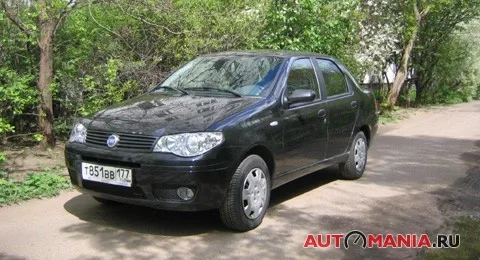
Fiat Albea. Spanish mentality
However, in recent years, the consciousness of motorists has gradually shifted towards Japanese brands — Mazda, Toyota, Honda, Mitsubishi, and, of course, Lexus. Judging by the queues for imported cars, other manufacturers are also doing well. Analysts are already predicting the title of the future hit of the Russian market for the new Ford Mondeo. But despite all this, there are global brands that are frankly unlucky here.
Take, for example, the Spanish division of VW — SEAT. It left our market long ago, and the current attempt to return still looks dubious in terms of sales. Although, perhaps, Altea and Toledo will be able to turn the situation around. English Rover, which has now moved to China, also received a rejection from our buyers a couple of years ago.
Another unlucky contender for our hearts is FIAT. The irony is that cars of this Italian concern (which also owns Lancia) are among the most popular in Europe: in Italy and Turkey, their share reaches almost 70%. But in Russia, only enthusiasts choose them.
And how powerfully the Italians stormed our market in the early 90s — they were among the first foreigners who took the risk. In 1991, the Tipo model appeared, recognized a year earlier as the "European Car of the Year".
The car turned out so successful and unusual that individual examples are still found on the streets. At the beginning of the new century, another attempt followed — the revolutionary Fiat Stilo in the B-class. Both models were advanced for their time and affordable. You won't believe it: the Tipo cost 8–9 thousand dollars, and the Stilo in maximum trim — 17–20 thousand. I drove the first for 11 years, tested the second for almost a week, and my family was very sad to part with it. It's a pity that both cars never received proper promotion here — they deserved it. Most likely, their reputation was harmed by subsequent models like Punto, Bravo, and Brava.
But this year, thanks to the efforts of Severstal Auto, FIAT made a third attempt to conquer Russia — this time with the help of the ZMA plant in Naberezhnye Chelny, where the Oka was once produced. The goal is to win the title of a people's car.
Among the contenders (which will soon be expanded and supported by a powerful PR campaign) are the designer-luxurious Italian Croma (only to order), the Polish baby Panda, recognized as "Car of The Year 2006", the slightly ascetic but noble inside Grande Punto, the Turkish microvan Doblo, and finally, the best-selling Albea — also of Turkish origin. The last two models are already being assembled in Naberezhnye Chelny.
The idea of a people's car has always lived in FIAT. Let us recall the first-born FIAT 124, which became the prototype of the "kopek". Let's sigh and name its price — 5,500 rubles (though with an average salary of 120 rubles).
FIAT Albea also aims to be a people's favorite and is ready to challenge the Chevrolet Aveo or KIA Rio. For the test, we were given a car in top trim for 14 thousand dollars (base version — 315 thousand rubles, or 12 thousand). The history of this model is tangled. Back in 1996 (let me remind you, it's now 2007), the Brazilians created the Palio hatchback. Then the Turks bought the license, converted it into a sedan, and named it Albea. For the last two years, this car has been the king of taxis, like the Chery Amulet in China, competing only with the Doblo.
Naturally, the main competitors in Europe are the Renault Logan, Peugeot 206 Sedan (made in Iran), and the Taganrog Hyundai Accent.
The origin of the test hero is not hard to determine. Open the hood — and on the battery, starter, belts, and other parts, you will see inscriptions in the language of a country where Russians love to vacation. The manufacturer is revealed by a plate with the abbreviation ZMA and the proud inscription "Made in Russia".
That the hands of craftsmen from the third world were involved in creating the car becomes clear almost immediately. First, you just can't get comfortable behind the wheel — by evening, your back starts to hurt. On the second day, a squeak on the right got to me: it turned out the airbag cover above the glove box was poorly fitted. This squeak, along with almost "Zhiguli" plastic, takes you back to the early 90s.
The instrument panel is also not pleasing — a classic set for European cars of the late 80s — early 90s. At least there's a tachometer, unlike the Zaporozhye Chevrolet Lanos. But that this is not quite a FIAT in the historical sense is visible not only in the trim. First, there's no native radio (Italians always installed it in the base). Second, the upholstery is cheap, more Chinese than Italian. Third, the left leg gets unbearably tired: the pedals work fine, but after pressing the clutch, there's nowhere to put your foot — it goes numb due to the uncomfortable seating position.
If you think the opinion of the car consists only of minuses, you're mistaken. There are plenty of pluses too. But in the Albea, it's often hard to understand what's a plus and what's a minus. For example, rear passengers are very comfortable here, but this is achieved because the front seats can't be adjusted properly. It's also comfortable in the back because the floor in the center is completely flat — like in the old Honda CR-V. But the speakers are not in the sides of the rear doors, as usual, but on the shelf above the heads of rear passengers. So it's hard to adjust the volume to suit both the driver and passengers. However, you can simply turn off the radio — and there will be no family disputes.
An obvious plus without a catch — no glare on the windshield. And yet almost 80% of even expensive cars sin with this, and test drivers often forget to write about it. Of course, it's important to note how the real braking distance differs from the stated one, or that the maximum speed falls short of the speedometer by 2.5 km/h. But safety is no less important: if the sun blinds you, it's dangerous.
Among the pluses of a budget car (without an onboard computer), I'd include extremely low fuel consumption: 8–9 liters per hundred in the city, no more than 5–6 on the highway. Add excellent suspension, high ground clearance, a small turning radius, and precise manual transmission operation.
Ground clearance is a separate topic. It's no less than that of a crossover, but the rear overhang is too close to the "curb", as they say in St. Petersburg.
Externally, the Albea is little inferior to more expensive classmates. From the rear, it resembles the Nissan Almera, from the front — the previous generation Mitsubishi Lancer. Given the price and equipment, the car is no worse. Perhaps someone will recall the Chevrolet Aveo Sedan. Here FIAT loses — inside, the Aveo compared to it is simply a "Rolls-Royce". The Korean's 1.4-liter engine produces 109 horses, while the Albea's herd with the same volume is only 77. Moreover, the Fiat doesn't even have an automatic in top trim. The Korean has a richer choice of engines and trims — the Albea has only one engine option under the hood.
In the glove box, I found an instruction manual translated into Russian. It says there are versions with 1.2, 1.6, and 1.3-liter diesel engines. None of this will be available in Russia. At least for now.
The interior of the Albea is spoiled by an indecently thick steering wheel, which tires your fingers. The main advantage of any car is, of course, safety. And in this regard, the Albea can give a head start to many well-promoted competitors: its crash tests are excellent. But there's also a downside — visibility. The side mirrors are small, provide little information, and are hard to trust. Reversing becomes a real ordeal, especially for those used to orienting by mirrors rather than turning their heads. And the high rear shelf behind the seatbacks makes this maneuver almost impossible. Honestly, I haven't encountered such a problem on any other car. During the test, several more questions accumulated that I never found answers to. For example, how was the load capacity calculated? When four people are in the cabin, the car noticeably sags with a creak, and ground clearance decreases almost by half. Or take the onboard computer. German and Japanese brands have long been able to speak Russian, but the Albea, assembled in Naberezhnye Chelny, has no Russian in the menu. However, there is Turkish, which is not surprising, Portuguese, Italian, Spanish, French, German, and, of course, English. But no Russian. I hope this shortcoming will be fixed soon, and then the small car will confidently merge into the general flow. If, of course, potential buyers are not scared off by the FIAT brand and Tatar assembly.
Dmitry Shavyrin
Technical specifications:
| Dimensions (mm) | 4186x1703x1490 |
| Curb weight (kg) | 1020 |
| Engine displacement (cc) | 1368 |
| Trunk volume (l) | 515 |
| Maximum power (hp) | 77 |
| Maximum speed (km/h) | 162 |
| Acceleration 0-100 km/h (s) | 13.5 |
| Average fuel consumption (l/100 km) | 6.5-7.5 |
| Fuel tank capacity (l) | 48 |
| Tires | 175/70 R14 |
| Gasoline | A-95 |
| Price | from 315,000 rubles (price of tested version – 368,000 rubles) |
We thank the company “Severstal Auto” for providing the car for the test.
Source – AUTOMANIA.RU