
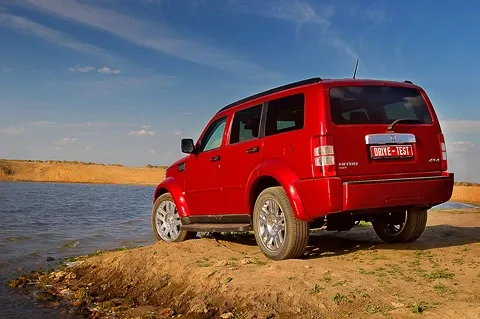
Actually, it's hard to call the Nitro a truly large car. However, from the outside, it's almost impossible to believe: to get into the cabin, there are even running boards installed, like on full-fledged SUVs with lifted suspension. True, you start doubting their reliability almost immediately — after a few of our outings, the steps noticeably bent and sagged. The culprit is flimsy stamped brackets. In summer, getting inside is a piece of cake. But in winter, these running boards are useless: your feet will slip off the icy surface, and if you try to step over them, you'll inevitably get dirty.
We close the door — and find ourselves in a true kingdom of contradictions. Such an interior could only have been created by Americans. Expensive leather on the seats coexists with cheap grades of plastic, which in places resemble thin linoleum, and it looks depressing. More cost-cutting? Couldn't they have made the cabin better, especially since the exterior turned out well? Although the Americans themselves hold a different opinion: in appearance (but not in feel), their cabin is quite decent. And why invest in expensive trim if in a couple of months the insides will still turn into something like an ashtray with sticky stains from spilled cola?
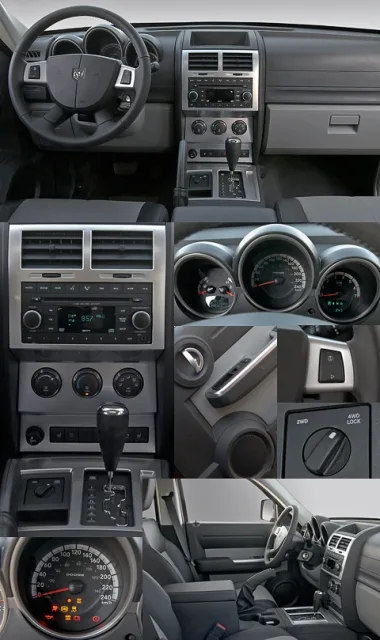
There are still a few hints of taste from the interior designers. Many will like the shapes and color combinations, but the quality of trim materials, assembly, and sound insulation could use some improvement. In our SXT, the place of honor for the head unit is taken by a six-disc DVD changer. In America, you can order a ceiling-mounted LCD monitor for it. By the way, there you can also order a multimedia system with a built-in hard drive, color touchscreen display, USB port, and navigation as an additional option.
Although, maybe I'm criticizing in vain — the developers have already promised to improve and bring the quality of interiors up to a decent level in the near future. We'll see.
However, cheap trim materials don't prevent you from getting comfortable behind the wheel. The only thing missing is steering column reach adjustment: at my 190 centimeters of height, it would definitely come in handy. All warning lights and gauges are placed at the bottom of three wells forming the instrument cluster. Reading information about the car's condition from them requires no effort at all — readability is excellent, everything is visible at a glance. And the visibility from the height is top-notch.
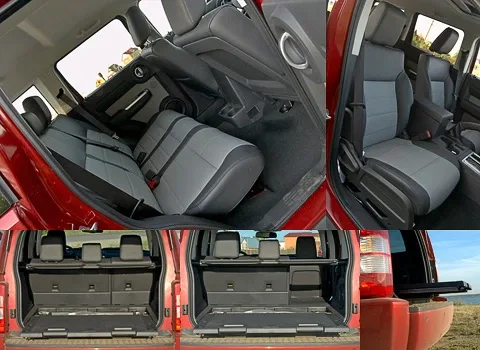
The cabin is very spacious. If needed, you can fit six people in it. Why? Just because. The sliding floor platform Load N'Go, which sits in the trunk, significantly simplifies the loading and unloading process; it can withstand 180 kg of cargo.
In the back, there's plenty of room. The split seatbacks are adjustable for recline — just great for a long road. By the way, credit where credit is due, even I with my ostrich legs sat behind myself. And what especially pleased me, I sat with a noticeable margin. These days, that's a rarity.
As for sound insulation, better not ask. The engine's solo is unforgettable, and as the revs increase, the sound accompaniment in the cabin grows proportionally. The transmission echoes the engine — not as loud as the engine, but still howling like a wolf. Moreover, it makes itself known not only through sound. In some modes, an unpleasant "geary" shudder runs through the Nitro's body. But no big deal — after all, the Infinity (no, not Infiniti!) "music" with its arsenal of speakers and subwoofer "pumps" so hard that it won't seem like much! And if you turn it up louder, all the aforementioned din, roar, and rumble admit defeat and retreat.
The dacha-camping image is well supported by the transformer trunk. With the seatbacks folded, you can pour an average of 389 liters of concrete into it. But as soon as you lay the rear row of seats "on its shoulder blades," the working volume of the trunk jumps to almost two cubic meters (1994 liters). What's really convenient is the sliding "countertop" that can withstand 180 kilograms of weight. Load your stuff onto it, slide it into the trunk — done, clothes not dirty, just dust off your palms.
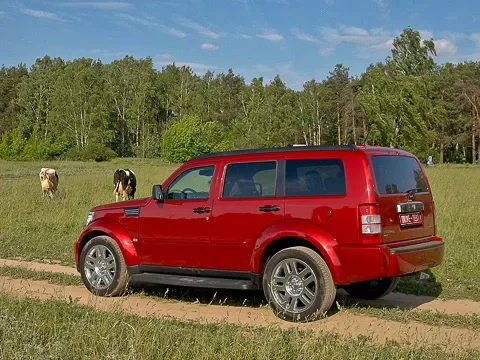
How does the car behave on the move? The external self-confidence that the Nitro literally radiates stays where the car was parked. The high center of gravity, quite soft and long-travel suspension make the Nitro quite wobbly on asphalt. In corners, it leans noticeably, and its rocking on gentle waves can easily provoke an attack of seasickness in passengers. The picture is completed by large unsprung masses. Particularly annoying is the "rudiment" in the form of a rear solid axle — on bumps, it bothers with noticeable jolts followed by damped oscillations. A cocktail of overpass seams and long corners is contraindicated for this crossover. When navigating them, the Nitro constantly tries to jump off the intended trajectory outward. Sometimes it even seems that a speed of 120 km/h is its ceiling. But on a straight line, the crossover holds quite well and doesn't bother with trajectory deviations.
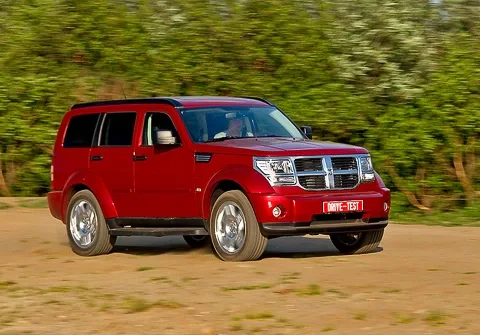
Bulging arches, as if drawn with a compass, massive sides, and a small glass area make you think we're facing a giant. In reality, it's not so.
In general, it's better to drive straight. But if you push the situation to the limit in a corner, the stability control system will help you get out unscathed, which by default extinguishes skids in their infancy. It's impossible to turn it off completely, but the activation threshold can be significantly lowered, so you can arrange safe drifting with slight slips. But you don't need to.
Despite the relatively sharp and quite informative steering wheel, you don't want to dart around in traffic on the Nitro, and that's not only thanks to the soft chassis. The numbers 3 and 7, written with a comma, serve more for self-affirmation. This engine can provide acceptable acceleration only on the first two relatively short gears. And what about further? When accelerating on the remaining ones, the Nitro goes flat, for which special "thanks" to the archaic four-speed "automatic." The gearbox doesn't spoil you with quick downshifts either. You can forget about manual mode altogether, if only because it simply doesn't exist here. So the Nitro, even with the big 3.7-liter engine, won't suit active driving.
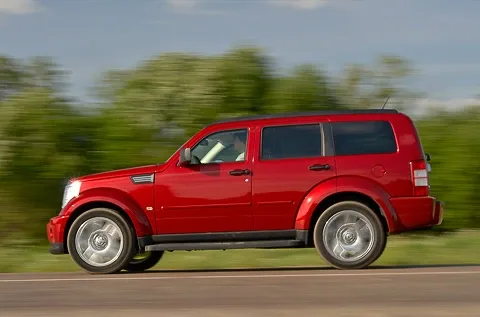
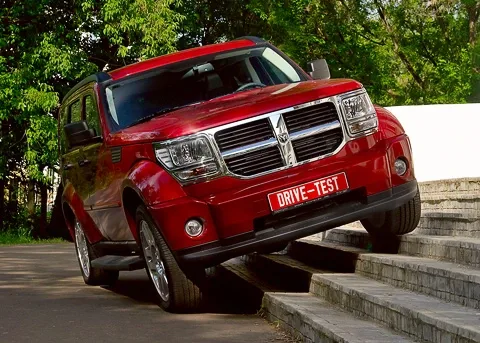
We would gladly classify the "Nitro" into the glorious family of SUVs: high seating position, big 20-inch wheels, decent pedigree. But, unfortunately, the transmission doesn't allow this. Despite the Dodge being on the same platform as the "off-roader" Jeep Cherokee, it has lost the ability to move adequately over heavy off-road terrain. Why? Because the creators, in pursuit of savings, deprived the transmission of a transfer case with a low range, a center differential, and locking cross-axle differentials. And in vain.
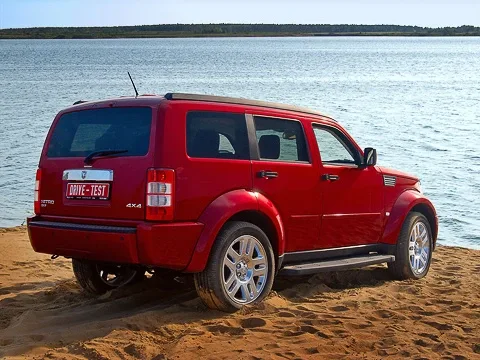
This is exactly the ill-fated place where the Nitro got stuck.
Instead of this splendor, the Nitro received a rigidly connected "front end" to the permanent rear drive. That would be fine if not for the algorithm of the traction control system, which is tasked with the function of locking differentials. If you overcome slippery, unreliable sections with a run-up, there will be no problems. The "anti-slip" will simply redistribute traction, braking the spinning wheels, and inertia will play a significant role in overcoming tricky sections.
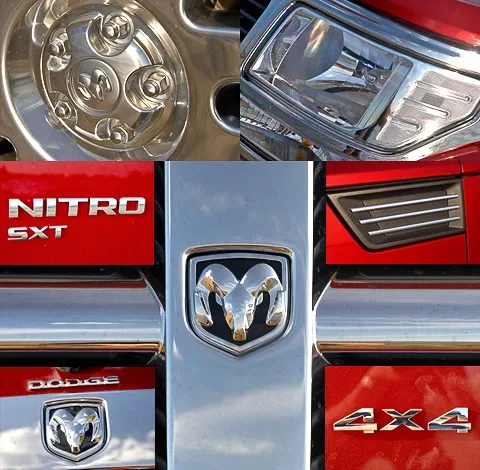
Well, of course, chrome! Where would we be without it? By the way, the grille on the front fenders is fake.
But as soon as you stop on a somewhat steep sandy or icy slope, the traction control system won't let you get going. The thing is, when starting off, it grabs all wheels at once. And it releases them only when the engine reaches certain revs, power, and torque (since there's no low gear). When overcoming a certain torque threshold (which depends on load and incline), the crossover finally moves off under the crunch of the traction control system and continues moving in jerks. At the same time, the system will proactively suppress any attempts of the wheels to break into wheelspin. An original method, no doubt. But a question arises: if you constantly operate the car in such difficult conditions, how long will the gearbox last? After all, with the 4WD Lock mode activated, the traction control system doesn't turn off for any price.
You can send clouds of dust, snow, or sand into the air from under the wheels by engaging rear-wheel drive mode. In it, wheelspin is somehow suppressed with a big delay: slightly overdo the gas — and the wheels "break loose."
Hardly anyone seriously expected the Nitro to be an off-road vehicle, but why does it behave so clumsily on asphalt? It seems that Chrysler Group simply didn't have a proper crossover platform, so the Nitro was built on the basis of the Cherokee — a car whose roughness on smooth surfaces is forgiven for its outstanding off-road talents.
The Americans didn't even try to make a crossover according to European standards — and, it seems, they didn't miscalculate: the competitors there are too strong. So what does Chrysler count on with its new soft-roader? Of course, on a bright personality. I agree, its driving manners are so-so, and the interior is far from ideal. But look at this exterior! If you need a crossover that won't get lost in traffic, the Dodge Nitro is one of the main contenders. It's only a pity that strict parents, without making it a real SUV, never taught it decent behavior in the city.
Specifications
| Characteristics | Dodge Nitro SXT |
|---|---|
| Body | |
| Number of doors/seats | 5/5 |
| Length, mm | 4,584 |
| Width, mm | 1,916 |
| Height, mm | 1,773 |
| Curb weight, kg | 1,970 |
| Gross weight, kg | 2,540 |
| Trunk volume, l. Rear seats folded/rear seats folded down | 389/1994 |
| Approach angle, degrees | 17 |
| Departure angle, degrees | 34 |
| Ramp angle, degrees | 20 |
| Fording depth, mm | 482.6 (at 16 km/h) |
| Engine | |
| Type | Petrol, with multi-point injection system |
| Location | Front, longitudinal |
| Number and arrangement of cylinders | 6, V-shaped |
| Number of valves | 12 |
| Displacement, cm3 | 3,701 |
| Max. power, hp/rpm-1 | 205/5200 |
| Max. torque, Nm/rpm-1 | 314/4000 |
| Transmission | |
| Gearbox | Automatic, four-speed |
| Drive | Rear permanent, plug-in all-wheel drive. Without center differential. No locking of wheel differentials provided. |
| Torque distribution (by default), front/rear axle | 50/50 |
| Chassis | |
| Front suspension | Independent, with double A-arms, coil springs and anti-roll bar |
| Rear suspension | Dependent, five-link, with coil springs and anti-roll bar |
| Front brakes | Ventilated disc |
| Rear brakes | Disc |
| Tires | 245/50 R20 |
| Ground clearance, mm | 210 |
| Steering | |
| Type | Rack and pinion with power steering |
| Number of steering wheel turns from lock to lock | 3.42 |
| Turning circle, m | 11.1 |
| Performance characteristics | |
| Maximum speed, km/h | 190 |
| Acceleration time from 0 to 100 km/h, s | 10.3 |
| Fuel consumption, l/100 km | |
| urban cycle | 17.5 |
| extra-urban cycle | 9 |
| combined cycle | 12.1 |
| Emission standard | Euro 4 |
| Fuel tank capacity, l | 73.8 |
| Fuel, octane number | 92–95 |
Equipment of the tested vehicle
Standard equipment- Next Generation airbags for driver and front passenger with multi-stage gas filling
- Side curtain airbags
- ABS
- Electronic Stability Program (ESP)
- Traction Control system
- Power steering
- Height-adjustable steering column
- Power seat adjustments
- Sentry Key (anti-theft system)
- Seat upholstery — YES Essentials fabric (does not absorb odors, does not fade)
- Load N’Go sliding floor platform in the cargo area
- Roof rails
- Running boards
- Rear parking sensors
- Two 12V power outlets
- Multi-function leather-wrapped steering wheel
- Air conditioning
- Multimedia system with AM/FM tuner, six-disc DVD changer, Bluetooth module
- Four-channel audio system with subwoofer
- Headlights with halogen lamps and delayed shut-off function
- Fog lights
- Auto-dimming rearview mirror
- Power-folding and heated exterior mirrors
- Front and rear power windows with automatic mode
- Tire pressure monitoring system
- Cruise control
- Alloy wheels, tire size 235/65 R17
- Compact spare wheel
- Power sunroof
- Deep factory tinting
- Leather seat upholstery
- Heated front seats
- Alloy wheels, tire size 245/50 R20
- Full-size spare wheel
Price of the base version — 36,400 euros
Price of the tested vehicle — 40,520 euros
The vehicle for the test was provided by ZAO “DaimlerChrysler Automobiles RUS”.
Technology
Safety
Design
The Nitro concept was first shown to the public at the Chicago Auto Show on February 10, 2005. The car reached production only by 2007.
Brother in arms
Behind the scenes
You've probably already read in the blog the story about how the Nitro flatly refused to drive on sand. Let's not go into details of its capricious behavior, better say thank you to our saviors. They are in the photo in the top right corner. If not for them and their “Sobol”, the Nitro would have had to spend the night on the sand dunes until morning. And all the other “junk” in the photos are shots we took while searching for a beautiful background. In one photo, you can clearly see how hard the photographers' work is. We had just started shooting when a huge herd of mad cows appeared out of nowhere, which almost trampled our wonderful crossover along with us.