
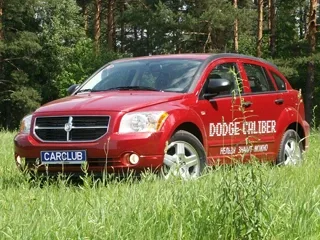
For the Dodge brand, which for many years remained a purely American phenomenon, the time has come to enter the world stage. The first swallow in this campaign was an unusual hybrid — the Caliber, combining the features of a hatchback, station wagon, and SUV. The name for conquering new markets is chosen very aptly.
In the Dodge lineup, this car replaced the compact Neon sedan, but inherited from it only the very idea of an affordable car. The designers used a platform familiar from the Jeep Compass, and in the future it will also form the basis of the Mitsubishi Outlander and Hyundai Tucson. So the off-road pedigree of the Caliber is as real as it gets. This is especially important for Russia: here, tall cars are held in high regard due to road quality. But a full-fledged SUV is always expensive, so the engineers went for a compromise: they left only front-wheel drive, but kept the tall body and impressive 17-inch wheels with high-profile tires.
Under the hood can be one of three gasoline engines with a displacement of 1.8, 2.0, or 2.4 liters, produced by the joint venture GEMA — the brainchild of DaimlerChrysler, Mitsubishi, and Hyundai. All engines received a variable valve timing system and calmly digest 92-octane gasoline. For Europe, a two-liter turbodiesel from Volkswagen is also provided, but in Russia only two versions are available: with a 1.8-liter engine (149 hp) paired with a manual transmission, and with a two-liter engine (156 hp) working in conjunction with a CVT. It was the latter in the top SXT trim that we got for the test.
The bright red Caliber on huge wheels looks truly impressive. Even without xenon (and it's not even in the options list), it easily conquers the left lane on any highway. The chrome radiator grille, which is only available on the SXT version, completely fills the rearview mirror of the car ahead, creating the feeling that a huge SUV is looming behind you. The rear lights are generally the largest among all DaimlerChrysler passenger cars. But the external massiveness is deceptive: the Dodge is only 4.4 meters long, which is just 15 cm more than the domestic "ten", and in height it exceeds ordinary cars by only 10 cm.
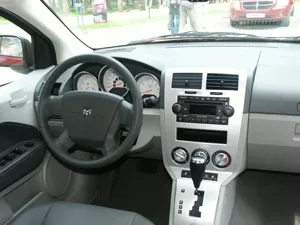
 The interior, alas, does not live up to such an impressive exterior. The hard gray plastic immediately hints that in the States the Caliber starts at $13,985, so it's better to forget about luxury. Even in the maximum configuration, you won't find climate control or parking sensors. But there is a Bose audio system with 11 speakers and a CD changer, as well as cruise control — a rarity for the golf class. And in the trunk door, a pair of folding speakers are hidden, so you can have a full-fledged disco at a picnic. Up front, there is a lot of space, largely thanks to the windshield pushed far forward. In the back, tall passengers will most likely be cramped — knees will press against the front seat backs, although the adjustable backrest tilt of the rear seat slightly saves the situation. The trunk is officially 524 liters, which is noticeably more than ordinary C-class hatchbacks and almost at the level of station wagons.
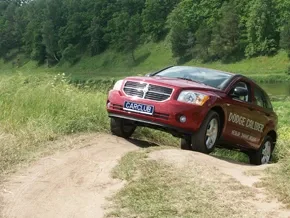
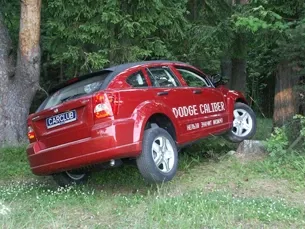 If the Caliber's exterior is pompous and the interior is simple, then the driving qualities pleasantly surprise. The energy-intensive suspension allows you to fly over speed bumps almost without slowing down. Of course, you shouldn't expect sporting sharpness from an American with a high seating position, but is it needed by the majority? Much more important is that on broken Moscow region roads, the Dodge allows you to rush at maximum speed, holding the steering wheel with one hand. And with a ground clearance of 195 mm — more than some crossovers — it easily climbs where ordinary cars are afraid to go. True, it's worth remembering the front-wheel drive: steep dirt climbs are better to attack with momentum.
The combination of the two-liter engine and CVT turned out to be successful for the Caliber. The continuously variable transmission skillfully selects revs according to the acceleration style, revealing the engine's potential. If you keep the tachometer needle in the 3000–4000 rpm zone, the car confidently overtakes the flow. And with the gas pedal fully depressed, the engine revs up to 6000 rpm, and the Caliber begins to accelerate. The acceleration is smooth and quite brisk, but only up to 160 km/h. Further, the brutal body starts to work against the car: the aerodynamics are nowhere near good, and the Dodge reaches 180 km/h with great difficulty. It won't go faster, whereas an ordinary hatchback with the same engine would easily hit 200 km/h. You have to pay for the spectacular appearance with both maximum speed and fuel consumption.
 As a result, the Caliber is a dense lump of advantages and disadvantages that leaves no one indifferent. It clearly divides people into those who love it and those who don't accept it. This means that the developers brilliantly accomplished their main task — to attract attention to the new brand.
I myself count myself in the first category. The high seating position makes the Caliber an excellent city dweller, and the ground clearance allows you to drive to the dacha without fear and storm snowdrifts in winter. Front-wheel drive is almost always enough for this. As for consumption — increased appetite wakes up only above 150 km/h. With calm driving at 120 km/h with cruise control on, the car is content with about 8.5 liters per hundred, which is quite decent for a two-liter engine with a CVT.
The price is also pleasing: the base Caliber starts from €17,700. But the fully equipped test car with a two-liter engine, CVT, and leather interior is priced at €23,100 — about the same as a Volkswagen Golf.
Leonid Pavlov