
In French — calibre. In American — Caliber. And how would that be in Russian?
In the 19th century, calibers were already driving along Moscow streets. For example, in M.N. Zagoskin's essays "Moscow and Muscovites" from the forties of the century before last, we read: "...and spring droshkies, from the humble caliber to the luxurious phaetons, remained the only carriage of all summer Moscow cabmen."
Cabman! Bring us a caliber. A Dodge brand one. After all, it's not the 19th century outside, but the 21st...
In the century before last, a caliber was a simple construction: a board mounted on two axles, pulled by a horse. Men sat astride it, while ladies sat sideways, as if in a saddle. Unsurprisingly, against the backdrop of such a "humble" carriage, spring phaetons seemed the height of refinement.
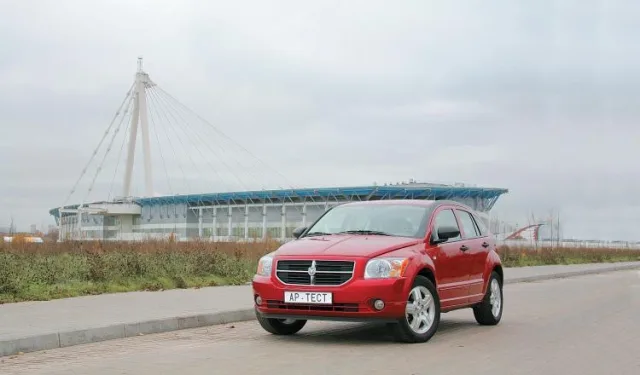
Today's Caliber, of course, is neither a limousine nor a sports car. However, calling it modest doesn't sit right. In the US, this model is sold with the motto "anything but cute." And it's true: a huge radiator grille spanning the entire width of the front, chiseled body lines, a taut profile. A real little predator!
 |  |  |
| On the back of the steering wheel of expensive versions, there are audio system control keys | To control the "wipers," you need to rotate the knob and ring on the right steering column stalk. Inconvenient! | The chiseled interior is made of plastic of different textures and shades, and with uneven gaps. But in a Dodge, this doesn't irritate: it's an "American"... |
Unlike the "French" with their toothless grilles, the Caliber looks truly brutal. A real American — solid, rough, imposing. And it doesn't matter that technically it's built on a shared platform with Mitsubishi.
However, it's not just about looks. The Caliber targets a niche that is still unoccupied in Russia, although the demand for such cars is obvious. A small hatchback with increased ground clearance is the dream of nearly half of our compatriots!
| The rings in the cup holders are beautifully illuminated | The instruments are impressive, but part of the filaments in the left display has already burned out |
Compact, yet spacious and practical. All-wheel drive is not mandatory, but ground clearance should be decent — so that neither snowdrifts nor high curbs are scary. There are almost no such offers on the market: Subaru Forester and Outback are noticeably larger and more expensive, and the fresh Suzuki SX4 is too small. In the segment around $25,000, the real choice is small — either Nissan Qashqai or Dodge Caliber. Moreover, the Qashqai will appear only in spring, while the Caliber is here and now!
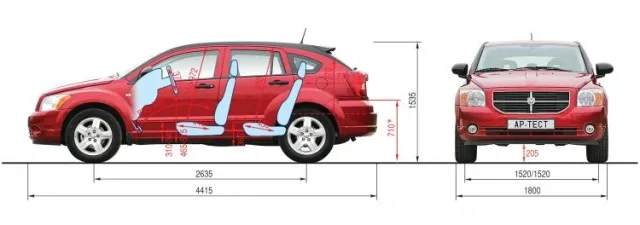
That's why the dark cherry Dodge went to the Dmitrov test track in proud solitude. Its direct competitor is still undergoing final pre-production tests. And comparing the Caliber with regular golf-class hatchbacks is hindered by the fundamental difference in ground clearance. If the Ford Focus is separated from the sinful Russian land by 129 mm, and the Volkswagen Golf by 154 mm, then the Caliber's ground clearance (real, measured by us on an inspection pit) is exactly 205 mm. Like a real "crossover."
 |  | |
| The seats are good — the driver's is more massive than the passenger's. There is height adjustment | Dual glove box: a practical thing | |
 |  |  |
| The driver's armrest is multifunctional — it can slide forward (sometimes, alas, following the elbow) and open access to the box inside, and in the folding lid there is a slot for an iPod digital player | ||
Inside, there's also a spirit of off-road adventure. Rough panels with sharp edges. A high threshold that you have to step over. Massive doors that take away space for elbows, but give a feeling of security and reliability.
The interior design, of course, is for enthusiasts — primarily for fans of American cars. It is they who will recognize the black rectangle of the "double-DIN" audio system on the central console, typical of many Chrysler models, and the archaic green vacuum-fluorescent displays, which Chrysler people hold onto with inexplicable persistence... And the cheap plastic of different shades, as well as uneven gaps between interior panels — all this is overlooked overseas.
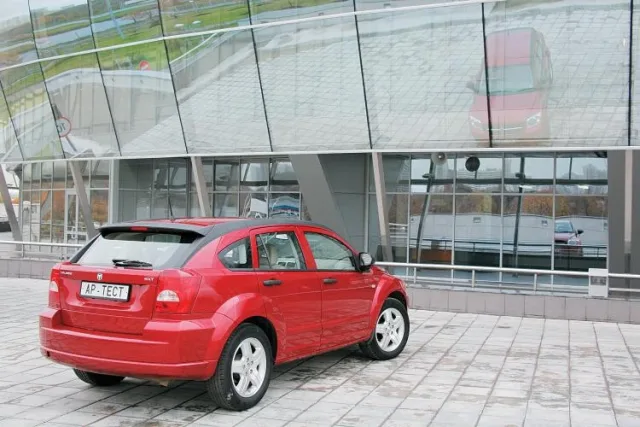
But Chrysler, under the wise and sensitive leadership of Mercedes man Dieter Zetsche, is striding forward by leaps and bounds. Don't believe it? Please — the Dodge Caliber is almost devoid of serious ergonomic flaws. The seats are not only American-wide, but in stiffness and profile they resemble good European ones — the backrest has clear lateral support. The adjustment ranges are sufficient, and the steering wheel adjusts not only in height but also in reach. True, just a little — as if it's play, not adjustment. And the steering wheel itself is clearly too large in diameter.
Americanisms, Americanisms... For example, the Caliber doesn't have climate control. At all. However, three ordinary rotary knobs manage the "climate" in the cabin without obvious flaws.
 |  | |
| The acoustics are mediocre, tiny pockets in the doors — for show | Auto mode — only for the driver's window | In the back, it's moderately spacious, but the tunnel on the floor is massive, the backs of the front seats are hard, and there's no central armrest |
| In the ceiling lamp of the trunk, there's a battery-powered flashlight with LEDs — with two levels of light intensity! | ||
There's also no rain sensor. But if the absence of "climate" is tolerated by undemanding citizens without much problem, then the manual control of the "wipers" in the Dodge is clearly arranged misanthropically — via a rotating ring on the knob of the right steering column stalk. As a result, a suddenly intensified rain becomes a problem: while you frantically find the right ring (one of three) with your hand, while you turn it by feel to the right number of clicks, the Caliber will cover dozens of meters in blind flight!
In the back, there are also many illogical solutions. First, it's a bit cramped — the high threshold and narrow door opening complicate entry, there's not much legroom by modern golf-class standards, and the middle passenger is hindered by the massive tunnel. And even for two, it's uncomfortable: there's no central armrest, and the window openings are claustrophobically small. But there is air supply to the feet of rear passengers — a plus in our northern latitudes. And why does the Dodge need rear seatback angle adjustment? The backrests can only be set more upright. Who might need that? Yogis, to train the swastika pose with a straight back — to understand the unity of all things?
But only a person well acquainted with the art of current European and Japanese packaging and ergonomics specialists can appreciate that the Caliber could be more spacious, more comfortable, and more luxurious. And for a simple user (or, as they say now, a user), the Dodge is good!
Especially for someone who is in no hurry.
 |  |  |
| Parts of the backrest fold down, forming a flat floor, and have three positions for the angle of inclination | The trunk volume is limited by a narrow opening and a high floor. But in the door, there are folding speakers for picnic sound | Under the floor — a "donut" spare tire |
In Russia, the Caliber is available either with a 1.8-liter engine and a five-speed manual gearbox, or with a two-liter unit and a Jatco CVT — it's this version that we got for testing. The new "global" Hyundai engine with a displacement of 2.0 liters is indeed good: dual variable valve timing, 156 hp and 190 Nm of torque. But as soon as you press the pedal to the floor, the Caliber is in no hurry to dash off: the engine lazily, with strain, revs up to 3000 rpm. Interestingly, the tachometer needle freezes at 6000 rpm only by 80 km/h — even in Drive mode, the CVT starts acceleration, imitating first, and a very "long" gear at that.
Why is it done this way? For acoustic comfort. If the CVT immediately brought the engine to peak revs, a monotonous, dreary hum would accompany any intense start from a traffic light. That's why BMW abandoned CVTs — after the experiment with the new Mini. When a CVT is disguised as a stepped "automatic," all its advantages disappear.
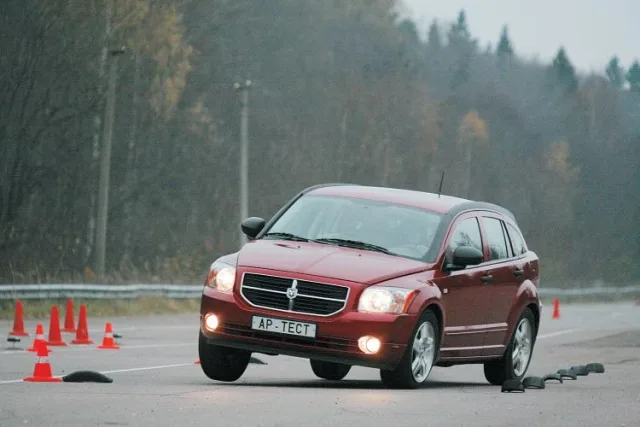
During an emergency obstacle avoidance maneuver, the Caliber first behaves decently — it slides moderately with the front end, following the steering wheel. But when returning to its lane — sharp and deep skids
The Caliber's CVT is exactly this kind of "compromise." With partial throttle or under full throttle, but up to 80 km/h, the transmission tries to please everyone, maintaining a semblance of a linear relationship between acceleration and engine revs. And only if you sharply stomp on the pedal at high speed does the engine reach maximum 6000 rpm. And even then, not immediately, but with laziness.
However, the Caliber can't be called sluggish: the 11.8 seconds to 100 km/h we measured is a decent result for a one-and-a-half-ton car with a two-liter engine. Especially since the CVT has a manual mode. In it, "gears" shift instantly, and throttle responses are immediate. Moreover, in manual mode, the CVT shifts up by itself, but down — no.
True, the "top speed" of 183 km/h is not high. But where would you go faster with such a "brick-like" face, clearly not aerodynamic?
The brakes are good — if you get used to the slightly increased pedal travel in normal modes. But full braking with ABS in the Caliber is excellent.
The chassis is tuned well, but not without flaws. While there's smooth asphalt under the wheels and a calm driver behind the wheel, everything is fine — the Dodge glides, smoothly changing lanes following the steering wheel's movements. There's reactive effort on the steering wheel, no delays in responses… Quite a "European"! The Caliber holds a straight line confidently. And it will help avoid a collision if needed: at low speed, two drivers completed the "moose test" on the first try without problems.
But if you drive faster, the Caliber starts to resemble a house built without a safety margin. A little load — and now the beams bend, cracks appear…
We drive straight — and sharply deflect the steering wheel. Do you feel how the rear suspension steers? It steers too much. Because of this, the Caliber veers to the side with an unpleasant "additional turn" — and wanders on a straight line even on gentle bumps. Moreover, you have to correct the trajectory "blindly" — the steering wheel fills with reactive effort only after the near-zero zone.
We take a sharper turn — the Dodge goes through it with a slight diagonal sway, and impacts from bumps are transmitted as knocks in the suspension and "arrive" at the steering wheel. Unpleasant! And in extreme modes, the Caliber can be simply unsafe. First, it predictably slides with the front end, but at some point it can unexpectedly and quite sharply break into a skid. What pretzels the Dodge performed in the expert's hands when searching for the limit speed of the "moose test" — you'd have to see it… Accordingly, the "maximum" in this exercise turned out to be low — skids in the last corridor didn't allow exceeding 73.1 km/h.
What does this say? That sharp avoidance maneuvers behind the wheel of the Caliber are undesirable. The Dodge will help avoid a collision, but then keeping the car from skidding or spinning 180° will be very difficult. A stability control system, which in America is offered for the Caliber for an additional $250–700 depending on the version, would help. But for Russian cars, ESP is not provided at all.
 |
| The "world" engine from Hyundai-DaimlerChrysler-Mitsubishi is designed for AI-92 gasoline — despite the high level of tuning (156 hp from two liters of displacement) |
So, Zagoskin's words about the "humble calibre" turned out to be prophetic: the Dodge Caliber, although much more comfortable than a bench on wheels, does not encourage fast driving. The optimal speed range is from 60 to 120 km/h. At lower speeds, the suspension seems a bit stiff, transmitting all small and medium bumps into the cabin. And at high speeds, the Caliber begins to sway a little.
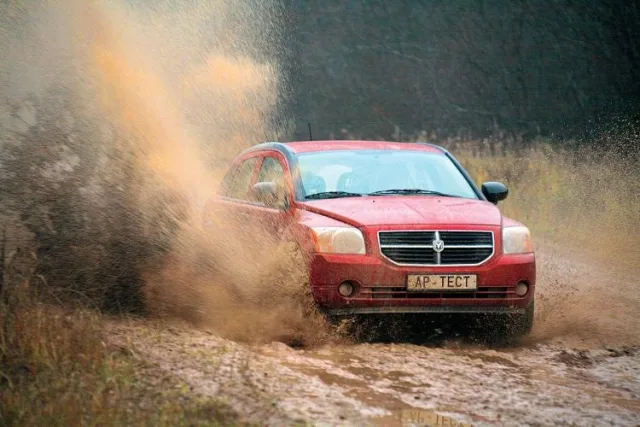
But the suspension's energy capacity was enough for our native autumn-soaked dirt road. Let the Dodge be front-wheel drive, let it be on regular road tires, but it can dash along a slushy dirt road without breakdowns on large potholes. After all, a ground clearance of 205 mm on our roads is an invaluable thing!
And therefore, despite all the shortcomings, we welcome the Dodge Caliber. A very timely and necessary car.
Yes, the "wipers" are inconvenient to control, the rear is not so cozy, the interior is finished inexpensively, the sound of the audio system is poor. Yes, comfort could be higher: the engine's voice during intense "CVT" accelerations with the pedal "to the floor" is annoying, the tires and suspension are "talkative," and the sound of sand on the wheel arches is too noticeable. Yes, in terms of acceleration dynamics, the Caliber is closer not to analogues in the golf class, but to large and heavy D-class sedans — without having their capacity. But at the same time, the "base" Caliber 1.8 with "mechanics" and air conditioning costs a tempting 17,700 euros, about the same as a Mazda 3 2.0 or Honda Civic. Given its bright appearance, fresh image, and increased cross-country capability — very interesting!
But if you compare the Caliber 2.0 for 20,800 euros with stylish golf-class hatchbacks with two-liter engines and "automatics," then only the Citroen C4 (from $27,080) and Volkswagen Golf (from $28,760) will be more expensive than the Dodge. And, for example, the Peugeot 307 XS 2.0 (143 hp) for $24,380 or the "cosmic" Honda Civic 1.8 (140 hp) for $26,200 — are already clearly more interesting offers. Moreover, all "Europeans" and "Japanese" for this money will be equipped incomparably better: here you have climate control, rain sensor, light sensor…
That's why in Europe and Russia the predecessor of the Caliber, the Dodge/Chrysler Neon sedan, didn't catch on — it was also not cheap compared to competitors, yielding to them in many parameters. But if the Neon didn't stand out with anything unusual, then the Caliber is a different breed. Never mind that it's "humble."
Head-on into the wall
So far, only the American National Highway Traffic Safety Administration (NHTSA) has tested the Dodge Caliber for passive safety using its own methodology, which fundamentally differs from the EuroNCAP rules we know. The NHTSA frontal crash test is a head-on impact into a concrete wall at 56 km/h. And in the side crash test, a cart with a deformable barrier hits the car at 62 km/h at an oblique angle (in Europe, a similar impact is carried out at 52 km/h and at a right angle). The Caliber passed both American tests with "excellent" — five stars. And according to the so-called rollover rating, the probability of the Caliber overturning does not exceed 15% — four stars out of five possible. But it should be noted that many cars with an American five-star rating perform weaker in European crash tests, since the frontal offset impact at 64 km/h (EuroNCAP) is a much more realistic and severe test, primarily for the car's body.
 |  |
| Frontal impact into a wall at 56 km/h | Side impact at an angle at 62 km/h |
A premium for style?
Russian prices for the American Dodge Caliber are quoted in euros. The most affordable Caliber SE 1.8 (150 hp) costs 17,700 euros (about $22,610) — the car has a five-speed "manual" and all necessary equipment, including four airbags, air conditioning, power accessories, and a CD player with four speakers. A tempting offer! But the Caliber 2.0 (156 hp) with a belt-driven CVT in a similar configuration will cost at least 20,800 euros ($26,600). The SXT version is more expensive (from $27,980) — additionally includes cruise control, fog lights, a six-disc CD changer, Boston acoustics, alloy wheels, and heated front seats. In addition, you can order leather interior ($1,530), a power sunroof ($1,020), a navigation system ($3,200), and "metallic" paint ($640). All-wheel-drive modifications are not supplied to Russia, but closer to the end of next year, deliveries of the "charged" front-wheel-drive version Caliber SRT4 with a 300-horsepower turbo engine 2.4 — like the future Mitsubishi Lancer Evolution X! — should begin.
The official warranty on the Dodge Caliber in Russia is two years without mileage limit. Moreover, for the entire electronic content of the power unit, including sensors and catalyst, the warranty period is extended to five years or 80 thousand kilometers. In addition, Chrysler in our country even provides a warranty for such "consumables" as bulbs, glass, battery, clutch and brake pads — the only limitation: the validity period of such coverage is only one year. It should be noted that the dealer network of the Dodge brand in Russia is not very wide: only 20 dealerships located in 10 cities.
Acceleration graph

| Cost of scheduled maintenance with consumables and parts* | ||
| Scheduled maintenance | Vehicle | |
| Dodge Caliber | ||
| Cost of standard hour | 60 | |
| Mileage, km | 10000 | 251 |
| 20000 | 251 | |
| 30000 | 356 | |
| 40000 | 251 | |
| 50000 | 487 | |
| 60000 | 251 | |
| 70000 | 337 | |
| 80000 | 251 | |
| 90000 | 251 | |
| Total | 2686 | |
| * Prices are in US dollars | ||
| Approximate prices for original parts at dealers in Moscow* | |
| Parts | Vehicle |
| Dodge Caliber | |
| Oil filter | 11 |
| Fuel filter | 62 |
| Air filter | 25 |
| Spark plug | 4 |
| Front pads | 146 |
| Rear pads | 123 |
| Front shock absorber | 117 |
| Rear shock absorber | 67 |
| Front headlight | 206 |
| Rear light | 187 |
| Front fender | 412 |
| Front bumper | 322 |
| Hood | 487 |
| Windshield | 449 |
| * Prices are in US dollars | |
| Some measurement results of Autoreview | ||
| Parameters | Vehicle | |
| Dodge Caliber | ||
| Maximum speed, km/h | 183.1 | |
| Acceleration time, s | 0—50 km/h | 4.7 |
| 0—100 km/h | 11.8 | |
| 0—150 km/h | 29.0 | |
| over 400 m | 18.5 | |
| over 1000 m | 33.5 | |
| 60—100 km/h (III) | 8.0 | |
| 60—100 km/h (IV) | 10.9 | |
| 80—120 km/h (V) | 17.7 | |
| 80—120 km/h (VI) | 31.1 | |
| 60—100 km/h (D) | 6.7 | |
| 80—120 km/h (D) | 8.8 | |
| Coast-down, m | from 50 km/h | 588 |
| 130—80 km/h | 959 | |
| 160—80 km/h | 1456 | |
| Braking from 100 km/h | distance, m | 40.6 |
| deceleration, m/s² | 9.7 | |
| Braking from 150 km/h | distance, m | 91.6 |
| deceleration, m/s² | 9.5 | |
| Equipment of the vehicle tested | |
| Equipment | Vehicle |
| Dodge Caliber SXT | |
| Price of base version, $ | 26304 |
| Front airbags | + |
| Front side airbags | + |
| Inflatable "curtains" | + |
| ABS | + |
| Power steering | + |
| Automatic transmission | +* |
| Multifunction steering wheel | + |
| Height-adjustable steering column | + |
| Leather-wrapped steering wheel | O |
| Multifunction steering wheel | + |
| Heated front seats | O |
| Auto-dimming rearview mirror | O |
| Central locking (remote) | + |
| Anti-theft alarm with immobilizer | +** |
| Air conditioning | + |
| Power and heated exterior mirrors | + |
| Power windows | + |
| Split-folding rear seat | + |
| CD audio system | O*** |
| CD changer | O |
| Tire pressure monitoring | O |
| Trip computer | + |
| Cruise control | + |
| Leather interior trim | O |
| Fog lights | + |
| Alloy wheels | + |
| Full-size spare wheel | – |
| Metal engine protection | – |
| Metallic paint | + |
| Adjustable rear seat backrests | + |
| Price of tested vehicle, $ | 29213 |
| * CVT | |
| ** Light | |
| *** Multiformat | |
| (+) Included in base version | |
| (–) Not included in base version | |
| (O) Options installed on tested vehicles | |
| Specifications | |
| Vehicle | Dodge Caliber |
| Body type | 5-door hatchback |
| Number of seats | 5 |
| Trunk volume, l | 524—1360 |
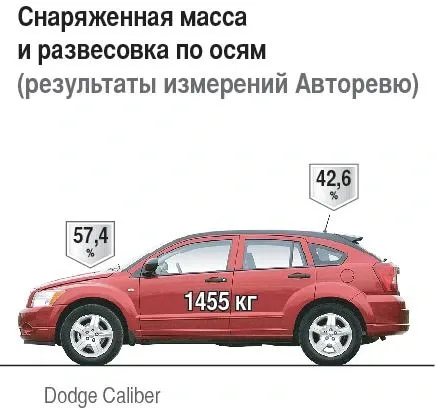
| Curb weight, kg | 1360 |
| Gross weight, kg | 1930 |
| Engine | petrol, with distributed injection |
| Location | front, transverse |
| Number and arrangement of cylinders | 4, in-line |
| Displacement, cm³ | 1998 |
| Cylinder bore/piston stroke, mm | 86.0/86.0 |
| Compression ratio | 10.5:1 |
| Number of valves | 16 |
| Max power, hp/kW/rpm | 156/115/6300 |
| Max torque, Nm/rpm | 190/5100 |
| Transmission | belt-driven CVT |
| Gear ratios | |
| range of gear ratios | 2.35—0.39 |
| reverse | 1.76 |
| final drive | 6.12 |
| Drive | front-wheel drive |
| Front suspension | independent, coil spring, McPherson |
| Rear suspension | independent, coil spring, multi-link |
| Front brakes | disc, ventilated |
| Rear brakes | disc |
| Tires | 215/60 R17 |
| Maximum speed, km/h | 186 |
| Acceleration time 0—100 km/h, s | 11.3 |
| Fuel consumption, l/100 km | |
| urban cycle | 10.1 |
| extra-urban cycle | 6.9 |
| combined cycle | 8.1 |
| Fuel tank capacity, l | 51 |
| Fuel | petrol AI-92 |
| Speedometer accuracy | ||||||||
| Vehicle | Speedometer readings, km/h | |||||||
| Dodge Caliber | 40 | 60 | 80 | 100 | 120 | 140 | 160 | 180 |
| 38 | 58 | 78 | 98 | 118 | 138 | 158 | 178 | |