
When a massive radiator grille with an aggressive emblem appears in the rearview mirror, a Focus driver hastily moves to the right — something imposing is approaching from behind. He yields, glances left — and is puzzled: he is being overtaken by a classmate, the five-door Dodge Caliber. This model has a difficult mission — to open the European market for the Dodge brand, and also the Russian one, where cars of this brand are rare, mostly "gray" Durango SUVs and Ram pickups. And behind the wheel of the Caliber was me, when I overtook the Focus on the highway leading to the northern part of Ibiza.
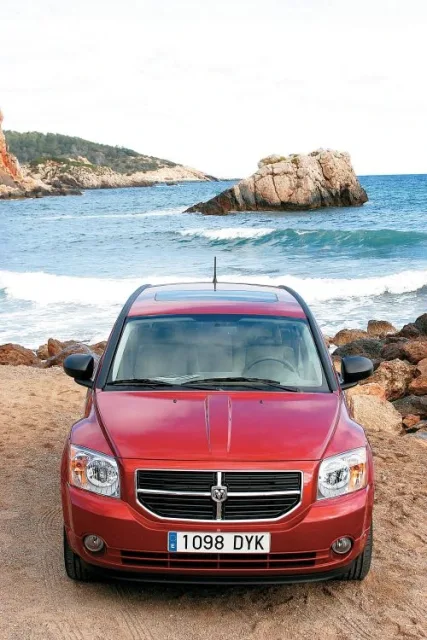
What drives Dodge when they bring the Caliber to the European market — a car created contrary to almost all the rules accepted in the Old World? Where has it been seen that a golf-class hatchback wears such a huge radiator grille? And a hood raised a meter off the ground? Unusual are also the fenders with arch extensions, and the not-small ground clearance for a front-wheel-drive model — 195 mm. What kind of golf class is this? Many indeed mistake the Caliber for a compact crossover — especially when looking at photos without objects for scale comparison. It is on this effect that the Americans are betting. After all, creating a typical hatchback from scratch and competing with European classmates is a hopeless task, so the Yankees went all-in, designing a small car with the appearance and proportions of a large SUV. American style. But will such cars be bought in Europe? Apparently, even the representatives of Dodge, part of the DaimlerChrysler concern, do not know the answer. At least, in response to questions about planned sales volumes and countries where maximum demand is expected, I did not hear clear answers. The Americans even keep silent about the scale of production at the plant in Belvidere (Illinois), where, along with the Caliber, the Jeep Patriot and Jeep Compass are produced. Are they afraid of jinxing it?
 |  |  |
| The interior looks nice, but to the touch — solid plastic | The front seat with four mechanical adjustments is comfortable even for tall drivers | In manual mode, the Jatco belt CVT imitates a sequential 6-speed gearbox |
They have concerns. Take aerodynamics, for example: the drag coefficient is 0.37 for petrol versions and 0.39 for diesel ones. For a modern golf class, this is too much — the same Volkswagen Golf shows Cx 0.32. And poor frontal streamlining limits the maximum speed and increases appetite.
 |  |
| Below the tachometer scale — indication of CVT modes | On the back of the spokes — audio system control keys, but gear shift buttons on the steering wheel, alas, are missing |
 |  |
| The front seat backrest folds forward, freeing space for long items | In the "glove box" — a cooled box for four half-liter bottles |
There are also drawbacks in the layout. If European manufacturers fight for every centimeter of interior space, the Caliber squanders inches. Voluminous seats, thick door panels… For large SUVs this is normal, but in a hatchback, massive elements mercilessly eat up space. Sitting behind the wheel is quite comfortable even with my height of 190 cm, but I could not sit "behind myself" — my knees press against the hard backrest of the front seat. There is no feeling of spaciousness in the cabin. But there is an impression that you are in a car of a higher class, at least higher in seating position. If compared with the Dodge Neon, which the Caliber replaced, the driver's seat has been raised by 10 cm. High seating, vertical front panel, large steering wheel — all signs of SUVs popular in Russia!
 |  |
| In the armrest — a convenient compartment for a phone or iPod | The rear seats are not too spacious, but the backrests are adjustable for tilt |
In front of the passenger — two spacious storage compartments, one of which is equipped with a refrigerator with a holder for four half-liter bottles. The armrest between the front seats slides forward by 76 mm, providing comfort for short drivers as well. The front seat backrest folds forward, allowing you to carry long items.
The rear seats, although not the most spacious, have adjustable backrest tilt. In the trunk — 530 liters of useful volume, a "spare"-doughnut under a rigid floor, a removable flashlight on the ceiling, and two speakers on the tailgate. The latter, however, is available in a special trim for lovers of noisy picnics.
 |  |  |
| "World engine" — a joint development of DaimlerCrysler, Mitsubishi, and Hyundai. Petrol units of 1.8 L and 2.0 L have a variable valve timing system on intake and exhaust and an intake manifold with variable geometry. Both engines digest 92-octane gasoline. At the end of the year, a third engine of 2.4 L will appear | Fold-down boom box — for lovers of noisy picnics | Under the rigid floor — a "spare"-doughnut |
Dodge representatives also prefer not to elaborate on the origin of the platform. Perhaps because this "cart" is one of the results of the collapsed alliance with Mitsubishi: the new Outlander, Lancer, and Dodge Caliber share a common base. Petrol engines of 1.8 L and 2.0 L (a 2.4 L version will be added later) were also developed with Mitsubishi's participation. These are modern economical engines, albeit without direct injection, but with a dual variable valve timing system — on intake and exhaust. And what about the diesel, without which Europe cannot do? It would seem there are no problems — DaimlerChrysler has suitable four-cylinder diesels 2.0 CDI or 1.8 CDI. But the engines are supplied by competitors: the same two-liter 140-horsepower units that are installed on the Volkswagen Golf. Each engine is assigned only one gearbox: for the 1.8 L — a five-speed manual, for the two-liter — a CVT, and for the diesel — a six-speed manual.
From June this year, only petrol cars will appear in Russia. Therefore, it is a pity that among the cars provided for the test there was no simplest version — only two-liter ones: petrol or diesel. I choose the petrol Dodge Caliber with a CVT.
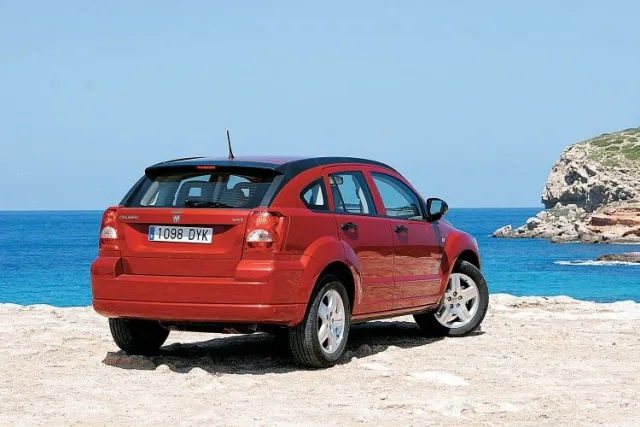
— We chose the CVT for fuel efficiency reasons. Compared to a classic "automatic", the CVT saves 6-8 percent of fuel. Moreover, it operates in a wider range of gear ratios, — explains John Dolan from the development department of DaimlerChrysler.
— And what about the service life, how often will the drive belt have to be changed?
— It does not need to be changed at all. The CVT with all components is designed for the entire service life of the vehicle. It is enough to change the oil in a timely manner, I think, every 100,000 km.
 |
| Power sunroof — from the list of optional equipment |
Recalling how softly and smoothly the CVT works in the Mercedes A-Class, I was already set for a calm ride. But expectations were not met. The engineers from America, based on packaging solutions, did not use the Mercedes unit and installed the CVT2 variator, made by the Japanese company Jatco, on the Caliber. At first glance, the design is similar: there is even a manual mode with simulated "gears," and the selector itself is very reminiscent of the one in the Mercedes. However, the Japanese CVT works noticeably rougher: in non-steady-state modes, jerks and delays appear. While driving calmly around the city, this is not annoying, but during overtaking, when you press the accelerator pedal to the floor, the car seems to lack pull — the tachometer flies to 6000 rpm, but the desired acceleration does not happen. I switch to manual mode, but here the situation is the opposite: the "gears" click very quickly and sharply, almost like in a sports car. Moreover, they are located very close to each other: during active acceleration, the difference between them is about 500 rpm — like on rally cars! For mountain serpentines, that's just what you need. But in everyday life, constantly yanking the lever back and forth quickly gets tiresome. Perhaps the shifts would bring more pleasure if the transmission control were placed on paddle shifters, but they are not here.
The Caliber behaves like a crossover not only because of its appearance, but also in character: it holds the straight line steadily, does not wander, but starts to squeal its tires quite early — mainly the front ones. If you add more speed at the corner entry, the inner wheel starts to spin. The feedback on the steering wheel is not dense enough — in normal modes, the effort is sufficient, but at high speed, you want more resistance. During sharp maneuvers, the steering wheel, on the contrary, becomes overly "grippy." With such handling, it will be difficult to compete with European rivals. However, in terms of ride smoothness, the Caliber pleasantly surprises. The suspension perfectly absorbs small irregularities and handles waves well. A significant role here is played by the fairly high-profile tires for today's times — 215/60 R17. So, special adaptation of the suspension to Russian roads will most likely not be needed: the ground clearance is already decent, and the chassis settings seem to already include a "package for bad roads."
I could not resist and tried the diesel version. In terms of acceleration dynamics, this Caliber is very reminiscent of a Volkswagen Golf with the same engine. Confident pickup in the range of 2000–4000 rpm, precise operation of the six-speed manual gearbox. It remains to hope that the five-speed manual, with which the Caliber 1.8 will come to Russia, will be no worse.
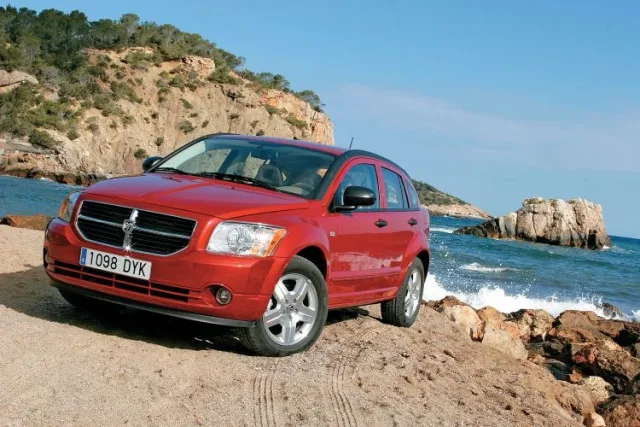
In the States, the main trump card of the Caliber was the price: the base version is sold there for $13,985, which is $410 cheaper than the Dodge Neon cost. But in Russia, it will not be cheap — the Dodge Caliber with a 1.8-liter engine in a configuration with ABS, six airbags, air conditioning, central locking, electric mirrors, and electric windows is priced at 18,200 euros. This is approximately the level of a Volkswagen Golf in comparable equipment, and that one is one of the most expensive cars in the class! The two-liter version with a CVT at the same level of equipment costs already 21,300 euros, and the top version — with leather interior, heated front seats, and an audio system with a CD/MP3 changer — 23,500 euros. That's a lot, especially against the background of the Mitsubishi Lancer and Ford Focus with their "dollar" price tags. By the way, it is precisely because of the price that all-wheel-drive versions will not go to Europe — marketers fear that buyers will not want to pay an extra 2–3 thousand euros for all-wheel drive, which is available in America. But there is hope that an all-wheel-drive Caliber will appear in Russia, and not a simple one, but a "charged" one — the Dodge Caliber SRT4 with a 2.4 Turbo engine producing 304 hp. Next year, this Caliber will begin to be sold not only in the USA, but also in Europe. Perhaps Russian dealers will also be allowed to import such cars.
| Overall dimensions, mm | |
| length | 4415 |
| width | 1800 |
| height | 1535 |
| wheelbase | 2635 |
| track front/rear | 1520/1520 |
| ground clearance | 195 |
| trunk volume, l | 524/1340* |
| * With rear seats folded | |
| Dodge Caliber (manufacturer data) | |||
| Modification | 1.8 | 2.0 | 2.0 TDI |
| Body type | 5-door hatchback | ||
| Number of seats | 5 | 5 | 5 |
| Curb weight, kg | 1320 | 1360 | 1425 |
| Gross weight, kg | 1890 | 1930 | 2000 |
| Engine | petrol, with distributed fuel injection | petrol, with distributed fuel injection | diesel, turbocharged |
| Location | front, transverse | front, transverse | front, transverse |
| Number and arrangement of cylinders | 4, in-line | 4, in-line | 4, in-line |
| Displacement, cm³ | 1798 | 1998 | 1968 |
| Compression ratio | 10.5:1 | 10.5:1 | 18.0:1 |
| Number of valves | 16 | 16 | 16 |
| Max power, hp/kW/rpm | 150/110/6500 | 156/115/6300 | 140/103/4000 |
| Max torque, Nm/rpm | 168/5200 | 190/5100 | 310/2500 |
| Gearbox | manual, 5-speed | belt-driven CVT | manual, 6-speed |
| Gear ratios | |||
| I | 3.77 | from 2.35 | 3.54 |
| II | 2.16 | 2.05 | |
| III | 1.41 | 1.37 | |
| IV | 1.03 | 0.97 | |
| V | 0.81 | 0.90 | |
| VI | — | up to 0.39 | 0.79 |
| reverse | 3.42 | 1.76 | 3.83 |
| final drive | 4.12 | 6.12 | 4.06(I—IV)/3.45(V—VI)* |
| Drive | front-wheel drive | front-wheel drive | front-wheel drive |
| Front suspension | independent, | independent, | independent, |
| spring, McPherson | spring, McPherson | spring, McPherson | |
| Rear suspension | independent, spring, multi-link | independent, spring, multi-link | independent, spring, multi-link |
| Front brakes | disc, ventilated | ||
| Rear brakes | disc | disc | disc |
| Tires | 215/60 R17 | 215/60 R17 | 215/60 R17 |
| Drag coefficient | 0.37 | 0.37 | 0.39 |
| Maximum speed, km/h | 184 | 186 | 196 |
| Acceleration time 0—100 km/h, s | 11.9 | 11.3 | 9.3 |
| Fuel consumption, l/100 km | |||
| urban cycle | 9.6 | 10.1 | 7.9 |
| extra-urban cycle | 6.0 | 6.9 | 5.1 |
| combined cycle | 7.3 | 8.1 | 6.1 |
| Fuel tank capacity, l | 51 | 51 | 51 |
| Fuel | AI-92 | AI-92 | diesel |
| * For I—IV gears/for V—VI gears | |||