
Dodge Avenger. Discovering America
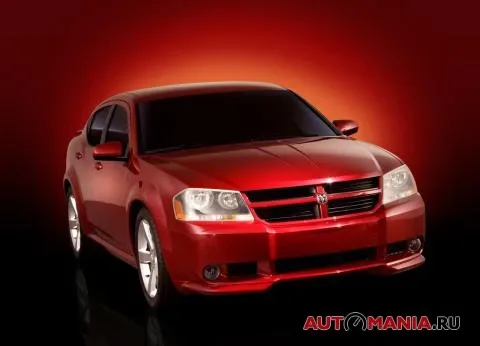
Dodge Avenger is the first D-class sedan that the American brand brings to Europe, and already the fourth model of the brand entering mass markets outside the USA. Dodge is bringing its entire lineup to the Old World and Russia — from the iconic Viper sports car and the assertive Nitro SUV to the muscular Caliber hatchback and the aggressive Avenger sedan. With this step, the company makes it clear: it is set only on victory. And the competition here, especially in Russia, where the D-class is in high demand, is very tough. So how does the Avenger plan to beat its renowned European and Japanese rivals?
It is no secret that in this class, a spacious interior, comfort, and, of course, powerful engines are important. With sedan design, everything is more or less predictable — you can't go wild with body shapes. Every manufacturer tries to stand out from the rest, but Dodge has perhaps succeeded the most: the designers managed to create a truly unique exterior. The Avenger owner can be sure — his car will not get lost in traffic, and even the driver of the most loaded foreign car will not give it an indifferent glance. You wouldn't call this sedan handsome, but it doesn't cause rejection either. The rough appearance of the "Yankee" suggests that in front of you is not a solid sedan, but a real supercar in the spirit of American muscle cars of the 60s. The massive radiator grille with a crosshair is the brand's signature, huge rectangular headlights, a protruding "jaw" of the bumper — and this is only the front view. The strongly protruding wheel arches make the side line even more expressive. The inflated rear arch, which partially covers the rear door glass, directly references sports cars of the sixties, and the high rear with large combined taillights on the edges of the trunk lid adds aggression to the appearance. The almost complete absence of chrome speaks of sporting ambitions, and black overlays on the middle pillars give a dynamic look even when the car is standing still.
The athletic image of the Avenger is emphasized by the wide wheelbase (2765 mm) and track (1570 mm), which also improve ride smoothness, stability, and handling. In addition, such a base increases the deformable zone of the engine compartment, which enhances passenger protection in a frontal impact. The manufacturer claims that in terms of safety, the Avenger is one of the best cars today. Safety and peace of mind have always been top priorities for European D-class buyers, and the new Avenger fully meets expectations, offering a full set of equipment to preserve the life and health of the driver and passengers. The power frame of the body made of dual-phase high-strength and ultra-high-strength steels creates effective protection in any situation. Even in the base configuration, there are advanced multi-stage front airbags, additional side airbags for the driver and front passenger, as well as full-size side curtains. Add ABS, traction control, ESP, and emergency braking assist — you'll agree, the list is impressive.
What's inside such an extraordinary car? The Avenger's interior almost completely repeats the new Sebring, which is by no means the cheapest in its class. However, spoiled Europeans may find the cabin not too rich — you definitely wouldn't call it luxurious. But one detail immediately catches the eye: the V-shaped center console, resembling ram's horns, tightly wraps around the gearshift lever trim. An interesting solution!
The texture of materials with a noble matte shine makes the interior quite presentable. The top of the panel and the center console are covered with matte grained Franklin plastic, which goes well with the trim of the ventilation grilles and the Dodge logo around the passenger. The main graphic element running from the instrument panel to the climate control and further throughout the cabin is the circle. The assembly is of high quality, although in some places you can find small gaps.
As for options, everything is more than decent: for example, the Chill Zone compartment for cooling drinks (four half-liter bottles will fit without problems) is included in standard equipment. Our test Avenger was also equipped with dual-zone climate control, but this, alas, is an additional option, as is the improved audio system. The main advantage of the cabin is spaciousness: the driver and four passengers will fit comfortably here. Almost home-like coziness on the rear sofa is created by plastic overlays that slightly cover the side windows. The trunk volume is 390 liters, and if you fold the rear seat, cargo capabilities increase noticeably, with the backrests lying flush with the floor. In general, everything is done on the principle of reasonable sufficiency — you can't deny the Americans practicality.
In Europe, the Avenger is offered in four versions: 2.0- and 2.4-liter engines of the World Engine series, a new 2.7-liter V6, and a 2.0-liter turbodiesel. However, the last two modifications will not go to Russia: buyers will be offered either the 2.0-liter version with a manual transmission, or the version with a 2.4-liter engine (170 hp) and an "automatic". You can't say that the first engine gives the car a sporty character, but paired with a 5-speed manual, its 156 "horses" will be enough to feel confident even in dense traffic. Especially since the larger engine doesn't give the expected increase: firstly, the difference of 14 hp is not so fundamental, and secondly, the 4-speed "automatic" adds a "fly in the ointment". The transmission is not quick — it shifts gears leisurely, lingering on each change. In general, it is clearly not capable of unleashing the full potential of the engine. If desired, you can switch to "manual" mode, but there are only two pedals, so electronics still interfere with the work. This mode cannot be called "honest".
But in terms of ride quality, the Avenger is almost a "European". Dodge engineers tried with suspension settings, ridding it of the languor inherent in almost all American cars. On the move, the sedan seemed composed and obedient. There were practically no body rolls in corners, and no pitching on longitudinal waves either. The car obeys the steering wheel well, doesn't wander, and holds the road well on transverse irregularities. In general, the Avenger drives like a regular front-wheel-drive sedan, and the rear multi-link suspension refines behavior in corners.
TECHNICAL SPECIFICATIONS
| Length (mm) | 4850 |
| Width (mm) | 1843 |
| Height (mm) | 1497 |
| Wheelbase (mm) | 2765 |
| Weight (kg) | 1520 |
| Trunk volume (l) | 390 |
| Engine displacement (cm3) | 2360 |
| Max power (hp) | 170 at 6000 rpm |
| Max torque (Nm) | 220 at 4400 rpm |
| Max speed (km/h) | 200 |
| Acceleration 0-100 km/h (s) | 11 |
| Average fuel consumption (l) | 9.8 |
| Price | 24,800 euros |
Source – AUTOMANIA.RU