
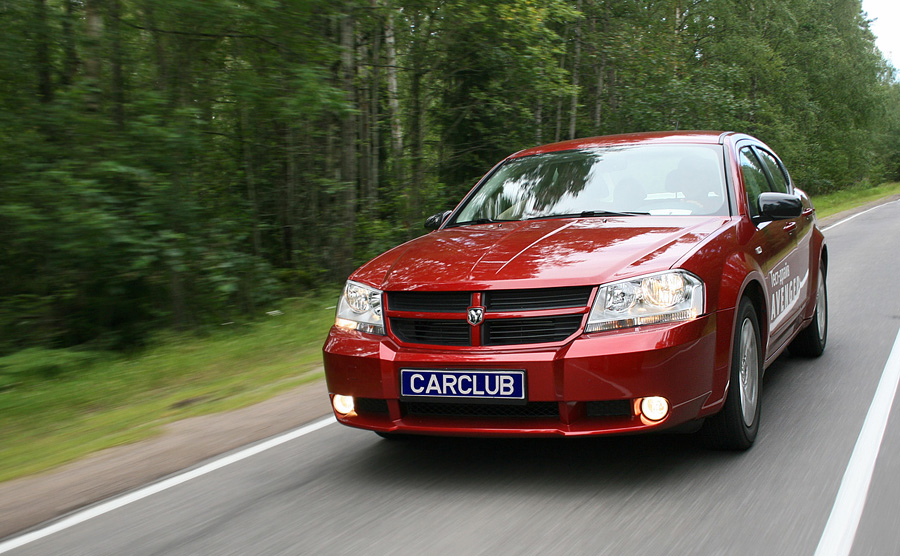
Dodge Avenger, built on the Chrysler Sebring platform, looks noticeably more interesting than its sibling, but offers fewer options.
CommentsAt the core of Dodge's advertising philosophy are four words — Power, Comfort, Boldness, and Reasonableness, which spells out the acronym PCRB. If you look at the brand's buyers through this lens, the picture that emerges is: people no older than middle age with income slightly above average. They want drive and adrenaline, but their finances don't yet allow them to buy a truly powerful car from a prestigious brand. So they have to look for compromises. Some go for a hot hatch like the Ford Focus ST or Mazda 3 MPS, while those with families are forced to look at larger cars. Here, you can't count on a powerful engine, but you can get a car with a memorable appearance. That's exactly what our test hero — the Dodge Avenger — became. The "Ram" on the hood, whose platform is borrowed from the Chrysler Sebring, looks more expressive, although it's poorer in equipment. The result is a car that's more affordable and "meaner" thanks to a retuned suspension, but still spacious inside, which is important for family use.
The Avenger's exterior can be described in one word — sweeping. It feels like it was drawn by hand, without much concern for saving space. Huge bumpers that no European manufacturer would dare to fit, a radiator grille with large cells, expressive bulges over the rear wheels, nice 17-inch wheels with tall tires — in all this, you can discern the legendary Dodge Charger from the wild 70s, when Muscle Cars tore down American roads, while back then we had the 24th Volga. Such a look either makes you fall in love at first sight or leaves you indifferent forever, and the second option seems less likely.
You open the driver's door and expect the interior to continue the theme of the bold exterior, but your gaze hits gray plastic that feels like wood to the touch. Americans, of course, have never been known for their love of interior trim, but this is too much! It's nice that such material is easy to recycle and cheap to produce, but even in a modest Hyundai Verna, the plastic is of higher quality. Only the numerous "metal-look" inserts save the interior — they add sportiness and lightness. You could, of course, try to look at this philosophically: they say, softness of plastic is a stereotype imposed by marketers. It doesn't affect driving qualities at all, but merely flatters our self-esteem — the softer, the more expensive and "cooler." In America, coolness is measured by body length and number of cylinders. Hence the difference in perception. But if you abstract from the hard plastic, then in terms of sound insulation, the Avenger almost reaches the level of a related Mercedes and noticeably surpasses competitors from Japan and Korea.
In front of the driver is an impressive instrument cluster in the form of three pods, which at night is flooded with bluish neon backlighting. For contrast, it's not ideal, but it looks great. As the designers claim, the center console's shape repeats the outlines of ram's horns, but I personally couldn't see such associations. What about you? Front passengers have access not only to numerous cupholders and a powerful audio system with a 6-MP3-disc changer and even DVD, but also to a two-tier glove box, the upper part of which is designed for 4 cans of 0.33 liters and can cool drinks. For an additional fee, a multimedia system with a 20-gigabyte hard drive is offered — you can load navigation maps, music, and photos onto it — as well as a 6.5-inch screen and Bluetooth. Moreover, the center console can record short voice notes, working like a voice recorder — this could be useful, for example, when talking to traffic police inspectors. Special mention should be made of the interior door handles: it feels like they were designed with Mike Tyson or the Klitschko brothers in mind. By the way, their shape also resembles the old Volga. Visibility due to the narrow rear window is, of course, so-so, but the side mirrors are large and with correct geometry.
The rear bench, as expected, is quite spacious — it's comfortable for two or three. But the trunk, when I opened it, caused real shock. Just as I convinced myself that hard plastic in the cabin isn't the worst problem, it turned out that the trunk lid is completely bare. Just painted metal with burrs after stamping, without any upholstery and even without a handle for closing. There's only a lever for opening from the inside — this has recently become standard for all American cars. It turns out that children in the USA love to hide in the trunk, but can't always get out. Such simplification, of course, doesn't affect driving qualities, but it looks frankly frightening. The Russian representative office of DaimlerChrysler agrees with this: they say that active negotiations are underway with the Americans to install at least formal upholstery in the trunk.
Compared to the Chrysler Sebring, whose driving qualities disappointed us, the "Avenger" — and that's how Avenger is translated from English — pleasantly surprised. It could be said that it avenged its older brother. It's far from the precision and sharpness of reactions of a BMW, but in terms of energy intensity, it can give many a run for their money. There's no typical American car rocking at all, and even on broken St. Petersburg roads, the suspension never bottomed out. For more control, I'd like the steering to be tighter and the wheel itself smaller in diameter. But even as it is, the Avenger handles very nicely: you can drive fast and still not lose comfort. And that's an indispensable quality for our country, because we hold two mutually exclusive proverbs in high regard: "What Russian doesn't love fast driving" and "In Russia, there are two problems: fools and roads"…
Dodge pleased even more in extreme modes. If you provocatively lift off the throttle, the car goes into a slight drift, which is immediately quelled by the stability control system. But even without electronics, the Avenger remains predictable and obedient.
In tune with the handling is the new "global" 2.4-liter engine with 170 hp, which is jointly produced by Chrysler, Mitsubishi, and Hyundai. However, it's paired with not the most successful gearbox — a thoughtful, archaic 4-speed automatic. The engine and transmission work in harmony, but without excitement. You can shift gears by moving the selector in a transverse slot, but the choice is limited. In the city, two first gears are enough — they provide quite brisk acceleration up to 125 km/h. But engaging third gear, which theoretically should push the needle to 200 km/h, noticeably kills the dynamics. On the other hand, even at high revs, the engine's growl is moderately audible in the cabin, and if you drive mostly in fourth gear, you can talk without raising your voice up to 150 km/h.
This results in an excellent balance of drive and comfort. Although for more active driving, the base 2.0-liter engine with 156 hp paired with a manual might be better suited. Especially since, according to factory data, its top speed is the same as the tested Avenger, and the price is 1800 euros lower. It seems that the bold Dodge has indeed decided to encroach on the tranquility of the lower part of the business class. Of course, it will be difficult for it to compete with the neat and docile, but sometimes completely faceless sedans from Korea and Japan. And luck, as we know, favors the brave — especially those as bold as the Avenger.
Text and photos: Leonid Pavlov.