The world has changed beyond recognition recently, and now American companies are entering our market with cars created specifically for Europe. Dodge joined this lineup quite recently but is behaving surprisingly assertively. It seems like the premiere of the provocative Nitro crossover has just died down, and the Americans are already aiming at the D segment with the Avenger sedan, which translates as "Avenger." Honestly, in this class, it was crowded even without a newcomer—the competition here is fierce, a fight to the death. So who and what is the Avenger planning to avenge? And does it have real chances of success? Let's try to figure it out.
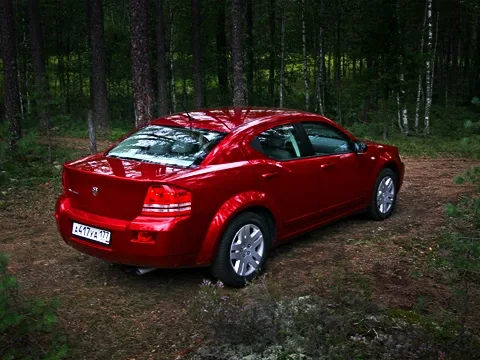
The rear of the Avenger is a spitting image of a scaled-down Charger sedan.
According to the creators' concept, the "Avenger" is aimed at bold and active young people aged 25 to 40 who don't want to be like everyone else. At the same time, the car is presented as the most sensible investment of money: for a modest sum, the buyer gets a well-equipped vehicle. And if you add fresh powertrains and modern safety systems to this, the offer looks even more tempting.
The picture becomes even more attractive at first glance at the Avenger in person. It's damn, devilishly, hellishly good! The car exudes raw, primitive, unrefined power. But calling it "cute" or "sweetie" just doesn't fit—its appearance is absolutely aggressive. Well, or almost absolute.
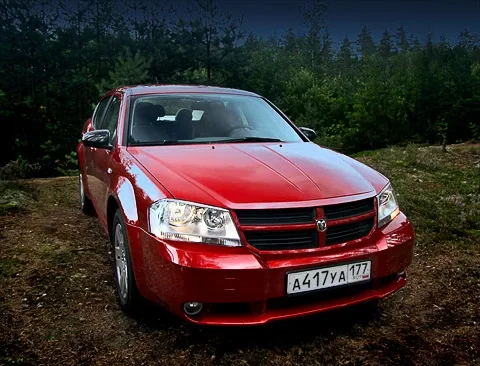
The rough and unpolished look of the Avenger gives away its American roots.
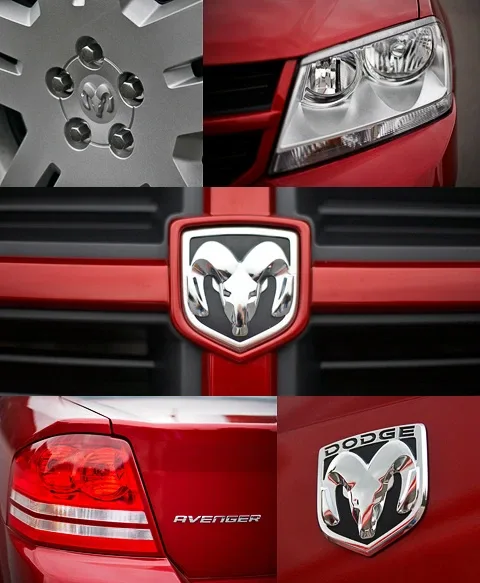
The signature cross-shaped grille, huge headlights as if chopped with an axe, massive wheel arches protruding outward, and the absolutely fantastic shape of the rear wing, referencing the muscle cars of the sixties, which you can't pass by calmly. The designers clearly earned their keep. As a result, the car looks monolithic and, more importantly, unlike anything else. That's why it catches so many interested glances on the streets.
Outside, everything is great. What about inside? Apart from the body and interior, the Avenger is a complete copy of the Chrysler Sebring, which we've already had a chance to drive. Same platform, same engines, and even the suspension is tuned absolutely identically. The difference is only in the shell and the interior.
I remember that cars associated with Chrysler were often criticized for cheap materials in the cabin. Maybe Dodge listened to the criticism, since they're planning to fight in the D class? There, without a cozy interior, there's nothing to do.
I sit down and... Wait, stop, how much does this car cost? Almost 33 thousand dollars?! It seems that either Dodge doesn't read the press at all, or they don't care about any reproaches and stubbornly stick to their line. The frankly cheap plastic hasn't gone anywhere, and its dull gray color brings mortal boredom. It's bleak, to say the least.
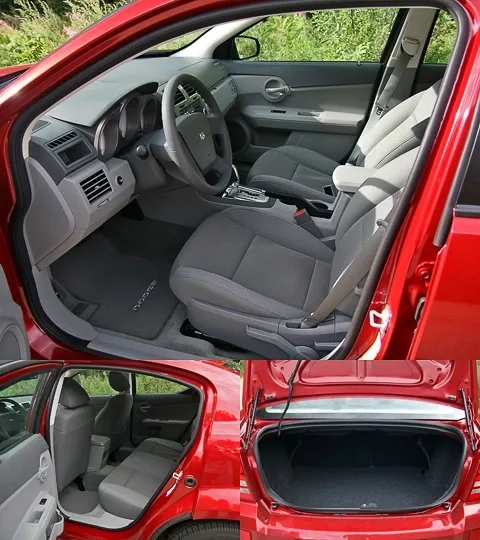
There's enough space, and you sit well. But the "bare" trunk on a car for this money looks a bit strange.
But that's where the complaints about the cabin end. There are also flaws in ergonomics. For example, the adjustment of the deflectors is set up terribly—it's inconvenient to use and distracts from the road. The seats are kind of "meh," and you can't achieve a perfect driving position. However, once again, the instrument panel, standard audio system, and climate control pleased us. Simple and intuitive.
There are also pleasant little things. So, in the front panel above the glove box, there's a cooled compartment for bottles. And optionally, you can order seat upholstery with YES Essentials fabric, which doesn't fade, doesn't absorb dirt and odors, and is also easy to clean. A practical thing.
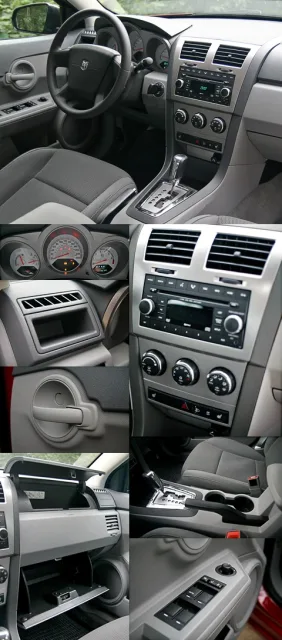
The interior is simple and cheap. And there are no heated or cooled cupholders like in the Chrysler Sebring here.
However, all these pleasant moments can't change the overall impression of the interior. You can't say about the Avenger that its insides match the promising exterior. The cabin is an obvious cost-saving measure, and such a move could be called brilliant if it weren't so transparent. It's too early for the manufacturer to sprinkle ashes on their head. It will be truly sad when such savings hit sales.
But if, say, the Avenger turns out to be phenomenal in motion or impresses with its level of comfort, then it's quite possible that many will forgive its "wooden" cabin. What's new in the tech? Under the hood of the test car is a 2.4-liter World Engine series unit with variable valve timing. The engine produces 170 horsepower and 220 newton-meters of torque. Of course, it meets Euro-4 standards. It works in tandem with an adaptive four-speed automatic transmission. Honestly, such gearboxes are a relic of the past, and Dodge should be ashamed of them. But let's say the engine's power is enough for normal driving.
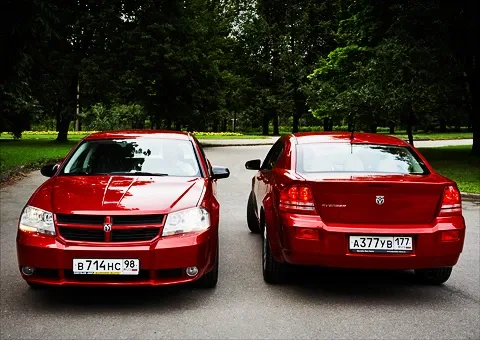
The technical filling of the Dodge Avenger is a complete copy of the Chrysler Sebring. But you can't tell from the outside.
The first kilometers seem to confirm these thoughts. In the slow St. Petersburg traffic, the Avenger feels confident, and the mirrors are convenient, which helps with maneuvers. But as soon as you leave the city... I'd really like to write that, by flooring the gas pedal, we broke away from our own shadow. Alas. It quickly became clear: our "American" accelerates without much enthusiasm. Honestly, without any enthusiasm at all.
When you try to start from a traffic light as briskly as possible, the Avenger turns into the most stubborn ram in the world and seems to declare: "Hey, boss, don't rush. That old lady over there has poor eyesight; she didn't see the sticker on my door!" Shock value is the main thing for the "Avenger," and it doesn't care that you're late or running for a plane. It will leisurely reach "a hundred" in the stated 11 seconds—exactly like an average car in traffic.
With such odds, it's even scary to imagine what torment a buyer who chooses the version with the two-liter engine is dooming themselves to. The top speed for both modifications is exactly 200 km/h, but we didn't even try to conquer that mark. The space shuttle Endeavour will have time to fly to the ISS more than once before our Dodge reaches such a mark.
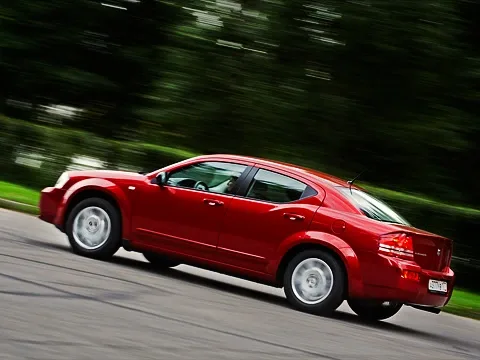
Moreover, if on smooth asphalt the Avenger doesn't cause much trouble in terms of handling (although you can't call it driver-oriented), then on broken roads, steering becomes a real torture. The car starts to throw from side to side, and to keep it on course, you have to constantly correct and keep your attention sharp. At the same time, the ride smoothness is generally decent.
In the back, there's plenty of space—for knees, shoulders, and head. But rear passengers are unlikely to see out the windows—the view is blocked by huge triangular plugs on the doors.
So what do we have in the end? A car with a flashy, striking appearance and a rather spacious but dull in every sense cabin. But it has, albeit not driver-oriented, a quite economical engine. It will be interesting to see how many buyers such a set of qualities will attract. The company itself has high hopes for the sedan and plans to sell at least 500 cars this year.
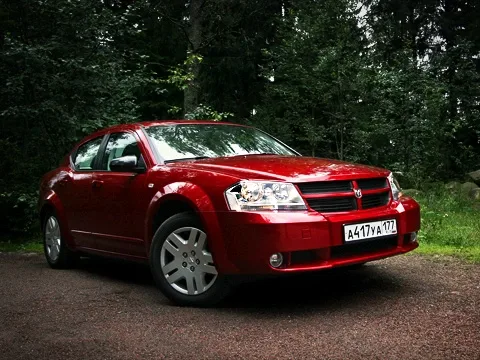
It turns out that the Avenger is no longer quite an "American," but not yet a "European" either. It will appeal to wealthy originals who really want to stand out from the gray mass. Buying it definitely won't be rational, but emotional—oh yes.
Technical specifications
| Specifications | 2.0 | 2.4 |
|---|---|---|
| Body | ||
| Number of doors/seats | 4/5 | |
| Length, mm | 4850 | |
| Width, mm | 1843 | |
| Height, mm | 1497 | |
| Curb weight, kg | 1480 | 1510 |
| Gross weight, kg | 2040 | |
| Trunk volume, l | 438 | |
| Engine | ||
| Type | Petrol, with distributed injection | |
| Location | Front, transverse | |
| Number and arrangement of cylinders | 4, in-line | |
| Number of valves | 16 | |
| Displacement, cm3 | 1998 | 2360 |
| Max. power, hp/rpm | 156/6300 | 170/6000 |
| Max. torque, Nm/rpm | 190/5100 | 220/4500 |
| Transmission | ||
| Gearbox | Manual, five-speed | Automatic, four-speed |
| Drive | Front | |
| Chassis | ||
| Front suspension | Independent, McPherson | |
| Rear suspension | Independent, multi-link | |
| Front brakes | Disc, ventilated | |
| Rear brakes | Disc | |
| Tires | 215/60 R17 | |
| Performance characteristics | ||
| Maximum speed, km/h | 200 | 200 |
| Acceleration time from 0 to 100 km/h, s | 12.1 | 11 |
| Fuel consumption, l/100 km | ||
| Urban cycle | 10.7 | 12.3 |
| Extra-urban cycle | 6.1 | 6.9 |
| Combined cycle | 7.8 | 8.9 |
| Emission standard | Euro-4 | |
| Fuel tank capacity, l | 64 | |
| Fuel | AI-95 | |
Dodge Avenger trim Standard equipment
Price of the car in base trim — 18220 euros (excluding VAT)
- 4 audio speakers
- Automatic headlight leveling
- Steel wheels 17 × 6.5
- Rear door locks with child safety lock
- Power-adjustable and heated exterior mirrors, folding
- Air conditioning
- Tire pressure monitoring — pictogram
- Cruise control
- Leather-wrapped gear shift knob
- Fabric seat upholstery
- Side airbags for front passengers
- Side curtain airbags
- Front airbags for driver and front passenger with multi-stage inflation — Next Generation
- Manual driver's seat height and lumbar adjustment
- Adjustable steering column
- Security alarm
- Rear seat split-folding 60/40
- Factory tinting
- Fog lights
- Central locking with remote control
- Summer tires 215/60 R17 BSW
- Power windows with 1-Touch function on driver's side
- Fabric seat upholstery YES Essentials
- Heated front seats
- Radio — AM/FM, MP3, CD/DVD player
- Fog lights
- Easy Clean Seat Group option package
- Radio — AM/FM, MP3, CD/DVD changer for 6 discs
- Metallic body paint optional
- Power sunroof
- Premium Convenience Group option package (auto-dimming rearview mirror, automatic climate control, automatic headlights)
Price of the car in base trim — 18220 euros (excluding VAT)
Design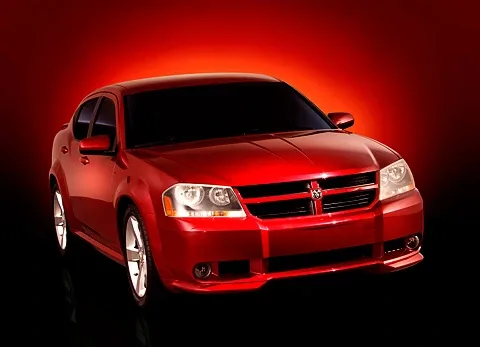
The prototype of the production Dodge Avenger was presented by the company last year at the Paris Motor Show. The car shown there was listed as a concept, although it differed from the production version only in minor details such as wheel rims and spoilers.
Behind the scenes