
Daihatsu Terios 1.5
Daihatsu Terios
Engine displacement — 1495 cc
Output — 105 hp
Peak torque —
Sprint from standstill to 100 km/h —
Top speed — 145 km/h
Transmission — automatic, 4-speed
Drive type —
Fuel consumption in combined cycle — 7.9 L per 100 km
Body dimensions:
Length — 4055 mm
Width — 1695 mm
Height — 1740 mm
Ground clearance — 200 mm
Curb weight — 1.2 tons
Tires — 205/65 R16

Sergey Akimov, photographer. Driving for 15 years.
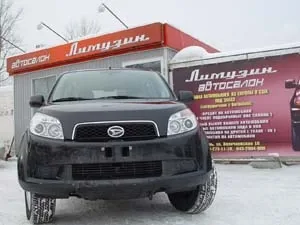
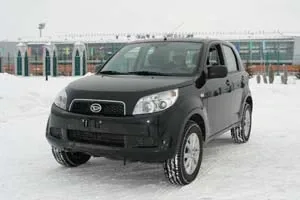
From the outside, the car looks quite attractive: wide door openings, large side mirrors, absence of controversial design solutions, and hefty wheels are pleasing.
The only thing that slightly catches the eye is the decorative spare wheel cover on the fifth door, painted in silver metallic.
Now let's look at the running gear. At the rear, there's a solid beam — an archaic design, but proven over the years and on our roads, while the front has independent suspension. Given the high center of gravity and this chassis layout, the car is more suited to a calm driving rhythm, including moderate off-roading. Plus, there's a forced locking of the center differential — an excellent helper on difficult sections or when tackling an icy incline.
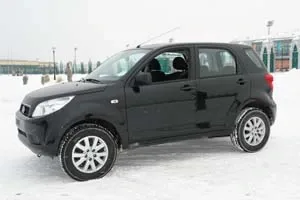
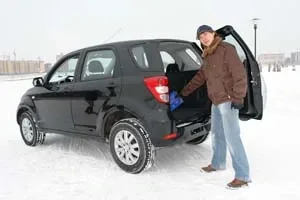
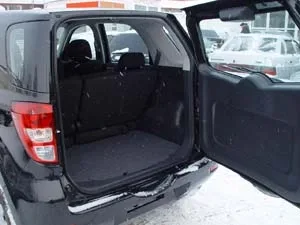
What's hidden inside? The interior doesn't shine with frills — everything is aimed at functionality, simplicity, and logic. There's an abundance of air above the heads of the driver and passengers, and the seat upholstery is practical and durable. The steering wheel is a bit thin and made of hard plastic; the trunk is spacious, but it lacks a protective cover. The second row is roomy for such a compact car. The upright seating is organized very competently, there's a sense of freedom inside, and wide doors make getting in and out as comfortable as possible.
Let's hit the road. I'll note right away: the car had summer tires, so I couldn't fully unleash its off-road potential. On packed snow without activating the lock, the car behaves almost like rear-wheel drive. In long corners, the rear axle slides, and the engagement of the front wheels is almost unnoticeable. Turn on the lock — and the picture changes, everything falls into place.
The automatic transmission works smoothly, without sharp jerks; it seems the all-wheel-drive system smooths out the character of the 1.5-liter engine.
The key question is — who is this car for? If you want an SUV, but a small one, and the Niva doesn't suit you in terms of quality, and Chinese cars don't yet inspire confidence.
Let's look at competitors:
Suzuki Jimny 1.3 ($20000), Vitara 2.0 ($32000), Tucson 2.0 ($28000), X-Trail 2.0 ($28000) — serious competition.
Final list of strengths:
- pleasant appearance,
- the name of a Japanese brand,
- convenient and thoughtful interior,
- decent fuel efficiency (for an SUV),
- good off-road capability,
- excellent visibility and large mirrors.
Weak points:
- you want a more powerful engine,
- too simple interior trim,
- outdated transmission.
Alfred, driving experience — 11 years.
I'm sure the Daihatsu brand is not familiar to everyone. This manufacturer became famous for compact cars with all-wheel drive. The brand's history dates back to 1907, when the company started producing and selling internal combustion engines. And since 1957, Daihatsu has been under the wing of the legendary Toyota Motor Co., Ltd. Since then, cars of this brand have gained recognition worldwide.
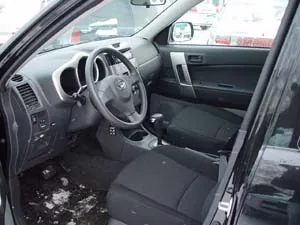
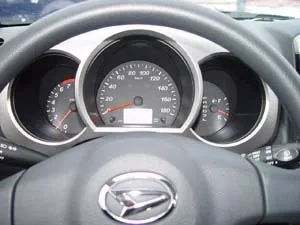
Our test subject was the Terios. The first acquaintance left a pleasant impression — a cutie. And not nearly as tiny as one might assume (the previous Terios was barely wider than the Oka). Calm, laconic body lines don't stir emotions, but everything looks solid and modern. Current headlight shapes, side edges, rear lights — all at the level. Inside, to my surprise, it turned out to be quite spacious: high ceilings and a jeep-like upright seating make the cabin roomy. The huge windshield and large side windows provide excellent forward visibility, and large mirrors almost completely eliminate blind spots. Inside, everything is neat and simple, but without primitivism. Yes, there are no frills — that's an obvious fact, but everything is intuitive. I'd describe such a car with the formula 'get in and go.' It's very driver-friendly: you sit down and immediately feel at home.
The most surprising thing about this car is that the modest 1.5-liter engine (on summer tires) briskly pulls the car with four adults on board. True, the logic of the automatic transmission remained a mystery to Vadim and me. No matter how hard we tried to understand it — all in vain. The same summer tires are to blame. You press the gas, and in response, only a hum from under the hood: either wheelspin or something unclear. This is perhaps the only serious complaint — summer tires and, frankly, the price is a bit off-putting. Maybe it's slightly overpriced, but you get an unusual and unpretentious car that will let you stand out from the crowd and be known as a person with taste.

Vasilya, personal car — Opel Corsa
I had no dealings with SUVs, so at first I doubted whether to participate, but seeing a cute compact car clearly made for women, I changed my mind. Sitting in the seat, I immediately felt comfort. Spacious cabin, high ceiling, excellent visibility, large side mirrors. The instrument panel, vents, stereo — all continuous round shapes and cute details, as if created specifically for girls. The pedals are positioned very conveniently, even in high heels (women will appreciate) it was easy to press them.
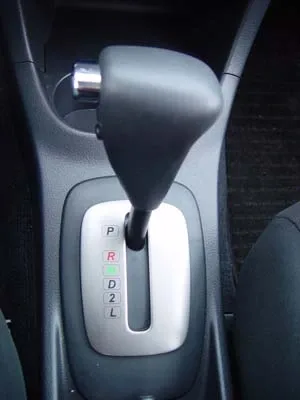
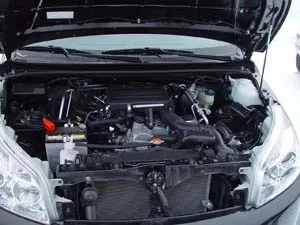
With my male colleagues, the car behaved capriciously (apparently, it senses strangers): the wheels spun almost in place, ABS activated too often. No, this is definitely a women's car. Taking their mistakes into account, I started smoothly and carefully. The car is soft; we simply don't notice small bumps. Snowdrifts on the road are also not a problem — just ease off the gas a bit, and we drive as if on asphalt. All-wheel drive gives extra confidence: I change lanes smoothly, turn left, now right. It seems the men also appreciated the pleasure of unhurried driving. The brakes are noticeably softer than on the Corsa, but you can get used to it quickly, and my ABS didn't even activate once. Of course, there's not enough power. Out of habit, I try to overtake someone, but alas. For all-wheel drive, the 1.5 L engine is a bit weak. But the car isn't made for driving thrills. Its element is confident movement on any surface: dry asphalt, wet dirt, or ice.
Daihatsu is a brand almost unknown in Russia. In traffic, it definitely won't get lost (unlike the tiresome 'women's' crossovers). The price is considerable — that's also a plus. I think such a car will appeal to a successful woman who values individuality.

Vadim. Driving experience — 9 years.
Before the trip, I painfully tried to recall what I knew about Daihatsu. It turned out — almost nothing. Except that off-road vehicles of this brand from the early 90s are in demand among athletes and off-road enthusiasts. That's the whole knowledge base. The car turned out to be compact, in my opinion, purely feminine in dimensions: the size of the previous RAV4 and larger than the Jimny. I immediately noted that the design is not 'washed out' — such a car definitely won't go unnoticed on the road. Inside, there's a variety of colors and shapes. You can, of course, grumble and say that personally, not everything suits me. But it's not worth it — clearly, the designers focused on female preferences. If we talk about objective things, it's worth noting the unexpectedly spacious cabin.
I'll clarify right away: the car had summer tires, so some conclusions may not be entirely accurate.

And yet, I admit, there is clearly not enough power here. Pulling away at an intersection is a bit heavy, and as for sharply darting into traffic — you can forget about that. However, I understand myself: all-wheel drive and a 1.5-liter engine — what else can you expect? To get driving pleasure, you either need to install an engine of at least 2.5 liters, or completely abandon all-wheel drive in favor of front-wheel drive. In corners, the car behaves calmly and predictably, but only until you ask a little more from it. Personally, I really missed stability control and traction control systems here. After this trip, I drew a conclusion for myself: the car is not bad, but personally it does not suit me. And this is only the first part of my conclusion, because then Vasylya got behind the wheel. I watch from the side: she, as if she had driven this car all her life, almost without thinking, adjusted the seat, adjusted the mirrors, and pulled away. Not a drop of tension, only smoothness and measuredness in every movement. Riding as a passenger was soft and comfortable, and even I liked it. It was clear that Vasylya instantly found a common language with the car. And here is the second part of my verdict: for women, this is just an excellent car.
Now about the money. Perhaps someone will say that $30,000 is too much. But let's ask ourselves: how many Daihatsu cars can you see on the streets of Kazan? That's right, most likely, none. This leads to the conclusion: truly rare things that can advantageously highlight the status of their owner simply cannot be cheap.